
e-Literate

Present is Prologue

Tag: Apereo Foundation

  • LMS Market Updates, Dec 2015

    There seems to be a series of news and analysis on the LMS higher education market worth summarizing.

    Major Adoption News

    I posted last weekend about University of Phoenix (UoP) and their LMS. UoP is well-known for being the biggest user of a homegrown LMS for well over a decade, but in the past several years they rolled out “Classroom”, an entirely new adaptive-learning based design. In a major strategic change, UoP is abandoning this effort and moving to a commercial provider.

    What we can now confirm at e-Literate is that the “learning platform” selected by the University of Phoenix is Blackboard Learn Ultra. This is the cloud-based redesign of Learn that Michael and I have described in several posts. Even with the University of Phoenix’s reduced enrollment, I consider this news to be the most important new client acquisition for Blackboard since at least 2011.

    Today Campus Technology reported that Stanford is moving to adopt Canvas as their campus-wide LMS. Previously Stanford was a founding member of Sakai, with its implementation called CourseWork.

    The university has been piloting Instructure Canvas since the 2014-2015 academic year. The vice provost for teaching & learning (VPTL) said in a statement that about 80 percent of faculty in the pilot reported being “very or somewhat satisfied” with the new platform; even more students (94 percent) found it “very or somewhat easy” to use.

    Alongside the pilot, two Stanford schools had already adopted the application independently. The Graduate School of Education moved to Canvas in 2013-2014, and the Graduate School of Business did so in 2014. Both adoptions were considered successes.

    During this school year, the migration was accelerated. Some 300 classes switched to Canvas. And the plan is to migrate the remaining 4,200 classes still using the legacy LMS software over the next academic year.
    (more…)

  • Moodle Moves Give Hints of What a Post-Fork World Could Look Like

    Phil and I have written about the growing tension between the interests of Moodle HQ and a those of a couple of the bigger Moodle Partners, most notably Blackboard. There are a number of ways that this tension could be resolved, but one of the more dramatic possibilities would be a fork of Moodle. While we are not predicting it will happen, a couple of developments hit the wires last week that give us some idea of what the world might look like if there were a real and permanent split between the two groups.

    (more…)

  • Community Source Is Dead

    As Phil noted in yesterday’s post, Kuali is moving to a for-profit model, and it looks like it is motivated more by sustainability pressures than by some grand affirmative vision for the organization. There has been a long-term debate in higher education about the value of “community source,” which is a particular governance and funding model for open source projects. This debate is arguably one of the reasons why Indiana University left the Sakai Foundation (as I will get into later in this post). At the moment, Kuali is easily the most high-profile and well-funded project that still identifies itself as Community Source. The fact that this project, led by the single most vocal proponent for the Community Source model, is moving to a different model strongly suggests that Community Source has failed.

    It’s worth taking some time to talk about why it has failed, because the story has implications for a wide range of open-licensed educational projects. For example, it is very relevant to my recent post on business models for Open Educational Resources (OER).

    (more…)

  • Unizin membership fee is separate from Canvas license fee

    With Unizin going public yesterday, I’ve been looking over our three posts at e-Literate to see if there are any corrections or clarifications needed.

    Based on yesterday’s press release, official web site release and media event, I have not found any corrections needed, but I do think there is a clarification needed on whether Unizin membership includes Canvas usage or not (it does not).

    Common Infrastructure

    During the media call, the Unizin team (representatives from the four founding schools plus Internet2 and Instructure) pushed the common infrastructure angle. Rather than being viewed as a buying club where schools can buy from a common set of pre-negotiated services, Unizin can more accurately be viewed as planned integration and operation of a common service to allow white-label outsourcing of the learning infrastructure. The idea is that a school can use Unizin’s infrastructure for LMS, content repository and analytics engine rather than hosting or maintaining their own, but the service will not be branded as Unizin for the faculty and student end users. From the Unizin FAQ page:

    There is another sense in which Unizin is different from MOOC efforts. Unizin is about providing common infrastructure to support the missions of its university members. It is not a public-facing brand. It will not offer content, courses, or degrees in its own name. Unizin’s membership model is built on the premise that universities need to strengthen their influence in the use of data and content for the long run. They will accomplish this goal by working together and taking greater control over content, while also opening content up for selective sharing.

    In this morning’s IHE article, the Unizin founders described the need for a common infrastructure:

    The digital learning consortium, announced Wednesday morning, aims to simplify how universities share learning analytics, content and software platforms. But in order to do so, Unizin needs its members to use the same infrastructure. A common learning management system is the first part of that package.

    “You don’t really have common infrastructure if you’re saying everything is heterogeneous,” said Brad Wheeler, the Unizin co-founder who serves as vice president for IT and chief information officer at Indiana University. “A lot of these different learning tools — Sakai, Blackboard, Canvas — they all do a bunch of really good stuff. But five universities picking five different ones — what’s the end value in that if they want to do something together?”

    Brad Wheeler went on to describe the results that will occur from sharing infrastructure:

    “This is a hard decision,” Wheeler said about picking Canvas. “I think the key point is enabling Unizin to do what it’s meant to do…. The path for Unizin is creating a dependence on Unizin — a university-owned entity — but creating potential for greater interdependence among our institutions.”

    Instead of differentiating themselves based on what software tools they individually pick, Wheeler said, Unizin’s member institutions will stand out based on what they do with the common platform — in other words, the degrees they offer, the research they produce and the students they serve.

    Clarification on Canvas Licensing

    (more…)

  • Unizin: What are the primary risks?

    In Michael’s most recent post on Unizin, the new “learning ecosystem” initiative driven by Indiana University, he asked the question of who would be threatened by the proposed consortium (with the answer of edX). This question assumes of course that Unizin actually succeeds in large part, but what are the primary risks for the initiative to succeed in the first place? Based on the public information we have available to date (primarily in the two posts linked above), I see two near-term risks and one long-term risk that rise above the others.

    Near-Term Risk: Getting Schools to Sign Up

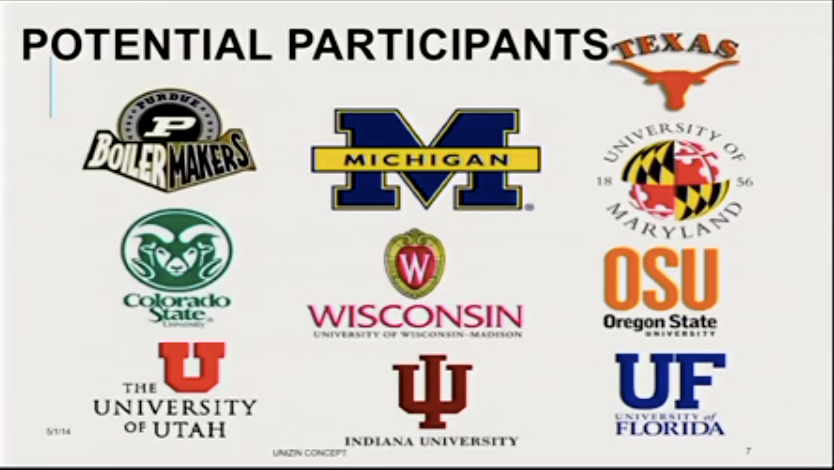
    The obvious question is whether there are enough schools willing to commit $1 million and adopt the proposed platforms to get the consortium off the ground. Based on the Colorado State University recording, it appears that the goal is to get 9 – 10 schools to commit $9 – $10 million in the initial phase. Beyond Indiana University, the most likely school to commit is the University of Michigan. Their leadership (dean of libraries, CIO) are fully behind the initiative, and from press reports they are seeking final approval. I cannot find any evidence that any other schools have reached this point, however.

    Slide from CSU Presentation
    Slide from CSU Presentation

    There are active debates in the Committee on Institutional Cooperation (CIC), primarily between provosts and CIOs, about Unizin and whether this approach works for member institutions. The provosts in fact already put out a position paper generally endorsing the same concept. (more…)

  • Unizin: Indiana University’s Secret New “Learning Ecosystem” Coalition

    Indiana University has been the driving force behind the creation of a new organization to develop a “learning ecosystem”. At least ten schools are being quietly asked to contribute $1 million each over a three-year period to join the consortium. The details of what that $1 million buys are unclear at this point. The centerpiece for the short-term appears to be a contract with Instructure for use of the Canvas LMS. But there are also hints of ambitious plans regarding learning object repositories and learning analytics.

    What is remarkable is the level of secrecy surrounding the project. Several sources from involved schools have indicated that very few people have been informed regarding their institutions’ prospective involvement. When school discussions do take place, care is being taken to keep them quiet. For example, a video recording of a presentation to faculty about Unizin at Colorado State University has since been removed from public access after it received some attention on Twitter (although e-Literate downloaded a copy of the video before it was removed from public access).

    Nevertheless, details of the project are beginning to leak out. In this post, I will share the facts that we have been able to confirm. Phil and I will both follow on with some analysis and inferences early next week. And of course, we will continue to bring you updates as news breaks.

    (more…)

  • Announcing the Apereo Foundation Advisory Council

    Long-time readers know that I have had a close affiliation with the Sakai Foundation at teams and served on the Board of Directors relatively recently. This year, Sakai merged with the Jasig Foundation to form the Apereo Foundation. The purpose of the new organization is to become a sort of Apache Foundation of higher education in the sense that it is an umbrella community where members of different open source projects can share best practices and find fellow travelers for higher ed-relevant open source software projects. In this merger, the whole is greater than the sum of its parts. For example, last week the foundation just announced that the board of the Opencast project, which supports the Matterhorn lecture capture and video management project, voted to effectively merge with the Apereo Foundation. (The decision is subject to discussion and feedback by the Opencast community.) On the one hand, Opencast probably wouldn’t have joined the Sakai Foundation because they want to interoperate with all LMSs and wouldn’t want to be perceived as favoring one over another. On the other hand, had they joined Jasig prior to the merger, they would not have had access to the rich community of education-focused technologists that Sakai has to offer. (Jasig has historically focused mostly on tech-oriented solutions like portals and identity management solutions). The fact that the Opencast community is interested in joining Apereo is a strong indicator that the new foundation is achieving its goal of establishing an ecumenical brand.

    And in that context, I am pleased to tell you that I will be involved with the foundation in a more ecumenical role. Specifically, I will be facilitating an advisory council.

    (more…)