
e-Literate

Present is Prologue

Tag: ASU

  • How Student and Faculty Interviews Were Chosen For e-Literate TV Series

    As part of our e-Literate TV set of case studies on personalized learning, Michael and I were fully aware that Arizona State University (ASU) was likely to generate the most controversy due to ASU’s aggressive changes to the concept of a modern research university. As we described in this introductory blog post:

    Which is one reason why we’re pretty excited about the release of the first two case studies in our new e-Literate TV series on the trend of so-called “personalized learning.” We see the series as primarily an exercise in journalism. We tried not to hold onto any hypothesis too tightly going in, and we committed to reporting on whatever we found, good or bad. We did look for schools that were being thoughtful about what they were trying to do and worked with them cooperatively, so it was not the kind of journalism that was likely to result in an exposé. We went in search of the current state of the art as practiced in real classrooms, whatever that turned out to be and however well it is working.

    As part of the back-and-forth discussions with the ASU case study release, John Warner brought up a good point in response to my description that our goal was “Basically to expose, let you form own opinions”. (more…)
  • Release of Empire State College Case Study on e-Literate TV

    Today we are thrilled to release the fourth case study in our new e-Literate TV series on “personalized learning”. In this series, we examine how that term, which is heavily marketed but poorly defined, is implemented on the ground at a variety of colleges and universities.

    We are adding two episodes from Empire State College (ESC), a school that was founded in 1971 as part of the State University of New York. Through a lot of one-on-one, student-faculty interactions, the school was designed to serve the needs of students who don’t do well at traditional colleges. What problems are they trying to solve? How do students view some of the changes? What role does the practice of granting prior-learning assessments (PLA) play in non-traditional students’ education?

    You can see all the case studies (either 2 or 3 per case study) at the series link, and you can access individual episodes below. (more…)

  • An Example Why LMS Should Not Be Only Part of Learning Ecosystem

    In Michael’s initial post on the Post-LMS, he built on this central theme:

    Reading Phil’s multiple reviews of Competency-Based Education (CBE) “LMSs”, one of the implications that jumps out at me is that we see a much more rapid and coherent progression of learning platform designs if you start with a particular pedagogical approach in mind.

    The idea here is not that the traditional LMS has no value (it can be critical infrastructure, particularly for mainstream faculty adoption), but rather that in the future we both see more learning platform designs being tied to specific pedagogies. This idea is quite relevant given the ongoing LMS users’ conferences (InstructureCon last week, D2L Fusion this week, BbWorld next month, Apereo / Sakai as well as iMoot in the past two months).

    Later in the post Michael mentions ASU’s Habitable Worlds as an example of assessing the quality of students’ participation instead of direct grading. (more…)

  • Personalized Learning Changes: Effect on instructors and coaches

    Kate Bowles left an interesting comment at my previous post about an ASU episode on e-Literate TV, where I argued that there is a profound change in the instructor role. Her comment:

    Phil, I’m interested to know if you found anything out about the pay rates for coaches v TAs. I’m also interested in what coaches were actually paid to do — how the parameters of their employable hours fit what they ended up doing. Academics are rarely encouraged to think of their work in terms of billable increments, because this would sink the ship. But still I’m curious. Did ASU really just hike up their staffing costs in moving to personalised learning, or was there some other cost efficiency here? If the overall increase in students paid off, how did this happen? I’m grappling with how this worked for ASU in budgetary terms, as the pedagogical gain is so clear.

    This comment happened to coincide with my participation in WCET’s Leadership Summit on Adaptive Learning, where similar subjects were being discussed. For the purposes of this blog post, we’ll use the “personalized learning” language, which includes use of adaptive software as a subset. Let’s first address the ASU-specific questions. (more…)

  • Instructor Replacement vs. Instructor Role Change

    Two weeks ago I wrote a post about faculty members’ perspective on student-centered pacing within a course. What about the changing role of faculty members – how do their lives change with some of the personalized learning approaches?

    In the video below, I spoke with Sue McClure, who teaches a redesigned remedial math course at Arizona State University (ASU) that is based on the use of Khan Academy videos. There are plenty of questions about whether this approach works and is sustainable, but for now let’s just get a first-hand view of how Sue’s role changed in this specific course. You’ll see that it took some prodding to get her to talk about her personal experience, and I did have to reflect back what I was hearing. Note that the “coaches” she described are teaching assistants.

    (more…)

  • Pilots? We don’t need no stinkin’ pilots!

    Timothy Harfield commented on Arizona State University’s approach to pilots and scaling innovation at ASU.

    excellent comment on the problem of scaling innovation in #HigherEd. This is a central concern for @UIAinnovation.

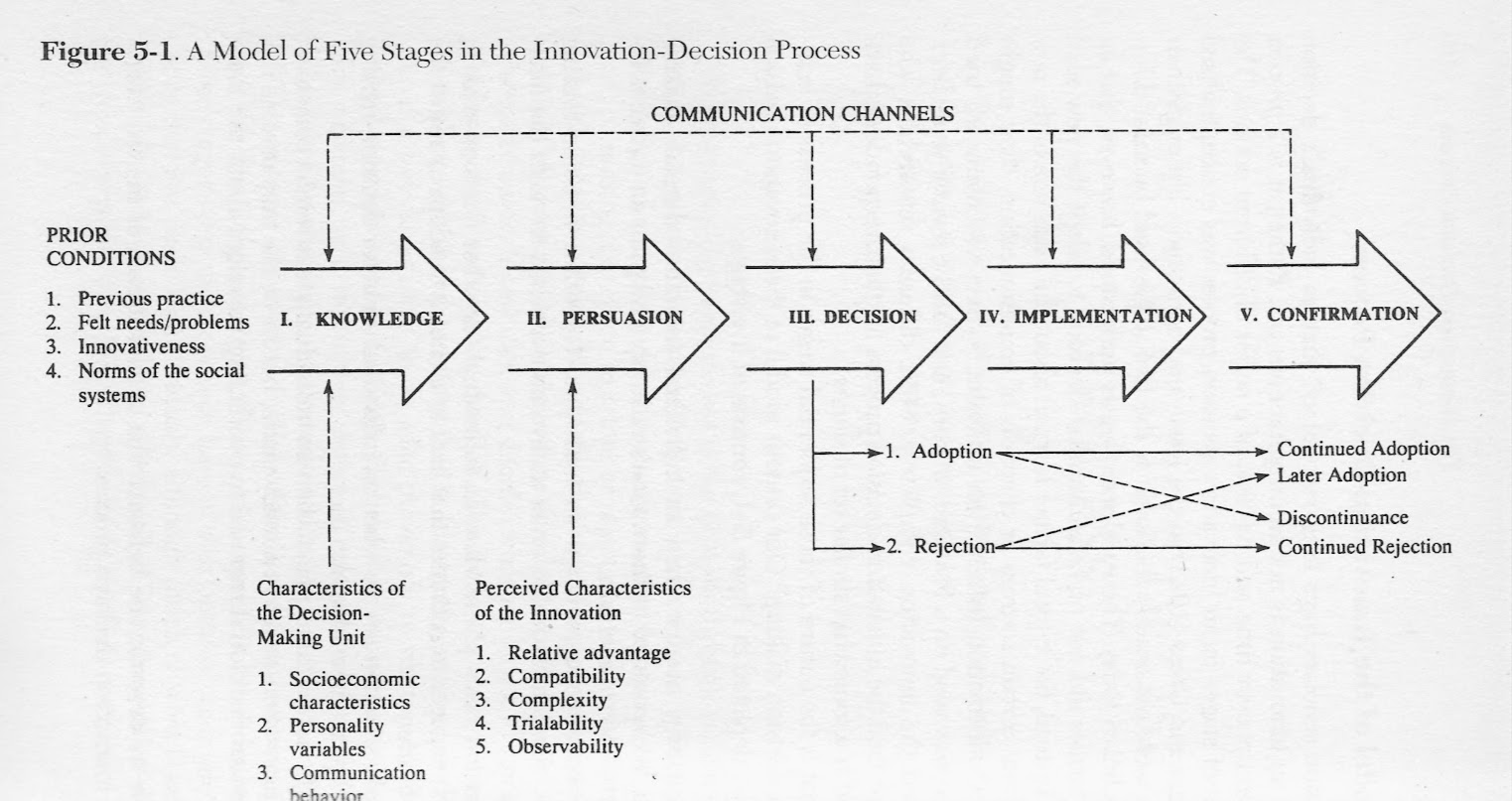
    The University Innovation Alliance is “a consortium of 11 large public research universities committed to making high-quality college degrees accessible to a diverse body of students”. I wrote about this “central concern” last summer in a post titled “Pilots: Too many ed tech innovations stuck in purgatory”, using the frame of Everett Rogers’ Diffusions of Innovations model. While the trigger for that post was on ed tech products, the same situation applies for the course design situation.

    5 Stages of Adoption

    What we are seeing in ed tech in most cases, I would argue, is that for institutions the new ideas (applications, products, services) are stuck the Persuasion stage. There is knowledge and application amongst some early adopters in small-scale pilots, but majority of faculty members either have no knowledge of the pilot or are not persuaded that the idea is to their advantage, and there is little support or structure to get the organization at large (i.e. the majority of faculty for a traditional institution, or perhaps for central academic technology organization) to make a considered decision. It’s important to note that in many cases, the innovation should not be spread to the majority, either due to being a poor solution or even due to organizational dynamics based on how the innovation is introduced.

    The Purgatory of Pilots

    This stuck process ends up as an ed tech purgatory – with promises and potential of the heaven of full institutional adoption with meaningful results to follow, but also with the peril of either never getting out of purgatory or outright rejection over time.

    (more…)

  • NYT Michael Crow Condensed Interview: More Info needed . . . and available

    The New York Times ran an “edited and condensed” interview with Arizona State University (ASU) president Michael Crow, titled “Reshaping Arizona State, and the Public Model”.

    Michael M. Crow sees Arizona State as the model of a public research university that measures itself by inclusivity, not exclusivity. In his 13 years as its president, he has profoundly reshaped the institution — hiring faculty stars from across the country, starting a bevy of interdisciplinary programs, growing the student body to some 83,000 and using technology to bring his ideas to scale, whether with web-based introductory math classes or eAdvisor, which monitors students’ progress toward their major. Last year, Dr. Crow made headlines when the university partnered with Starbucks to offer students the chance to complete their degree online for free. His new book, written with the historian William B. Dabars, is called, appropriately, “Designing the New American University.”

    (more…)