e-Literate

Present is Prologue

Tag: ASU

  • Announcing a Lesson-level Interoperability Standards Effort

    I’m delighted to announce a project aimed at making it easier to share interactive digital content at the lesson level as well as to establish baseline educational analytics for digital curricular materials. I’m tempted to call this a “courseware” interoperability effort, but its potential application is broader than that term would imply to some folks. For example, the work could support well-structured content in LMSs.

    This effort is consistent in philosophy with my recent “Content as Infrastructure” post series as well as the post of a version of my IMS talk on interoperability, learning analytics, and pedagogical intent. One of the main outputs of the project will be a white paper, released as an Empirical Educator Project (EEP) contribution, describing the standards proposal that is ultimately developed and its value to education. The project also dovetails very nicely with both previously announced and as-yet-unannounced EEP projects, and I’m very excited about the work.

    The idea for the work both grew out of and is funded through a grant from the U.S. Department of Education (ED) to develop “active OER.” In the course of the grant planning process, ASU professor and grant PI Ariel Anbar came to the conclusion that the grant would have a much broader impact if the content being developed were interoperable. He consulted with ED, and they agreed that interoperability would potentially increase the impact of the resources related to the grant. So a small fragment of the grant budget was carved off to test the viability of building a coalition that can make useful progress on proposed standards definitions that are both practically useful and likely to be adopted. At the moment, my work as a facilitator is the main budget expense for the project.

    Business and mission goals

    We had a kick-off meeting of a small group in late October. (More on who was in it, why they were chosen, and how we hope to expand later in this post.) Here are the notes I captured on the goals and ambitions for impact:

    • Reduce platform lock-in for any interactive courseware content, particularly interactive OER content, which will support the following:
      • Increase the quality of existing OER content by enabling the preservation of learning design
      • Increase the supply of interactive OER content by creating a clear and achievable interoperability standard for content developers
      • Increase the availability and value of OER content for value-added platform and service providers by lowering the cost of goods involved in converting the currently available “flat” OER resources into interactive lessons with effective learning design 
      • Enable educators to more easily mix and match interactive content at the lesson level
      • Enable the development of an ecosystem of non-OER content that could be licensed at the lesson level
    • Enable lesson-level, cross-platform, cross-content learning analytics which will support the following:
      • Data-based continuous improvement of learning content, regardless of its source
      • Baseline student learning analytics capabilities that will enable institutions to monitor student progress in an apples-to-apples way across lessons, products, and courses
      • Student- and instructor-facing analytics that will help them analyze how well their respective learning and teaching strategies impact outcomes
    • A vision for implementation and ecosystem development that incentivizes participation for a wide range of commercial and non-commercial value-added participants in order to:
      • Lower the barrier to adoption for courseware platforms by assuring customers that any content they develop or use will not be locked into the licensed platform
      • Lower the cost-of-goods and availability of high-quality pre-existing content for value-added OER curricular materials product and service providers
      • Enable micro-licensing models for commercial content vendors that develop high-value lesson-level content
      • Lower the barrier for non-profit organizations and consortia to create interactive content that is competitive in functionality and measurable quality with baseline student and teacher expectations for commercial courseware

    I’ll provide more of my personal take on these goals in a subsequent post, but there is consensus in the group that we should be working toward a set of goals that are good for everyone—students, instructors, institutions, and value-added content and platform providers.

    Functional and technical goals

    Consistent with the posts I linked to at the top of this one, we’re going to start by identifying questions that educators and students would want to answer about student progress, effectiveness of content design, and effectiveness of learning intervention. Our default atomic unit for this work is the “lesson.” Our starting point for identifying this set of questions will be the ones that the participating implementors have identified as ones that their users/adopters/customers want to answer, but I expect that we’ll expand from that base over the two-year life of the initial project.

    Once we know what questions we want to answer, then we will identify the metadata for the content that is needed to answer those questions. For example, which learning objective(s) does this assessment question assess? Is the assessment formative or summative? That sort of thing. No firm decisions have been made about how this would work on the technical level, but the basic idea is that the pedagogical intent of the learning design would be captured in some machine-readable form.

    Technically, we’d like to build on as much existing standards infrastructure as possible and propose developing as little new work as possible. While the project, as a piece of a larger ED grant, does not have a formal affiliation with an interoperability standards body, I am pleased to say that IMS Global and its CEO, Rob Abel, have been highly encouraging and offered technical support to the group as we think through the effort. IMS has a lot of the infrastructure that would be needed for the effort already baked into its existing specifications. It makes all the sense in the world to try to re-use or extend standards that are already developed and adopted.

    Ultimately, the group will produce a set of recommendations for interoperability standards along with a rationale for those recommendations. The hope and intention are that these recommendations will be taken up and carried forward by the appropriate bodies at the end of the project and that the participants will continue to work together on implementation.

    More on process and risk management

    Standards development is a tricky business. You want to get to an “everybody in the pool” moment, but at the same time, you can’t win everybody over by promising to boil the ocean. So we thought a lot about how to get this process rolling and balance different risks over time.

    At my suggestion, we started by inviting in just a few of the many implementors who ultimately should be at the table. Two—Carnegie Mellon University’s Open Learning Initiative and Lumen Learning—are long-time and active participants in the OER world. While this effort will be helpful to more than just OER, the primary purpose of the grant is for the development of (inter)active OER, so we wanted representatives who could speak to the needs and nuances of the OER ecosystem. The two other implementors we invited—Smart Sparrow and CogBooks—are courseware platform implementers that both work extensively with ASU already. Smart Sparrow is also playing a major role in this OER grant since Ariel has chosen its Inspark Education network to help manage the grant and is building the content on the Smart Sparrow platform. Also, CMU, Lumen, and Smart Sparrow have all been participants in EEP. In addition to the implementers and ASU, we had representatives from Scottsdale Community College and ED at the kick-off meeting.

    This is a small enough group with enough interconnections that we have a good chance of making progress on scoping goals without excessive amounts up-front diplomacy required but diverse enough that we would get different opinions and perspectives. It’s a good group for getting started and for testing the basic idea that what we want to accomplish is doable within a reasonable period of time. Ultimately, however, the project will need more and different folks to be involved if it going to result in broadly implemented interoperability standards. The starting group of four implementer participants is going to work toward a letter they all can sign onto that says they are committing in principle to implement any standards that ultimately flow out of this effort. The value in their commitment at this early stage is to decrease the risk of other implementors who may want to join but are skeptical that the effort will produce results. In parallel, the project is seeking additional funding that would enable us to support the participation of more stakeholders—educators, platform implementers, content developers, and standards committees (and possibly students as well).

    It is early days for this work. So far, the group has only met once. There is still a lot to do and a lot to be figured out. But I am hopeful that we can both develop useful recommendations for advancing interoperability standards and pioneer some new ways of working together on productive EdTech collaboration in the process.

  • Postscript on Rio Salado Coverage: Clarity about different outcome types

    Postscript on Rio Salado Coverage: Clarity about different outcome types

    After my two posts two weeks ago calling into question whether Rio Salado College has demonstrated clear student outcomes that justify its usage as an exemplar institution, college officials have responded through the WCET blog and in an article from Paul Fain at Inside Higher Ed. I recommend reading the IHE article in particular to get an understanding of the challenging an nuanced question of what is “good enough” in terms of college completion, and for even more detail read Rio’s written response. Unfortunately, the lengthy explanations on graduation rates from Rio end up obscuring a critical distinction between awarding degrees versus certificates of completion. The reason this matters is that Rio appears to be doing a better than average job supporting student transfers to four-year degree programs, a worse than average job of helping students complete two-year degrees, and an unknown job of providing students with non-degree stand-alone certificates.

    Before dealing with this issue, I’d like to point out how useful this dialog has been and how open Rio has been in sharing internal metrics. One example that I wish other institutions used, and that can help us clarify how to understand completion data, is based on student goals.

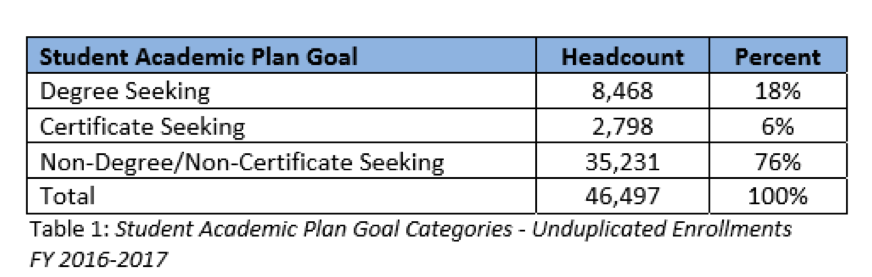
    Rio Student Intentions

    Fully 76% of Rio students have no intention to get a degree or certificate, and of this group 33% (11,628) indicated earning transferable credit as the key reason to enroll. As Sally Johnstone said in the IHE article, “It’s a feeder school for Arizona State University”. This transfer of credit mission can be good or bad – it depends on how well these students perform in getting an ASU degree. In the written response, but not in WCET or IHE articles, Rio shares an interesting but incomplete metric.

    Additionally, as part of the work RSC does related to accountability, we track the success of our transfer students to the three public universities in Arizona (The 2010/11 – 2015/16 5 year trend shows a 77.10% increase in bachelor degrees awarded to students that had completed a minimum of 12 credit hours (up to 60 or more hours) at Rio Salado College).

    Increase to what and over what? It is not clear if this is comparing to Arizona university students who do not transfer any credits from Rio, or those who transfer less than 12, or those who transfer from other colleges. Nevertheless, this is an indicator of the college helping students obtain four-year degrees through credit transfers.

    Once you get beyond non-degree / non-certificate seeking students, the numbers are murkier, and this is the area that needs clarity. One out of four Rio students are there to get an award – how successful are they? Rio recommends we look at the Voluntary Framework for Accountability (VFA) measures, instead of IPEDS, with the following results.

    • 2-year graduation rate is higher than peer institutions: Rio 13%; Peer Institutions 10%
    • 6-year graduation rate for credential-seeking cohort is 36.2%
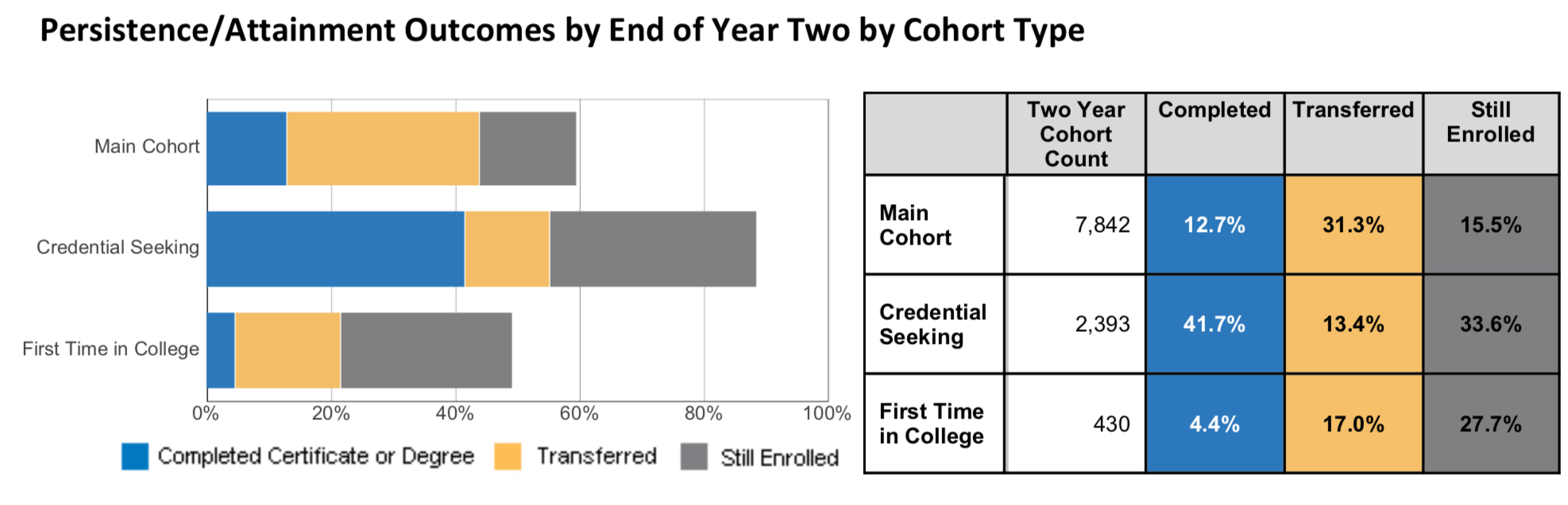
    • The credential seeking cohort far outperformed sister institutions in completion: Rio 42%; Peer Institutions 16%

    I do not know why Rio uses the term graduation rate, as VFA instead describes Percent Students Completed a Formal Award, but from the numbers used we can see where the data comes from. The first and third bullets come from the VFA Two-Year Progress measures (blue column under Completed). ((The VFA definition of the cohorts: Main Cohort = fall entering, first time at reporting college; “all students”; Credential Seeking = earned 12 credits by end of year two.))

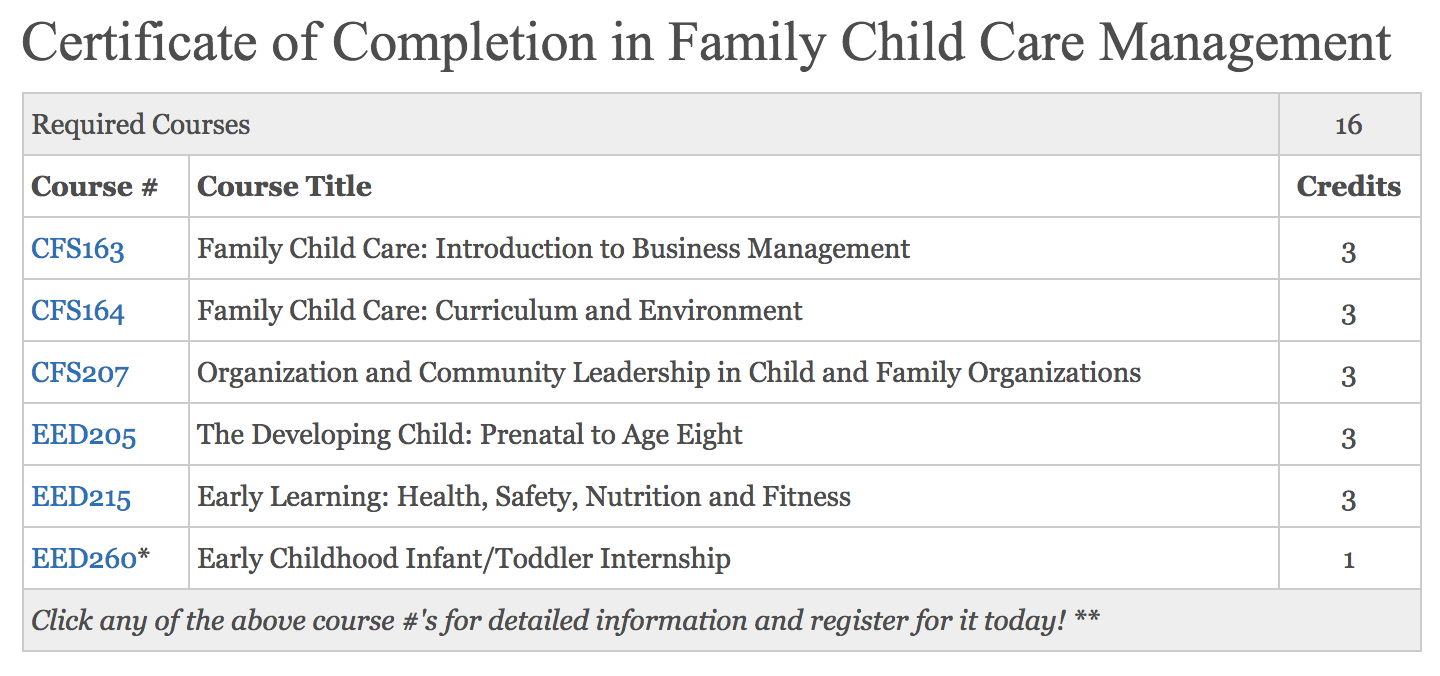
    What is key is that the Completed metric includes those who obtained an associate’s degree or official certificate. Unlike degrees, certificates of completion have no standards across schools, and their usage is very uneven. As an example of Rio’s usage:

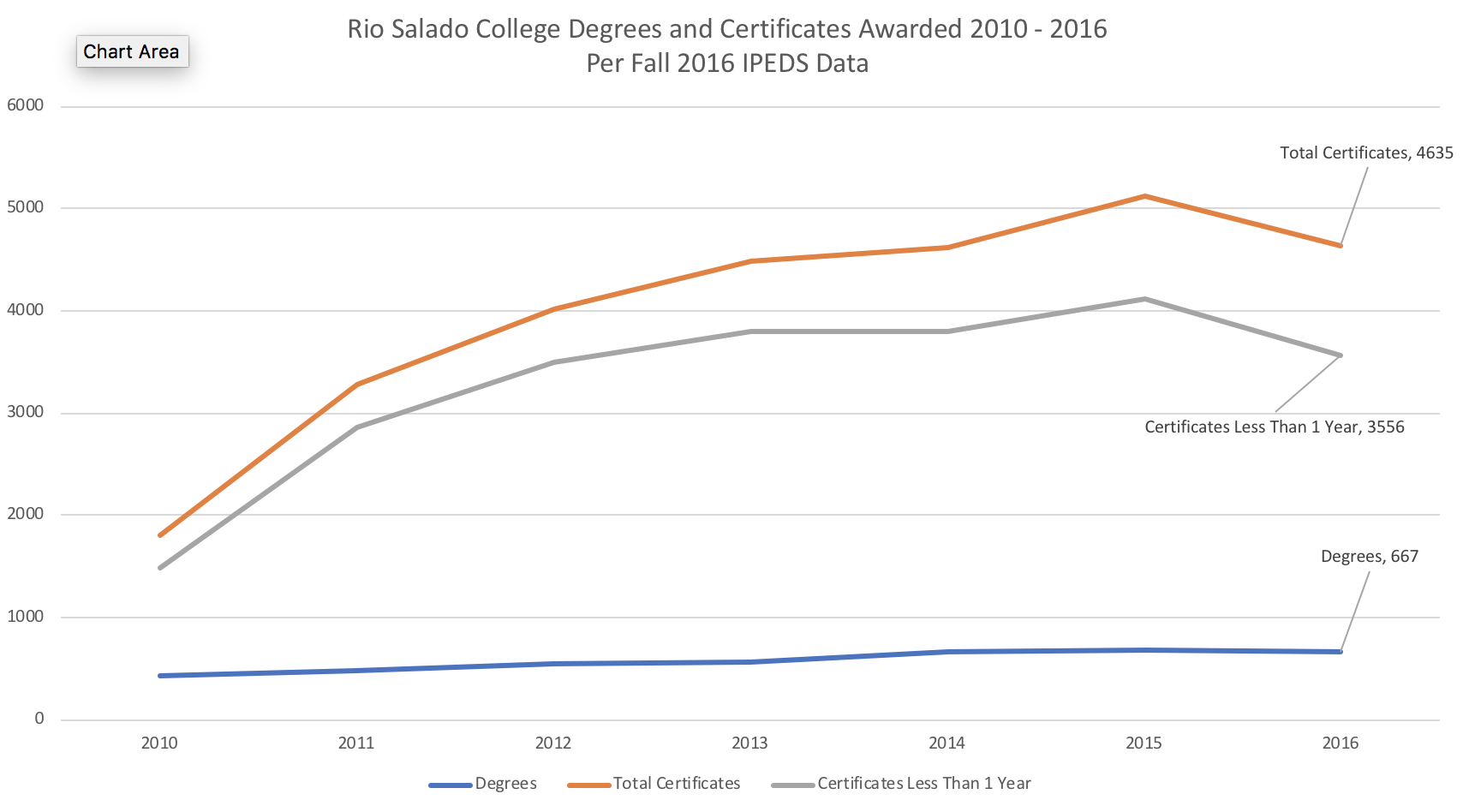
    Notably, since 2010 Rio has defined and awarded more and more of these <1 year certificates, based on IPEDS data.

    We can see is that the large majority of completions, which Rio labels under graduation rate, comes from the nonstandard certificates rather than degrees.

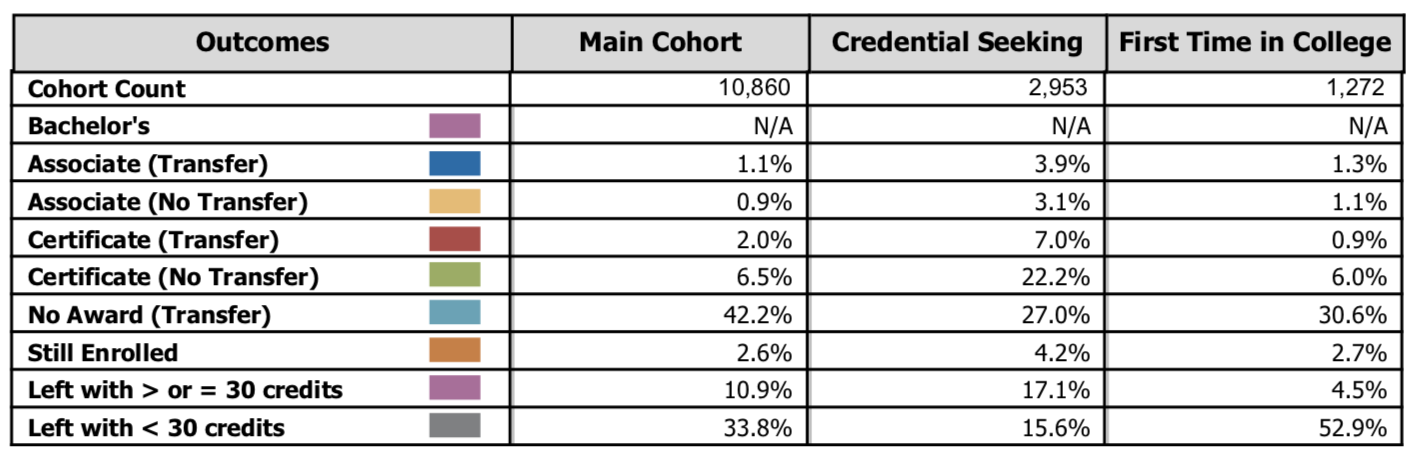
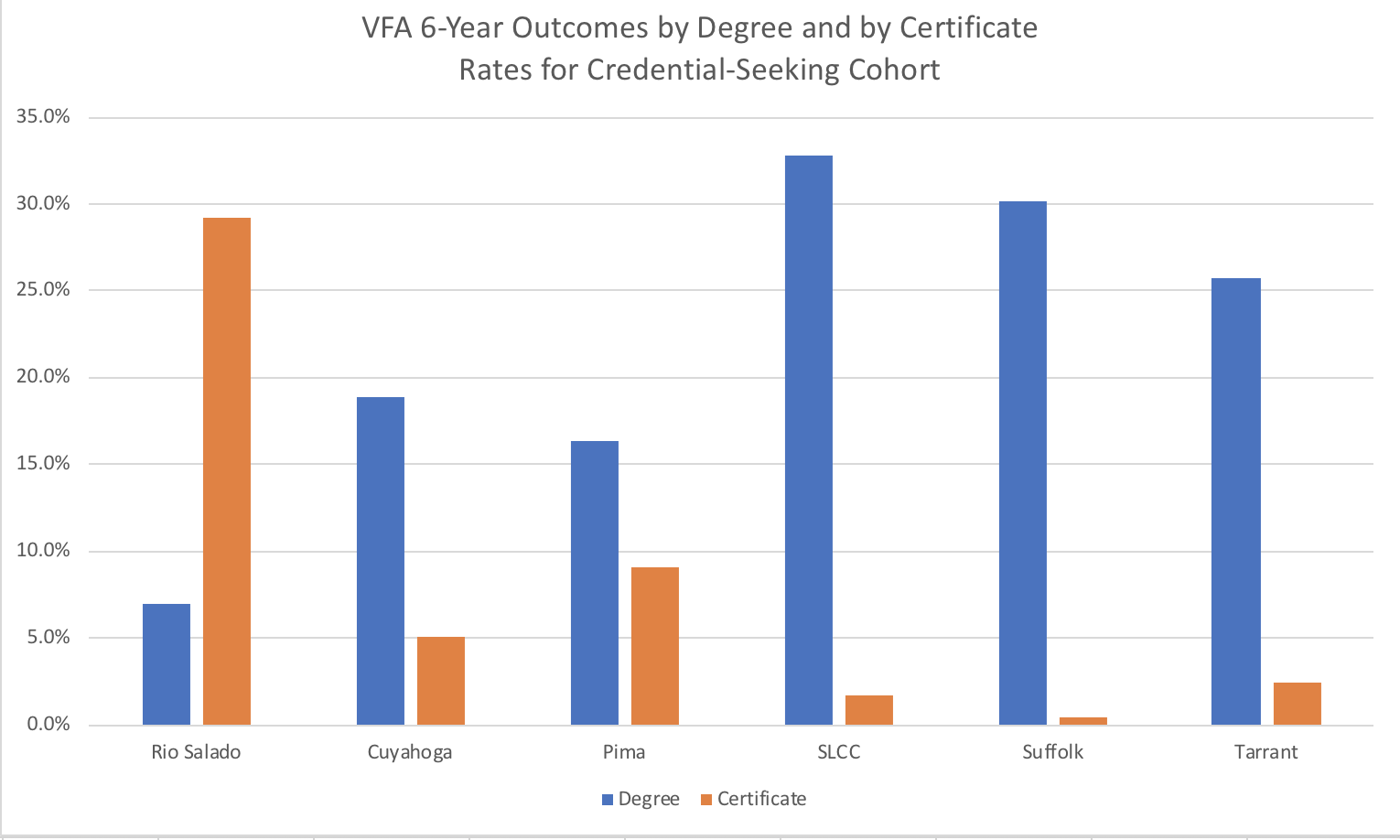
    One of the strengths of VFA is that under the Six-Year Outcomes measures, you can separate out the various types of award. Below is the data for Rio – pay attention to the Credential-Seeking Cohort, as it removes the majority of non-degree / non-certificate seeking students at Rio only looking to transfer a small number of credits. ((For degree or certificate-seeking cohorts, I prefer the Rio definition based on student self-reporting, but the VFA definitions get at the same idea.)) Also note that VFA outcomes are mutually-exclusive and hierarchical in the order shown. If a student gets a certificate and a degree, they are listed under the degree outcome.

    For the Credential-Seeking Cohort, 22% of Rio students get a certificate and do not transfer to a four-year school, 7% get a certificate and transfer, 3% get an associate’s degree and do not transfer, and 4% get an associate’s degree and transfer. A large majority of Rio Salado completions are for certificates, which is consistent with the IPEDS data.

    How does Rio compare to other large community colleges? While we have not analyzed all 200+ colleges in VFA, spot checking with some peer schools indicates that Rio is well below others in awarding degrees but well above others in awarding certificates.

    The resulting data provide the basis of my comment in IHE:

    “This is not a bad situation, per se, as long as students are gaining value in the workplace for these official certificates,” he said via email. “But certificates are not useful in terms of comparing apples to apples, especially when one school uses them liberally, as does Rio, and most other schools do not.”

    Hill also noted that Rio Salado’s VFA completion rate for associate degree programs is a “troublesome” 7 percent.

    While I appreciate the valuable sharing of information from Rio Salado in this process, I’ll stick with my original conclusion:

    At best, this is a school with mixed results that should not simply be labeled a success without caveats or explanations.

    Rio has shown that they can cut costs and still be a successful transfer school, but not that they can be a successful degree school. This matters a great deal in terms of how transferrable the lessons are. It’s fine to focus on transfers when you’re right next door to ASU. But what if you’re Adirondack Community College? There are places where degree completion matter more or less than at Rio. And what about those students going to Rio who *are* seeking degrees? Does this model promote some educational outcomes at the expense of others? And if so, shouldn’t students know about that before enrolling?

  • Rio Salado College As Exemplar: A critical external view

    In yesterday’s post I described how a review of two courses at Rio Salado College indicated reasons to question the use of this school in the ASU / BCG case study report on Digital Learning ((Disclosure: Our e-Literate TV series was funded in part by the Bill & Melinda Gates Foundation who also funded the ASU / BCG study.)). The report, titled “Making Digital Learning Work: Success Strategies From Six Leading Universities and Community Colleges”, has the following description [emphasis added]:

    How can the use of digital technologies in postsecondary education impact students’ access to education, student outcomes, and the return on investment for students and institutions? What are the biggest challenges for an institution seeking to implement high-quality digital learning opportunities? What promising practices enable an institution to achieve impact at a larger scale? [snip]

    The answers, at least in part, lie in case studies of six colleges and universities: Arizona State University, the University of Central Florida, Georgia State University, Houston Community College, Kentucky Community and Technical College System, and Rio Salado Community College. The first three institutions in this list are public research universities, representing different geographic populations and access missions. The other three institutions include two community colleges and a state-wide community college system.

    These six institutions have a strong track record of using digital learning to serve large, socioeconomically diverse student populations, and each has been a pioneer in innovating to expand access to postsecondary education, improve student outcomes, and provide higher education at an affordable cost.

    Let’s look at the track record of Rio Salado College in terms of aggregate academic student outcomes to see how appropriate it is to include them as an exemplar in such a case study-based report. For much of my analysis, I looked at the 862 public 2-year colleges fully reporting data in the Fall 2016 IPEDS data set.

    Reduced Expenditures

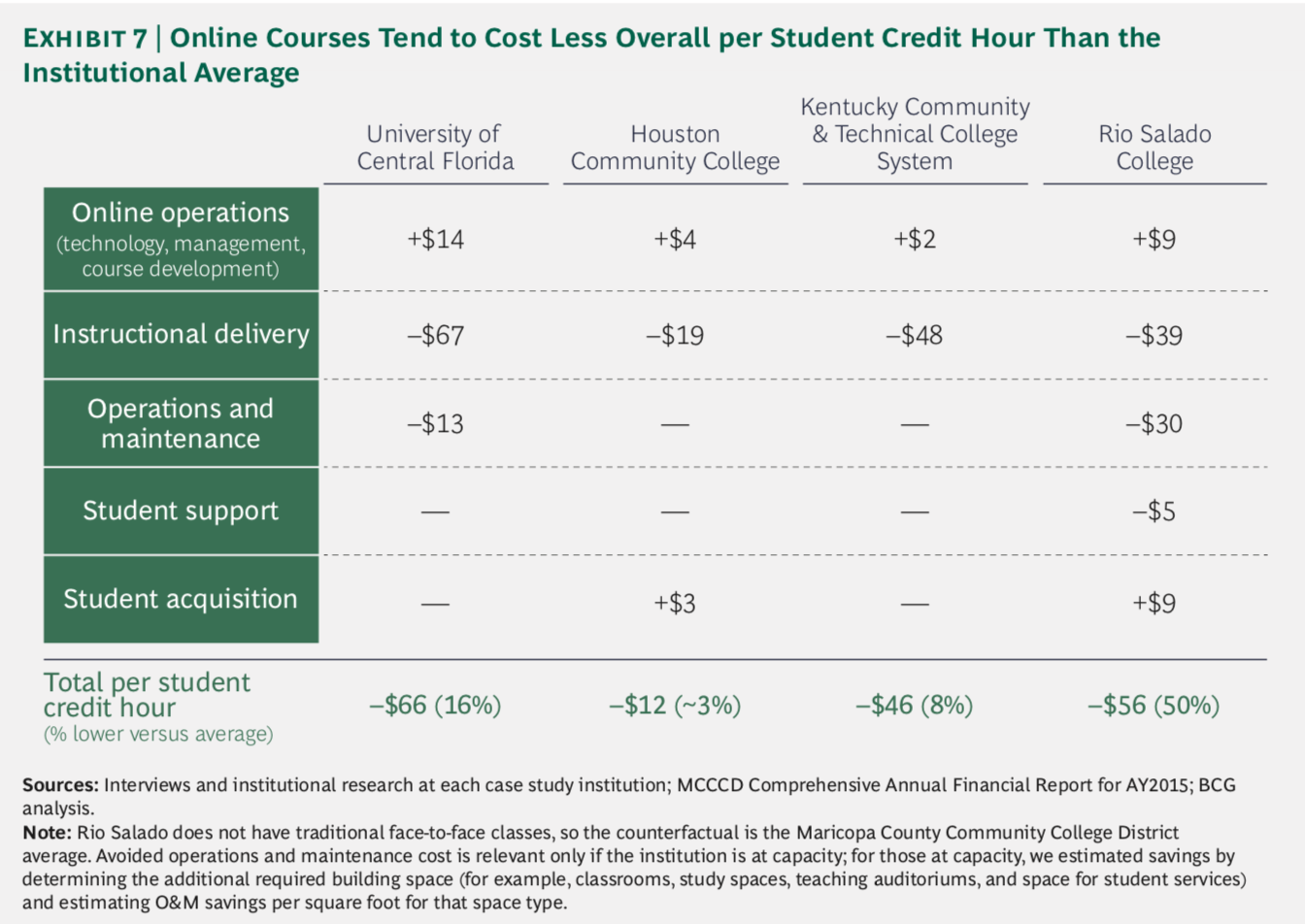
    The primary claim made in the ASU / BCG report is that Rio Salado is has reduced costs.

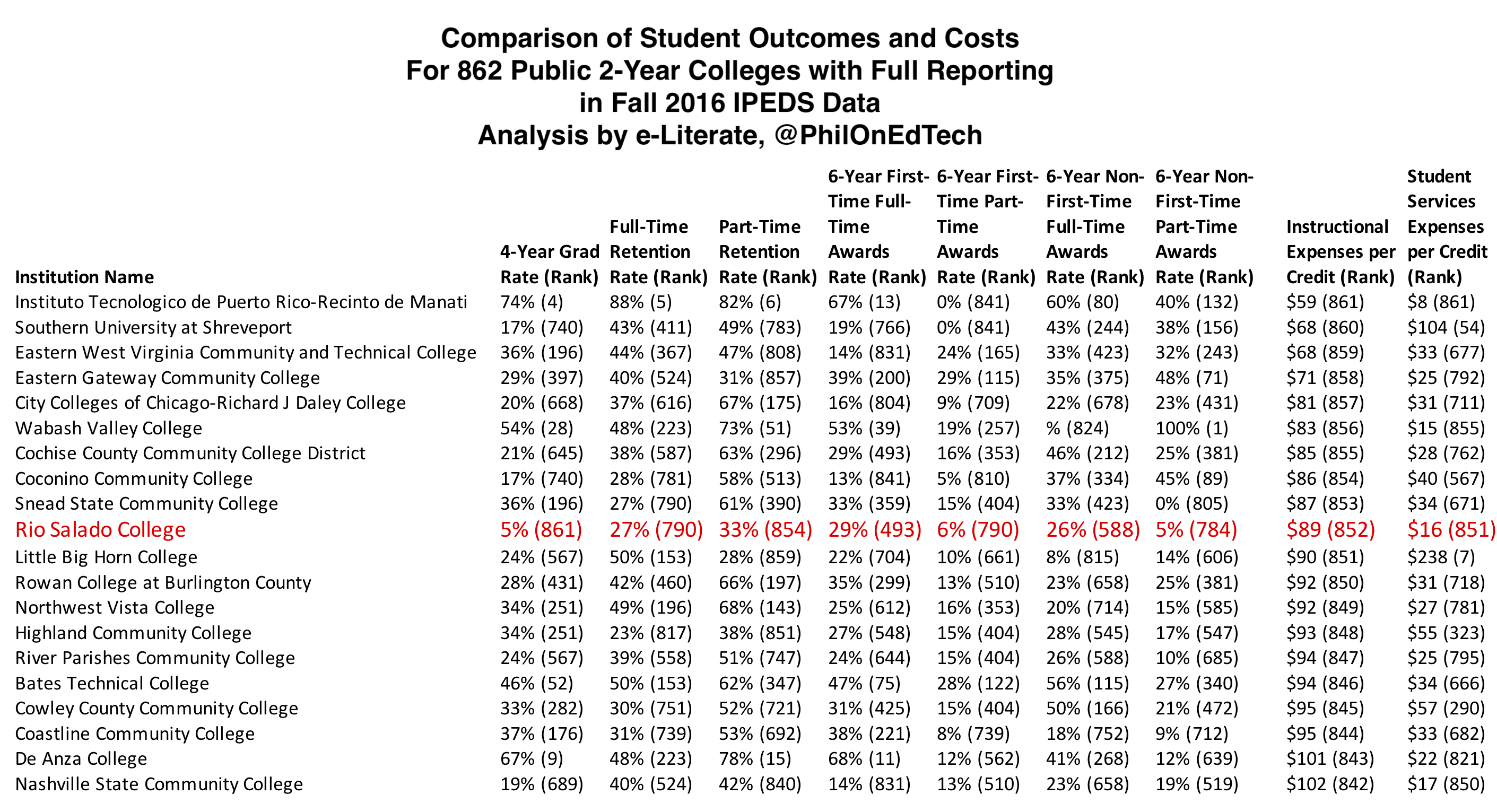
    This claim does hold up to scrutiny, as Rio’s $89 of instructional delivery costs per student credit hour and $16 of student services costs are 10th and 9th lowest in the country for the 862 colleges I reviewed.

    The primary outcomes claims made in the case study quickly brush off the standard metrics for Rio.

    Rio Salado’s success is not defined solely by improvements in graduation and retention rates. In particular, the college has a high transfer-out rate (32% compared to an average of 19% for other MCCCD colleges [ed. – the other schools in the Maricopa County Community College District]), and the students who transfer to Arizona universities from Rio Salado have a 74% four-year graduation rate—3 percentage points higher than the average for other MCCCD transfer students. At Rio Salado itself, students’ course-level success rates have slowly been improving over time, to about 64% in 2016.

    Graduation and Retention Rates

    It is all well and good to point out the importance of transfer students, but we should not ignore graduation and retention rates. And we should explore whether the data supports the phrase “improvements in graduation and retention rates”.

    The report describes Rio’s investment in a suite of advising tools.

    Obtaining these advisory tools required an initial investment of $1 million, but the tools pay for themselves by increasing Rio Salado’s term-to-term retention by 7%, increasing ROI through improved student progress and the additional tuition dollars that the institution receives from retained students.

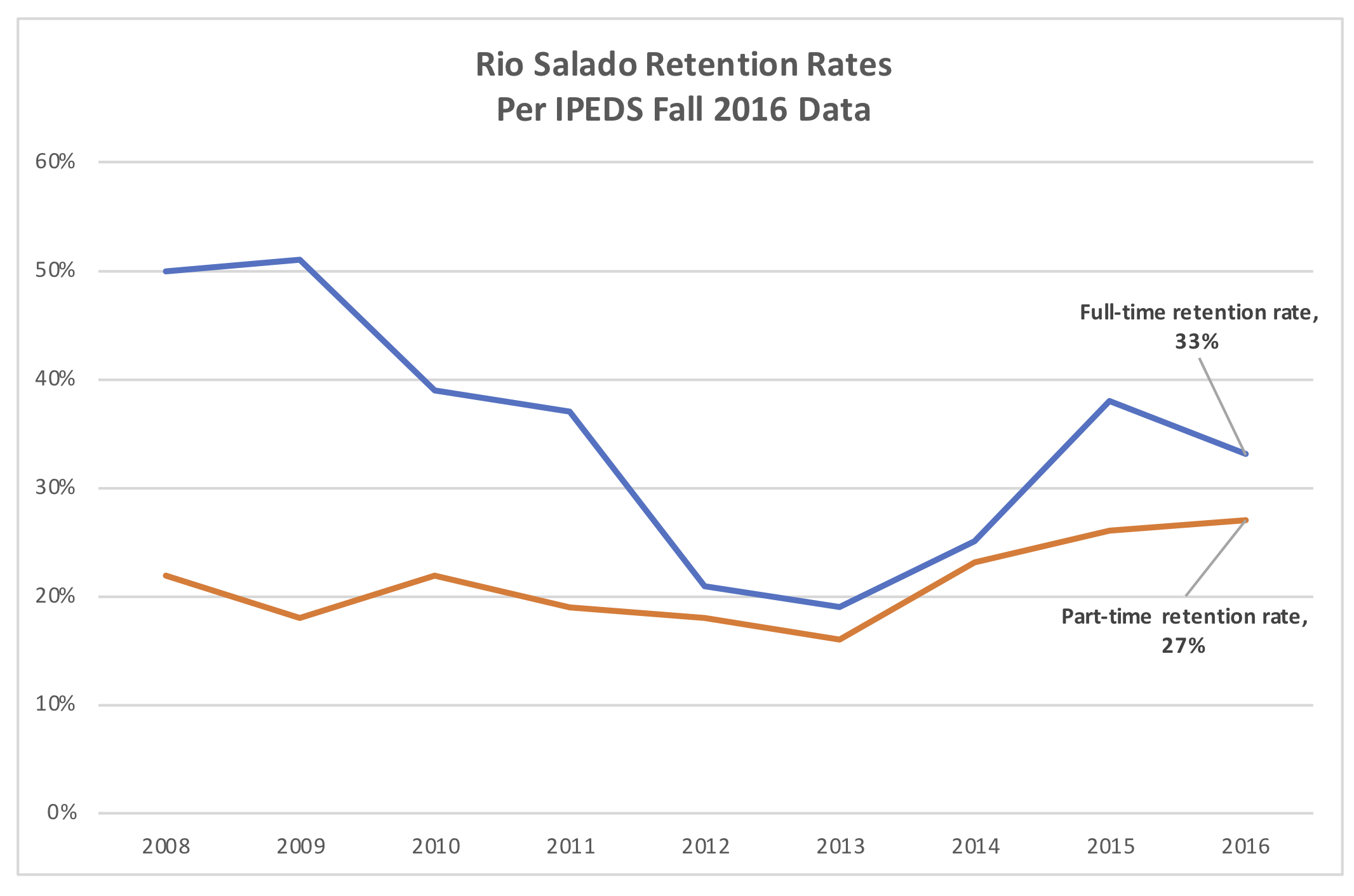
    Looking at IPEDS data, we can see Year 1 to Year 2 retention rates (not quite the same as term-to-term), and it shows improvement since 2013. Unfortunately, Rio’s retention rates for full-time and part-time students are both in the bottom 10% of all community colleges at 33% and 27%, respectively. And the full-time rate is lower than it was prior to 2011.

    Rio Salado Year 2 Retention Rates

    While the ASU / BCG report does not mention graduation rates directly, there have been several claims made about Rio’s numbers in other publications.

    The problem is that Rio Salado’s 4-year graduation rate for first-time full-time students as reported in IPEDS is 5% – the second lowest of any public 2-year college in the nation. How can we resolve this discrepancy?

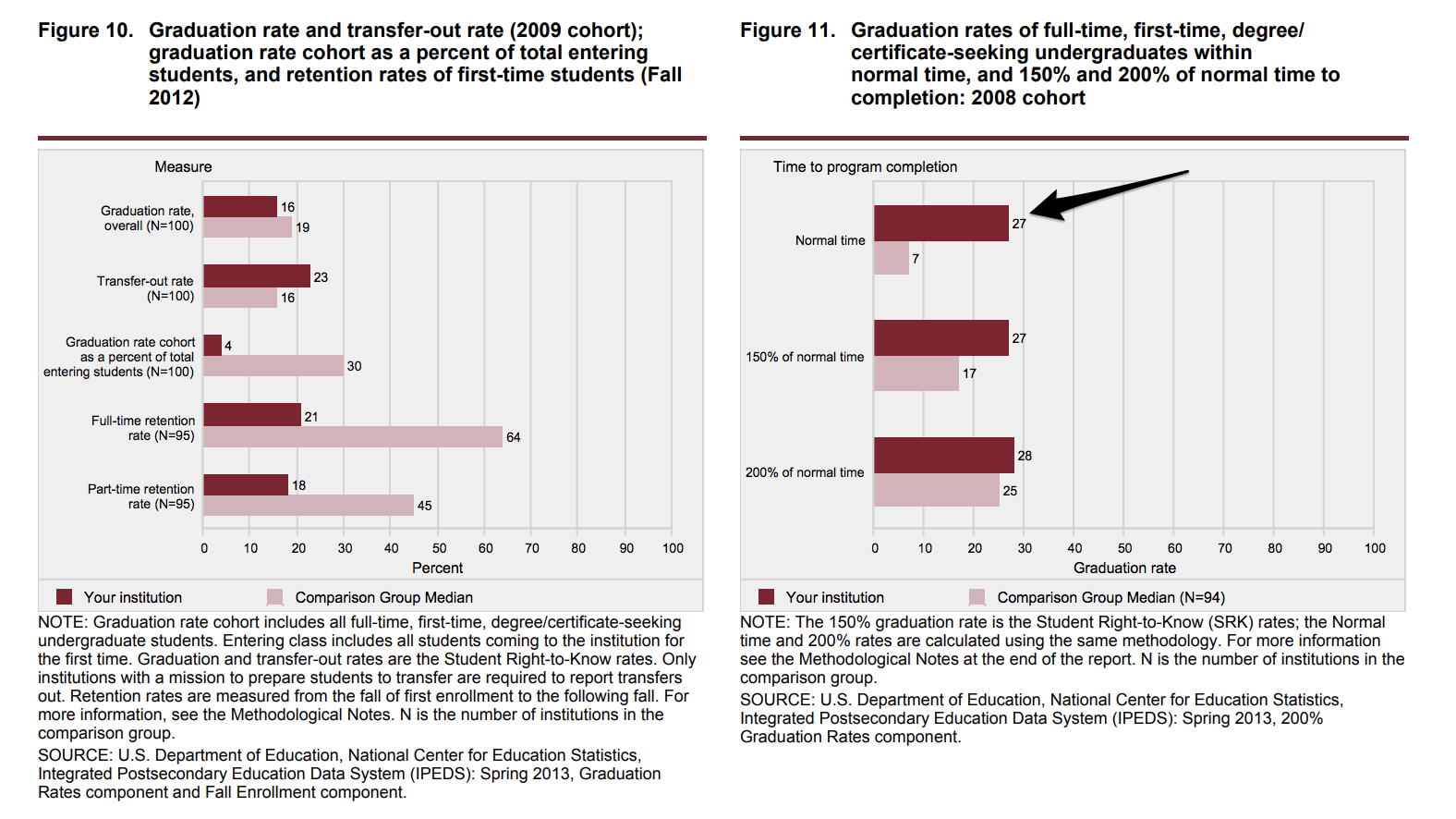
    The key to understanding the claims in these four articles is to follow the two links, which both point to a customized IPEDS Feedback Report from 2013 for Rio against their selection of 100 peer institutions.

    Figures 10 and 11 from IPEDS report

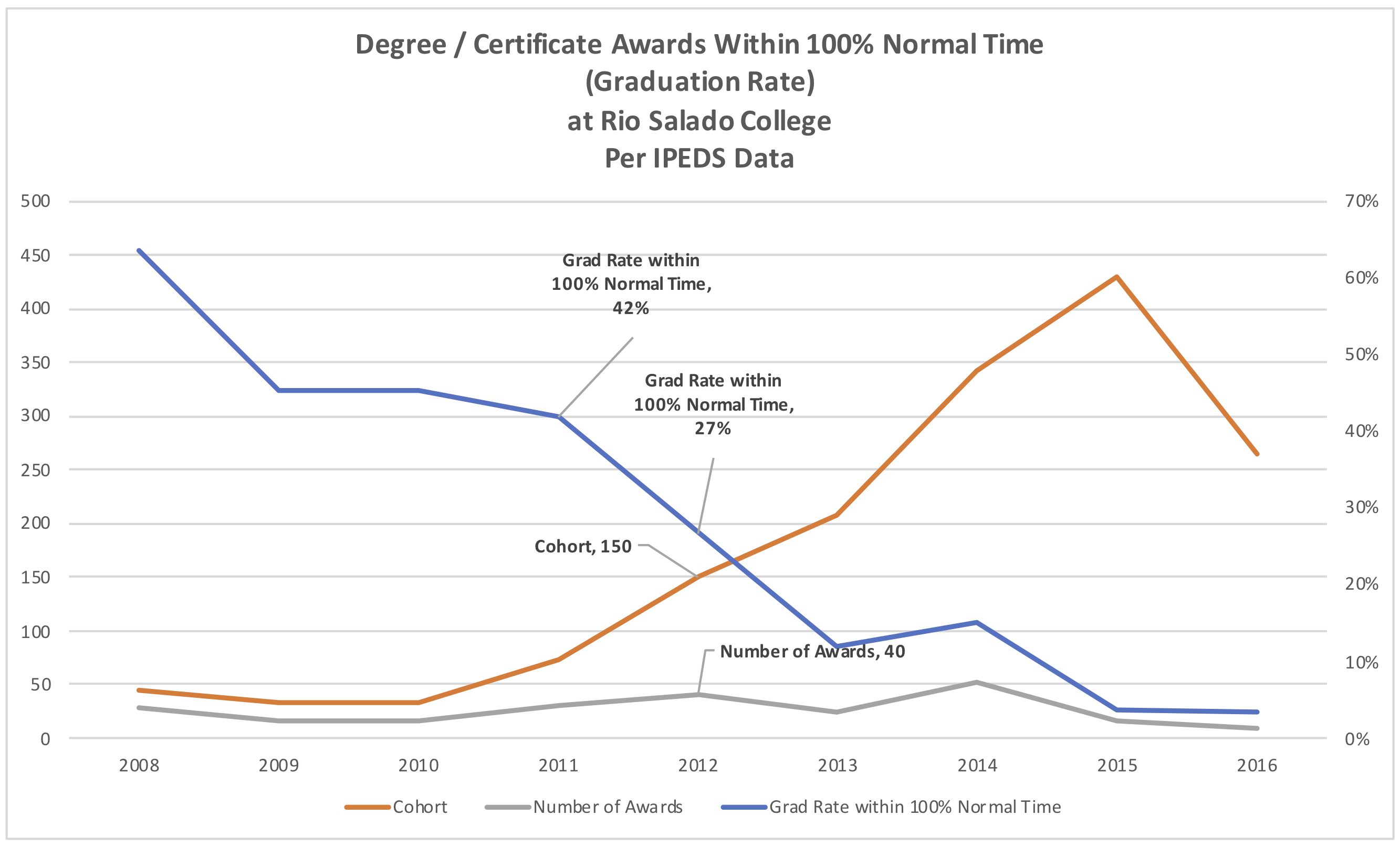
    This measure captures any award – degree or certificate – for a small cohort of entering full-time students at Rio from 2009. If you trace that data through IPEDS, you see that this measure is for a 150-student cohort (in 2012) out of the 45,000+ students at Rio.

    Using this specific metric, you can find the 42% graduation rate in 2011, and the “four times greater” rate of 27% in 2012, both as the rate plummets from 64% in 2008 to 3% in 2016.

    Using broader, up-to-date metrics for graduation and retention rates as well as the new IPEDS outcomes measures (which allows comparison outside of just full-time first-time cohorts), we see that Rio Salado College has some of the lowest student outcomes measures in the country.

    For all but two measures (6-year First-Time Full-Time Awards and 6-year Non-First-Time Full-Time Awards), the performance is in the bottom 10% of all colleges in the study. For those two awards measures, the performance is in the bottom half of the country and represents just 11% of the student body.

    Transfer Rates

    What we are left with are reports about high transfer rates and subsequent success rates 3% higher than other transfers out of the same district. The IPEDS data set now includes transfer rates in its new Outcomes Measures section, and it is true that Rio Salado College does transfer out a significant portion of students. For all cohorts defined below, Rio is in top 20% of public 2-year institutions.

    • First-Time Full-Time Students: 39% transfer rate, Rank 170 out of 862
    • First-Time Part-Time Students: 47% transfer rate, Rank 112 out of 862
    • Non-First-Time Full-Time Students: 46% transfer rate, Rank 196 out of 862
    • Non-First-Time Part-Time Students: 59% transfer rate, Rank 121 out of 862

    Note that this data indicates that students transferred to another institution and are still enrolled there. This data does not indicate what portion of the transfers were planned versus students deciding to move on for other reasons. Nevertheless, for a community college, especially one with very close ties to ASU (I have been told that a large percentage of Rio students are ASU students trying to fill out their schedule based on saving money and more convenient schedules), this is a favorable metric.

    I cannot provide independent confirmation on the subsequent success rates, so we’ll accept that claim at face value.

    Case Study Questions

    I should note that Rio Salado College does provide accurate information on the metrics mentioned in this post, both through IPEDS reporting and through their Research & Planning section of the web site. The picture that emerges from the aggregate outcomes data is of a large school that:

    • transfers out greater than average percentage of students;
    • is just below average for awarding certificates for full-time students;
    • is among the poorest performing in the country for retaining students;
    • is among the poorest performing in the country for awarding degrees; and
    • is among the poorest performing in the country for awarding certificates for part-time students.

    At best, this is a school with mixed results that should not simply be labeled a success without caveats or explanations.

    One question we should ask is whether it is appropriate to hold up a school with some of the lowest student outcomes measures in the country as an exemplar. Yes, Rio Salado has found a way to spend as little as possible on instruction and student support services, and yes, a lot of students transfer out, but that is not enough. We need greater evidence of student success if we are to use them as a case study for others to emulate. And we also need a more robust genre of a case study that looks across, at a minimum, a relatively standard set of publicly-available information, and deeper dives where appropriate, to understand educational practices and their impacts on students. These case studies should present information in context – the good and the bad – since education is complex and challenging, and a clear focus on evidence will benefit all parties in the end.

  • Rio Salado College As Exemplar: A critical internal view

    Rio Salado College As Exemplar: A critical internal view

    10 days ago Arizona State University (ASU) and the Boston Consulting Group (BCG) released a report, supported by the Bill & Melinda Gates Foundation (BMGF) ((Disclosure: Our e-Literate TV series was funded in part by the Bill & Melinda Gates Foundation.)), titled “Making Digital Learning Work: Success Strategies From Six Leading Universities and Community Colleges”. The basic idea [emphasis added]:

    How can the use of digital technologies in postsecondary education impact students’ access to education, student outcomes, and the return on investment for students and institutions? What are the biggest challenges for an institution seeking to implement high-quality digital learning opportunities? What promising practices enable an institution to achieve impact at a larger scale? [snip]

    The answers, at least in part, lie in case studies of six colleges and universities: Arizona State University, the University of Central Florida, Georgia State University, Houston Community College, Kentucky Community and Technical College System, and Rio Salado Community College. The first three institutions in this list are public research universities, representing different geographic populations and access missions. The other three institutions include two community colleges and a state-wide community college system.

    These six institutions have a strong track record of using digital learning to serve large, socioeconomically diverse student populations, and each has been a pioneer in innovating to expand access to postsecondary education, improve student outcomes, and provide higher education at an affordable cost.

    The methodology is a case study of each school, and the report then takes a stance on what other institutions should do.

    Now is the time for leaders to champion the potential of digital learning to open the doors of higher education wider and to improve student outcomes, while operating more efficiently and at lower cost. The journey of each college or university will be unique, but the set of promising practices described in this report may serve as a useful guide for all institutions.

    There are multiple methods to evaluating a school; it turns out that some are more meaningful than others, and it is always helpful to start with what students experience in actual courses. The ASU / BCG report provides useful context on course design.

    At Rio Salado, 22 full-time faculty chairs develop courses with the support of a central team that includes subject-matter experts, instructional designers, media support staff, and production staff. About 1,500 adjunct faculty members teach the courses, which they can personalize by adding an introductory message or video for each module.

    It turns out that I have access to two courses – ENG102 (First Year Composition) and EED200 (Foundations of Early Childhood Education) – and this gives an opportunity to better understand the student experience. What these courses indicate, however, is a troubling lack of meaningful interaction between faculty and students.

    Looking at ENG102, the course materials is Rio Salado developed courseware embedded in their custom course management system, RioLearn. The materials appear to be quite extensive, and all materials are available at the start of the term in 14 lessons. To find actual due dates, students have to go to the gradebook, as no specific dates are included in the courseware.

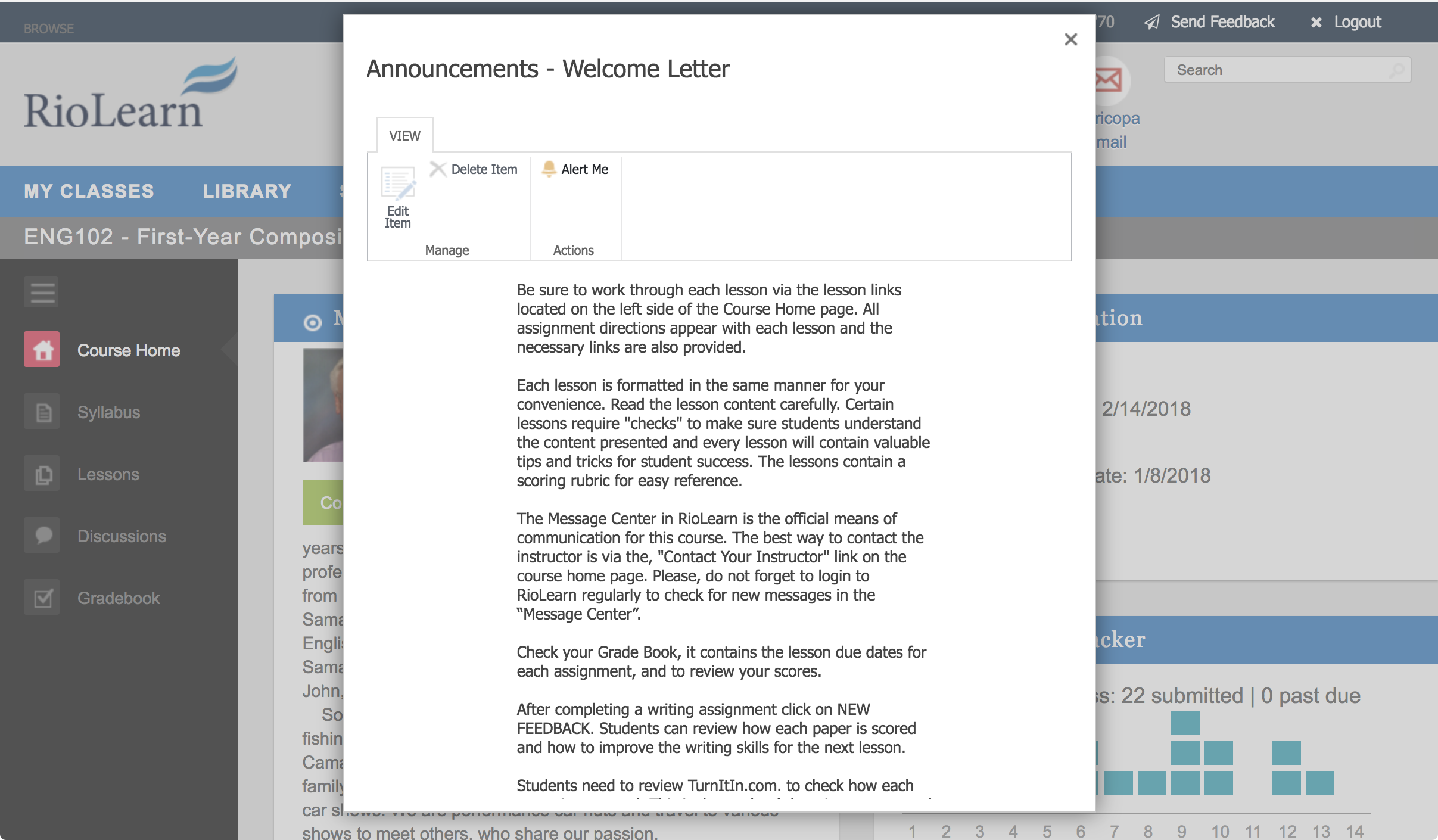
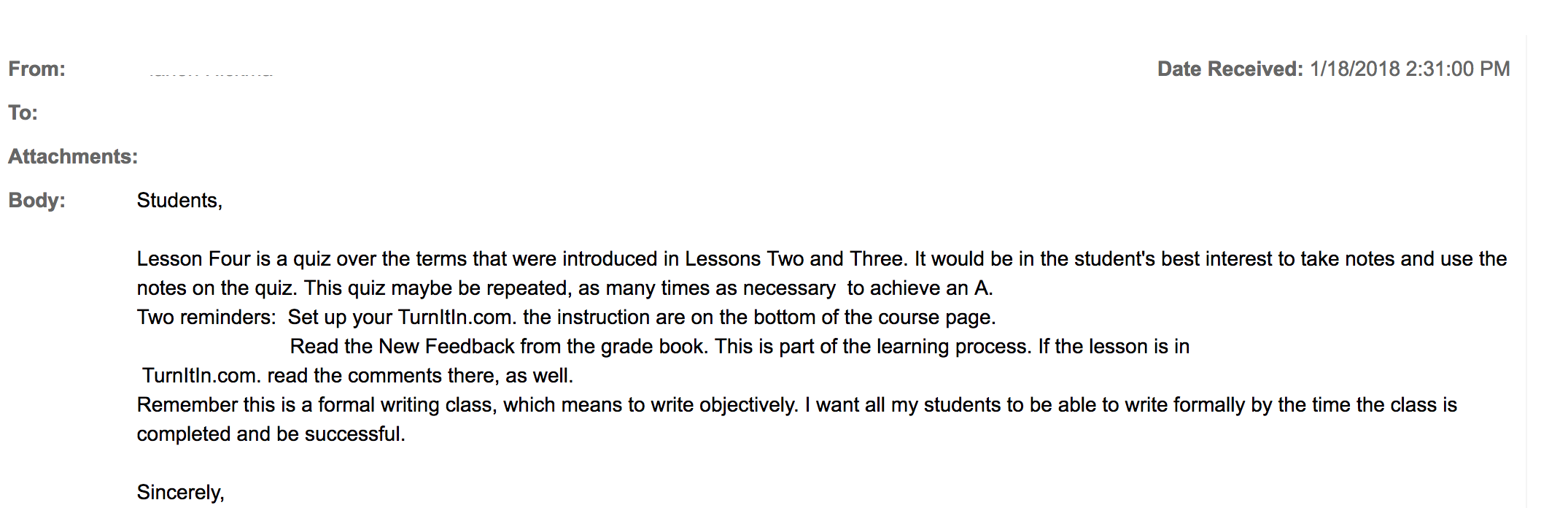
    Course Welcome Message

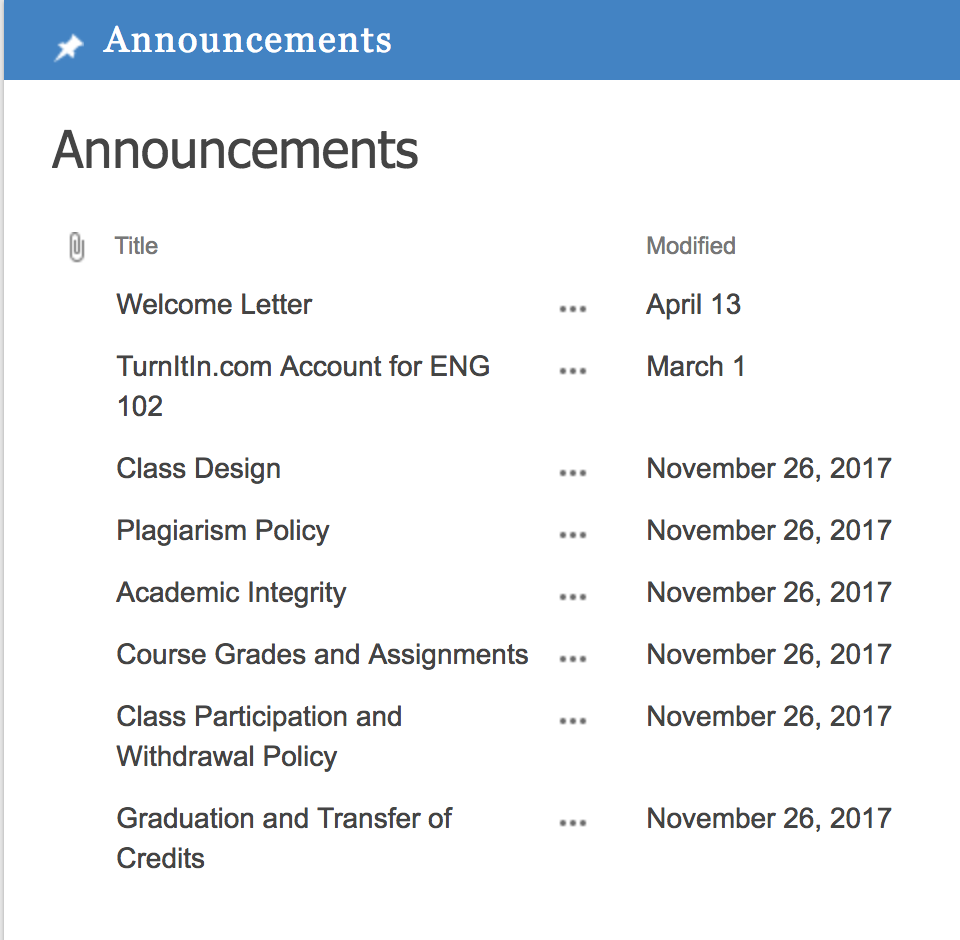
    The instructor sent out several announcements at the beginning of class, a welcome letter, and then one reminder or update message at the beginning of each month. That’s it for instructor-initiated interactions.

    Course announcements

    Sample Message

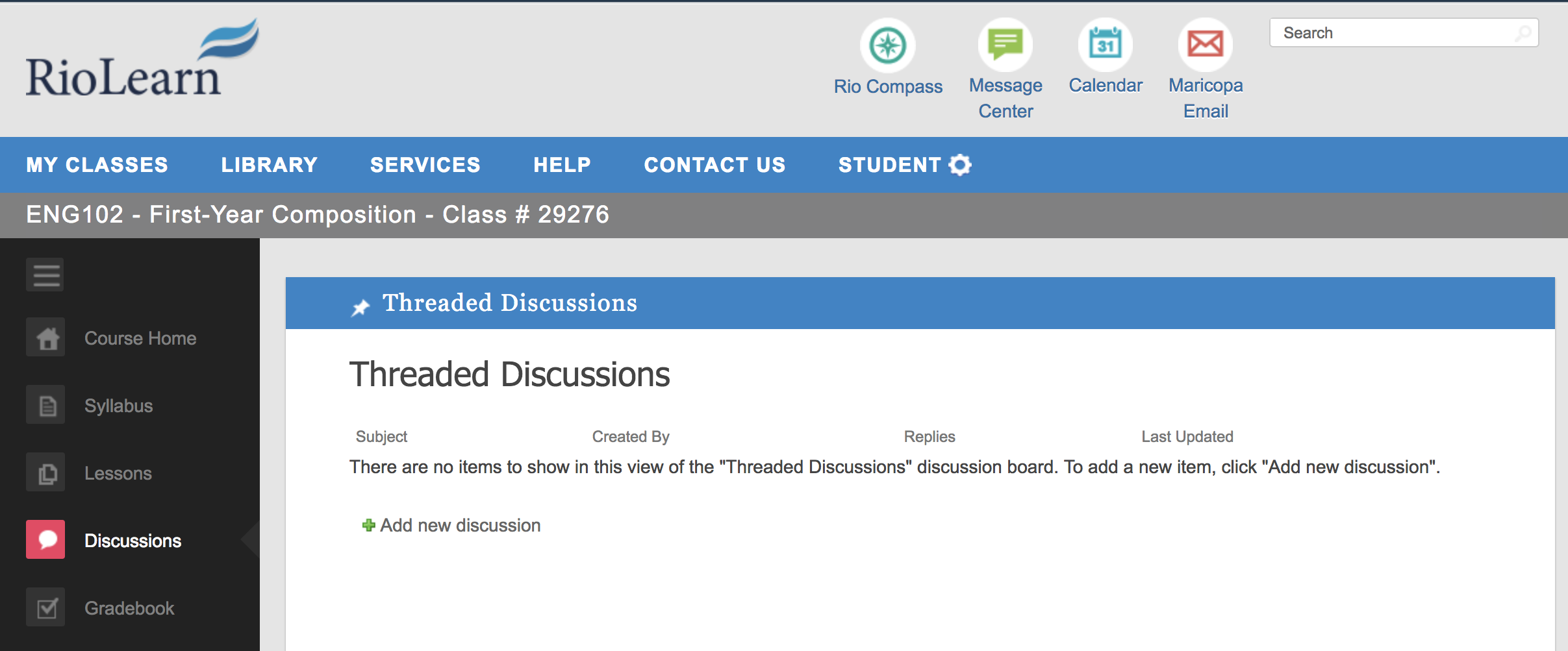
    There were no student-to-student discussions, as the discussion board was unused for the course. There was one peer-review activity, but otherwise no interactions between students. I have been a frequent critic of threaded discussion boards, but it is certainly better to have something instead of nothing.

    Discussion Tool

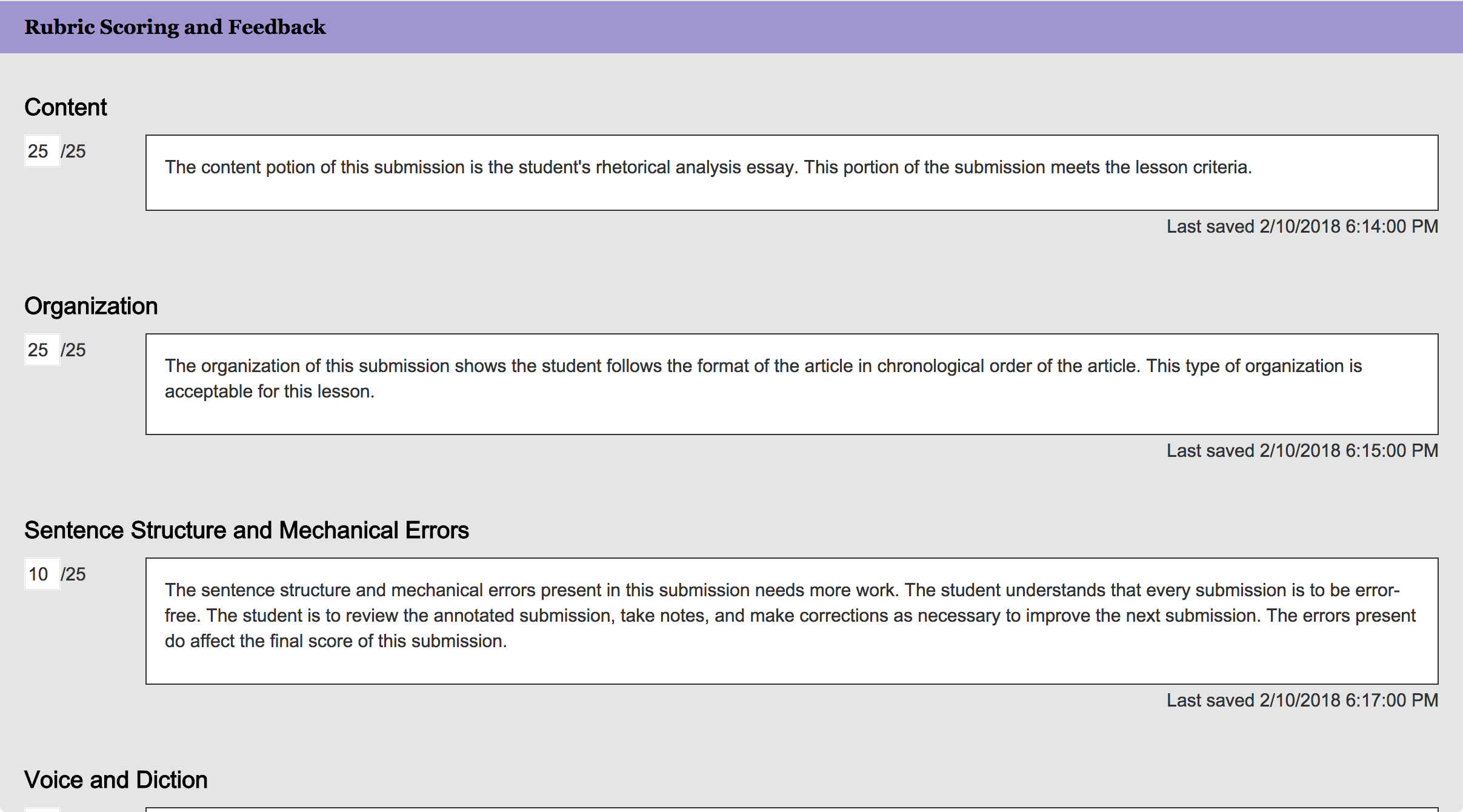
    The rest of the interactions came in two categories: grading of assignments and responses to student-initiated messages. The primary feedback method in these two courses was faculty usage of the custom-developed Feedback Tool, which uses rubrics to grade assignments.

    Lesson Feedback

    There were several assignments that included annotated mark-ups of the submitted papers, which appear to be the most useful feedback from instructors.

    A review of EED200 shows the same course structure – few instructor-initiated interactions, use of rubric grading as feedback on assignments, and specific responses when students send questions in through the Message Center.

    For both courses, the instructors typically responded to student messages within a day or two.

    This approach is troubling, as both courses appear to not meet the “regular and substantive interaction” regulation for credit-bearing online courses. I have been critical about the vague standards and the egregious application by the Department of Education’s Office of Inspector General audit of Western Governors University, but these complaints do not mean that the regulation has no point. The idea is that course design and facilitation should be implemented to ensure that students are not left to figure out static course materials and to be responsible for initiating most forms of interaction. As stated in a 2014 Dear Colleague Letter on the subject of regular and substantive interaction based on competency-based education (CBE) approaches [emphasis added]:

    We do not consider interaction that is wholly optional or initiated primarily by the student to be regular and substantive interaction between students and instructors. Interaction that occurs only upon the request of the student (either electronically or otherwise) would not be considered regular and substantive interaction.

    Some institutions design their CBE programs using a faculty model where no single faculty member is responsible for all aspects of a given course or competency. In these models, different instructors might perform different roles: for example, some working with students to develop and implement an academic action plan, others evaluating assessments and providing substantive feedback (merely grading a test or paper would not be substantive interaction), and still others responding to content questions.

    The problem with case studies is that the selection of cases to study may not be representative or appropriate to prove one’s thesis. It is possible that I happened to look in detail at two courses that are aberrations. But even so, this view is troubling, as these are centrally-developed courses (not subject to the whim of individual instructors), and both courses have little meaningful provisions for faculty-student or student-student interactions. The instructors were responsive to messages, but that is not enough to back up claims of high-quality courses. The dissonance between these two courses and what is described in the ASU / BCG report led me to take a critical look at the data.

    For the next post, I’ll take the external view and look at aggregate public data on Rio Salado College on academic outcomes.

  • Challenge Of Student Transition Between Active And Passive Learning Models

    Last week the Hechinger Report profiled an innovative charter school in San Diego called High Tech High (insert surfer jokes here) that follows an active, project based learning (PBL) model. The school doesn’t use textbooks, and they don’t base the curriculum on testing. The question they ask is whether this approach prepares students for college.

    As a result, for [former HTH student Grace] Shefcik, college – with its large classes and lecture-based materials– came as a bit of a shock at first. At the University of California, Santa Cruz, she is one of more than 15,000 undergraduates, her assignments now usually consist of essays and exams. At High Tech High, Shefcik had just 127 students in her graduating class, allowing her to form close relationships with peers and teachers.

    The premise of the article is that PBL prepares students for life but maybe not for college. Grace described the big difference between high school, with constant feedback and encouragement, to college, where you rarely get feedback. Other students describe their frustration in not knowing how to study for tests once they get to college.

    After a recent screening of “Most Likely to Succeed” at the New Schools Summit in Burlingame, California, High Tech High CEO Larry Rosenstock told an audience, “We actually find that many of our students find themselves bored when they get to college.” (more…)

  • Release of University of California at Davis Case Study on e-Literate TV

    Today we are thrilled to release the fifth and final case study in our new e-Literate TV series on “personalized learning”. In this series, we examine how that term, which is heavily marketed but poorly defined, is implemented on the ground at a variety of colleges and universities. We plan to cap off this series with two analysis episodes looking at themes across the case studies.

    We are adding three episodes from the University of California at Davis (UC Davis), a large research university that has a strong emphasis in science, technology, engineering, and math or STEM fields. The school has determined that the biggest opportunity to improve STEM education is to improve the success rates in introductory sciences classes – the ones typically taught in large lecture format at universities of their size. Can you personalize this most impersonal of academic experiences? What opportunities and barriers do institutions face when they try to extend personalized learning approaches?

    You can see all the case studies (either 2 or 3 per case study) at the series link, and you can access individual episodes below. (more…)

  • ASU Is No Longer Using Khan Academy In Developmental Math Program

    In these two episodes of e-Literate TV, we shared how Arizona State University (ASU) started using Khan Academy as the software platform for a redesigned developmental math course ((The terms remedial math and developmental math are interchangeable in this context.)) (MAT 110). The program was designed in Summer 2014 and ran through Fall 2014 and Spring 2015 terms. Recognizing the public information shared through e-Literate TV, ASU officials recently informed us that they had made a programmatic change and will replace their use of Khan Academy software with McGraw-Hill’s LearnSmart software that is used in other sections of developmental math.

    To put this news in context, here is the first episode’s mention of Khan Academy usage. (more…)