e-Literate

Present is Prologue

Tag: Blackboard

  • A Blackboard Debt Update, and a Lesson on Public Relations

    The short version of this story is that Blackboard has sold off their Transact business and moved their corporate headquarters out of Washington, DC. Both of these are sensible moves that give them an opportunity to reduce their debt load and get on better financial footing. Not being a debt expert with access to the information to the information that credit rating agencies have, I can’t comment at this point on how much this improves their outlook.

    That should be the sum total of this post. Unfortunately, because Blackboard handled some of our previous coverage poorly, the news also provides evidence that they weren’t entirely forthright with us in previous conversations about the tools they had at their disposal for handling their debt. So I’m obliged to complicate the news with an accountability story. Since I am weary of writing accountability stories after 14 years of writing them, I prefer to turn this story into a lesson about how ed tech companies can handle difficult PR situations better, in the hopes that I will have to write fewer of these stories in the future.

    If what you mainly care about is Blackboard’s financial health, then you can stop here. If you’re interested in learning more about how ed tech companies accidentally get themselves into unnecessary trouble, and how they can minimize their chances of doing so, then read on.

    Asking for Trouble

    Back in the summer of last year, I got into two consecutive spats with Blackboard, neither of which I saw coming. The first was about our data showing that Instructure Canvas had surpassed Blackboard in US market share. Now, everybody, including Blackboard, knew that those market share lines where moving closer together. Counting methodologies being complex and legitimately debatable, it’s possible to have honest disagreements about how close they are or whether they have crossed at any given moment. But we considered this more of a milestone that summed up a long-term trend than a big story in and of itself.

    There were a couple of ways that Blackboard could have handled this. One was to play it to the hilt. Being branded—pun intended—as the corporate juggernaut has been a problem for Blackboard for a long time. They could have finally turned the tables on Instructure and portrayed themselves as the scrappy underdog. Or they could have just kept quiet and let the story pass. It would have disappeared down the memory hole in about three days. Instead, they engaged in a strong public pushback against our numbers. That doesn’t make them bad people; they have a right to defend themselves as they see fit. But from a purely strategic perspective, their choice had the effect of both prolonging their bad news cycle and provoking responses from us.

    In one of those responses, I tried to explain—again—that the market share lines crossing really wasn’t news but rather a symbol of the ongoing trend. If you want real potential bad news for Blackboard, I argued—and this is where the danger of prolonging the bad news cycle caused further complications for them—you should look at their debt situation:

    The real issue of concern is the potential behavior of their debt and equity owners. I’ll come back to the point about Blackboard’s total product portfolio in that context….

    The second “Blackboard alert” article worth reading is the one by Katherine Doherty and Eliza Ronalds-Hannon at Bloomberg News. This one wasn’t a reaction to our piece but rather coincidental timing triggered by the same underlying concerns. I spoke with Doherty, whose beat includes companies with distressed debt.

    The debt is the real existential issue. Without it, Blackboard would just be a company that continues to struggle with its flagship product but which would have enough runway to turn itself around over time, one way or another. In the Bloomberg article, Blackboard CEO Bill Ballhaus repeats Miller’s reminder that the company sells other products and services. And as we have pointed out repeatedly here on e-Literate, the international markets are an increasingly large percentage of Blackboard’s financial picture. The fundamentals of the company may not be great, but they’re not dire either. Given time, good leadership, and low debt, a company in this position should be able to right itself.

    But because Blackboard has high debt, their situation potentially a lot more volatile. One major reason why the market share milestone matters is that it’s an apt metaphor for Blackboard’s financial waterline. At their current debt levels, the company can’t afford for their market share to continue to drop.

    Contract losses have sent Blackboard’s revenue and earnings sliding, according to people with knowledge of the matter, making it harder to carry more than $1.3 billion of rated debt. With some of Blackboard’s bonds selling at deeply distressed levels, Ballhaus is crafting a comeback, and possible options include the sale of its payment processing division, said the people, who asked not to be identified because the discussions are private.

    So, I wrote that Bloomberg news reported that Blackboard has debt levels that are high enough to cause potential problems for its business. Elsewhere, we reported that Moody’s had made some negative comments about their debt as well. Reporting these things is a little like reporting that the Weather Channel is predicting a high likelihood of heavy snow. It’s not something you argue about.

    I went on to say that, while the debt situation was serious for Blackboard, it was far from certain doom:

    Even in this situation, the results for Blackboard Learn customers won’t necessarily be bad, or even noticeable—depending on how the finances are resolved. If Blackboard sells off Transact, gets a good price for it, pays down some debt, and otherwise sticks with the current management’s plan, that could buy them some time and some ability to survive further erosion of market share around Learn. If the company’s owner, Providence Equity, decides to take more drastic steps, then the potential impact on customers is unpredictable. And Providence’s calculations regarding how much drastic action is required must be at least partly driven by their assessment of how close Blackboard is to bottoming out in LMS market share loss.

    This story was harder for the company to ignore, but they still had some options. I had said some good things about the company in that post, and some critical things about their competition. Their CEO, Bill Ballhaus, is a turnaround specialist. The Private Equity owners of Blackboard have signaled their trust in him by making him both Chairman and CEO. They had a good story line there. And they were going to have an option to engage with us in person very soon at BbWorld.

    So what strategy did they choose?

    Keep digging

    They pushed back hard. We had two meetings with Blackboard executives, including our meeting with Bill Ballhaus, in which they brought up the debt issue immediately and completely dismissed it as illegitimate. This was what poker players call a “tell.” It was so far out of the norm for this sort of analyst/executive meeting that it sent a clear signal of how concerned they were about the coverage. Now, some of that is simply due to the fact that people read what we write and react to it, and they don’t always read it carefully. So we know that Blackboard got inbound calls that were triggered by that post. But the tone of the pushback, coupled with the implausibility of the arguments, were highly inconsistent from our experience with this management team.

    This instantly changed the story line of BbWorld for us, and not in a way that Blackboard had intended. Here’s what I wrote in my follow-up post, entitled “Blackboard’s Defenses of Its Finances Are Not Persuasive,” about that meeting:

    When we were at BbWorld the week before last, Blackboard’s executive management pushed back vehemently on our analysis of how their high levels of debt could impact their business decisions. We heard their strong disagreement expressed in our very first meeting of the conference from Chief Learning and Innovation Officer Phill Miller and in our very last meeting from CEO Bill Ballhaus.

    We stand by our analysis. In fact, Blackboard’s pushback had the opposite of its intended effect. We left BbWorld more convinced that we are right rather than less….

    Ballhaus argued to us that the amount of debt that Blackboard is carrying is a strategic choice that he and the private equity investors—he used the pronoun “we”—make together. In particular, he argued, “we” could choose at any time to invest more money in the company, paying down debt in exchange for equity. Further, he argued, it’s logical to assume that Providence would do so if needed because “they only make their money if we improve.”…

    Paying down debt in exchange for equity, called “recapitalization,” is a strong vote of confidence by a private equity (PE) owner. First, since debt holders get paid before equity holders in the event of bankruptcy, it increases risk for the PE firm. Second, it would mean a substantial investment of cash, which is partly what PE firms typically try to minimize by requiring the companies that they own to take on substantial debt in the first place. When PE-owned companies find that they are in danger of being unable to make their debt payments—which both Moody’s and S&P Global Ratings have said is currently the case with Blackboard—the PE owners can and do employ a number of different strategies that are financially less risky to them in order to address the problem, either instead of or in addition to recapitalizing.

    For example, when Cengage Learning found itself with unmanageable debt levels after its acquisition by private equity, they filed for bankruptcy:

    “The decisive actions we are taking today will reduce our debt and improve our capital structure to support our long-term business strategy of transitioning from traditional print models to digital educational and research materials,” Michael Hansen, Cengage Learning’s chief executive, said in a statement.

    To be crystal clear, I am not suggesting that Blackboard is likely to file for bankruptcy. Providence Equity has other options at its disposal, some of which I will write about in the next section.

    Rather, the point is that Ballhaus’ claim that we should just assume Providence will see it as being in their interest to recapitalize Blackboard is not credible on its face to anybody with even passing knowledge of how private equity companies work. For example, the tone of the Washington Business Journal article I referenced above, which (obviously) was written by a business reporter, suggests significant skepticism that Providence will not let the company’s debt challenges impact their business decisions. The industry experts we typically consult with when writing financial or business stories like this one were even harsher in their evaluations of Blackboard’s position. Two literally laughed out loud at it.

    I’m pretty sure that wasn’t the coverage Blackboard was hoping for.

    And it was destined to get worse. Because they were now stuck in a trap of their own making.

    The Trap

    What do you do as an analyst when you believe a company has been making misleading statements to you and that there will be evidence supporting your theory of the case in the future? You lay down a marker and wait.

    Here’s what I wrote:

    [I]n fairness, there is an empirical fact of the matter here, and we do not yet have conclusive public evidence that the company’s high levels of debt will, in fact, affect their business strategy. So here’s what we’re going to do:

    1. I will summarize their position as objectively as I can.
    2. I will explain why we don’t find their position persuasive.
    3. I will lay out the signs that concrete evidence we will be looking for going forward that will either support or undermine our thesis.
    4. Phil and I will publish updates as we monitor these signs and, if there is no additional public evidence of our thesis by BbWorld 2019 (or strong evidence emerges that we are wrong before then), then we will publish a mea culpa post….

    Here are a few actions Blackboard could take in the future that would indicate Providence Equity has chosen to push Blackboard to solve its own debt problem rather than making it go away with more of Providence’s money:

    • Sell off one or more parts of the business: A Bloomberg piece written by journalists from their distressed debt desk reports, “With some of Blackboard’s bonds selling at deeply distressed levels, Ballhaus is crafting a comeback, and possible options include the sale of its payment processing division, said the people, who asked not to be identified because the discussions are private.” Said payment processing division, Blackboard Transact, is a cash cow for the company. If Blackboard sells off one of its more profitable business units at a time when the company is having trouble making debt payments, that would indicate a choice by Providence Equity to find a way to reduce debt pressure that is less risky for them in terms of cash investment but more risky for Blackboard in terms of long-term health. Particularly since Providence already tried to sell Blackboard once and has now owned the company for well past the normal sell-by date that PE companies like to follow, the sale of Transact might suggest further moves to follow.
    • Unload expenses (like office space): The Washington Business Journal article notes, “Blackboard is also interested in unloading its 70,000 square feet of office space at 1111 19th street, with 12,000 square feet already sublet, according to an April post on Tech Office Spaces. It’s unclear where Blackboard will go if it succeeds in leasing out its entire footprint. Blackboard stood to benefit from a tax rebate program for companies that agree to sign 50,000 square feet for at least a dozen years, valued at half the company’s tenant improvement costs, or a maximum of $5 million over five years.” Of course, companies take cost-cutting measures all the time, regardless of their financial health. The business reporter’s phrasing suggests that he may be detecting a whiff of desperation in the specifics of this transaction. Since that’s his expertise more than ours, we’ll be looking for additional confirmation of our thesis, such as if Blackboard were to…
    • Significantly restructure with major layoffs: If Blackboard were to move to a smaller office while also laying off employees—beyond those that might leave in a sale of a business division or the slow leak of headcount that the company has been having for a while now—that would certainly be an indicator that Providence is not ready to just give Blackboard the money the company needs to complete a turn-around and is instead pushing them to solve their own financial problems.

    I wrote that post on July 31st, 2018. Where are we seven and a half months later?

    Trap Sprung

    Last week, Blackboard announced the sale of Transact.

    Boom.

    Note that this is not an objectively bad thing for Blackboard. To the contrary, it helps them with their debt problem in a way that has little to no impact on their core customers. The problem is that it also runs against the grain of the story line that Blackboard executives pushed to us aggressively last summer. They turned what should have been a good story for them into a more complicated story.

    Also, last January, Blackboard announced they would be moving their headquarters out of Washington, DC to a new space in Reston, VA.

    Boom.

    Note that this is also not an objectively bad thing for Blackboard, also a way for them to manage their debt problem without impacting customers, and also in tension with the story they told us last year.

    The layoff evidence is less clear. There are plenty of comments on Glassdoor about ongoing layoffs (as well as voluntary talent drain) at the company, but that sort of evidence needs to be taken with a heaping teaspoon of salt. And honestly, I am hoping that I don’t see evidence of a major restructuring going forward. I never want to root for people to lose their jobs.

    So overall, there is pretty clear evidence that (a) all the debt agencies were not wrong when they said Blackboard had debt issues, (b) we were not wrong when we said that Blackboard could not expect Providence Equity to solve their problems by simply showering them with more money, and (c) Blackboard is taking necessary and reasonable steps to reduce their debt load. In other breaking news, gravity still exists.

    I let Blackboard know I would be writing an update to my previous post and gave Mr. Ballhaus an opportunity to revise and extend his previous remarks. Here’s what I got back:

    Our decision to divest in Transact is consistent with our strategic efforts to simplify our business as we move to a purely SaaS model and enhance focus on our core teaching and learning portfolio. The fact that we have tightened our strategic focus toward our current education clients and are accelerating innovation to benefit them is a stark contrast from our competitors who are looking to grow their business in areas outside of education.

    Proceeds of the sale will go toward deleveraging the company and also present potential opportunities to reinvest in the business.

    OK. This isn’t a bad statement as far as it goes. The last sentence is most directly relevant. The rest is stuff that he wants to get in, which is fine and expected. The truth is that he’s heavily constrained in what he can say about the debt management for legal and other reasons. As I said at the top, regarding the substance of the situation, I’m not a financial expert and do not have access to the information that debt agencies do, so I will wait for them to weigh in on how all of this affects Blackboard’s financial prognosis. It can’t be bad, but I’m not qualified to judge how much they’ve improved without the benefit of expert input.

    Regarding the PR situation, as far as I’m concerned, this was a fairly normal corporate answer. We’re back on terra firma. The more interesting question is how companies can avoid getting themselves into this situation in the first place. Blackboard is far from the only company that has gone through this sort of thing with us. And while we occasionally run into CEOs who are simply bad humans, usually these situations arise out of missteps that happen while the people at these companies are under enormous pressure because the companies are working their way through a rough patch. I have been on the inside of a company as an employee in that sort of a situation. It is not easy. External-facing leaders in particular need to cultivate reflexes to deal with these sorts of crisis situations. And make no mistake; an analyst or reporter raising uncomfortable questions about something your company is struggling with definitely feels like a crisis situation.

    So what’s the right reflex to cultivate?

    Honesty Works

    Executives need to understand the power of honesty as an offensive weapon. Set aside ethics for a moment. I’m talking about it from a purely strategic perspective. Let’s look at a couple of examples of how to play this card, starting with Blackboard.

    I made the analogy earlier between the debt agencies and the Weather Channel. Let’s extend that analogy a bit. I live in Massachusetts. It snows a lot up here. (Or at least, it used to.) But we have very professional road crews who know what they are doing. Most of the time, we can get a dumping of 18 inches at night and still drive on safe roads the next morning. We check the weather, but we don’t freak out about it. One way Mr. Ballhaus could have handled the debt conversation would have been to wait for us to bring the topic up—which we would have—and then say something analogous to the following:

    It’s true; the Weather Channel is predicting snow. I lived for ten years in rural Minnesota. In a house with a very long driveway. I have a truck with a snow plow on it. Here is my shovel. Any questions?

    Here’s how that looks in business terms:

    It’s true; the debt agencies are concerned about our debt load. That’s one reason why Providence Equity brought me in. I’m a Private Equity turn-around guy. This is pretty much what I do. You guys have been around the block enough to know that I can’t talk about the details of how we’re going to manage it, but we have strategies in place for strengthening the company’s balance sheet while protecting our customers.

    Every word of this is either undeniably true or reasonably plausible, and there’s not much we could have said in response. It also doesn’t make for much of a story. It becomes a “this is one of a number of factors that we’re watching” kind of thing. It doesn’t become the dominant story line coming out of BbWorld. And it softens the analysts up just a little bit. With a story like debt risk, there’s always a lot that we don’t know. The flavor of our coverage is influenced by our trust in management to be reasonably honest and open with us. In this context, a little bit of good will goes a long way.

    For another example, take the case where Pearson was trying to manage a story I was chasing of their CIO’s penchant for repeatedly talking about the company’s supposed ambition to build, in his words, the Netflix of education. I was (and still am) pretty sure that isn’t what Pearson is trying to do. But because this very high-level person continues to be allowed to publicly declare that they are trying to do this, and because Pearson is a big place where the right hand sometimes doesn’t know what the left hand is doing, only somebody who outranks the CIO can definitively put the question to rest. And there is only one person who outranks him: CEO John Fallon. After much discussion with Pearson’s PR team and some interviews with a couple of the CIO’s peers in other relevant parts of the organization, and very much to my surprise, I was given direct access to Pearson’s CEO. So here we go, I thought. This was going to be easy. He could put this story to bed, and I could spend my time writing a story about something good rather than something dumb.

    That’s not what happened. 

    But it so easily could have.

    Yeah, Pearson doesn’t want to be the Netflix of education, and Albert shouldn’t have said that we do. We do think that we need to become an internet-scale digital company, and we do think that the trend toward renting digital assets is one that is relevant to the educational market. That said, we understand that analogies are fraught in education and we don’t wish to oversimplify. In fact, we sold off our consumer businesses in part because we want supporting educators in managing those complexities to be the core of what we do. When we talk about efficacy, that’s what we mean.

    That answer not only would have spiked the “Pearson can’t stop talking about being the Netflix of education” story; it also would have turned me toward writing an update to my original efficacy story, complete with reporting on the genuinely good work the company’s efficacy team has been doing since then. The Netflix thing would have ended up getting mostly buried as a side note about how difficult and fraught it is for companies to talk about their work.

    It wouldn’t have mattered if I knew the answer was a strategic attempt to kill or divert the story. As long as it was honest, it would have been fair game. Beyond that, I would much rather write a story about a company that’s trying to do the right thing and does it imperfectly than play a game of gotcha with a company because the management is giving answers that I feel I have an obligation to police. When leadership chooses not to play the honesty card, they often accidentally trigger a gotcha game that generally doesn’t end well for them and puts them in a worse light than they actually deserve. I wanted to say definitively that Pearson isn’t trying to be the Netflix of education because I believe it to be true. I know they are doing good work because I have seen it with my own eyes. I could have written a story about that. But because Mr. Fallon chose not to play the honesty card, the story ended up being about Pearson failing to clearly disavow the Netflix analogy, and I couldn’t definitively write what I believe to be true about the company because Mr. Fallon didn’t give me the proof that I needed for the story.

    I could go on; I have many more examples like these. A positive one is when Instructure’s former CEO Josh Coates completely transformed a negative story about the company charging customers for access to their own data. Not only did he admit that the company screwed up in very blunt terms; he changed the policy, encouraged us to call customers and verify that they were satisfied with the changes, and thanked Phil for calling his attention to the problem. There are reasons why we wrote very little negative coverage of Instructure during the Coates years. One is that the leadership team really understood the power of honesty.

    The bottom line is that honesty is disarming. Good analysts always try to maintain healthy skepticism, but they also try to be good judges of character. Because good analysis is partly based on knowing how much you trust the particular version of events that a company’s management is giving you. In contrast, when leaders give in to the (understandable) temptation to deflect, they look dishonest. I want to be very clear about separating a moment of failing to be honest, which we all have had under pressure from time to time, from being a fundamentally dishonest person, of which I have met relatively few in my life. Analysts (and reporters) have to distinguish between the two based on very little information, and they have the obligation to be skeptical. Also, good analysts have instincts that lead them to poke where it hurts. The reflex of the person being poked will be to protect the sore spot. Effective leaders learn to fight that reflex in the moment. They acknowledge problems that the analyst may have uncovered (to the degree that they can) and turn that moment of vulnerability into an opportunity.

  • Instructure: Plans to expand beyond Canvas LMS into machine learning and AI

    Instructure: Plans to expand beyond Canvas LMS into machine learning and AI

    It’s common knowledge that Instructure has shifted its focus to place more emphasis on its growth in corporate learning markets than in the educational markets that have fueled the company growth to date. We covered the initial news about their introduction of the corporate learning LMS, Bridge, four years ago.

    While Instructure has excelled on maintaining product focus and simplicity of user experience, this move outside of education raises the question about whether they can maintain company focus. The corporate market is very different than the education market – different product needs, fragmented vendor market, different buying patterns. Many companies have tried to cross over between education and corporate learning, but most have failed. Blackboard, D2L and Moodle have made a footprint in the corporate space using one product for both markets. Instructure’s approach is different.

    As noted, the other Big Four LMS vendors are also targeting corporate learning (or professional ed, or workplace, pick your name). D2L and Blackboard are using the same platforms in both markets (Brightspace for D2L, Learn and Open LMS for Blackboard), while Moodle released Workplace, a set of plugins on top of core Moodle. Instructure, however, has different products for educational and corporate markets.

    That is old news. What is more interesting is to understand Instructure’s emerging strategy given the new executive team. Thanks to the nature of Instructure being a publicly-traded company, we are getting more insight that should set expectations for educational customers. As CEO Dan Goldsmith said during an investor conference a week ago:

    We really changed the company, as I came in nine months ago and then took over as CEO January 1st of this year. We’re initiating the second chapter in the journey of Instructure.

    I should first note that the audience for these calls is the investment community, so naturally Instructure executives focused more on financial performance and projections that they would in academic meetings. But there is a lot to learn here.

    In some ways, the changes to operations of Instructure are welcome and are already helping them manage corporate finances. In other ways, however, that second chapter reads a lot like Blackboard. Moving beyond the LMS, willing to bet on corporate acquisition, expecting big focus on data and analytics, and continuing challenges in completing products.

    Operational Improvements

    One of the ongoing criticisms of Instructure, particularly by their competitors, is that they continue to lose money and are buying growth. While these observations are accurate, as long as Instructure keeps growing, they have never been at risk of running out of money or having their losses significantly impact their operations. Under the new leadership, Instructure has been much more aggressive in managing expenses, with a big milestone described on the conference call by CFO Steve Kaminsky [emphasis added].

    Turning to the expense side. With our focus on operational excellence during the second half of 2018, we’ve changed the mindset of our leadership team and the entire organization about how we approach the business and fund investment. We focused on disciplined investments for balancing profitable growth has been put in place and is reflected in the outlook we provided today. On the cash side, we have a strong cash position to support our important strategic objectives for both Canvas and Bridge. And looking forward to 2019, we anticipate being approximately free cash flow neutral for the full year.

    Beyond simple finances, we have seen some operational changes for international operations as well. The global regions (EMEA, Latin America, APAC) all have more autonomy now, including control over country-specific marketing and product management. The non-US operations have moved beyond being regional sales and support offices into more aggressive engines of growth. In Europe and other regions, the management team has more autonomy is deciding which countries are worth investment for expanding markets, and when. From the Feb 25th investor presentation:

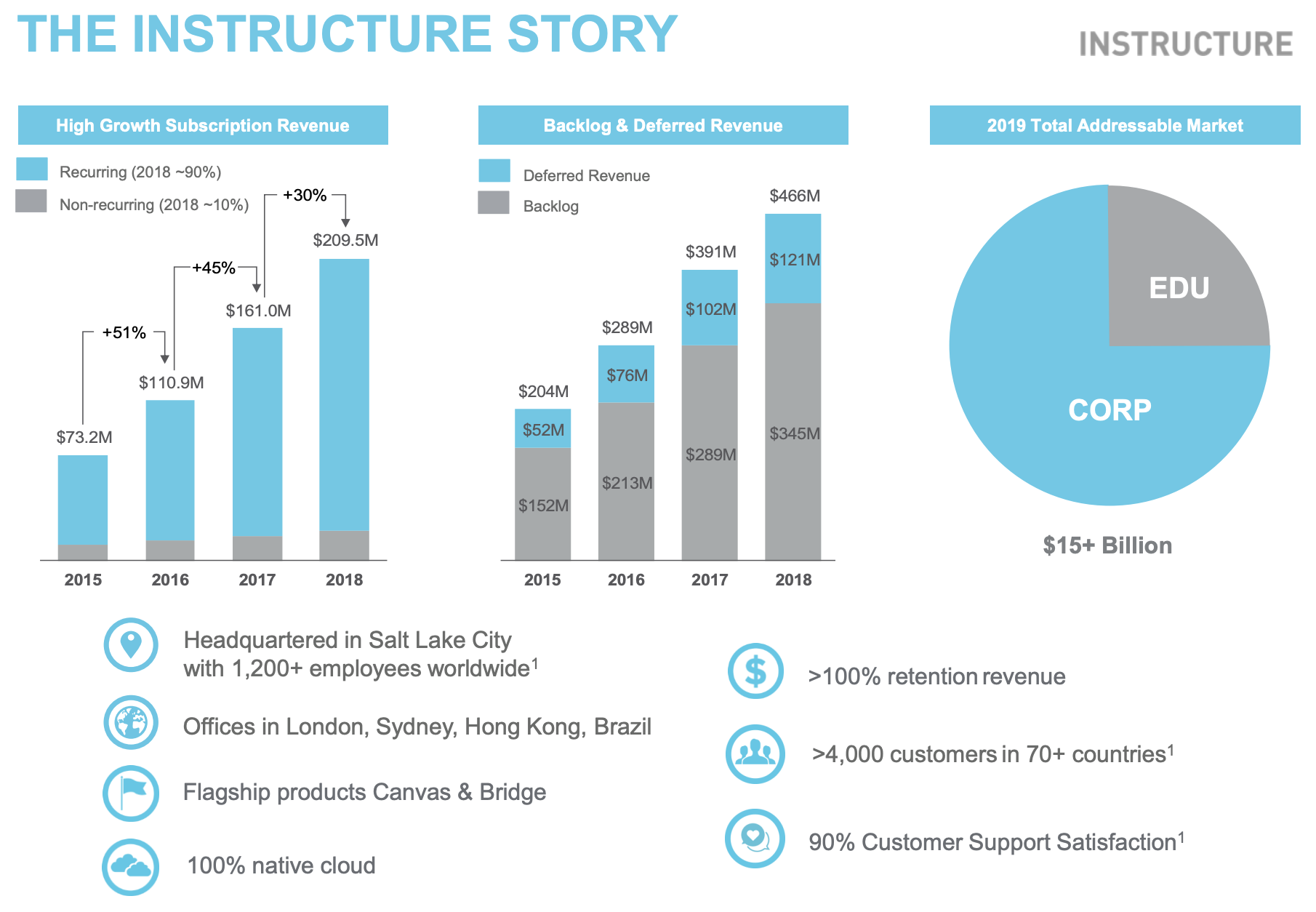
    The Instructure Story

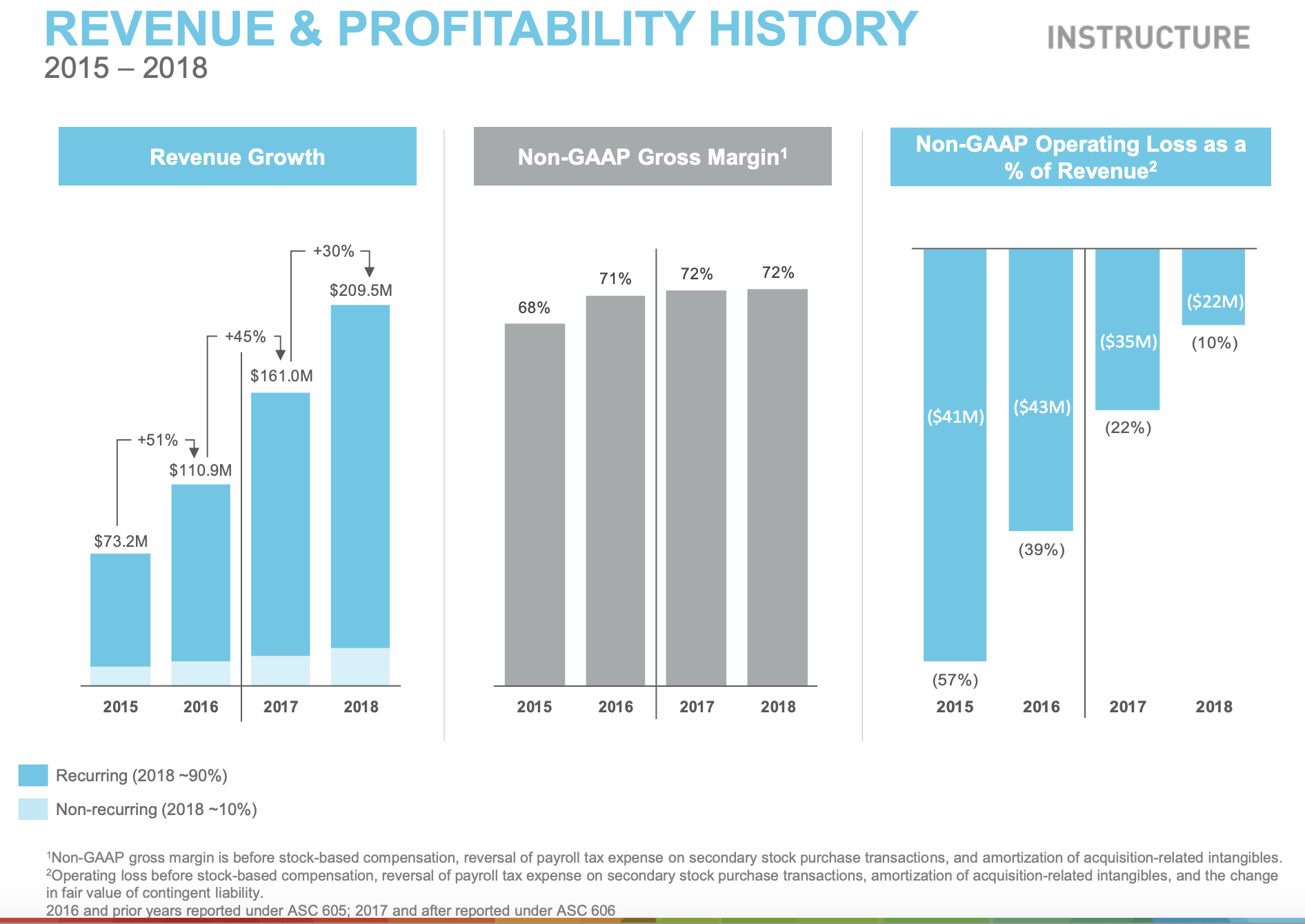
    With the improving operations, Instructure has reduced their operating losses from 57% of revenue to 10% of revenue in the past three years.

    Investor conference slide

    Moving Beyond the LMS

    On the same day as Instructure’s earnings call and release of FY2018 financial results, the company announced the acquisition of Portfolium for $43 million, a small startup focusing on “ePortfolio network, student-centered assessment, job matching capabilities, and academic and co-curricular pathways”. We interviewed Instructure staff the same day as the earnings call and noted a different message. In our initial call, the Portfolium acquisition was positioned primarily as a way to improve how Instructure can handle structured assessments in the education market – think CBE, mastery learning, with ePortfolios not as the goal but as the necessary infrastructure. During the earnings call, however, the positioning was more about bridging educational and corporate markets and expanding total addressable market (TAM).

    Today, we’ve taken a great stride towards enabling that transition with our expected acquisition of Portfolium, a successful long time Canvas partner. Portfolium vision is to help each person realize their full potential by connecting learning with opportunity, through e-portfolios, program and course level assessments, career pathways and by matching students to job opportunities. Portfolium will join Instructure with a wealth of shared customers, such as Virginia Tech, Santa Clara University and Swinburne University in Australia. This acquisition is a great match in vision and culture and represents our first major step into the Student Success market. And while Portfolium’s current offerings provide an excellent solution, more importantly, they establish the first Bridge between academia and the corporate world that aligns precisely with Instructure’s vision.

    Instructure now views itself as a company with a suite of products, and they are much more open to using corporate M&A to build this portfolio.

    Emphasis on Data & Analytics

    The second initiative announced on the earnings call was DIG, a strategic move with data and analytics.

    I am also pleased to share with you an early insight into our second growth initiative focused on analytics, data science and artificial intelligence. The code name for this initiative is DIG. And this technology platform combined with the most comprehensive SaaS database on the educational experience uniquely positions us to deliver meaningful value to our customers. And from a growth perspective, DIG has the potential to double our TAM in education.

    Instructure started ramping up their data and analytics efforts (again) about a year ago, although the focus was described at the time as being about internal analytics – that is, making Canvas a better and more valuable LMS product. From what I have heard the product validation for DIG are consistent with this message – dashboards, surfacing useful data within a workflow, etc. But that was not how DIG is being sold during the conference call [emphasis added].

    We’ve been working on the scaffolding for [DIG] for well over a year now. I mentioned in our remarks that we already have product validation towards out there in the market. We have instructors and students consuming output from some of the initial experiments with DIG. And we anticipate later this year obviously to make more announcements around specific products and offerings and how we bring them into the market. DIG ultimately is a platform first and foremost based upon machine learning and artificial intelligence. I believe that any multi tenant SaaS company born in the cloud has the opportunity once they hit a certain market share. And in fact, it may even be incumbent upon those organizations to partner with the industry and evolve that industry with new insights and predictive modeling using AI and ML. That’s what DIG is at its heart.

    This is brand new behavior for Instructure as a company. Previously the company was reticent to talk much about non-released products, but now they are talking not just about a new initiative, they are touting buzzwordy machine learning and artificial intelligence and predictive modeling well before any of those capabilities exist or are in customer hands. Goldsmith further clarified the DIG plans during the investor conference discussion [starting at 9:00, emphasis added].

    We already have analytical capabilities in our Canvas platform. I want to be really clear and delineate the difference between an analytics and reporting capability, and a machine learning and AI platform. [snip]

    We have the most comprehensive database on the educational experience in the globe. So given that information that we have, no one else has those data assets at their fingertips to be able to develop those algorithms and predictive models.

    Goldsmith then described an example of predicting a student’s expected performance in a class and how that prediction reliability goes up over time. Then we get the vision.

    What’s even more interesting and compelling is that we can take that information, correlate it across all sorts of universities, curricula, etc, and we can start making recommendations and suggestions to the student or instructor in how they can be more successful. Watch this video, read this passage, do problems 17-34 in this textbook, spend an extra two hours on this or that. When we drive student success, we impact things like retention, we impact the productivity of the teachers, and it’s a huge opportunity. That’s just one small example.

    Our DIG initiative, it is first and foremost a platform for ML and AI, and we will deliver and monetize it by offering different functional domains of predictive algorithms and insights. Maybe things like student success, retention, coaching and advising, career pathing, as well as a number of the other metrics that will help improve the value of an institution or connectivity across institutions. [snip]

    We’ve gone through enough cycles thus far to have demonstrable results around improving outcomes with students and improving student success. [snip] I hope to have something at least in beta by the end of this year.

    Wow. Robot tutor in the sky – meet the new kid on the block.

    The most generous interpretation I have is that they are being sloppy in their terminology and casually throwing out machine learning and AI to eager investors, while the reality could be more mundane but useful sharing of useful data to help instructors or administrators.

    If I had to guess, however, I would suggest that Instructure has its sights set on additional corporate acquisitions over the next year or two to try and back up these expectations. I hope they realize they are not the first company to believe that AI on top of their best-in-world data will deliver success for all.

    The message is also clear that Portfolium and DIG are intended to increase TAM. This means separate product categories with separate pricing in addition to Canvas. Either that or offering Canvas at different pricing levels to include add-on product bundles.

    Challenges in Completing Products

    We noted the modernization efforts behind Quizzes.Next, the next generation quizzing and test engine for Canvas, as well as the big schedule miss. In short, Quizzes.Next was announced at InstructureCon 2016 as being available within a few months. 12 months later at InstructureCon 2017 it entered limited beta, and at InstructureCon 2018 it entered general availability. But the story is not over. Quizzes.Next is still not at feature parity with the original quiz engine, as noted by Indiana University.

    Instructure has released a new quizzing tool for Canvas called Quizzes.Next. Quizzes.Next offers several new features and question types, but is missing many features from the current Quizzes tool on which many instructors depend. Both tools will continue to be available until Quizzes.Next has achieved feature parity with Canvas Quizzes. The original Canvas Quizzes tool will eventually be retired, but Instructure has not yet announced the timeline.

    If you read the Canvas Community page comparing features, it is clear that feature parity is not imminent. The transparency is impressive, however, and from what we are hearing customers are still giving Instructure some leeway because of trust. But Quizzes.Next and its delivery is a continuing problem, not least of which is the reduction in R&D spending growth for Canvas, described by CFO Steve Kaminsky on the call.

    Regarding the R&D investment, we don’t really break that out. But what we can tell you qualitatively is while we are doing some incremental investments on the Canvas side and DIG is a good example of that, the lion share of the growth in R&D is going into Bridge.

    What to Expect

    Instructure is at a crossroads. While they continue to grow, especially in education markets, and while they report improving financial performance, Instructure is entering uncharted territory (for them) in this second chapter. It is remarkable that they have not lost a major educational LMS customer in the 8+ years since Canvas was first selected by the Utah Education Network, but there are some warning signs that should not be ignored and some risky expectations being set.

  • Blackboard Updates: Learn SaaS progress and LMS market news

    Blackboard Updates: Learn SaaS progress and LMS market news

    Blackboard had a lot of news to share two weeks ago when we spoke with CEO Bill Ballhaus and senior teaching and learning executives. The updates addressed efforts to streamline the business, customer retention, and customer acquisition. Blackboard ((Disclosure: Blackboard is a subscriber to our LMS Market Analysis service.)) was upbeat about their current position and prospects going forward, but we see a mixed picture.

    Ballhaus said that Blackboard’s efforts to simplify the business were paying off and leading to greater focus on their core teaching and learning businesses. While the company was built as an enterprise software amalgamation based on 20+ corporate acquisitions, Ballhaus described how management is looking forward to becoming a Software as a Service (SaaS) business with a simpler focus. While the executives declined to comment on current M&A activity, Blackboard appears to be trying to sell its CashNet and Transact products that are part of the same business line focused on campus ID and payment processing, for up to $800 million and $720 million respectively ((Although it is possible that both of these reports are referring to the same combined transaction – CashNet and Transact together. This explanation makes more sense to me.)). Remembering that Blackboard reportedly tried but failed to sell the entire company for ~$3 billion in 2015, there is no guarantee that they will actually sell either unit or get the desired prices. [Update 3/7: Blackboard did end up selling entire Transact business unit , including CashNet, to PE firm Reverence Capital for a reported $720m.] But if they do succeed, the profits from either sale will help the company pay down and manage its debt. And it will back up the claims of focusing the company on core teaching and learning business.

    The claim of the company looking forward to being a pure-SaaS business is largely based on their ability to migrate the flagship Learn LMS client base over to the AWS-enabled Learn SaaS offering. Blackboard leadership believes that the ongoing migrating effort has been a critical factor in improving their customer retention numbers, an argument that we made last summer.

    The third issue, which is related to the first two, is that we believe that the migration to Learn SaaS might be a better indicator – at least in the short run – than Ultra adoption of whether a school plans to stick with Blackboard. Whether or not the school enables Ultra base navigation or any courses in the Ultra Experience.

    When a school moves to Learn SaaS, they tend to sign contract extensions for 1 – 3 years to cover the new services. And the migration to Learn SaaS does not suffer from the vague terminology issues – a school either uses Learn deployed on SaaS (through AWS) or they don’t.

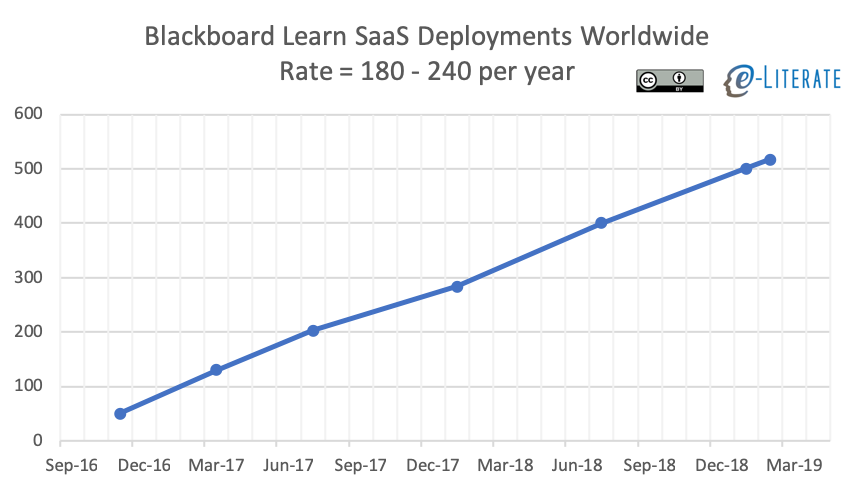
    Ballhaus went so far as to say that Blackboard’s improvements in client retention was the primary factor in the overall market slowdown last year. While we certainly feel that Blackboard has benefited from the slowdown and has improved client retention lately, we are not convinced on the cause and effect dynamics. By tracking the public proclamations of Learn SaaS adoptions, we see an interesting linear trend leading to the current ~25% of Learn clients being on SaaS.

    Learn SaaS Adoptions Over Time

    Blackboard continued to present the importance of their broad product portfolio combined with their experience. Ballhaus stressed that the LMS is necessary but not sufficient as a strategy for the company. Blackboard management sees Blackboard at an inflection point in 2019 in a good way, and they stressed that their big focus will now be on data and analytics offerings. Remember this paragraph when we get to the Instructure update post.

    Early in February Blackboard announced what could be their biggest LMS win since we broke the news of University of Phoenix selecting Blackboard Learn Ultra in late 2015 (a migration that is scheduled to be complete by this summer). From the press release about Galileo Global and their 100,000+ student system:

    Blackboard today announced that Galileo Global Education, a leading international provider of higher education and Europe’s largest higher education group, will roll out Blackboard Learn with the Ultra experience as the common Learning Management System (LMS) for its network of 37 schools with 80 campuses across 10 countries. Blackboard Learn Ultra was selected over other cloud-based solutions for the ease of use, the powerful features, and the unparalleled level of support provided by Blackboard.

    On the surface, this is a big win for Blackboard, but the story comes with a caveat regarding its relevance to the LMS market. What was not shared during our call with Blackboard executives is that they share their private equity owner (Providence) with Galileo as described in late 2017.

    Laureate Education, Inc. (NASDAQ:LAUR), the world’s largest global network of higher education institutions, and Galileo Global Education, a company under the umbrella of Providence Equity, a leading global asset management firm, have signed an agreement for the sale of Laureate’s institutions in Italy and Cyprus for a total transaction value of Euro 225 million (USD 263 million at the current exchange rate).

    Two or three schools within Galileo were already on Blackboard Learn, a few on Moodle, and the majority on Homegrown or not really using an LMS previously. Unless we can get independent confirmation about the nature of the selection (was it truly competitive or was it earmarked for Blackboard as long as they met minimum requirements), I would not extrapolate this news to show broader movements in the market.

    Blackboard also presented some data around roughly 200 new LMS customer acquisitions in 2018 (“new logos”) for both Open LMS (the rebranded Moodlerooms) and Learn.

    • The majority of the reported wins, roughly 120 based on interview, are for Open LMS, showing continued growth for this under-the-radar Blackboard product. These numbers are impressive, but we note that last year the company reported 223 Moodlerooms “new logos” in 2017. It will be interesting to track over time if this deceleration is primarily driven by the general market slowdown vs. fallout from the cancelled Moodle Partner agreement.
    • For the Learn LMS, Blackboard is reporting ~80 new logos in 2018, of which 52% are in higher education. If accurate, this would be a significant turnaround for the company; however, our data do not show this level of new wins for Blackboard unless you include Galileo as roughly 30 “new logos”. We asked Blackboard to back up that number with specifics such as sample listings to see if we have holes in our data, but Blackboard declined to provide further information due to “privacy reasons”. During the same time period, according to our data, Blackboard has lost more than 100 institutions, more than three fourths moving to Canvas and the remainder moving to D2L Brightspace.

    In the end, Blackboard is making steady progress with Learn SaaS deployments and contract extensions, benefiting from the LMS market slowdown, and winning their biggest new LMS account since 2015. We are not convinced that Blackboard is causing the slowdown or that their new Learn momentum goes beyond Galileo Global, but there are signs of progress worth sharing.

    Update 2/27: Fixed description of CashNet and Transact, which are part of the same business line, and added footnote.

  • Is Microsoft or Google your next LMS? The view from BETT

    Is Microsoft or Google your next LMS? The view from BETT

    The following is a guest post from Jason Cole, a longtime colleague and freelance consultant who recently moved back to London. Previously, Jason was Vice Chancellor for IT at the Peralta Community College District, and before that was CEO and Board Chair at Remote-Learner. [ed]

    I recently spent a day at BETT (formerly known as the British Educational Training and Technology show), the UK’s largest educational technology show. The show tends to skew towards the primary and further education market (k-12 and community college in the US), but there is also significant higher education presence. If you are looking for a US equivalent, its more akin to ISTE than EDUCAUSE.

    For those who haven’t been to BETT, it can be a bit overwhelming. There are over 34,000 attendees and 900 exhibitors from 138 countries. The massive show floor hosts everyone from national trade organizations from Denmark, Spain, UAE and Egypt to little ed tech startups that will probably evaporate in a few years.

    Everything is in one giant exhibition hall, with auditoriums scattered amongst the vendor booths. You can hear the noise of the conference space everywhere, even in the main event auditorium.

    For all of the activity, what was noticeable was the absence of the major LMS vendors besides Instructure Canvas. The company sponsored talks and roundtable lunches, but it didn’t have a traditional marketing booth. Their presence and sponsorship, however, meant they were the only LMS vendor anyone was talking about. D2L, Moodle, the UK Moodle partners, and Blackboard had no discernible presence. WebAnywhere is now focused on the SchoolJotter product and corporate Totara market. Synergy had small table in the back with one small Moodle Partner badge. Why – is BETT just a bad bet for lead generation and branding for the LMS providers? The large schools presence may mean less traffic for the higher ed (HE) focused LMS providers. But there are HE attendees, and Moodle had a strong schools presence. Some might argue the limitations of GDPR make lead generation difficult in European shows, but the presence of 900 exhibitors seems to imply there is some return on investment.

    On the other side of the spectrum, Google and Microsoft had large crowds in their large multi-plot booths. Each company had case study talks by users, how-to’s for teachers, and partner ecosystem mini-booths. Most of the hands-on presentations by these two tech giants were near capacity when I checked in throughout the day, as were most of the case study discussions.

    Every presentation in the Microsoft booth had real-time captioning displayed directly above the slides, and every presentation had real-time translation into multiple languages. Microsoft is obviously confident in both services, and from what I could see these services were remarkably accurate.

    It may have been the (AI-recommended) Microsoft Kool-aid ((Somehow an AI tied to a screen with a camera judged my reactions to three pictures, and estimated my age and gender and then labelled me an “Empowerer”. It’s recommendation was a rather refreshing apple cucumber drink with Spirulina distributed for free by two attendants. I have no idea why empowerers need cucumber, nor was there any falsifiable alternatives to getting a different flavour. Would the Innovator beverage make me more creative? Ah, the joys of inscrutable machine logic!)), but it appears Google and Microsoft are edging their way into the LMS space. Their presence at a K-12 focused show suggests they are finding traction at the younger grades. But as their education offerings grow in sophistication, and their ecosystem advantages start to accelerate, I believe a more concerted push in the higher ed space is inevitable.

    When Microsoft makes their push, the learning system won’t look like an LMS, but it will look like Teams. Teams is Microsoft’s central communication application for business, rolling in Skype and other business lines. There is an education version for teachers. Students with courses in Teams access their materials, communicate with the instructor and each other, and collaborate using Office and other tools online.

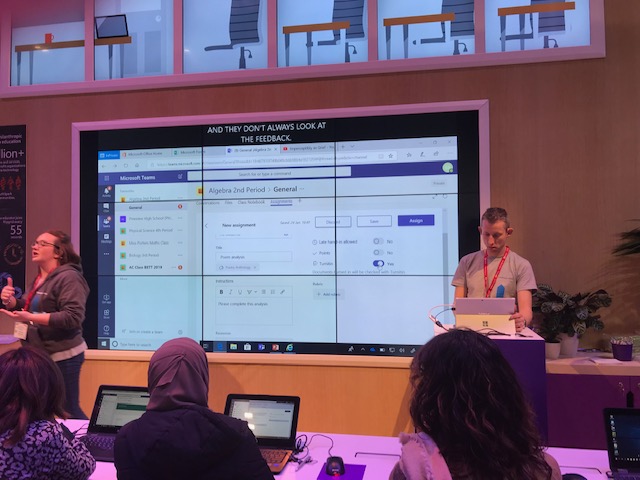
    View of Microsoft Teams demo

    The early indicator of Microsoft’s intent is their recently released Assignments for Teams for Education. Assignments gives teachers an easy to use tool to create either quizzes (using Forms) or submissions (using the Office suite). The student work can be graded using either a straight score or a rubric. Students see the results in their Teams, and teachers can download the grades for all the Assignments to Excel. It’s an interesting feature that signals a definite intent from Microsoft to meet the needs of teachers in the education version.

    Teams is not ready to replace or compete with the LMS yet, but it isn’t terribly far away. The Teams interface for classrooms needs some reorganization, it needs a centralized grade book that isn’t reliant on export to Excel, and it needs a slightly better authoring experience to combine the features together in learning modules. Teams and Sharepoint would also need a clear content strategy enable integration with publisher tools and content. But none of these challenges are impossible, and some Microsoft partners already have pieces of the solution.

    The ecosystem around Teams and Office will give Microsoft an increasingly interesting story. Microsoft is rapidly integrating service platforms for email, calendar, business logic, business intelligence, AI, device management, and cloud services into the Teams platform. There is enormous potential for educational organizations to leverage these capabilities to deliver a unified student experience. The “learning management” features move into the background, while students interact with a single application and message flow.

    While the potential is there, there are a few hurdles on the way. Moving into the learning and teaching side of the HE market requires a different channel strategy than the current focus on the productivity and infrastructure side of the house. Microsoft relies on a combination of direct account management and partner sales in a complex selling process. The Microsoft partners who would need to engage in the sales process and own customer relationship tend not to have academic sales experience, nor do they have the brand recognition of Canvas, Moodle, D2L and Blackboard among faculty. Given the sales costs and margins, a higher education focused Microsoft partner would have difficulty achieving scale. I would watch for more bottoms up adoption, pressure from students coming to HE from Google and Microsoft schools, and adoption outside of the traditional HE context as early indicators of a market shift.

    Other observations:

    • By sheer number of vendors, apparently every school in the EU is going to have a robotics lab and a maker space in the next few years. Lots of Arduino, 3D printers, and so… many… robots.
    • A few VR and AR vendors were making a splash (and inducing large scale motion sickness) with headsets and learning simulations.
    • Newton Rooms, modular, pre-packaged hands on science learning rooms, designed in Norway are one of my new favourite things.
  • State of Higher Ed LMS Market for US and Canada: 2018 Year-End Edition

    State of Higher Ed LMS Market for US and Canada: 2018 Year-End Edition

    This is the eleventh year I have shared the LMS market share graphic, commonly known as the squid graphic, for US and Canadian higher education. This past year we at e-Literate shifted our LMS Market Analysis reports from Spring / Fall to Mid-Year / End-of-Year to better allow analysis of entire years. With the release of our end-of-2018 report last week to subscribers, it’s time for us to look at updates on the institutional LMS market for North America (US and Canada) higher education. Note that our coverage for the market analysis includes Europe, Latin America, Oceania (Australia, New Zealand, and surrounding island countries) as well as emerging coverage of the Middle East.

    We present the following data “by institutions”, with market share as a percentage of the total number of institutions using each LMS as a primary system, and “by enrollments”, where we scale the institutions by its total enrollment. The latter better captures the business of the LMS market, since most licensing deals are based the number of students.

    But first, let’s look at an updated LMS market share graphic, commonly known as the squid graphic, for US and Canadian higher education. The original idea remains – to give a picture of the LMS market in one page, highlighting the story of the market over time. The key to the graphic is that the width of each band represents the percentage of institutions using a particular LMS as its primary system.

    Higher ed LMS market share for US and Canada, January 2019

    This year there are two inter-related trends that deserve a broader explanation -the LMS market slowed down with less activity overall, and Canvas and Blackboard continue to be neck-and-neck in the top spot of this market.

    We recently described the overall market activity slowdown in that there are fewer LMS formal evaluations taking place since mid 2018, with initial data pointing to a 20 – 25% drop from a year earlier. This slowdown seems to be a type of plateau rather than a continuing trend, and we are watching to see if it is temporary or not.

    Last summer we shared the symbolic passing of the torch where Canvas surpassed Blackboard in US market share, which was the first time Blackboard was not the top system since the market emerged two decades ago. What is interesting is that half a year later, the two systems are still neck-and-neck. In the US Canvas is still slightly ahead, and in North America (adding in Canada), Blackboard remains in the top spot by 0.4% (26.8% to 26.4%). Why is Canvas not continuing to extend its lead? Looking at the underlying data, there seems to be three reasons to consider:

    • The overall market slowdown means that there are fewer deals for Canvas to win lately.
    • Blackboard continues its University of Phoenix implementation, which still includes dozens of campuses despite its enrollment drop.
    • The shutdown in December of the for-profit Education Corporation of America (Virginia College and Brightwood College systems) meant that Canvas lost several dozen campuses.

    The latter two points should fully play out in the next three months, possibly making this a one-time change in trends, but it is important to call this situation out.

    Some other notes:

    • The market continues to consolidate around the Big Four – Blackboard, Canvas, D2L Brightspace, and Moodle.
    • The Homegrown option for LMS usage is going away, at least in a statistical sense. Only a handful of schools even consider this option.
    • D2L shares the challenge of having picked up several large for-profit systems that are closing campuses and therefore hurting market share. In D2L’s case, the biggest one is the former EDMC schools – the Art Institutes, Argosy University, and South University – that were sold out of bankruptcy to a non-profit entity and have closed dozens of campuses over the past year. These losses offset many of D2L’s wins in 2018.
    • Moodle had a few new wins in North America.

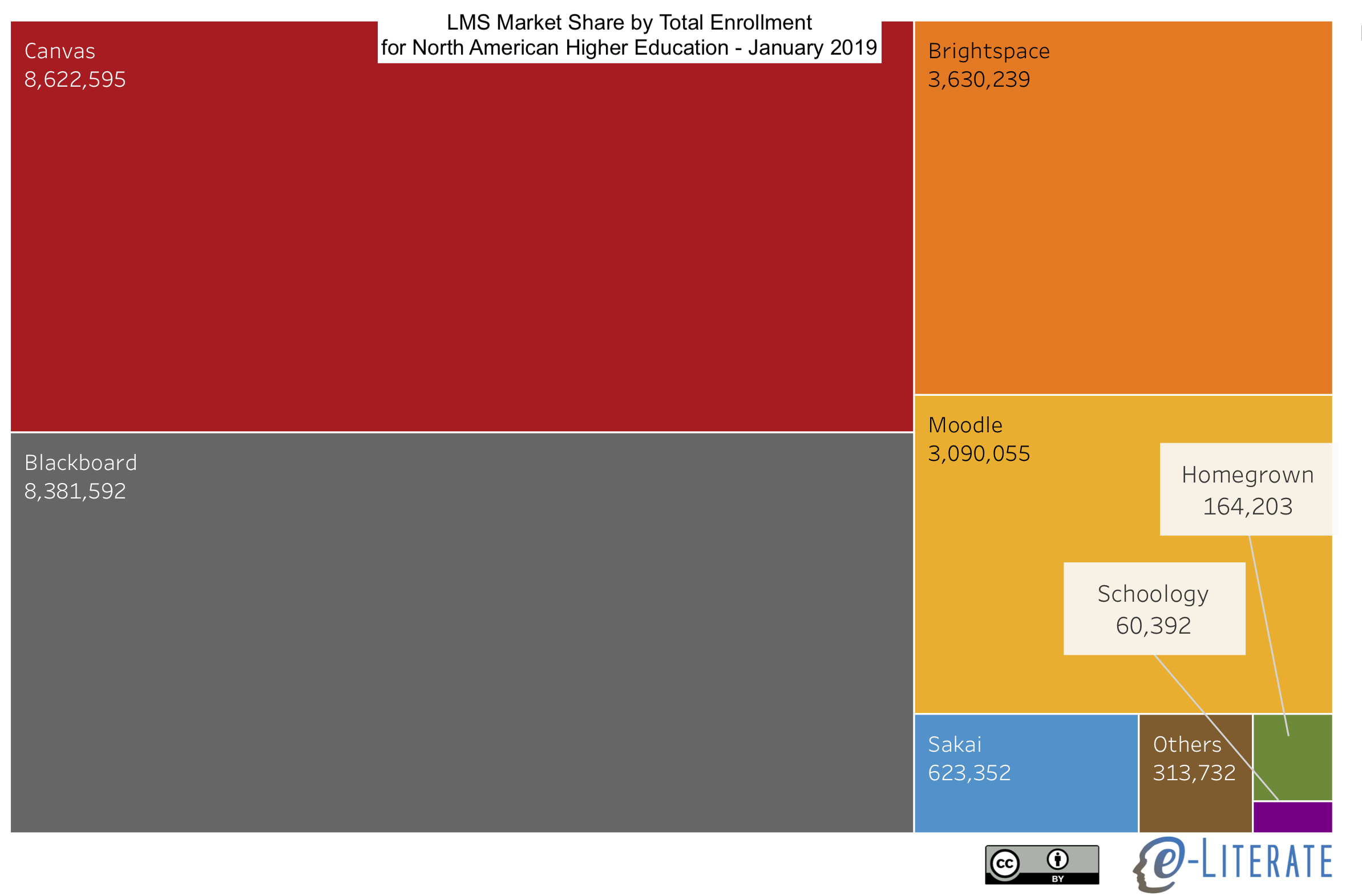
    Sticking with North America, we can also show LMS market share scaled by the enrollment of each institution, giving a different measure worth considering.

    NA LMS Market Share by Enrollment

    We’ll share more information on other global regions in the coming months.

  • Contrasting LMS Adoption Patterns in Four English-Speaking Countries

    Contrasting LMS Adoption Patterns in Four English-Speaking Countries

    The article is Cross-posted at LISTedTECH.

    One of the trends we have been covering is the gradual consolidation of global LMS markets in higher education around “the Big Four”, Moodle, Blackboard, Canvas, and D2L Brightspace. While there are market similarities in terms of this consolidation along with the broader move to the cloud, it would be a mistake to view various global regions as having the same same trends overall, even in a subset of English-speaking countries.

    By taking a step back and looking at institutional market share per country per year since 2000 (i.e. the percentage of higher education institutions having a particular LMS as their primary system), different adoption patterns become more apparent. In this case we’re looking at Australia / New Zealand (see note below), the United Kingdom, the US, and Canada. Note ahead of time that Blackboard acquired WebCT in 2004 and ANGEL in 2009 – this view separates out the product lines regardless of ownership, thus “Blackboard” means “Blackboard Learn / Academics Suite”. Also note that his is just one subset of the global market intended to show different patterns.

    Historical LMS adoption in US, Canada, UK, Australia & New Zealand

    • While the very early market was practically a duopoly, the preference for WebCT vs. Blackboard varied significantly.
    • Australia and New Zealand have a rich history of homegrown LMS development, including CECIL (University of Auckland in New Zealand), which some argue was the very first web-based LMS. There was still quite a bit of Homegrown LMS activity in the early 2000s along with a strong early preference for WebCT over Blackboard. Australia is the home country for Moodle (Perth), yet it lagged the UK in terms of late 2000s adoption of that system.
    • The UK showed a preference for Blackboard over WebCT, while also having significant Homegrown LMS adoptions early in the 2000s. Starting in 2003 we see the most rapid shift towards Moodle of any of these four countries, followed by a more recent move towards Canvas starting in 2013, starting with the Birmingham University adoption.
    • Canada is the home country for both WebCT (Vancouver, British Columbia) and D2L Brightspace (Kitchener, Ontario), and accordingly we see the highest percentages for both systems. This country also shows the slowest market gains for Canvas compared to the other three. Overall, early in the market, Homegrown solutions were much more common.
    • The US – home country to Blackboard, Pearson, Canvas, and Sakai –  is seen as an outlier by not having Moodle as the dominant system in terms of installed base. Pearson LearningStudio, formerly eCollege, was quite important in the US market, largely due to its position in the for-profit sector. And this is the leading country in terms of Canvas installed base and growth.

    There are other patterns to see in the data, but the overall point is to note how different adoption patterns can be in the LMS market, even for a subset of English-speaking countries since 2000. ((Disclosure: Blackboard, D2L, Moodle HQ, Instructure are all subscribers to our LMS Market Analysis service.))

    Update 27 Nov: We have duplicated the x axis to show on both levels for clarify. The data is based on number of institutions and represent running totals of active implementations where we have implementation / decommission dates – approximately 75% of all known active systems. The current totals used for each country are approximately 200 for Australia, 250 for Canada, 700 for the UK, and 3,500 for the US.

    Update 30 Nov: In an embarrassing mistake I credited CECIL to Australia when it was based at the University of Auckland in New Zealand. We have since updated the graphic to include both countries combined and edited the description of that region’s Homegrown activity. The article now combines Australia and New Zealand and treats as one country for the purposes of this analysis.

  • North American Higher Ed LMS Market Share by Enrollments: A consolidating market

    North American Higher Ed LMS Market Share by Enrollments: A consolidating market

    We have published market share data measured by total institutional enrollment instead of institutional count in several posts at e-Literate over the years, within the twice-annual reports of our LMS Market Analysis service, and for several of our premium subscribers of the same service. In July of this year we reported that Canvas had overtaken Blackboard as the market leader in US higher education in terms of institutional adoptions as well as scaled by enrollment. These last two posts got a fair amount of media and vendor attention.

    What we have realized, however, is that we have not made this information on market share by enrollment easy to access in one place. LMS company revenue tends to be based on the total enrollment of adopting institutions, thus this enrollment-based measure provides a more direct connection to company finances. Given the increased importance of LMS provider business models and revenue to the future trends of the market, we are sharing the information more broadly.

    In this view below we share North American (US and Canada combined) total enrollment for LMSs that are primary – that is, available for the entire institution. Total enrollment in this case means the institutional student count, but it does not imply that all students at that institution actually have courses using the LMS (see comment below from John Fritz). It is important to note that during an LMS transition there is often a period of time (6 – 18 months) where two systems overlap, with both available to the school. Therefore the total market share enrollments will be somewhat higher than actual total enrollments, as a subset of LMS-transitioning institutions will be counted twice.

    You can download a spreadsheet version here.

    LMS Market Share by Enrollment NA HE

    Some notes on the data worth considering:

    • Canvas has not just surpassed Blackboard Learn in this updated view, 35% to 33% – it has also expanded its lead as the most-adopted LMS in North American higher ed markets (while Moodle has clear lead worldwide in total installed base).
    • D2L Brightspace has been in third place for NA HE markets since 2016 when viewing by enrollments.
    • Moodle is fourth and has been dropping in recent years.
    • The top view of total enrollments adds in the effect of changing enrollments – both at a national level and an institutional level.
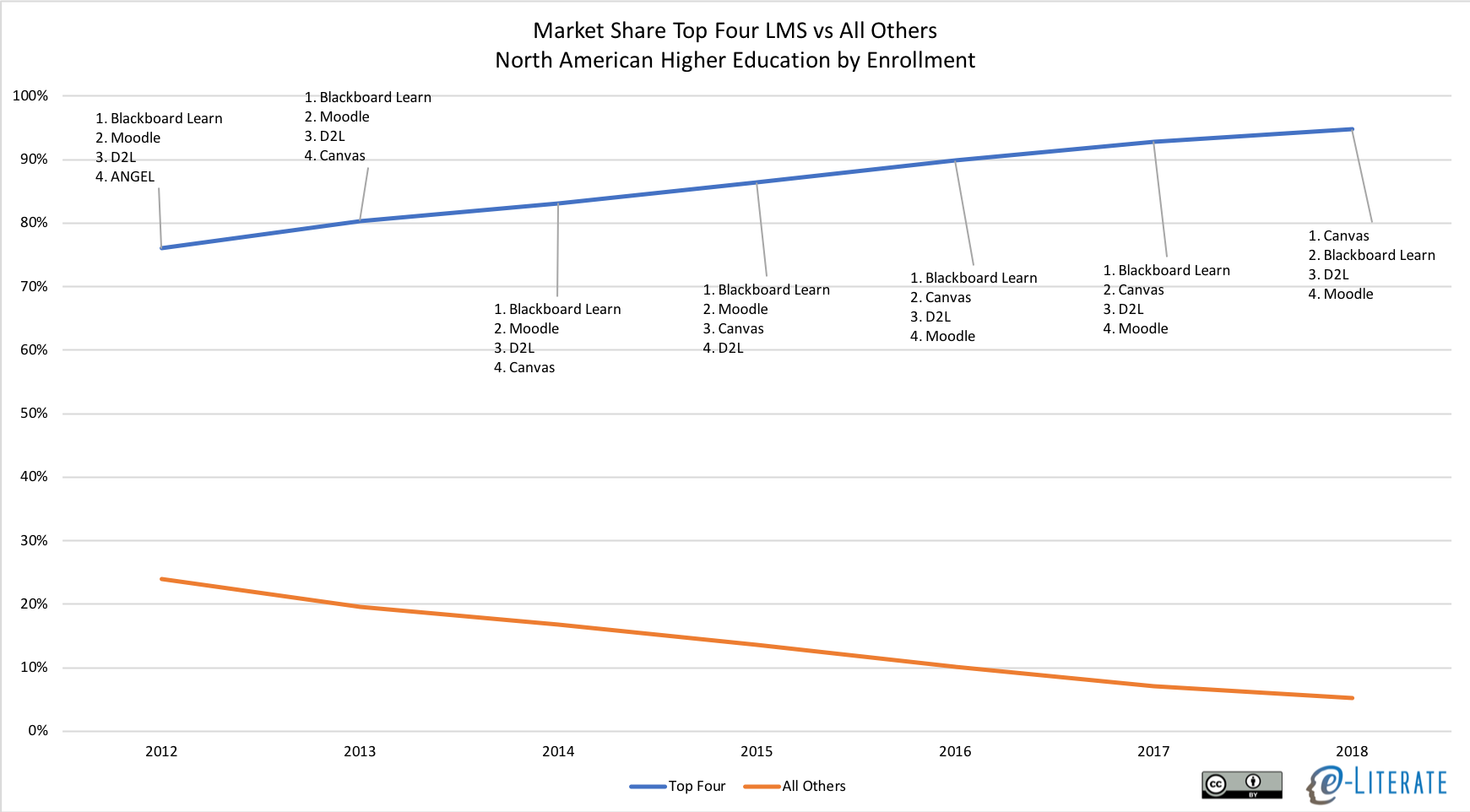
    • In the past five years, the LMS Market for North American higher ed has become increasingly dominated by “the Big Four” (Instructure Canvas, Blackboard Learn, D2L Brightspace, Moodle) for institution-wide adoptions; the aggregate market share of year’s top four systems moving from 80% to 95% in past five years.

    This last point deserves more analysis. There are other systems gaining new institutional clients (think Schoology here, or think CBE-specific platforms like Motivis), but they are mostly picking up either small schools or being adopted for specific programs and not for the entire institution.

    Consolidation of NA HE LMS Market

    Expect more coverage as we enter ed tech fall conference season.

    Update 8/3: Added sentence in third paragraph to clarify usage of total enrollment terminology.