
e-Literate

Present is Prologue

Tag: Blackboard

  • Comparing Fully-Online vs Mixed-Course Enrollment Data

    Mike Caulfield wrote a post yesterday about a new Blackboard report on design findings regarding online students. The focus of Mike’s post was that people often assume that the norm for an “online” student is taking all courses online, when in fact it is more common for students to take some courses online and some face-to-face (what Mike calls “Mixed-Course”). This distinction is important:

    What shocks some people reading this, I think, is that online students would have face-to-face courses as a comparison or option, or that they would be consciously choosing between online and face-to-face in the course of a semester. But this is the norm now at state universities and community colleges; it’s only a secret to people not in those sorts of environments.

    I agree that this is an important topic, so let’s look at the data in more detail (and for those wondering if you can connect to Tableau Public to edit online data visualizations while flying, the answer is yes if you’re patient). The best source of information is the IPEDS database, with the most recent data for Fall 2014. WCET put out an excellent report analyzing the distance education data in IPEDS – more on that later. Both IPEDS and WCET use the term “Some but not all” in the same manner as “Mixed-Course”. Based on overall data combining undergraduate and graduate students, Mike is right that more students are Mixed-Course than they are Fully-Online – 2.926 million vs. 2.824 million. (more…)
  • Previous LMS For Schools Moving to Canvas in US and Canada

    During the most recent quarterly earnings call for Instructure, an analyst asked an interesting question (despite starting off from the Chris Farley Show format).

    Corey Greendale (First Analysis Securities Corporation):  Awesome. A couple of other things on the, primarily on the Higher Ed space but I guess on education space, there’s a whole lot of couple questions about the competitive environment. When you’re and I don’t know if you will ever get into this level of granularity but when you got competitive wins against the Blackboard, are those predominantly from legacy ANGEL, are you getting those wins as much from Learn as well.

    Josh Coates (CEO of Instructure):  A lot of them are from Learn. Most, you know I don’t have the stats right off the top of my head. A lot of the ANGEL and WebCT stuff is been mopped up in the previous years and so, what’s left the majority of what’s left is Learn and our win rate against Blackboard it continues to be incredibly high, not just domestically but internationally as well.

    In fact, I think most of three out of the four international schools that we announced in this earnings where Blackboard Learn replacements, so yes Learn’s getting it.

    The question gets to the issue of whether Canvas is just picking up higher education clients coming off of discontinued LMSs (Angel, WebCT, etc) or if they are picking up clients from ongoing platforms such as Blackboard Learn. Beyond the obvious interest of investors and other ed tech vendors, this issue in general affects higher education institutions going through a vendor selection – for the system in consideration, are there many other schools considering the same migration path?

    Thanks to the work we’ve been doing with LISTedTECH and our new subscription service, we can answer this question in a little more detail. One of the charts we share shows higher education migrations over the past five years in the US and Canada. (more…)

  • Blackboard CEO’s First 100 Days: Reorganization and Learn Ultra Updates

    Just over four years after Providence Equity Partners acquired Blackboard and three years after they brought in Jay Bhatt to replace co-founder Michael Chasen, the company hired Bill Ballhaus as its new CEO at the beginning of January. 100 days in, Ballhaus is starting to make changes to the organization and providing some insights into future corporate directions.

    The most significant change is a reorganization that combines strategy, product management and marketing in one group under Katie Blot. In an interview Michael and I had with Ballhaus and Blot earlier this week, they described the primary motivation for the organizational change as the need to more tightly align those functions. Also significant is that this change means the departure of Mark Strassman, SVP Product Marketing & Management, and Tracey Stout, SVP of Marketing & Sales Effectiveness. Blackboard provided the following statement. (more…)

  • State of Higher Ed LMS Market for US and Canada: Spring 2016 Edition

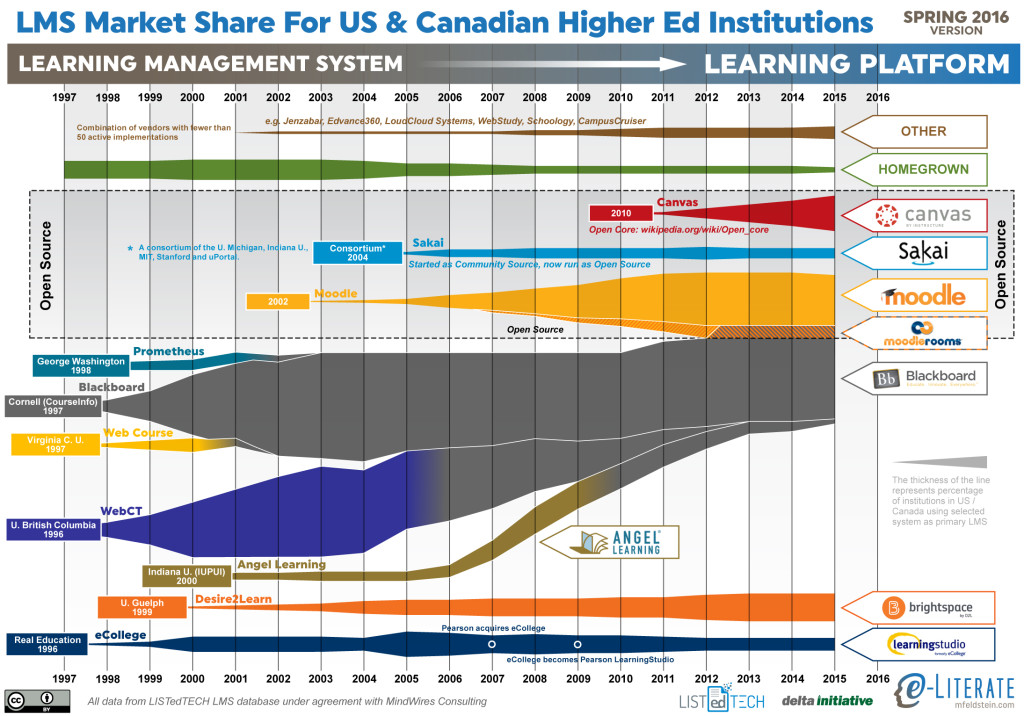
    This is the eighth year I have shared the LMS market share graphic, commonly known as the squid graphic, for (mostly) US higher education. The original idea remains – to give a picture of the LMS market in one page, highlighting the story of the market over time. The key to the graphic is that the width of each band represents the percentage of institutions using a particular LMS as its primary system.

    This year marks a significant change based on our upcoming LMS subscription service. We are working with LISTedTECH to provide market data and visualizations. This data source provides historical and current measures of institutional adoptions, allowing new insights into how the market has worked and current trends. This current graphic gets all of its data from LISTedTECH. Where previous versions of the graphic used an anchoring technique, combining data from different sources in different years, with interpolation where the data was unavailable. Now, every year’s data is based on this single data source.

    This graphic has been in the public domain for years, however, and we think it best to keep it that way. In this way we hope that the new service will provide valuable insight for subscribers but also improve what we continue to share here on the e-Literate blog.

    Since we have data over time now and not just snapshots, we have picked the end of each year for that data. For this reason, the data goes through the end of 2015. We have 2016 data but chose not to share partial-year results in an effort to avoid confusion.

    LMS_MarketShare_20160316

    A few items to note:

    • As noted in previous years, the fastest-growing LMS is Canvas. There is no other solution close in terms of matching the Canvas growth.
    • Blackboard continues to lose market share, although the vast majority of that reduction over the past two years has been from customers leaving ANGEL. Blackboard Learn lost only a handful of clients in the past year.
    • While the end-of-life occurs next year, Pearson’s has announced LearningStudio’s end-of-life for the end of 2017.
    • With the new data set, the rapid rise and market strength of WebCT becomes much more apparent than previous graphics.
    • There is a growing line for “Other”, capturing the growth of those systems with less than 50 active implementations as primary systems; systems like Jenzabar, Edvance360, LoudCloud Systems, WebStudy, Schoology, and CampusCruiser.
    • While we continue to show Canvas in the Open Source area, we have noted a more precise description as an Open Core model.

    For a better description of the upcoming LMS subscription service, read this post and / or sign up for more information here.

  • Wheaton College Selects Schoology As New LMS In Surprise Decision

    Schoology, a social cloud-based LMS known mostly used in the K-12 market, has set its sights on expanding into the higher education market using their recent $32 million funding round. Last January, Colorado State University’s Global Campus selected Schoology to replace Blackboard Learn, yet the market impact of this decision was limited, partially due to the non-traditional nature of the online-only campus. What Schoology has needed to gain more market credibility and awareness is a second set of higher ed institutions selecting Schoology in an open competition. Enter Wheaton College in Illinois, which recently selected Schoology as its new LMS. This is the most significant new selection that I have seen.

    I interviewed CIO Wendy Woodward from Wheaton to find out more on the nature of this decision. For context, Woodward became Wheaton’s CIO in January 2015, moving from her previous job at Northwestern University. Based on her listening tour to understand campus needs, the decision to replace the LMS was listed near the top of the list. Given Northwestern’s recent move to Canvas, Woodward related that there was a common assumption that Wheaton would do the same. The faculty committee fully went through the evaluation process, however, and ended up selecting Schoology after inviting responses from 10 different solutions. The campus has already begun pilots and plans to be fully migrated to the new system by Fall 2016. (more…)

  • After Customer Feedback And Further Delays, Blackboard Changes Learn Ultra Strategy For LMS

    A full seven months after BbWorld 2015, Blackboard has yet to move any new functionality for Learn Ultra from “in development” or “in research” to “available” according a new public webinar. That is, Learn Ultra is no further along from a customer delivery perspective than they were in July 2015, when they were already a year late. Furthermore, Blackboard promised at BbWorld 2015 that Learn Ultra would be available to all customers in technical preview mode by Fall 2015 and available for active pilots with students and course content by Spring 2016, yet I have talked to several of Blackboard’s best long-term customers who have no access to Ultra and no updates on plans. What is becoming clear is that Learn Ultra as originally envisioned will not be in General Availability by BbWorld 2016.

    I asked Blackboard for statements on the current Ultra status and was able to interview Mark Strassman, Senior VP of Product and Marketing,  late last week. Mark described that Blackboard has decided to change their product strategy based on selected customer feedback in technical preview. According to Strassman:

    Based on customer feedback on our Learn SaaS offering, we have evolved our strategy to make it easier for institutions to move to Learn SaaS and adopt Learn with the Ultra Experience. Later this year we will provide a new Ultra-inspired theme that customers can use with either Learn 9.1 or Learn SaaS with the Original Experience. This theme will give users of our current product an updated look-and-feel, and make it easier for them to deploy Learn Ultra, either standalone, or alongside existing courses in the Original Experience.

    What this means is that Learn 9.1 Original will start to look more like Ultra and Ultra will start to look more like 9.1 Original. Let’s unpack that statement a little. (more…)

  • LearningStudio and OpenClass End-Of-Life: Pearson is getting out of LMS market

    Pearson has notified customers that LearningStudio will be shut down as a standalone LMS over the next 2-3 years. Created from the Pearson acquisition of both eCollege and Fronter, LearningStudio has been targeted primarily at fully-online programs and associated hybrid programs – not for simple augmentation of face-to-face classes. The customer base has mostly included for-profit institutions as well as not-for-profit programs that are often packaged with an online service prover model (e.g. Embanet customers). As of this year, LearningStudio has approximately 110 customers with 1.2 million unique student enrollments.

    This decision is not one isolated to LearningStudio, as the end-of-life notification caps a series of moves by Pearson to get out of the LMS market in general. (more…)