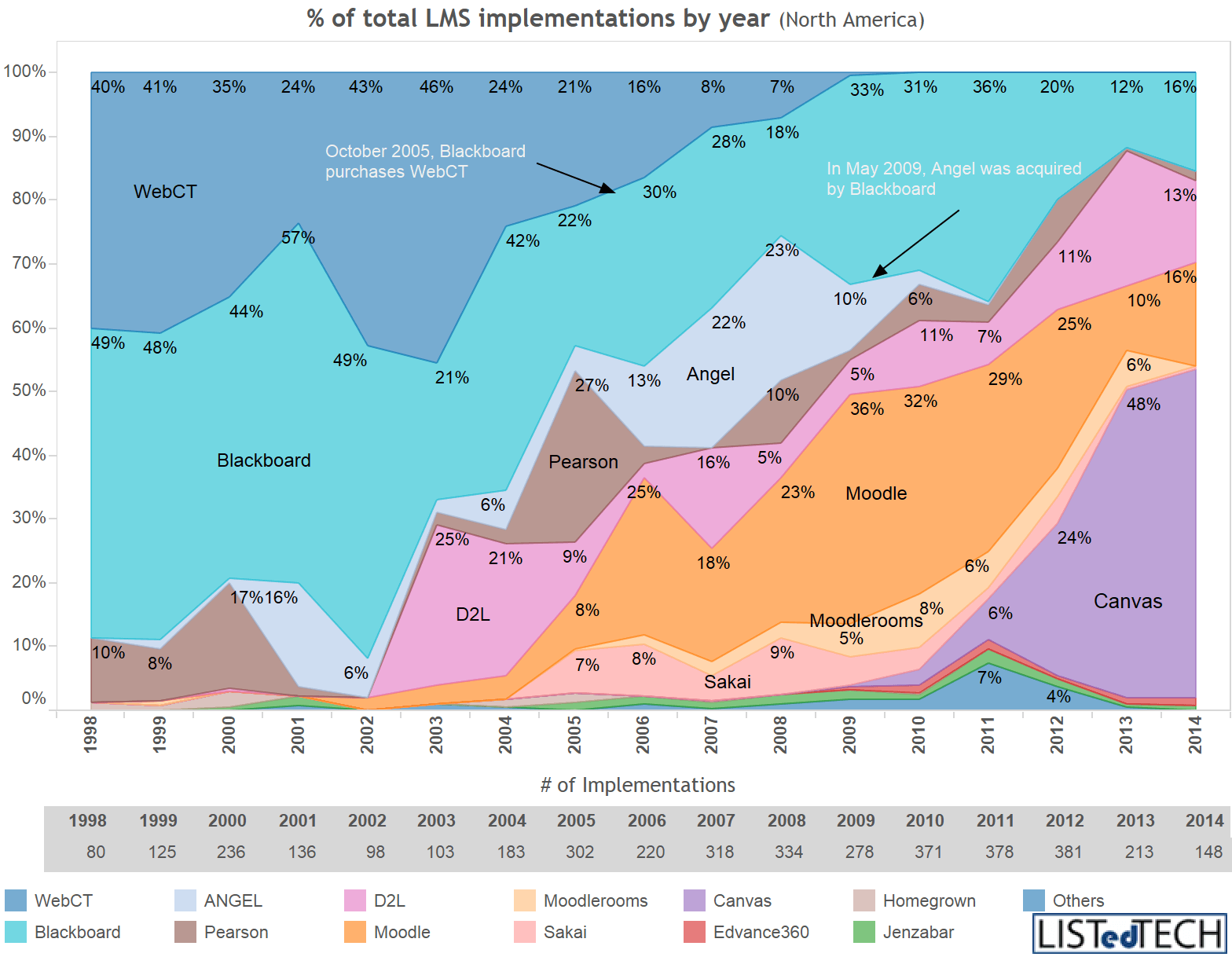
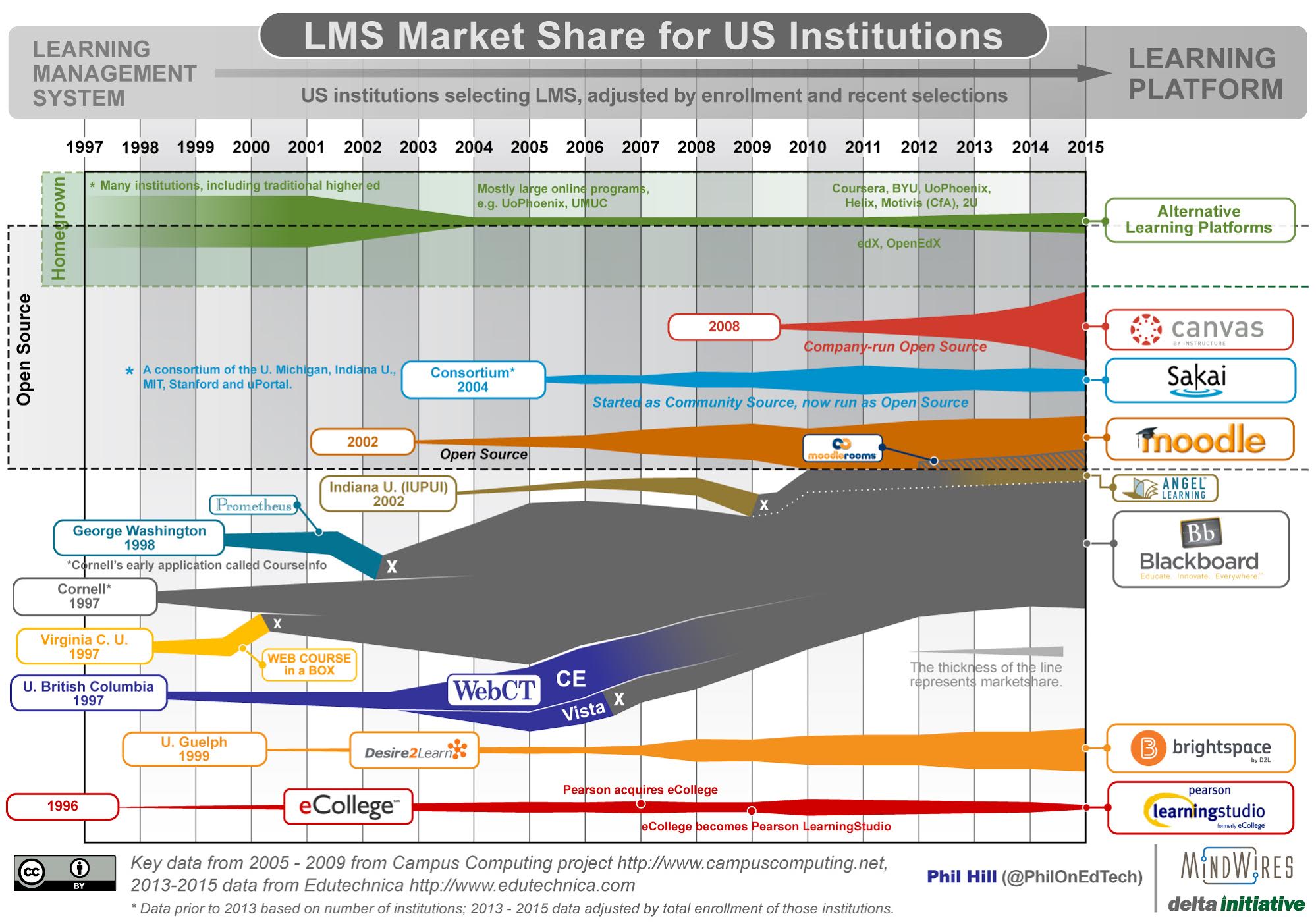
One year ago Blackboard’s strategy for Moodle was floundering. After the 2012 acquisition of Moodlerooms and Netspot, Blackboard had kept its promises of supporting the open source community – and in fact, Blackboard pays much more than 50% of the total revenue going to Moodle HQ ((This information based on tweet last spring showing Moodlerooms + Netspot combined were more than 50% of revenue, and that the next largest Moodle Partner, Remote-Learner, has left the program. Since last year I have confirmed this information through multiple sources.)) – but that does not mean they had a strategy. Key Moodlerooms employees were leaving, and the management was frustrated. Last fall the remaining Moodlerooms management put together an emerging strategy to invest in (through corporate M&A) and grow the Moodle business, mostly outside of the US.
In just the past twelve months, Blackboard has acquired three Moodle-based companies – Remote-Learner UK (Moodle Partner in the UK), X-Ray Analytics (learning analytics for Moodle), and Nivel Siete (Moodle Partner in Colombia). When you add in organic growth to these acquisition, Blackboard has added ~450 new clients using Moodle in this same time period, reaching a current total of ~1400.
This is a change worth exploring. To paraphrase Michael’s statements to me and in his recent BbWorld coverage:
If you want to understand Blackboard and their future, you have to understand what they’re doing internationally. If you want to understand what they’re doing internationally, you have to understand what they’re doing with Moodle.
Based on this perspective, I accepted an invitation from Blackboard to come visit Nivel Siete last week to get a first-hand view of what this acquisition means I also attended the MoodleMoot Colombia #mootco15 conference and talked directly to Moodle customers in Latin America. Let’s first unpack that last phrase.
- Note that due to the nature of this trip, I “talked directly” with Blackboard employees, Nivel Siete employees, Blackboard resellers, and Nivel Siete customers. They did give me free access to talk privately with whoever I wanted to, but treat this post as somewhat of an inside view rather than one that also includes perspectives from competitors.
- “Moodle” is very significant in Latin America. It is the default LMS that dominates learning environments. The competition, or alternative solution, there is Blackboard Learn or . . . another route to get Moodle. In this market D2L and Canvas have virtually no presence – each company has just a couple of clients in Latin America and are not currently a factor in LMS decision-making. Schoology has one very large customer in Uruguay serving hundreds of thousands of students. Blackboard Learn serves the top of the market – e.g. the top 10% in terms of revenue of Colombian institutions, where they already serve the majority of that sub-market according to the people I talked to. For the remaining 90%, it is pretty much Moodle, Moodle, alternate applications that are not LMSs, or nothing. ((Again, much of this information is from people related to Blackboard, but it also matches my investigation of press releases and public statements about specific customers of D2L and Instructure.))
- I chose “customers” instead of “schools” or “institutions” for a reason. What is not understood in much of the education community is that Moodle has a large footprint outside of higher ed and K-12 markets. Approximately 2/3 of Nivel Siete’s clients are in corporate learning, and several others are government. And this situation is quite common for Moodle. In the US, more than 1/3 of Moodlerooms’ and approximately 1/2 of Remote-Learner’s customers are corporate learning. Phill Miller, the VP of International for Moodlerooms, said that for most of the Moodle hosting and service providers he has met, they also are serving corporate clients at similar numbers as education.
- I chose “Latin America” instead of “Colombia” for a reason. While all but ~12 of Nivel Siete’s existing clients are in Colombia, Blackboard bought the company to act as a center of excellence or support service company for most of Latin America – Colombia, Mexico, Brazil, and Peru in particular. Cognos Online, their current local reseller for Latin America for core Blackboard products (Learn, Collaborate, etc) will become the reseller also for their Moodle customers. Nivel Siete will support a broader set of clients. In other words, this is not a simple acquisition of customers – it is an expansion of international presence.
And while we’re at it, the conference reception included a great opera mini flash mob (make sure to watch past 0:37):
Nivel Siete
Nivel Siete (meaning Level 7, a reference from two of the founders’ college days when a professor talked about need to understand deeper levels of the technology stack than just top-level applications that customers see), is a company of just over 20 employees in Bogota. They have 237+ clients, but that is growing. During the three days while I was there they signed several new contracts. They offer Moodle hosting and service in a cloud environment based on Amazon Web Services (AWS) – not true SaaS, as they allow multiple software versions in production and have not automated all provisioning or upgrade processes. What they primarily offer, according to the founders, is a culture of how to service and support using cloud services and specific marketing and sales techniques.
In Latin America, most customers care more about the local sales and support company than they do about the core software. As one person put it, they believe in skin-to-skin sales, where clients have relationships they trust as long as solutions are provided. Most LMS customers in Latin America do not care as much about the components of that solution as they do about relationships, service, and price. And yet, due to open source software and lightweight infrastructure needs, Moodle is dominant as noted above. The Moodle brand, code base, and code licensing does not matter as much as the Moodle culture and ecosystem. From a commercial standpoint, Nivel Siete’s competitors include a myriad of non Moodle Partner hosting providers – telcos bundling in hosting, mom-and-pop providers, self-hosting – or non-consumption. For a subset of the market, Nivel Siete has competed with Blackboard Learn.
Beyond Cognos Online, Blackboard has another ~9 resellers in Latin America, and Nivel Siete (or whatever they decide to name the new unit) will support all of these resellers. This is actually the biggest motivation other than cash for the company to sell – they were seeking methods to extend their influence, and this opportunity made the most sense.
Blackboard Learn and Ultra
What about that Learn sub-market? Most clients and sales people (resellers as well as Blackboard channel manager) are aware of Learn Ultra, but the market seems to understand already that Ultra is not for them . . . yet. They appear to be taking a ‘talk to me when it’s done and done in Spanish’ approach and not basing current decisions on Ultra. In this sense, the timing for Ultra does not matter all that much, as the market is not waiting on it. Once Ultra is ready for Latin America, Blackboard sales (channel manager and resellers) expect the switchover to be quicker than in the US, as LMS major upgrades (involving major UI and UX changes) or adoptions tend to take weeks or months instead of a year or more as we often see in the states. At least in the near term, Learn Ultra is not a big factor in this market.
What Blackboard is best known for in this market is the large SENA contract running on Learn. SENA (National Service for Learning) is a government organization that runs the majority of all vocational colleges – providing certificates and 2-year vocational degrees mostly for lower-income students, a real rising middle class move that is important in developing countries. Blackboard describes SENA as having 6+ million total enrollment, with ~80% in classrooms and ~20% in distance learning.
Integration
The challenge Blackboard faces is integrating its Learn and Moodle operations through the same groups – Nivel Siete internal group, Cognos Online and other resellers serving both lines – without muddling the message and go-to-market approach. Currently Learn is marketed and sold through traditional enterprise sales methods – multiple meetings, sales calls, large bids – while Nivel Siete’s offering of Moodle is marketed and sold with more of a subscription-based mentality. As described by ForceManagement:
A customer who has moved to a subscription-based model of consumption has completely different expectations about how companies are going interact with them.
How you market to them, how you sell to them, how you bill them, how you nurture the relationship – it’s all affected by the Subscription Economy. The customer’s idea of value has changed. And, if the customer’s idea of value has changed, your value proposition should be aligned accordingly. [snip]
The subscription-based sales process relies less on the closing of a sale and more on the nurturing of a long-term relationship to create lifetime customer value.
One of Nivel Siete’s most effective techniques is their The e-Learner Magazine that highlights customer telling their own stories and lessons in a quasi-independent fashion. The company has relied on inbound calls and quick signups and service startups. There is quite a cultural difference between enterprise software and subscription-based approaches. While Blackboard themselves are facing such changes due to Ultra and newly-offered SaaS models, the group in Latin America is facing the challenge of two different cultures served by the same organizations today.
To help address this challenge, Cognos Online is planning to have two separate teams selling / servicing mainline Blackboard products and Moodle products. But even then, CEO Fernery Morales described that their biggest risk is muddling the message and integrating appropriately.
Moodle Strategy and Risk
At the same time, this strategy and growth comes at a time where the Moodle community at large appears to be at an inflection point. This inflection point I see comes from a variety of triggers:
- Blackboard acquisitions causing Moodle HQ, other Moodle Partners, and some subset of users’ concerns about commercialization;
- Creation of the Moodle Association as well as Moodle Cloud services as alternate paths to Moodle Partners for revenue and setup; and
- Remote-Learner leaving the Moodle Partner program and planning to join the Moodle Association, with its associated lost revenue and public questioning value.
I don’t have time to fully describe these changes here, but Moodle itself is both an opportunity and a risk mostly based on its own success globally. More of that in a future post.
What Does This Mean Beyond Latin America?
It’s too early to fully know, but here are a few notes.
- Despite the positioning in the US media, there is no “international” market. There are multiple local or regional markets outside of the US that have tremendous growth opportunities for US and other companies outside of those immediate markets. Addressing these markets puts a high premium on localization – having feet on the ground for people who know the culture, can be trusted in the region, and including product customizations meant for those markets. Much of the ed tech investment boom is built on expectations of international growth, but how many ed tech companies actually know how to address local or regional non-US markets? This focus on localizing international markets is one of Blackboard’s greatest strengths.
- Based on the above, at least in Latin America Blackboard is building itself up as being the status quo before other learning platforms really get a chance to strategically enter the market. For example, Instructure has clearly not chosen to go after non English-speaking international markets yet, but by the time they do push Canvas into Latin America, and if Blackboard is successful integrating Nivel Siete, for example, it is likely Instructure will face an entrenched competitor and potential clients who by default assume Moodle or Learn as solutions.
- Blackboard as a company has one big growth opportunity right now – the collection of non-US “international” markets that represent just under 1/4 of the company’s revenue. Domestic higher ed is not growing, K-12 is actually decreasing, but international is growing. These growing markets need Moodle and traditional Learn 9.1 much more than Ultra. I suspect that this growing importance is creating more and more tension internal to Blackboard, as the company needs to balance Ultra with traditional Learn and Moodle development.
- While I strongly believe in the mission of US community colleges and low-cost 4-year institutions, in Latin America the importance of education in building up an emerging middle class is much greater than in US. We hear this “importance of education” and “building of middle class” used in generic terms regarding ed tech potential, but seeing this connection more closely by being in country is inspiring. This is a real global need that can and should drive future investment in people and technology to address.