e-Literate

Present is Prologue

Tag: Blackboard

  • State of Higher Ed LMS Market for US and Canada: Spring 2017 Edition

    State of Higher Ed LMS Market for US and Canada: Spring 2017 Edition

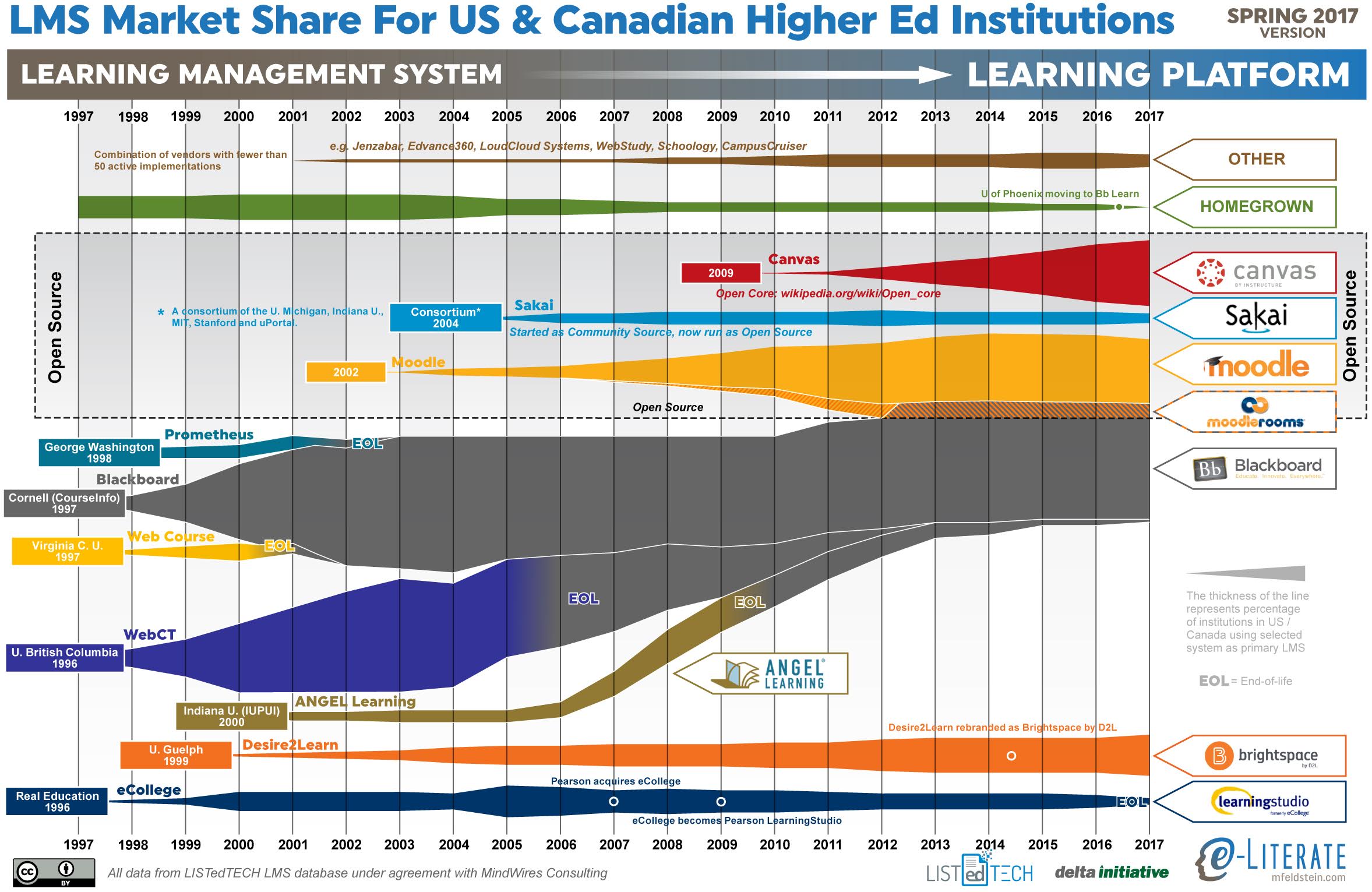
    This is the ninth year I have shared the LMS market share graphic, commonly known as the squid graphic, for US and Canadian higher education. The original idea remains – to give a picture of the LMS market in one page, highlighting the story of the market over time. The key to the graphic is that the width of each band represents the percentage of institutions using a particular LMS as its primary system.

    Last year we made a big shift based on our LMS market analysis service – we are working with LISTedTECH to provide market data and visualizations. This data source provides historical and current measures of institutional adoptions, allowing new insights into how the market has worked and current trends. Our spring report for subscribers will be released this month. Data for 2017 goes through April 1 of this year.

    (more…)

  • Recommended Reading: Signs of Restraint in the Analytics Hype Machine

    Recommended Reading: Signs of Restraint in the Analytics Hype Machine

    Mike Sharkey’s recent post on the Blackboard blog site, “Analytics isn’t a thing,” triggered by an epiphany he had while reading the latest NMC Horizon Report, suggests that we might finally be seeing a maturation in the much-hyped analytics space. Rather than viewing analytics as a product category in and of itself, Mike concludes that the market is finally embracing analytics as a tool that can help solve discrete problems in specific situations. He writes:

    “My point is that we shouldn’t be “selling analytics” and customers shouldn’t be looking to “buy analytics.” Analytics isn’t a thing. Analytics help solve problems like retention, student success, operational efficiency, or engagement.”

    (more…)

  • Vert Capital and Scriba Corp: Institutions losing course data in company’s death throes

    Vert Capital and Scriba Corp: Institutions losing course data in company’s death throes

    After last year’s disastrous outage at UC Davis due to Scriba Corp’s change of data center for the Sakai LMS (branded as SmartSite at UC Davis), it turns out that there is more damage to be done as the company slowly disappears. What appears to have happened in the past few months is that Scriba has not been paying this new data center provider (IO Data Centers), and that company is withholding the data on its servers until the issue is resolved. The end result is that several remaining Scriba customers have lost not just a live Sakai site but also the underlying current and historic course data. In at least one case, this dispute has caused a distance education program to be halted until the school figures out how to set up a new LMS site and to recreate their course content.

    Based on two people familiar with Scriba’s recent operations, despite several remaining schools continuing to pay hosting fees, Scriba was not fully paying IO Data Centers. While I have no information on whether there was a legitimate complaint or whether this was simply non-payment to save cash while Scriba died, I will point out that last Spring Scriba’s contract with the Apereo Foundation to remain a commercial affiliate was cancelled under similar circumstances. Scriba simply stopped paying Apereo until the foundation’s board voted to terminate their contract. (more…)

  • Ellucian Stops Support for Brainstorm, its CBE platform

    Ellucian Stops Support for Brainstorm, its CBE platform

    In a surprise move, Ellucian has decided to end support for Brainstorm, the competency-based education (CBE) platform it acquired from Helix Education two years ago. All Brainstorm customers are being notified of the end-of-life and aggressive measures are being used to help these customers quickly migrate to alternative platforms.

    Ellucian staff contacted me to share the general news of ending Brainstorm support. The stated reason for this change is that Ellucian perceives that there is insufficient market demand for full CBE programs, with many schools looking to ease into CBE in a minimalist fashion (I’m paraphrasing here). Brainstorm was designed primarily for non seat-time courses that are fully based on a competency framework and self-paced student access. We have covered Brainstorm / Helix on these issues here, including this observation:

    One educational model that is becoming more and more important is competency-based education (CBE). One of the challenges for this model is that the traditional LMS – based on a traditional model using grades, seat time and synchronous cohort of students – is not easily adapted to serve CBE needs.

    (more…)

  • New Release of European LMS Market Report

    New Release of European LMS Market Report

    Our Spring 2016 LMS Market Report from our new LMS subscription service focused mostly on the United States and Canada. The LMS market, however is increasingly global in nature. LMS suppliers rely on markets outside of US and Canada for growth, and Moodle in particular has a long history of global adoption. Maintaining a US/Canadian view without additional data can be misleading when forecasting the roadmaps and future states of various LMS solutions.

    What we haven’t had until now is a view of the LMS market in Europe. Thanks to our partnership with LISTedTECH, we can now share data from more than 1,600 higher education institutions throughout Europe and provide the first independent market analysis for this region. While this report and future analysis is part of the LMS subscription service, we are sharing the initial version freely with a CC-BY license. (more…)

  • Update: LMS Usage In Large Online Programs (Top 50 in US)

    By: Phil Hill and Justin Menard. Cross-posted at LISTedTECH

    Three and a half years ago Phil wrote a post “Snapshot of LMS Market for Large Online Programs in the US” giving a view into this growing segment of higher education.  Large online enrollment institutions typically mean a centrally-coordinated provision of online courses, often with duplicate course sections, and these programs tend to use more of the LMS than ad hoc online courses or blended courses. Further, these programs are dynamic – they are far more likely to grow significantly or shrink significantly than face-to-face or blended programs. As such, this segment can have different usage patterns than the broader market. Thanks to the partnership between e-Literate and LISTedTECH for our LMS subscription service, we have a much richer data set now. One of our subscribers asked a question over the weekend about this subject, so it seemed time to update this view.

    What we are showing below are the 50 institutions with the greatest number of students taking at least one online class based on the IPEDS database, for graduate and undergraduate combined. The most recent enrollment data set was for Fall 2014, so the enrollment data is slightly out of date. But the LMS listings should be up-to-date. In fact, we are showing some leading data, such as the University of Phoenix usage of Blackboard Learn and Kaplan University usage of D2L Brightspace – neither school has fully transitioned to the new LMS, but they have made official decisions and begun deployment. We have grouped the schools by sector, as well. (more…)

  • Educational Software Patents: A Call to Vendors

    A number of people responding to the Chronicle’s article on the Elsevier patent asked me to write something about it. For those of you who haven’t been following ed tech for at least a decade or just haven’t been following e-Literate for that long, the main reason that people who weren’t my mom started reading this blog in significant numbers was the work I did explaining the patent that Blackboard was asserting against D2L, the mechanics and progress of the lawsuit and, more generally, how software patents work and why they are bad for ed tech. So I felt obliged to respond to requests for my thoughts regarding the Elsevier patent. I published them in my reaction in our column at the Chronicle. Since it’s behind their pay wall, I’ll briefly summarize the points here:

    • For a variety of reasons related to the legal complexities of software patents, we can’t really know the legal scope of Elsevier’s patent unless and until it goes to trial.
    • Trying to figure out what the patent means before is not only hard but could put you and your employer at increased legal risk, so read it at your own peril. Seriously.
    • Elsevier’s public statements indicate that they might be willing to assert it (i.e., sue somebody for infringement of it).
    • Whatever your general opinion of software patents may be, offensive use of them in education is really bad because the companies are too small and the profit margins too thin to support that kind of legal activity (in contrast to, say, the mobile phone and pharmaceutical industries). Offensive use of software patents could destroy progress and innovation in educational software.
    • Inevitably, more and more leaders of education-related companies—including Elsevier’s current CEO—were not around during the Blackboard patent suit and have not seen the massive brand damage that Blackboard did to itself in the process. The danger of patent assertion is increasing because the deterrent is fading.
    • There are few legal tools available to deter patent assertion. The best tool universities have is economic.

    I ended by calling for leaders of educational institutions to gather together and sign a pledge that they would not procure products from companies that assert education-related software patents. But I don’t have a lot of hope that it will happen. After all, if they weren’t sufficiently motivated to take collective action during and immediately after the Blackboard suit, why would they be now? This doesn’t mean that they will fail to act in the face of an actual patent suit. Schools voted with their feet in response to Blackboard. In fact, the brand damage was so profound that I believe it is impacting the company’s sales to this day, even though the CEO during the suit left a long time ago and the legal architect of the suit has left the company as well. There will be consequences for companies that assert educational software patents. But there is no visible deterrent for companies that do not remember Blackboard v. Desire2Learn. Blackboard spent a lot of money and retarded the LMS market for a long time before they finally admitted defeat.

    This is an area where vendors could show leadership. As I mentioned in the piece, the fact that educational software patents exist means that there is strong motivation for companies to file for patents that they can use in defensive counter-suits, even if they have no plans to ever use them offensively. D2L didn’t have any patents at the time of the lawsuit, but I would be shocked if they didn’t have any today for exactly this reason.

    The right thing for vendors to do here is to create what’s known as a patent pool. Any patent owner who contributes to the pool pledges to only use that patent for defensive counter-suits. In return, the owner also gets to use any other patents in the pool for defensive purposes. The rules would be a little more complex to work out than a typical patent pool because there is no single well-defined software category or product that they are protecting (like Linux or video streaming technologies, for example). But it could be done. And it would only take two or three players to get it rolling. The most obvious candidate to lead this is Blackboard. They have a strong need to define themselves as “not your father’s Blackboard” and probably still have patents. If they could get Pearson, McGraw Hill Education, or D2L at the table and hammer out the structure for a patent pool, then they could begin to invite other players in.

    In an era where algorithms are increasingly important differentiators in educational software, we can expect patents to proliferate and the temptation to assert them to grow accordingly. We really need corporate leaders to step up and demonstrate their moral commitment to protecting education from this growing threat. I’d love to see this happen and would love to help make it happen.

    Any takers?