
e-Literate

Present is Prologue

Tag: Creative-Commons

  • Please License Your COVID-19 Resources CC-BY or Public Domain


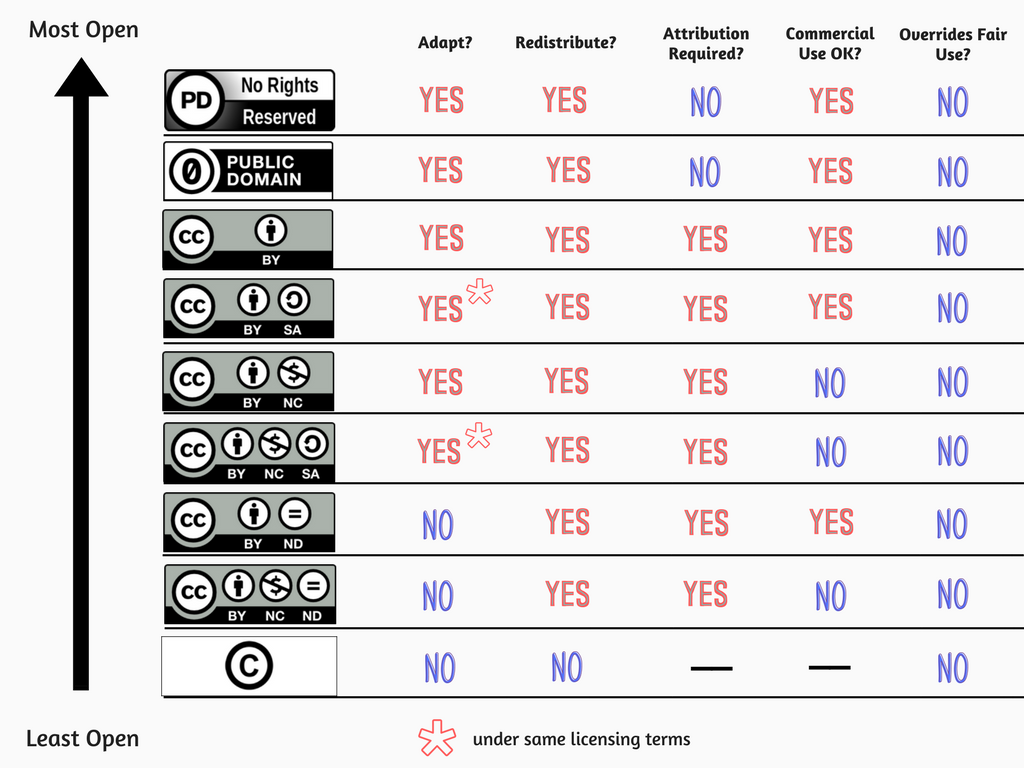
    CC BY Aaron McCollough (adapted from a table by Anita Walz)

    I’ve started sorting through the generous mess that is the COVID-19 educational resource sharing with an eye toward a lasting resiliency network that I wrote about yesterday. One good place to start (of many, I’m finding) is Lumen Learning’s list of recommended resources. ((Disclosure: Lumen is a sponsor of the Empirical Educator Project.)) While Lumen is sharing their curation free with everybody online, one of the strengths that the commercial providers offer during this time of crisis is that they also often have fairly direct lines of communication with their customers. Their survival depends on their ability to cut through the noise and reach particular people with well-targeted messages. In times like these, their communications and marketing teams can be turned into information distribution networks. We need to reach educators efficiently with high-quality information. We need these distribution networks.

    Right now, a lot of EdTech companies are doing what Lumen is doing. They are curating their own lists of content and getting them out to their customers. Many of these resources are being produced by and for academics. The companies are curating and distributing. Ideally, we would be working as a sector consistently, over time, to create and organize educational resiliency content that organizations with effective distribution capabilities. These could be commercial providers, universities, or professional associations. The most important thing is to get high-quality information to people who need it at their moment of need.

    In this kind of situation, we should reduce the friction of sharing as much as possible. One source of friction is licensing. People that want to share high-quality content created by others need to consider whether the creator has granted them the right to do so. That is the law, and it is also the right thing to do. But it is a source of friction to sharing. If your top priority is to create content that will reach and help as many people as possible, then you should reduce that friction as much as possible.

    There is a simple way to do that. First, make sure that your content bears an explicit license that grants sharing rights. Don’t make people come to you and ask for permission. Second, choose the most permissive license that you can justify. The most permissive license possible would be a public domain mark. This simply says, “I am giving this to the world and don’t need credit or payment. Please use it.” The second-most permissive option would be the Creative Commons Attribution license (CC-BY). This license says, “I am giving this to the world, and all I ask in return is that you give me credit for my work.” Either of these licenses will enable the broadest range of distribution networks to pick up your contribution with as little friction as possible.

    I do not recommend Creative Commons license conditions such as Non-Commercial or Share-Alike for this kind of resource. Non-Commercial (CC-BY-NC) is the worst. If a commercial entity shares your CC-BY-NC-licensed resource to their customers and they don’t charge for it, is that commercial use? Nobody knows. So commercial entities have both legal and ethical reasons to be cautious about sharing CC-BY-NC resources. Share-Alike (CC-BY-SA) is not quite as bad but also problematic. Again, if a commercial entity, or even a professional association, wanted to bundle your resources with some of their copyrighted material in order to help educators in their time of crisis, could they do it under this license? Do you want to prohibit that use?

    The Non-Derivatives clause (CC-BY-ND) if you’re worried about a piece of information with your name on it being chopped up in ways that you don’t approve. But every restriction clause creates a trade-off in terms of broadest use. Please think carefully about potential trade-offs with the ones that you impose.

    I am not making the blanket argument that all educational resources should be licensed CC-BY or public domain (although the argument could be made). I am urging my readers—both academic and commercial—to explicitly contribute as much of your crisis support content as possible under as permissive a sharing license as possible.
  • OER and the Future of Knewton

    Jose Ferriera, the CEO of Knewton, recently published a piece on edSurge arguing that scaling OER cannot “break the textbook industry” because, according to him, it has low production values, no instructional design, and is not enterprise grade. Unsurprisingly, David Wiley disagrees. I also disagree, but for somewhat different reasons than David’s.

    (more…)

  • Villanova Distance Learning Task Force: A case study in missing attribution

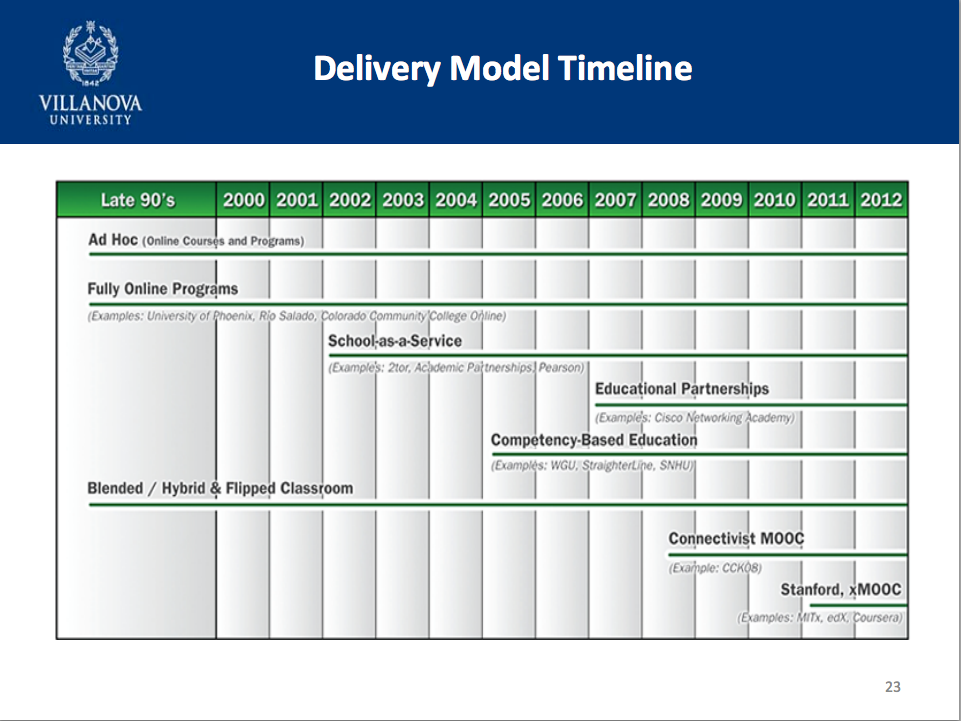
    While doing research for a blog post about 2U filing for an IPO, I ran across a presentation given last year by the Villanova University Distance Learning Task Force for a Faculty Forum. In this presentation I found one of my graphics that was shared on e-Literate and in EDUCAUSE Review.

    Slide 1I’m flattered that they would find this information useful, and this usage is why I usually include a footer to many of the graphics showing that they are licensed under creative commons to facilitate sharing. All I ask is for attribution and occasionally no derivatives.

    However, not only was there no attribution in the presentation, but the footer has been stripped off (I do not know if this was done by Villanova personnel or if they found a stripped-down version). Maybe that was just an unfortunate situation.

    But wait, just five slides down I find another graphic, same situation. (more…)

  • Boundless Is Totally #Winning

    I was contacted by Boundless CEO Ariel Diaz regarding a concern he had with my blog post about the lawsuit outcome. This was not entirely surprising, and I was curious to see which aspects of the post concerned him. Was it my characterization of Boundless as not a content company? Was it my speculation that Boundless was really designed to ride on Chegg’s coattails with the VC community? No, none of those. It was my claim that Boundless lost the legal fight.

    You may wonder, “How can a company that was required to pay $600,000 to the plaintiffs, destroy three of the products it had created, and accept a permanent injunction on how it does business going forward, have actually won?” I wondered that too.

    (more…)

  • Textbook Publishers and OERs

    Not too long ago, The Chronicle ran an piece called “Publishers Criticize Federal Investment in Open Educational Resources.” The meat of the article was some quotes of textbook company executives on a panel at an SIIA conference speaking out against a provision in a United States Department of Labor grants program that requires course materials being produced for grant-supported courses to be released under a Creative Commons Attribution license. Here’s a taste of their comments:

    “I think it’s very dangerous for them to be in the product business,” said Bill Hughes, vice president of business development and innovation at Pearson Education.

    “There’s no free lunch,” said James Kourmadas, vice president of strategic marketing at McGraw-Hill Higher Education.

    “I fear when big bucks from government is put into certain places, it actually stops pushing people to innovate,” said Kevin Wiggen, chief technology officer of Blackboard Xythos….

    “I think what the industry says is that we don’t see the point in the government collecting up taxpayer money and trying to rebuild an industry from scratch,” said Mr. Kourmadas of McGraw-Hill.

    To my esteemed fellow textbook industry professionals, I reply,

    Dudes. Seriously? (more…)

  • What I'd Like to See Next in iTunes University

    Update: Although you can’t copy and paste the podcatching URL from the iTunes client, it is apparently possible to expose the podcatching URL from the administration interface. I have no direct information about why this is so. However, it is consistent with Apple’s general approach to DRM. It may be that by making it easy for the producer to expose the URL but inconvenient for the consumer to do so without help from the producer, they are trying to strike a balance that gives iTunes U a “soft” DRM capability without resorting to encryption. But that’s just a guess.

    This is part 6 of a series of posts documenting a vist to Apple headquarters in February, 2005. For the full series, see part 1, part 2, part 3, part 4, part 5. and part 6.

    As you can probably tell from my last few posts, I’m pretty jazzed about the potential of iTunes U. But that doesn’t mean that I think the first version is perfect by any means. Here’s what I’d like to see from Apple going forward: (more…)

  • Search, Copyright, and Course Pack Affordances

    I’m still very much interested in the idea of creating a system that enables professors to assemble course packs out of Open Access or, better yet, Creative Commons-licensed content. But my idea is broadening somewhat based on what I’m learning at my new job. (more…)