
e-Literate

Present is Prologue

Tag: Desire2Learn

  • Desire2Learn’s Analytics Product Looks Very Good

    I’ve been super-busy with a consulting gig over the last few weeks and have fallen off the wagon with my blogging. This is one of the many reasons that I am grateful to have Phil as my prolific yet profound co-publisher and that we have attracted a group of terrific featured bloggers.

    Anyway, I thought I would get back to business with a long-overdue post about D2L’s learning analytics product, called “Insights.” There are several pieces to the product, but I’m going to focus on the component that they call the Student Success System. I have blogged from time to time on Purdue’s Course Signals project, (now commercialized in an offering from Elucian), as having set the bar for student retention analytics. More recently, I wrote about Blackboard’s Retention Center, which is clearly following in Purdue’s footsteps. My impression of Retention Center is that it is a reasonable Version 1 product that captures some but not all of the value of Course Signals.

    D2L’s Student Success System also follows in Purdue’s footsteps. But rather than simply playing catch-up, I would call it an incremental but meaningful improvement over Course Signals in most aspects. From what I can tell based on initial conversations with D2L about the product details, this now appears to be the system to beat. (I reserve the right to change my opinion based on implementation experiences from clients, which are particularly important for this product.)
    (more…)

  • LMS Market Update: May and June News

    There have been a number of LMS and Learning Platform announcements over the past month or two that will help shape the market over the next year or more. One trend I’ve described is the transition from an LMS market to a Learning Platform market, which includes a broader scope of products. Below are some of the notable announcements. I expect that Michael and I will write separate posts in more detail on several of these updates.

    • LMS CEO panel discussion at Learning Impact
    • Instructure, maker of Canvas LMS, raises $30M
    • Desire2Learn announces Student Success System as predictive analytics with new release
    • Sakai OAE recovers from loss of partners, rebrands as Apereo OAE
    • Coursera shifts strategy in partnering with schools, now overlaps with LMS market
    • edX finishes releasing platform code as open source
    • LMS conference season approaching

    LMS CEO panel discussion at Learning Impact

    In mid May, Inside Higher Ed’s Scott Jaschik hosted a panel discussion of the LMS CEOs at the Learning Impact conference. Blackboard’s new CEO, Jay Bhatt, was welcomed into the higher education community with the, ahem, liveliest panel discussion in recent memory. Given the all-star panel (John Baker, CEO, Desire2Learn; Jay Bhatt, CEO, Blackboard; Josh Coates, CEO Instructure; Martin Dougiamas, Moodle Founder and Lead Developer, Moodle; Manoj Kutty, CEO, LoudCloud Systems; Matt Leavy, CEO, Pearson eCollege), I’ve been surprised to see very little discussion after the event.

    But then I remembered:

    The First Rule of the LMS Panel is you do not talk about the LMS Panel

    (more…)

  • Snapshot of LMS Market for Large Online Programs in the US

    The transformation of the higher education LMS market continues, and I expect more changes over the next 2 – 3 years. However, it seems time to capture a key segment of the market based on two recent announcements that directly impact large online programs.

    UMUC Selects Desire2Learn

    Following a multi-year strategic study and product selection, the University of Maryland University College (UMUC) selected Desire2Learn to replace the homegrown WebTycho LMS in use for over a decade. While there has been no press release, there are now official documents publicly available that describe this effort. Per the Faculty Advisory Committee (FAC) Newsletter:

    As announced last year, UMUC is planning to replace WebTycho with another learning management system. After a great deal of questions for the vendors, references checks and tests of functionality, Desire2Learn was chosen. More than 200 faculty, staff and students worldwide were part of the decision which was reported to have been by an overwhelming majority. The roll out will occur gradually over the next year or two. [snip]

    Not only is UMUC moving away from the WebTycho platform to the Desire2Learn (D2L) learning management system, but additional changes are in the works which will transform the online learning experience for our students and faculty.

    UMUC is part of the University of Maryland system, and it has a global focus – serving over 90,000 students worldwide.

    Mississippi Community Colleges Select Canvas

    The Mississippi Virtual Community College (MSVCC) provides the LMS for the system’s online program as well as for all 15 campuses. After a 6-month RFP process, MSVCC will be migrating from Blackboard Learn and Desire2Learn and implementing Canvas as the new LMS. From the press release:

    (more…)

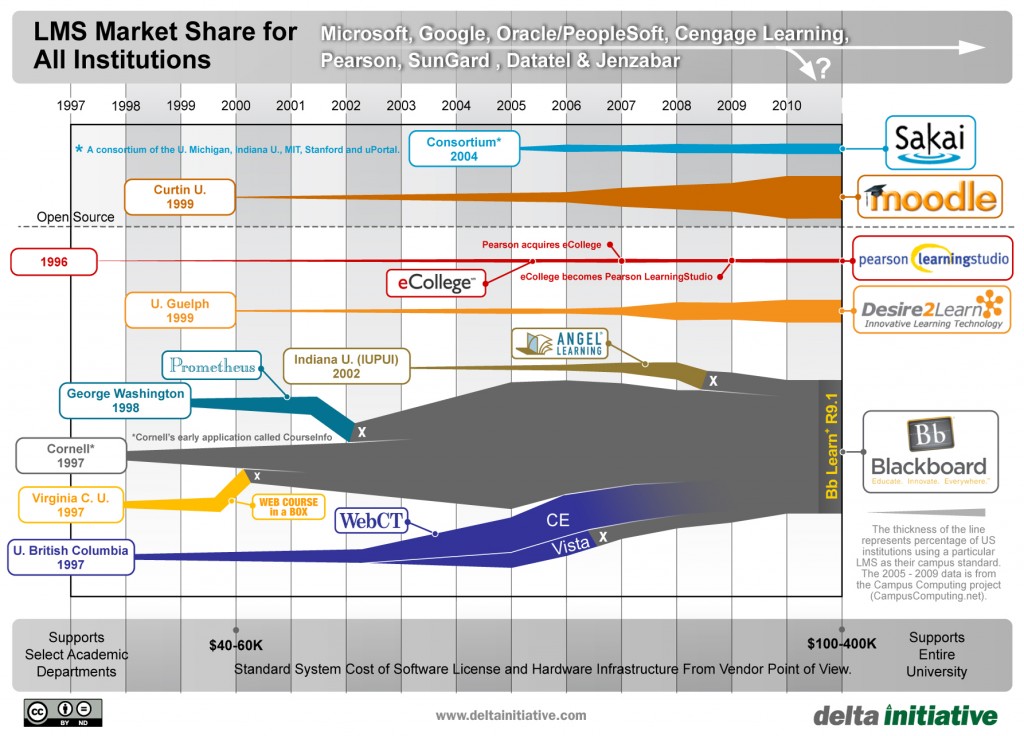
  • State of the Higher Education LMS Market: A Graphical View

    The transformation of the higher education LMS market continues, and I expect more changes over the next 2 – 3 years. However, it seems time to capture the state of the market based on changes over the past year or two.

    I shared the most recent graphic summarizing the market in mid 2011. As with all previous versions, the 2005 – 2009 data points are based on the Campus Computing Project, and therefore is based on US adoption from non-profit institutions. This set of longitudinal data provides an anchor for the summary.

    The most significant changes over the past two years include the following.

    (more…)

  • Desire2Learn Mobile Contest Winners

    I’ve been meaning to get to this post for a while. Way back in July, I had the privilege to be a judge in Desire2Learn’s Edge Challenge. Basically, they offered cash prizes for groups building compelling mobile applications for education. One of the nice aspects of the contest was that the apps didn’t have to have anything to do with D2L’s technologies (although use of those technologies was, of course, encouraged). Basically, if it was new and innovative and good for students and teachers, then it didn’t matter what technology was used. As a judge, I both evaluated the entrants and then—the fun part—got to participate in a coaching session with the winners.

    The two companies that made it to the coaching session were both really interesting. The first, mPrep, delivers lessons and quizzes to K12 students in Kenya via text messages on mobile phones (whether they are smartphones or not). There is also an analytics portal for teachers. The company has aspirations to expand its reach across Africa and, eventually, to the rest of the developing world. Here’s their video entry:

    The second was a company called Primal. They have a semantic search technology that helps you zero in on what you were actually looking for by understanding your interests. They built an app on top of their core technology called Learning Sherpa. Basically, the tool combines the class context of what is being taught (e.g., anatomy and physiology) with the student’s interests (e.g., baseball and statistics) to find articles that cover both areas. In other words, it helps students find their zone of proximal curiosity in the context of the class.  Here’s their video entry:

    Great stuff. Both of these start-ups impressed me a great deal. I think D2L’s contest was outstanding and I hope they do it again.


  • Clarification on Cloud, SaaS and Multi-tenant Language

    In several recent posts I have argued about the importance of cloud-based platforms, and Michael Feldstein has written some insightful analysis on the subject. Quite often the terms Cloud and SaaS (software as a service) are misunderstood, or at least used differently as the terms get redefined, which is common in technology markets.

    Last week I wrote a post that included a comment about Desire2Learn and their usage of cloud and SaaS terms.

    The terms cloud and SaaS, as used in Desire2Learn’s and NEA’s descriptions, tend to blur the distinction between Desire2Learn’s enterprise software virtualization model and multi-tenant platform models. Desire2Learn has made great strides in developing a virtualized cloud servers for business model that is not multi-tenant (where all or most clients run on the same defined application instance on the same version).  There are arguments that this issue only matters to the provider. I’ll write more on this subject in a subsequent post, but for now I’ll just point out that the cloud model used by Desire2Learn has significant differences with the model used by Instructure’s Canvas LMS, Pearson’s OpenClass, Lore’s platform, and the majority of new learning platforms coming out.

    John Baker, CEO of Desire2Learn, did not agree with this statement as shared in the comments.

    One key correction is that our Cloud or Software-as-a-Service (SaaS) solutions are multi-tenant. Multi-tenancy has been part of our solution for over a decade. It may also be important to point out that approximately 90 percent of our clients use our SaaS offering. We’d be happy to share more infromation with you and others on how we have evolved over the years.

    (more…)

  • Desire2Learn Raises $80 Million in First-Time Venture Capital Funding

    Desire2Learn has been around since 1999, and John Baker, CEO and founder of the company, has made it a point of pride that the company has grown to over 500 employees without external funding. From a financial perspective, however, the Canadian company just reversed its long-standing approach and raised $80 million in venture capital (VC) funding. From a strategy perspective, there are no changes – rather a plan to accelerate the corporate growth based on the existing strategy. This might seem to be a large investment for this situation, but Desire2Learn’s two VC investors clearly think the possibilities are just now emerging.

    The two venture capital firms behind the investment are OMERS Ventures, the VC arm of a Canadian pension fund, and New Enterprise Associates (NEA), one of the lead investors in Coursera and Edmodo. The $80 million is the 5th largest north american series A VC deal and the largest ever VC deal for a Canadian software company.

    (more…)