e-Literate

Present is Prologue

Tag: distance education

  • Price Of Faculty Not Using LMS? $39 million for CCSF

    Price Of Faculty Not Using LMS? $39 million for CCSF

    This morning the San Francisco Chronicle published an article about City College of San Francisco (CCSF) having to repay the state of California $39 million due to an audit of distance education courses.

    City College of San Francisco, struggling for every dollar it can muster, must repay the state nearly $39 million because it can’t prove that instructors taught thousands of students in hundreds of online classes from 2011 to 2014, an audit revealed.

    City College has been unable to verify teaching about 16,000 students in 587 online courses — from Accent Improvement to Cardiorespiratory Emergencies — over the three-year period, according to the state-commissioned audit that ended in September.

    It took a little bit of digging during a conference call (shh, don’t tell the hosts), but it looks like the issue was that the vast majority of faculty teaching online or hybrid courses chose to not use the centralized Moodle LMS system despite district policy that the LMS is the official record of student and faculty interaction.  (more…)

  • Fall 2014 IPEDS Data: Interactive table ranking DE programs by enrollment

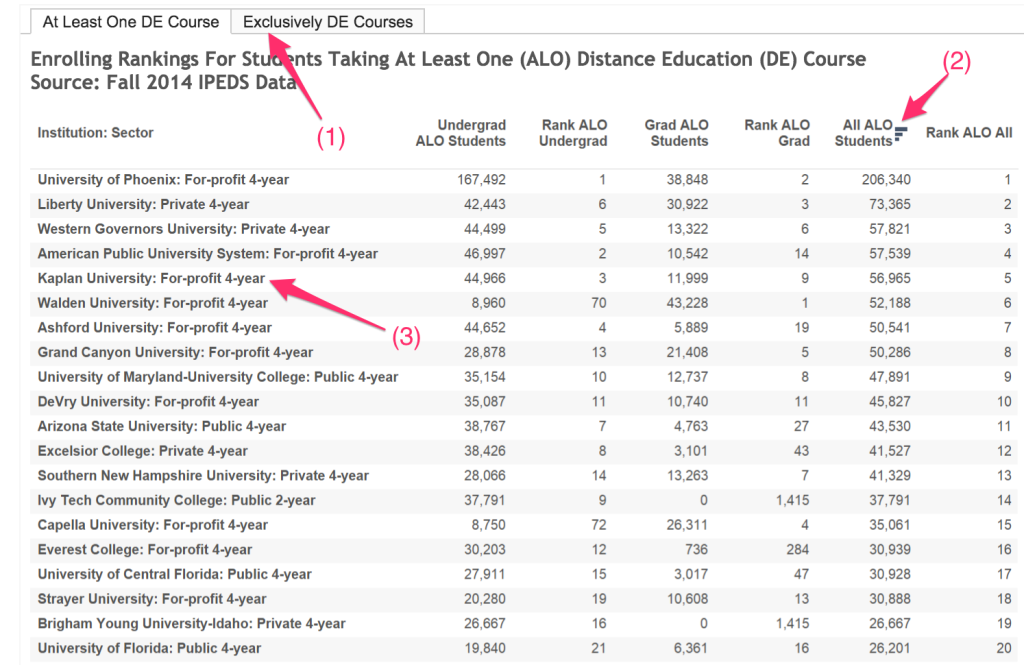
    Last week I shared a static view of the US institutions with the 30 highest enrollments of students taking at least one online (distance ed, or DE) course. But we can do better than that, thanks to some help from Justin Menard at LISTedTECH and his Tableau guidance.

    The following interactive chart allows you to see the full rankings based on undergraduate, graduate and combined enrollments. And it has two views – one for students taking at least one online course and one for exclusive online students. Note the following:

    Tableau hints

    • (1) shows how you can change views by selecting the appropriate tab.
    • (2) shows how you can sort on any of the three measures (hover over the column header).
    • (3) shows the sector for each institution by the institution name.

    (more…)

  • Fall 2014 IPEDS Data: Top 30 largest online enrollments per institution

    The National Center for Educational Statistics (NCES) and its Integrated Postsecondary Education Data System (IPEDS) provide the most official data on colleges and universities in the United States. This is the third year of data.

    Let’s look at the top 30 online programs for Fall 2014 (in terms of total number of students taking at least one online course). Some notes on the data source:

    • I have combined the categories ‘students exclusively taking distance education courses’ and ‘students taking some but not all distance education courses’ to obtain the ‘at least one online course’ category;
    • Each sector is listed by column;
    • IPEDS tracks data based on the accredited body, which can differ for systems – I manually combined most for-profit systems into one institution entity as well as Arizona State University[1];
    • See this post for Fall 2013 Top 30 data and see this post for Fall 2014 profile by sector and state.

    Fall 2014 Top 30 Largest Online Enrollments Per Institution (more…)

  • Fall 2014 IPEDS Data: New Profile of US Higher Ed Online Education

    The National Center for Educational Statistics (NCES) and its Integrated Postsecondary Education Data System (IPEDS) provide the most official data on colleges and universities in the United States. I have been analyzing and sharing the data in the initial Fall 2012 dataset and for the Fall 2013 dataset. Both WCET and the Babson Survey Research Group also provide analysis of the IPEDS data for distance education. I highly recommend the following analysis in addition to the profile below (we have all worked together behind the scenes to share data and analyses).

    Below is a profile of online education in the US for degree-granting colleges and university, broken out by sector and for each state. (more…)

  • No Discernible Growth in US Higher Ed Online Learning

    By 2015, 25 million post-secondary students in the United States will be taking classes online. And as that happens, the number of students who take classes exclusively on physical campuses will plummet, from 14.4 million in 2010 to just 4.1 million five years later, according to a new forecast released by market research firm Ambient Insight.

    – Campus Technology, 2011

    On the positive side, Moody’s notes that the U.S. Department of Education projects a 20-percent growth in master’s degrees and a 9-percent growth in associate degrees, opportunities in both online education and new certificate programs, and a rising earnings premium for those with college degrees.

    – Chronicle of Higher Ed, 2014

    Q.  How likely would it be that this fraction [% students taking online courses] would grow to become a majority of students over the next five years? A [from institutional academic leaders]. Nearly two-thirds responded that this was “Very likely,” with an additional one-quarter calling it “Likely.” [That’s almost 90% combined]

    – Grade Change, Babson Survey 2013

    More than two-thirds of instructors (68 percent) say their institutions are planning to expand their online offerings, but they are split on whether or not this is a good idea (36 percent positive, 38 percent negative, 26 percent neutral).

    – Inside Higher Ed 2014

    Still, the [disruptive innovation] theory predicts that, be it steam or online education, existing consumers will ultimately adopt the disruption, and a host of struggling colleges and universities — the bottom 25 percent of every tier, we predict — will disappear or merge in the next 10 to 15 years.

    – Clayton Christensen in NY Times 2013

    You could be forgiven for assuming that the continued growth of online education within US higher ed was a foregone conclusion. We all know it’s happening; the questions is how to adapt to the new world.

    But what if the assumption is wrong? Based on the official Department of Education / NCES new IPEDS data for Fall 2013 term, for the first time there has been no discernible growth in postsecondary students taking at least one online course in the US. (more…)

  • Fall 2013 IPEDS Data: New Profile of US Higher Ed Online Education

    The National Center for Educational Statistics (NCES) and its Integrated Postsecondary Education Data System (IPEDS) provide the most official data on colleges and universities in the United States. Last year they released data on distance education (essentially online courses) starting with the Fall 2012 term. Last week they released new data for the Fall 2013 term. Below is a profile of online education in the US for degree-granting colleges and university, broken out by sector and for each state.

    Please note the following:

    • For the most part distance education and online education terms are interchangeable, but they are not equivalent as DE can include courses delivered by a medium other than the Internet (e.g. correspondence course).
    • I have provided some flat images as well as an interactive graphic at the bottom of the post. The interactive graphic has much better image resolution than the flat images.
    • There are three tabs below in the interactive graphic – the first shows totals for the US by sector and by level (grad, undergrad); the second also shows the data for each state; the third shows a map view.
    • Please note that along with Russ Poulin from WCET we have identified some significant problems with IPEDS data validity – see this article for more information.

    (more…)

  • Fall 2013 IPEDS Data: Top 30 largest online enrollments per institution

    The National Center for Educational Statistics (NCES) and its Integrated Postsecondary Education Data System (IPEDS) provide the most official data on colleges and universities in the United States. Last year they released data on distance education (essentially online courses) starting with the Fall 2012 term. Last week they released new data for the Fall 2013 term.

    Let’s look at the top 30 online programs for Fall 2013 (in terms of total number of students taking at least one online course) while showing both 2012 and 2013 data. Some notes on the data source:

    • I have combined the categories ‘students exclusively taking distance education courses’ and ‘students taking some but not all distance education courses’ to obtain the ‘at least one DE’ category;
    • The ‘All Students’ category combines those taking DE course with those taking no DE courses;
    • I have highlighted in red the not-for-profit sectors;
    • IPEDS tracks data based on the accredited body, which can differ for systems – I manually combined most for-profit systems into one institution entity as well as Arizona State University ((ASU splits into various entities although the online programs are coordinated.)); and
    • Please note that along with Russ Poulin from WCET we have identified some significant problems with IPEDS data validity – see this article for more information.

    (more…)