e-Literate

Present is Prologue

Tag: Ed Tech

  • e-Literate Top 20 Posts For 2014

    I typically don’t write year-end reviews or top 10 (or 20) lists, but I need to work on our consulting company finances. At this point, any distraction seems more enjoyable than working in QuickBooks.

    We’ve had a fun year at e-Literate, and one recent change is that we are now more willing break stories when appropriate. We typically comment on ed tech stories a few days after the release, providing analysis and commentary, but there are several cases where we felt a story needed to go public. In such cases (e.g. Unizin creation, Cal State Online demise, management changes at Instructure and Blackboard) we tend to break the news objectively, providing mostly descriptions and explanations, allowing others to provide commentary.

    The following list is based on Jetpack stats on WordPress, which does not capture people who read posts through RSS feeds (we send out full articles through the feed). So the stats have a bias towards people who come to e-Literate for specific articles rather than our regular readers. We also tend to get longer-term readership of articles over many months, so this list also has a bias for articles posted a while ago.

    With that in mind, here are the top 20 most read articles on e-Literate in terms of page views for the past 12 months along with publication date.

    1. Can Pearson Solve the Rubric’s Cube? (Dec 2013) – This article proves that people are willing to read a 7,000 word post published on New Year’s Eve.
    2. A response to USA Today article on Flipped Classroom research (Oct 2013) – This article is our most steady one, consistently getting around 100 views per day.
    3. Unizin: Indiana University’s Secret New “Learning Ecosystem” Coalition (May 2014) – This is the article where we broke the story about Unizin, based largely on a presentation at Colorado State University.

    4. (more…)

  • Blackboard’s SVP of Product Development Gary Lang Resigns

    Gary Lang, Blackboard’s senior vice president in charge of product development and cloud operations, has announced his resignation and plans to join Amazon. Gary took the job with Blackboard in June 2013 and, along with CEO Jay Bhatt and SVP of Product Management Mark Strassman, formed the core management team that had worked together previously at AutoDesk. Gary led the reorganization effort to bring all product development under one organization, a core component of Blackboard’s recent strategy.

    Michael described Blackboard’s new product moves toward cloud computing and an entirely new user experience (UX) for the Learn LMS, and Gary was the executive in charge of these efforts. These significant changes have yet to fully roll out to customers (public cloud in pilot, new UX about to enter pilot). Gary was also added to the IMS Global board of directors in July 2014 – I would expect this role to change as well given the move to Amazon. (more…)

  • Upcoming EDUCAUSE Webinars on Dec 4th and Dec 8th

    Michael and I will be participating in two upcoming EDUCAUSE webinars.

    Massive and Open: A Flipped Webinar about What We Are Learning

    On Thursday, December 4th from 1:00–2:00 p.m. ET we will be joined by George Siemens for an EDUCAUSE Live! webinar:

    In 2012, MOOCs burst into public consciousness with course rosters large enough to fill a stadium and grand promises that they would disrupt higher education. Two years later, after some disappointments, setbacks, and not a small amount of schadenfreude, MOOCs seem almost passé. And yet, away from the sound and the fury, researchers and teachers have been busy finding answers to some basic questions: What are MOOCs good for, and what can we learn from them? Phil Hill and Michael Feldstein will talk about what we’re learning so far. (more…)

  • LISTedTECH: New wiki site and great visualizations

    Last year I wrote about a relatively new site offering very interesting data and visualizations in the ed tech world. LISTedTECH was created by Justin Menard, who is Business Intelligence Senior Analyst at University of Ottawa. First of all, the site is broader in scope than just the LMS – there is a rich source of data & visualizations on MOOCs, university rankings, and IPEDS data. Most of the visualizations are presented by Tableau and therefore interactive in nature, allowing the user to filter data, zoom in on geographic data, etc. Since e-Literate is not set up for full-page visualizations, I have included screen shots below, but clicking on the image will take you to the appropriate LISTedTECH page.

    Top_Learning_Management_System__LMS__by_State_or_Province_-_LISTedTECH

    (more…)

  • New LMS Market Data: Edutechnica provides one-year update

    In Fall 2013 we saw a rich source of LMS market data emerge.

    George Kroner, a former engineer at Blackboard who now works for University of Maryland University College (UMUC), has developed what may be the most thorough measurement of LMS adoption in higher education at Edutechnica (OK, he’s better at coding and analysis than site naming). This side project (not affiliated with UMUC) started two months ago based on George’s ambition to unite various learning communities with better data. He said that he was inspired by the Campus Computing Project (CCP) and that Edutechnica should be seen as complementary to the CCP.

    The project is based on a web crawler that checks against national databases as a starting point to identify the higher education institution, then goes out to the official school web site to find the official LMS (or multiple LMSs officially used). The initial data is all based on the Anglosphere (US, UK, Canada, Australia), but there is no reason this data could not expand.

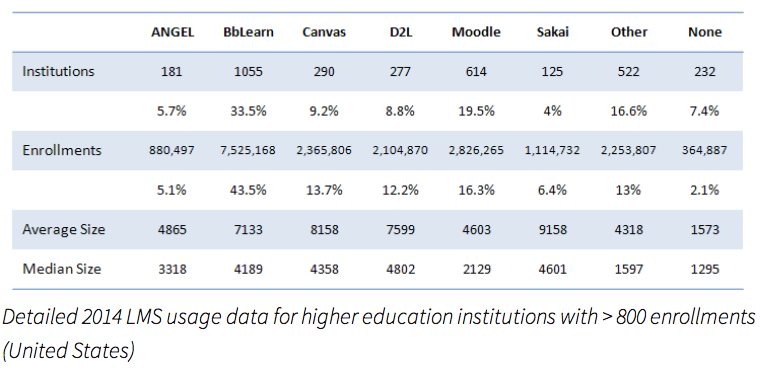
    There is new data available in Edutechnica’s one-year update, with year-over-year comparisons available as well as improvements to the methodology. Note that the methodology has improved both in terms of setting the denominator and in terms of how many schools are included in the data collection.

    The Fall 2014 data which now includes all schools with more than 800 enrollments:

    (more…)

  • Opening Up the LMS Walled Garden

    In yesterday’s post I described where I (and many others) see the LMS market heading in terms of interoperability.

    At the same time, the LMS does a very poor job at providing a lot of the learning technologies desired by faculty and students. There is no way that a monolithic LMS can keep up with the market – it cannot match functionality of open internet tools especially without adding feature bloat.

    I would add that part of the cause of the “false binary position” that D’Arcy points out is that much of the public commentary focuses on where the LMS has been rather than where it is going. There is a significant movement based on interoperability that is leading, perhaps painfully and slowly, to a world where the LMS can coexist with open educational tools, with even end users (faculty and students) eventually having the ability to select their tools that can share rosters and data with the institutional LMS.

    Coexistence and interoperability, however, should not imply merely having links from the LMS to external tools as is too often the case.

    The Walled Garden

    The LMS (which George Station rightly points out was really called the Course Management System in the early years) started out as a walled garden with basic functionality of syllabus sharing, announcements, gradebook, email, and a few other tools.

    walledgarden

    (more…)

  • LMS and Open: The false binary is based on past, not future markets

    D’Arcy Norman has an excellent blog post up titled “On the false binary of LMS vs. Open” that captures a false framing issue.

    We’re pushed into a false binary position – either you’re on the side of the evil LMS, working to destroy all that is beautiful and good, or you’re on the side of openness, love, and awesomeness. Choose. There is no possible way to teach (or learn) effectively in an LMS! It is EVIL and must be rooted out before it sinks its rotting tendrils into the unsuspecting students who are completely and utterly defenseless against its unnatural power!

    While D’Arcy is a proponent of open tools, he rightly calls out the need to understand institutional responsibilities.

    But. We can’t just abdicate the responsibility of the institution to provide the facilities that are needed to support the activities of the instructors and students. That doesn’t mean just “hey – there’s the internet. go to it.” It means providing ways for students to register in courses. For their enrolment to be automatically processed to provision access to resources (physical classrooms, online environments, libraries, etc…). For students’ grades and records to be automatically pushed back into the Registrar’s database so they can get credit for completing the course. For integration with library systems, to grant acccess to online reserve reading materials and other resources needed as part of the course.

    This is an important point, in that the institutional LMS is important and will not, and should not, go away anytime soon. I have pointed out recently that the LMS is one of the very few technologies now used in a majority of courses within an institution, and the institutional responsibility described above helping to explain why. (more…)