Last week I published threee-Literate TVepisodes on Northern Arizona University and their suite of initiatives aimed at helping first-year (and often first-generation) students. In those videos, NAU staff made some interesting claims, in particular that they are seeing improved student performance in subsequent courses after students take one of their modified emporium math courses in the Lumberjack Mathematics Center.
In episode 1 of our e-Literate TV case study on Northern Arizona University, we gave a broad overview of the suite of initiatives (primarily) targeted at helping first-year students amidst the tensions coming from growing enrollments. ((Disclosure: Our e-Literate TV series of video case studies and explainer videos is funded by a grant from the Bill & Melinda Gates Foundation.)) In episode 2 we covered their advising and student support, including work with IPASS initiative. In this episode we look at their modified math emporium approach leveraging the Lumberjack Mathematics Center.
Math emporia have a mixed reputation, occasionally described as “the place where all the non-math majors are generally sent to virtually teach themselves subjects” or that “we’ve outsourced jobs for professors to a bunch of students on hourly wage”. Yet studies have shown positive results in many cases. Just saying there is an emporium approach doesn’t tell you much – some are run well with plenty of support for students, and some leave students on their own with poor support. So it is useful to see a specific case. How has NAU implemented a math emporium approach, what does it look like, what support is provided, and what are the results? NAU has implemented a modified emporium, and they have invested in a new facility to support this model.
In episode 1 of our e-Literate TV case study on Northern Arizona University, we gave a broad overview of the suite of initiatives (primarily) targeted at helping first-year students amidst the tensions coming from growing enrollments. ((Disclosure: Our e-Literate TV series of video case studies and explainer videos is funded by a grant from the Bill & Melinda Gates Foundation.)) In this episode we look outside of the classroom to see how they’re approach advising and student support.
As we mentioned yesterday, NAU has a rapidly growing enrollment and has a large percentage of students (more than 40% of incoming freshman) that are first-generation. These students do not have a long-history of academic success, and they typically do not have a family support system in place to help them understand what to expect in college and how to succeed. First-generation students tend to come from lower-income families and have a greater tendency to work 20+ hours per week on top of their college studies. We even documented last year how first-generation students tend to spend more on textbooks. Simply put, for schools attracting high percentages of first-generation students, there is an even greater need to provide support and advising structures in place to help them acclimate to college life and studying requirements. And even guidance on how to manage their degree and career plans.
This is the context to understand the challenges NAU faces as they have changed their approach to advising and student support.
As part of our e-Literate TV series of case studies, we had a chance this fall to interview faculty and staff at Northern Arizona University about, well, a lot of stuff. ((Disclosure: Our e-Literate TV series of video case studies and explainer videos is funded by a grant from the Bill & Melinda Gates Foundation.)) Rather than highlighting a specific program or course redesign, NAU has invested in and implemented a suite of initiatives focused on improving student learning and success by rethinking the experience of (mostly) first-year students.
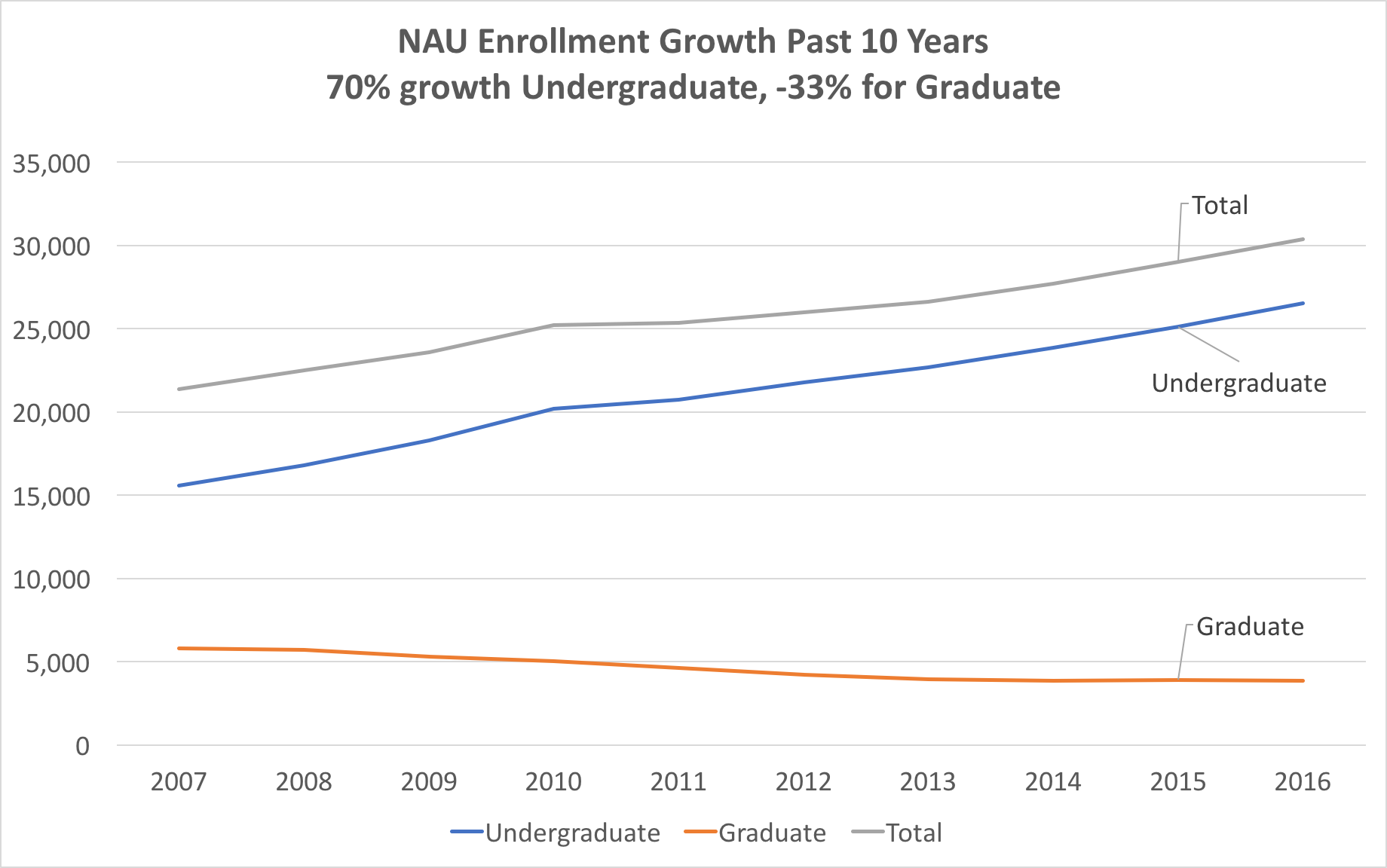
The core challenge NAU faces is to make these student-facing changes while facing growing enrollment, particularly for full-time undergraduate students.
In episode 1, we looked at an effort by the College of Liberal Arts at the University of Texas at Austin to develop SMOCs – Synchronous Massive Online Courses – where the core of the redesign centers on the synchronous online experience for large lecture courses (1000+ students in some cases) courses. ((Disclosure: Our e-Literate TV series of video case studies and explainer videos is funded by a grant from the Bill & Melinda Gates Foundation.)) In episode 2, we took a deeper look at how SMOCs work as well as a discussion of high-level course design costs. In this concluding episode, we ask the question of whether SMOCs work, in terms of improved learning outcomes and / or learning experiences.
Last month we shared a video describing how the College of Liberal Arts at the University of Texas at Austin is taking a different approach than some of the courseware-based or other course redesign efforts. ((Disclosure: Our e-Literate TV series of video case studies and explainer videos is funded by a grant from the Bill & Melinda Gates Foundation.)) In many of these other redesigns, there is an emphasis on the asynchronous elements of lab section and lecture preparation and even fully flipping the classroom (no lectures in class on the course content). In contrast, the UT Austin approach to improving the large lecture course centers on SMOCs – Synchronous Massive Online Courses – where the core of the redesign centers on the synchronous course lecture. Watch episode 1 to get a better feel of what problem they are trying to solve and how this SMOC approach appears to keep faculty in their traditional role, albeit with additional preparation time and video production.
In this episode, we’re taking a deeper look at how SMOCs work as well as high-level course design costs.
Inside Higher Ed recently published its fifth annual Survey of Faculty Attitudes Toward Technology, conducted in collaboration with researchers from Gallup. These reports cover a range of attitudinal questions on ed tech, online education, and new models of delivering course content. One of the key findings of this year’s report, as described in a Gallup blog, is that there is still a high level of disagreement among faculty of the relative merits of online courses versus traditional face to face courses, but there are some important nuances to the results. The survey finds that a majority of faculty (55%) “disagree or strongly disagree” with the idea that online courses can deliver the same student outcomes that in-person courses produce. Among faculty who have actually taught online, however, there is a much more positive view of the ability for online education to match in-person courses. (more…)