I’ve been fascinated by the rapid progression of ChatGPT article fads:
Look at this weird thing that writes stuff!
I asked ChatGPT a question—and here’s what it answered!!
I asked ChatGPT to write this article—and it totally did!!!
Students could use ChatGPT to student essays write essays!!!! End of the world or totally awesome?????
I asked ChatGPT for suggestions about preventing students from using ChatGPT to cheat—and it gave me five great suggestions (and five terrible ones)!!!!!!
Waitaminute. Let’s back up.
Students finding easy ways to cheat is not exactly a new thing. Remember, “to Chegg” is a verb now. Let’s back up to fad #3. Writers are asking ChatGPT to write their articles, publishing those articles, and then advertising that the articles published under their by-line were written in 30 seconds by a machine.
Do they want to get replaced by an algorithm?
It seems to me we’re thinking about the problem that these algorithms present in the wrong way.
At the moment, ChatGPT is a toy
Language-generating algorithms ChatGPT and their image-generating cousins are toys in both good and bad ways. In a good way, they invite people to play. Anyone, whether or not they know anything about programming, can explore the possibilities and limitations of a certain kind of cutting-edge AI. It’s fun. And, like all good games, you learn by playing. You can learn what they can and can’t do well. How to write a good prompt. And so on. They make AI more accessible and, in a certain way, more understandable.
They’re toys in the bad sense because they weren’t designed for any particular purpose and tend to do weird things for any given task. For example, I tried to get DALL-E 2—ChatGPT’s image-generating sibling—to create a retro comic book cover depicting ChatGPT as a scary vampire. I tried half a dozen different prompts. The best result I got was with “An evil vampire on the cover of a retro comic book called ‘ChatGPT’”. Here’s the best image it came up with:
“An evil vampire on the cover of a retro comic book called ‘ChatGPT’” as interpreted by DALL-E 2
The algorithm does evil comic-book vampires pretty well. Spelling a word that was explicitly spelled for it in the prompt? Not so much.
Remember, a large language model algorithm like the one behind DALL-E 2 and ChatGPT don’t understand anything. It’s taking a bag of words and putting together pieces it found on the internet to construct something that seems like an appropriate response.
ChatGPT, for example, is notoriously bad at math. Because it doesn’t calculate. That’s not what it is designed to do. Its developers have been working on improving this limitation. So I asked it about how good at math it is:
Me: How good are you at math?
ChatGPT: I am able to perform basic arithmetic operations, such as addition, subtraction, multiplication and division. My training data includes mathematical concepts and I have been trained to recognize and respond to arithmetic questions. However, it is important to note that I may make mistakes in complex or unconventional mathematical computations.
Me What is 2794 + 83948?
ChatGPT: 87,742
That answer is incorrect.
So ChatGPT, the miracle of modern technology destined to destroy all education, is not as “smart” as a calculator. Note that you can ask Google or your Apple search prompt the same question and reliably get a correct answer. OpenAI (the makers of OpenAI) are likely trying to combine much simpler but mathematically reliable algorithms with the GPT-3 algorithm that underlies ChatGPT and DALL-E 2. The fact that they haven’t solved this problem yet suggests it is non-trivial. These different types of algorithms can be challenging to mesh. Many of the more impressive applications of artificial intelligence and machine learning are made possible by an ensemble of different algorithms working together, some of which fit together more naturally than others.
Don’t get me wrong; the math problem will be solved. The OpenAI engineers will crack it just as they are now pretty good at preventing ChatGPT from making stock predictions or answering questions about current events when its data set hasn’t been updated since 2021. But it’s a game of whack-a-mole. Because you can ask ChatGPT anything, people do ask it anything. The creators are learning a lot about the questions people ask and what can go wrong with the answers. This new knowledge will help them design more specific solutions. But a general-purpose prompt tool like ChatGPT will be hard to make good at solving any one particular problem.
I’m not convinced that ChatGPT, as it exists today, represents a big leap forward in essay cheating. It has length limitations, has to be fact-checked, can’t produce references, and spits out highly variable quality of reasoning and argumentation. Students would learn more by trying to fix the problems with a ChatGPT-generated draft than they would by going to a traditional essay mill.
Short answer questions are a different matter. ChatGPT is already dangerous in this area. But again, students can already “Chegg” those.
Yes, but…
Could somebody write a better program specifically for writing school essays? Or magazine articles? Yes. That work is already underway.
So what do we do about the essay cheating problem? Let’s start with the two most common answers. We can develop algorithms that detect prose that was written by other algorithms. That too is already underway. So we’ll have yet another flavor of the cheating/anti-cheating arms race that benefits nobody except the arms dealers. The anti-cheating tools may be necessary as one element of a holistic strategy, but they are not the ultimate answer.
Second, we can develop essay-writing prompts and processes that are hard for the algorithms to respond to. This would be useful, partly because it would be good for educators to rethink their stale old assignments and teaching practices anyway. But it’s a lot of often uncompensated work for which the educators have not been trained. And it ends up being another arms race because the algorithms will keep changing.
We miss the point if we respond to language-generating AI as a static threat that might become more sophisticated over time but won’t fundamentally change. ChatGPT is just a friendly way for us to develop intuitions about how one family of these algorithms works at the moment. You’re wrong if you think it is a one-time shock to the system. We’re just at the beginning. The pace of AI progress is accelerating. It is not just going to get incrementally better. It is going to radically change in capabilities at a rapid pace. It will continue to have limitations, but they will be different limitations.
So what do we do?
How about talking to the students?
When adaptive learning hit peak hype, a glib response to teacher hysteria started making the rounds: “If you [teachers] can be replaced by a computer, then you probably should be.”
Doesn’t that apply…um…generally?
If all students learn is how to use ChatGPT to write their essays, why wouldn’t their hypothetical future employer use ChatGPT instead of hiring them? Why would students spend $30K, $40K, $50K, or more a year to practice demonstrating that a free-to-use piece of software does their best work for them? Students need to learn the work these tools can do so they can also understand the work the tools can’t do. Because that is the work the students could get paid for. Technology will make some jobs obsolete, leave others untouched, change some, and create new ones. These categories will continue to evolve for the foreseeable future.
At a time when students are more conscious than ever about the price-to-value of a college education, they ought to be open to the argument that they will only make a decent living at jobs they can do better than the machine. So they should learn those skills. Why learn to write better? So you can learn to think more creatively and communicate that creativity precisely. Those are skills where the primates still have the advantage.
Once we engage students openly and honestly on that point, we will start building a social contract that will discourage cheating and establish the foundational understanding we need for rethinking the curriculum—not just to keep from falling too far behind the tech but to help students get out in front of it. The current limitations of these AI toys demonstrate both the dangers and the potential. Suppose you want to apply the technology to any particular domain. In that case, whether it’s math, writing advertising copy, or something else, you need to understand how the software works and how the human expertise and social or business processes work. Whole echelons of new careers will be created to solve these problems. We will need thinkers who can communicate. Learning how to formulate one’s own thoughts in writing is an excellent way to learn both skills.
Fighting the tech won’t solve the problem or even prevent it from getting worse. Neither will ignoring it. We have to engage with it. And by “we,” I include the students. After all, it’s their futures at risk here.
(Disclaimer: This blog post was written by ChatGPT.)
(I’m kidding, of course.)
(I am able to perform basic humor operations, such as generating dirty limericks and “your momma is so ugly” jokes. My training data includes humorous concepts, and I have been trained to recognize and respond to knock-knock questions. However, it is important to note that I may make mistakes in complex or unconventional humor.)
As I outlined recently in my “e-Literate’s Changing Themes for Changing Times” post, I am shifting my coverage somewhat. I’ll be developing and calling out tags I use for these themes so that you can go to an archive page on each one. This one will be listed under the “changing enrollment” tag.
Just before Christmas, The New York Times published an ostensibly feel-good story about a Syrian refugee who built a massively successful chocolate business in Canada. But the story buries the lede. The company’s CEO could have—and should have—been a doctor. He couldn’t get credit for his prior education in Syria. Canada is facing an acute healthcare crisis because of a shortage of skilled workers. Canada has figured out half the problem with the labor shortages that plague many industries there and here. They are welcoming immigrants willing to work hard and do the jobs. But they are missing the other half, enabling those immigrants, many of whom arrive with skills, to employ those skills where they are needed. This denial of economic opportunity causes a well-intentioned policy to fail to live up to its economic and humanitarian aspirations.
Canada’s labor shortages are hardly unique, as anyone who has been paying attention to the US economy knows. We are suffering real economic pain from our inability to attract, train, and retain skilled workers in various industries. Worse, in this new era of economic, geopolitical, rapid technological advancement (e.g., ChatGPT) and climate volatility, we can expect the shifts in job markets to accelerate as supply chains get rewired, industries get disrupted, and reconfigured,
Until recently, I have been a skeptic regarding Competency-Based Education (CBE) and Prior Learning Assessment (PLA) because I did not believe the economic drivers were present to force the massive reconfiguration of the higher education system. But situations change. Long-term economic forces will increasingly drive demand for more rapid reskilling than our current system can support. Meanwhile, a significant and growing percentage of U.S. colleges and universities face enrollment crises. While this problem is often framed by academia as a decrease in the supply of students—the so-called “enrollment cliff,” the hot job market, and so on—I think it is better understood as a failure to respond to changing demand and new opportunities. EdTech and venture investors have been arguing this for decades. I continue to believe that they were wrong. But, like I said, situations change.
In this post, I will argue that now is the time for CBE and PLA at scale, using the Canadian healthcare labor market as the primary example. I will also make the case by focusing on skills mainly as an additive to the degree—the degree-plus-“skills” formula promoted by Coursera, boot camps and the like—institutions are missing opportunities. We will see that well-defined paths for pre-degree career credentials exist in critical industries. By neglecting these paths and leaving them to others, traditional higher education leaves itself vulnerable while failing to serve its mission to students and the public good.
Willy Wonka could have invented the everlasting artificial heart
Let’s return to our story about the Syrian refugee and his Canadian chocolate empire:
Back in Syria, [Refugee Tareq] Hadhad’s father, Isam, had founded a confectioners in Damascus that eventually employed hundreds of people and shipped its chocolates throughout the Middle East. Bombing during the civil war leveled it.
The Hadhads became privately sponsored refugees in Antigonish, Nova Scotia. While the town is the home of St. Francis Xavier University, it is generally known for having an aging population rather than being economically vibrant.
Mr. Hadhad was midway through medical school when he fled Syria. But once in Canada, and with considerable help from the people of Antigonish, he vowed to re-establish his father’s business under the name Peace by Chocolate….
This month, Mr. Hadhad opened a new, bigger shop and expanded the factory that produces the company’s chocolate. In all, Mr. Hadhad told me, Peace by Chocolate now employs about 75 people and could hire 30 to 40 more workers — if they were available in Antigonish. About 1,000 stores across Canada now sell its chocolates, thanks in part to a deal with the Empire Company, the Nova Scotia-based grocer that owns the Sobeys and Canada Safeway supermarket chains.
What an incredible story. Tucked in it is a comment about labor shortages, but given the aging population of Antigonish, that makes sense. Mr. Hadhad is doing precisely what the government of Canada and the people of Antigonish hoped he would do when they invited him and his family; create jobs that would attract more young workers. “Building a business in Canada, he said, is much easier in than in Syria,” he said.
But.
he was also keen to discuss what’s become something of a personal mission for him: eliminating barriers for newcomers and showing Canadians the economic value of immigrants.
A former medical student, Mr. Hadhad is disturbed that many immigrants are unable to use their skills immediately when they come to Canada; instead, they often must undergo additional schooling, and face slow and costly certification processes.
Mr. Hadhad was told that if he wanted to pursue his medical studies, he would have to return to high school, obtain a Canadian undergraduate degree and then take medical school admission exams.
Here’s a guy who was halfway through medical school when he arrived. He was told he would have to repeat all his education starting from high school to finish his degree and become a practicing physician.
Let’s set aside the humanitarian aspect of this. Forget that most immigrants don’t arrive with the second set of skills Mr. Haddad had—running a chocolate business—or the confidence and support to reinvent themselves. Instead, let’s look at this purely from a policy perspective. Was Mr. Haddad’s career change a net gain or a net loss for Canada?
About a month before The New York Times ran the chocolateer story, it ran another one with the headline, “Alleviating Canada’s Acute Shortage of Family Doctors“. According to that article, “Nova Scotia’s latest monthly tally, released in mid-October, showed that 110,640 people, or 11 percent of the population, were on the wait list for a family doctor.”
Nova Scotia [is] not alone. The recently re-elected Coalition Avenir Québec government dropped its promise to ensure that everyone has a family doctor. More than 800,000 Quebecers are without one. In Ontario, the provincial advocacy group for family physicians estimates that 1.8 million residents do not have a family doctor and another 1.7 million people are under the care of physicians older than 65 who are nearing retirement.
The desperation to secure a physician pushed Janet Mort in British Columbia to drastic measures. She took out an ad in a local newspaper in search of a physician to fill her 82-year-old husband’s prescriptions after his physician retired, as reported by Global News. Her strategy was successful.
For others, the process to find a family doctor has meant working the phones to call individual clinics or to join growing provincial wait lists. Those who turn to the services of walk-in family doctors find longer wait room times and no continuity of care. And some people add to the congestion in overburdened hospital emergency departments.
This is a many-faceted problem but one of the causes is that physicians are not trained in how to run a private practice as a business:
[Katherine Stringer, the head of the Department of Family Medicine at Dalhousie University in Halifax,] acknowledged that while family doctors are in effect small business owners, the training they receive on how to run their business while in medical school is “very rudimentary.”
As a result, Dr. Stringer said, for many new doctors “it’s a very stressful first year.” Emulating a strategy used for new technology companies, the medical school has brought in mentors to help new doctors find their way. Dalhousie is also working with the province on establishing teams to set up all of the patient record compiling needed for a new practice.
Guess which could-have-been-a-doctor has proven he has prodigious business-building skills? While I believe in the healing power of chocolate, I suspect that the 110,640 people waiting to get a primary care physician would have preferred another option.
Nor is primary care the only area where Nova Scotia’s health system suffers from a labor crisis. A quick search on the topic yields disturbing results. A Nova Scotia woman died on New Year’s eve while waiting for care in an emergency room. The same article notes that emergency room deaths are rising in the province while 43,000 people left Nova Scotia emergency rooms without being seen by a doctor last year.
There are, of course, many reasons for Canada’s healthcare crisis. Cost-cutting measures and (often related) rise in time-consuming paperwork are significant drivers. But telling eager, trained physicians that they will have to repeat their education, starting in high school, does not help.
Responding more nimbly to labor market changes
The obvious solution, of course, is to test the immigrant healthcare workers on what they know and train them to fill the gaps. Canada is aware of this possibility. For example, The Globe and Mail reports Ontario is implementing a “Practice-Ready Assessment” program that “could add hundreds of foreign-trained doctors to the overstretched health care system within months.” The same article states, “Some estimates put the number of foreign-trained physicians living in Ontario but not working in their field as high as 13,000. They are blocked by licensing hurdles and other barriers because their medical training was done elsewhere.”
Thirteen-thousand foreign-trained physicians are theoretically available to an overstretched system but have been blocked from practicing because they have not been given a chance to prove what they know. Ontario is one of just three Canadian provinces that are taking this approach so far. And they haven’t implemented it yet. A quick internet search will show similar mismatches with skilled nurses. Like a story in The New York Times from a few months ago entitled “‘Disaster Mode’: Emergency Rooms Across Canada Close Amid Crisis.” From the article: “Increasingly, I think many of us realize we are not going to, in the short term, train our way out of this…. We can’t produce nurses quickly, with the exception, possibly, of some foreign graduates.”
Before joining, he struggled to find work, in part because of a felony conviction for burglary. “It’s a no-brainer,” he said of joining the Civilian Climate Corps, which pays him $20 per hour to learn skills and receive the certifications that he needs to get work. He hopes to go back to school to become an engineer.
Did you catch that last sentence? Mr. Clark wants to go back to school to become an engineer.
There’s only one problem. New York City’s Civilian Climate Corps is a collaboration between the municipal government and employers. No colleges or universities are mentioned in the article or on the organization’s website. When Mr. Clark is ready to go back to college and become an engineer, will he get credit for the knowledge and skills he has learned through the program? As of today, I see no evidence of any pathway to do so. New York City has a robust collection of community colleges within the CUNY system. Why are they not involved? If Mr. Clark had completed his apprenticeship in a CUNY-affiliated program and received CUNY credit, it would be natural for him to return to CUNY someday to get his engineering degree. As it stands today, CUNY means nothing to him, and his knowledge means nothing to CUNY.
We need to be able to meet students where they are and get them where they need to go. “Meeting students where they are” is often a euphemism for talking about skill deficits. There is so much more than deficits to “where students are,” including pre-existing skills. Today, we are seeing alternative skills networks being built around the edges of academia, particularly in credentialed trades like electricians and allied healthcare. Becoming certified in medical billing in the United States does not require a degree and can lead to earning a decent living. It’s an example of a relatively quick path to financial sustainability. I’m unsure whether similar pathways exist in Canada, where the medical paperwork processing explosion seems to be a newer phenomenon. Economies and job markets change.
Meanwhile, people continue to aspire. Mr. Clark wants to go “back to school” to become an engineer. Nobody has told him that, as far as the system is concerned, he never went to school. Until academia better integrates itself into this network of ever-shifting needs and skill gaps, it will continue to face shrinking enrollments and dwindling relevance.
To truly meet students where they are and get them to where they want to go, we need to assess what they already know on a granular level, give them credit for it, and help them fill in any gaps on an equally granular level. The knowledge Mr. Roberts gains working on heat pumps and electric car chargers will likely not line up neatly with traditional college course curricula. Mr. Hadhad may also have skill gaps that do not line up neatly with the courses he would have needed to take to become a Canadian physician. (For example, he would have no reason to know basic details about how the Canadian healthcare system works.) Both came from backgrounds where becoming an income earner quickly was a high priority. Both have highly valued skills that the workforce needs.
Perhaps one day, Mr. Roberts could someday create a breakthrough in heat pump efficiency or electric car charging speeds. If so, I imagine two likely paths for him to learn the skills he will need to make that contribution to society. Either he will go to college, or he will learn what he needs on the job.
In general, employers do not make good educators. If employer training becomes the dominant path, it will be a narrow and inefficient one. Some institution is needed to fill the educational role. Colleges and universities could provide this role while weaving career paths through the traditional liberal arts education that has served humanity so well for so long. But only if they build the pathways to accommodate these continuous and granular needs. If they don’t, then somebody else will.
Reminder: related webinar
While we’re not going to be taking a deep dive into these issues, the webinar I’ll be facilitating this week will provide some basic groundwork for understanding CBE.
ChatGPT is creating allkinds of buzzaboutstudentscheating on essays. So it got me thinking. If I had had access to a tool like ChatGPT when I was in college, would I have used it to cheat?
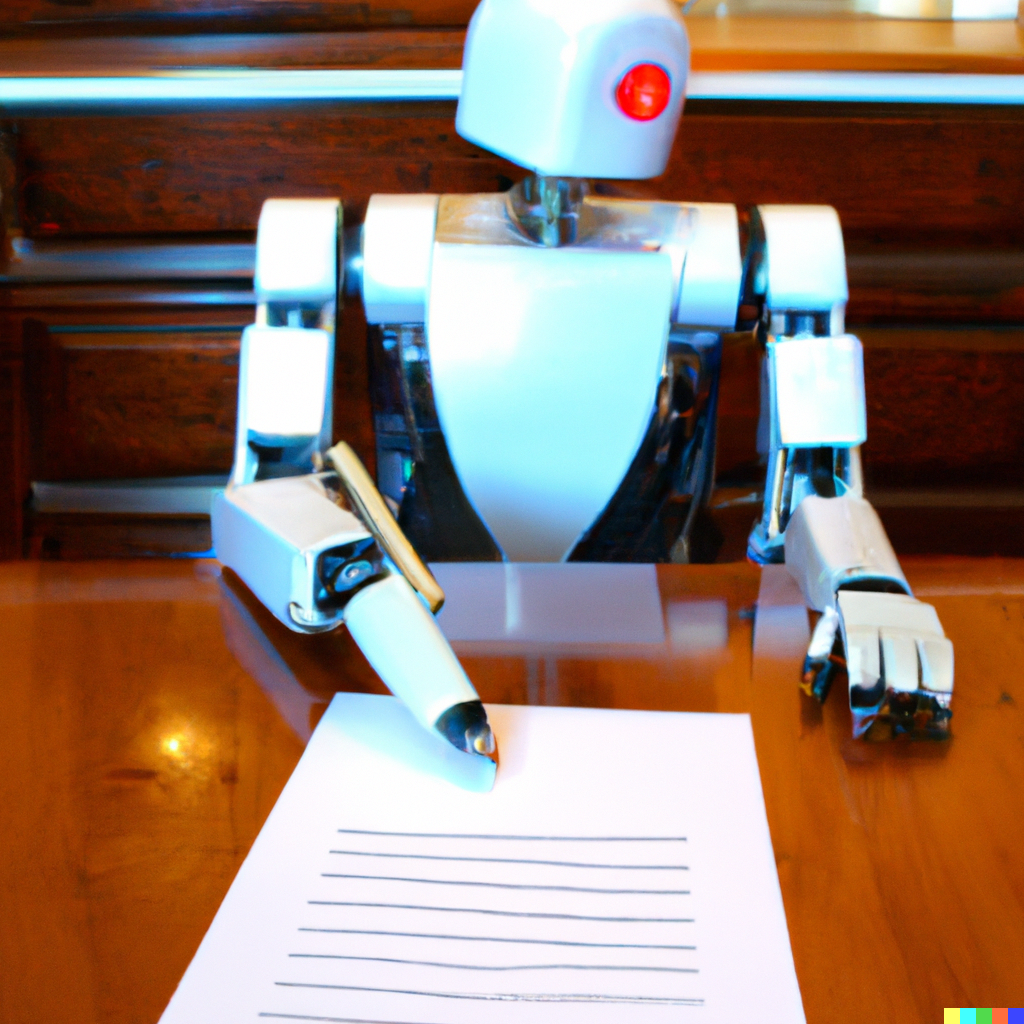
“A robot writing an essay” as interpreted by DALL-E 2
Yes. Absolutely. One hundred percent. But I wouldn’t have thought of it as cheating.
Cheating is a state of mind
When I was in college, I had a massive chip on my shoulder. If I caught the slightest whiff that the professor didn’t care whether I was learning or the assignment was not well-designed to help me learn something, I would immediately flip into “grudge” mode.
I never cheated. The whole point, in my immature mind, was to prove that I was smarter than the professor. So I would stay up late, party the night before the assignment was due, and give myself three or four hours to write it the next morning, hung over, before I had to turn it in. To give you a sense of just how far these grudges went, I didn’t actually enjoy partying very much. Sometimes I would go out of my way to do so because of the stupid assignment. It was all part of a game to challenge myself. No pain, no game.
I wasn’t always so self-destructive about it. If I felt the professor was genuinely interested in my learning but had simply written an assignment I wouldn’t learn from, I’d take the writing prompt and try to be as creative—and subversive—as possible. But that only worked when the professor would understand and appreciate the joke. If I had a professor who had (in my judgment) given me a coloring book and was going to grade me on whether I colored inside the lines, that triggered my worst adolescent self. While I didn’t cheat in the conventional sense, my goal was to minimize effort required to get an adequate grade and show myself how smart I was in the process. My social contract with the teacher was no less broken than the student who copied somebody else’s work. I once defined cheating as “engaging in behaviors that are intended to facilitate passing without learning.” By that standard, I cheated my ass off.
Something like ChatGPT would have been part of the game to me. If you’ve played around with it at all (or read some articles about it), you’ll know that writing prompts that lead the AI to generate good text is something of an art. I would have spent a lot of time crafting the best prompt possible. Then I would have edited the output. I still would have wanted to produce a good essay. If this process took more time to produce the end result than just writing it from scratch myself, it wouldn’t have mattered to me. I would have subverted the assignment into something that actually challenged me while flipping the bird to the instructor who had the temerity to underestimate or underappreciate their students in general and me in particular. That was the whole point of the game. I wanted to learn. And I wanted to care. Nothing pissed me off more than a professor who wasted my educational time.
ChatGPT wouldn’t have violated my “no cheating” rule because I wouldn’t have been cheating according to myrules.
Faculty tend to think that cheating is defined by their rules and the college honor code. The reality is far more complex. For me, it was heavily influenced by my social contract with each teacher, whether I felt they were holding up their end of the bargain, and how I could turn every assignment into a game that was a fun mental challenge. Other students may be influenced by which assignments they think are important for their career goals, how much work is reasonable to expect of them and, very often, or whether they think the instructor cares about their learning.
I can’t emphasize that last point enough. I’ve conducted a fair few focus groups with students over the years. The results consistently supported the research evidence that students are heavily influenced by whether they believe their teacher cares about their learning. And this manifests in surprising ways. I remember one particular focus group vividly. We were talking about what factors cause students to engage in with a class more than they expected or planned to. They all agreed that having a teacher that cared about their learning was a major factor. I asked them how they can tell if a teacher cares. I got some of the usual, expected answers like “she knows my name” or “he talks to me after class to see how I’m doing.” One surprising answer that elicited a lot of nods from the group was, “She picked a random student during class and asks them a question about the reading. She didn’t grade us on the answer but it’s embarrassing if you don’t know it.”
“You liked that?” I asked, somewhat incredulously.
“No,” he replied. “I hated it. But I know she did it because she wanted us to learn. So I did the readings.”
ChatGPT as a tutor
The current fad with journalism about ChatGPT is to ask the bot some version of, “If you were writing this article, what would you write?” The value of that exercise depends on the incisiveness of the commentary regarding the output, the prompt, and the relationship to writing craft. Examples of this genre can range from pretty interesting to pretty terrible, depending on the quality of thinking of the human “writer” involved. Bad articles end either in “WHEEEEE!” or “NO HUMAN WILL EVER LEARN HOW TO WRITE A COMPLETE SENTENCE AGAIN!” Better articles give us insight into what the tool is good for as a writing aid and how that reflects on writing craft.
Let’s see how well I fare at this genre. Can ChatGPT write this blog post for me? The base question I’m after is how to use a tool like ChatGPT to engage students in the craft of writing the way it would have engaged me. As you’ll learn by playing around with the tool or even reading some of the better articles on it, part of the craft in getting useful answers out of ChatGPT is writing a good prompt. My prompts in the experiments below are in bold. ChatGPT’s answers follow.
I’m a college philosophy professor. I have created an assignment asking students to write an essay on a particular topic. They are allowed to use ChatGPT to generate their first draft but will be graded on the accuracy, originality of thought, and writing quality of their final draft. They will also be evaluated on the quality of the ChatGPT prompt that they write. What are the educational strengths and weaknesses of this assignment?
There are both strengths and weaknesses to using a tool like ChatGPT for a college philosophy assignment. One potential strength is that it can help students generate ideas and get started on their essays. This can be particularly helpful for students who may be struggling to come up with a topic or approach to the assignment.
Another potential strength is that using ChatGPT can help students practice using technology in their writing. This is an important skill in today’s world, and it can help students develop the ability to effectively use tools like ChatGPT in their future academic and professional endeavors.
On the other hand, there are some potential weaknesses to this assignment. One is that ChatGPT is a tool that generates text based on prompts, but it does not have the ability to understand the meaning or significance of the words it generates. This means that the essays produced using ChatGPT may not be as original or thought-provoking as those produced by the students themselves.
Another potential weakness is that using ChatGPT could discourage students from engaging with the material in a deep and meaningful way. Instead of reading and thinking critically about the assigned texts, they may simply use ChatGPT to generate a first draft and then submit it without further thought or analysis.
Overall, the use of ChatGPT in a college philosophy assignment has both strengths and weaknesses. It can be a helpful tool for generating ideas and getting started on an essay, but it should not be used as a substitute for careful reading, thinking, and writing.
My dialogue with ChatGPT
Meh. ChatGPT’s answer has all the hallmarks of an adequate but unimaginative high school essay, right down to the form. It has not produced an essay that is “original or thought-provoking” or written content that engages with the prompt “in a deep and meaningful way.”
We can marvel at the ability for the technology to do this well. It is genuinely miraculous and merits a brief pause for a moment of wonder. That said, the content itself is not enlightening or even particularly interesting by human writing standards.
Let’s try again. I’ve altered the prompt using language from ChatGPT’s output in our first try. To make the changes more obvious, I’m showing the text I deleted from the original prompt and underlining the text I added:
I’m a college philosophy professor. I have created an assignment asking students to write an essay on a particular topic. They are allowed to use ChatGPT to generate their first draft but will be graded on the accuracy, originality of thought, and writing quality of their final draft. They will also be evaluated on the quality of the ChatGPT prompt that they write. What are the educational strengths and weaknesses of this assignment?How can I improve this assignment to encourage students to produce more original, thought-provoking assignments in which the students engage with the material in a deep and meaningful way?
One way to improve this assignment would be to provide more guidance on how to use ChatGPT effectively. For example, you could provide students with examples of good and bad ChatGPT prompts, and explain how to write a prompt that will generate thoughtful, original responses from the tool.
Another way to improve the assignment would be to require students to engage more deeply with the material before using ChatGPT. For example, you could ask them to read and annotate the assigned texts, or to participate in a class discussion, before using ChatGPT to generate their first draft. This will help ensure that they have a strong understanding of the material and are able to generate original, thought-provoking ideas on their own.
In addition, you could also consider modifying the grading criteria for the assignment. For example, you could place less emphasis on the accuracy of the ChatGPT-generated text, and instead focus on the student’s own writing and analysis in the final draft. This would encourage students to take the time to engage with the material and produce original, well-written essays.
Overall, there are several ways you could improve this assignment to encourage students to produce more original, thought-provoking work. By providing more guidance on how to use ChatGPT effectively, requiring deeper engagement with the material, and modifying the grading criteria, you can help students develop the skills and habits needed to produce high-quality work in their philosophy studies.
My dialogue with ChatGPT
This answer is more interesting. The first suggestion—teach students how to write effective prompts—is a good start. I do think this is a skill that will be taught widely in schools within five years. (It should be sooner than that and it realistically might be later.) I don’t agree with the suggestion to de-emphasize the accuracy of ChatGPT’s text. Evaluating the quality of source material is an essential skill which becomes more important, complex, and interesting with the introduction of tools like this one. That said, a lot depends on context. I could imagine assignments for which I would take ChatGPT’s advice on this point. Notice, though, that the structure of the “essay” ChatGPT generated is still pretty stiff and formulaic. Leaning too heavily on a tool like this could have the effect of cultivating competent writing at the expense of stifling great writing.
Still, I can see the shape of a pedagogical process—and preferably a supporting end-to-end tool—that teaches many of the skills involved with good writing, including some hard ones like checking sources and editing—while including some elements of creativity. If it is scaffolded properly—again, with the right tool and process but also with a good, solid rubric—it could enable educators to spend more of their time honing in on specific aspects of the writing process with less drudgery. Particularly if used judiciously as part of the writing curriculum rather than the whole thing, it could be quite useful.
It’s also honest. It strengthens rather than weakens the social contract between student and educator by allowing the students to use a tool as long as they are open about it and are using it as part of a genuine learning process rather than a shortcut around thought work.
Would I use ChatGPT to help me write blog posts?
In principle, I have no problem with the idea of using machine-generated text in e-Literate posts as long as it is properly attributed. In practice, I haven’t been able to figure out a way to make it useful.
Part of the value of e-Literate is that it can be surprising in both content and form. Novelty teaches while entertaining. Could a tool like ChatGPT develop the right sort of novelty to fit with this blog? On the surface, it probably could. We’re already starting to see examples of the tool being asked to write an article on X subject in the style of Y person. If trained on the thousands of posts I’ve written, I suspect that a tool like ChatGPT, or maybe the next generation of it, could learn to use more em dashes, write convoluted sentences, and be more snarky. It might even incorporate some themes that show up in my posts.
But it doesn’t actually understand anything that it writes. ChatGPT distills and synthesizes answers that have already been given. It can only write about ideas that I have already thought of and written about. It can’t write about the idea I’m going to have tomorrow. e-Literate isn’t about what I know. It’s about what I’m learning. As such, I don’t yet see how I could get much value out of a tool like ChatGPT in the foreseeable future, at least for this blog. The only exception I can think of is for posts like this one that are about the tool. ChatGPT didn’t really write part of this post for me. It generated artifacts for me to analyze in my own writing.
These lines of demarcation—the lines between when a tool can do all of a job, some of it, or none of it—are both constantly moving and critical to watch. Because they define knowledge work and point to the future of work. We need to be teaching people how to do the kinds of knowledge work that computers can’t do well and are not likely to be able to do well in the near future. Much has been written about the economic implications to the AI revolution, some of which are problematic for the employment market. But we can put too much emphasis on that part. Learning about artificial intelligence can be a means for exploring, appreciating, and refining natural intelligence. These tools are fun. I learn from using them. Those two statements are connected.
Would I teach writing using ChatGPT?
If I were teaching writing today, would I use an AI tool? In practice, probably not, simply because it would be too much work to cobble together the pieces. ((I have now guaranteed that I will get an avalanche of emails from EdTech startups claiming to solve this problem. Please direct your messages to my chatbot.)) This is the perennial challenge of EdTech, which, on balance, creates a vastly underestimated drag on the amount of time educators have to put into the thought work of delivering high-quality education. In principle, though, yes, I absolutely would. I have a clear picture in my head of what I would need in terms of the EdTech and what sorts of writing work I would (and wouldn’t) use it for.
Do I think higher ed is ready for widespread adoption of these tools? That’s a harder question. Teaching this way requires a new skillset. Higher ed has abysmally under-resourced professional development support for teaching, on the whole. Also, teaching this way isn’t what our PhD system trains young academics to aspire to. Many will see it as a dumbing down of the work they have dedicated their lives to. And if implemented poorly, it can easily turn into that.
So will AI text generation tools revolutionize or kill college writing? Both! Neither! For sure! Probably! Eventually! Somewhat! It’s…complicated.
Artificial intelligence will soon be able to research and write essays as well as humans can. So will genuine education be swept away by a tidal wave of cheating – or is AI just another technical aid that teaching and assessment will evolve to take account of? John Ross reports[.]
Does AI Spell the End of Education?
This is an excellent article. I don’t mean that it is insightful or well-written. While it has its moments, overall, it’s an unenlightening mess wrapped in clickbait packaging. It is not good writing or good journalism.
But it is a near-perfect illustration of how the popular representations of both artificial intelligence (AI) and cheating can be harmful. ((The THE article also completely elides the difference between artificial intelligence (AI) and its cousin machine learning (ML). This is forgivable because the reader doesn’t need to understand the difference for the purpose of the piece. I’m not going to delve into the distinction in this blog post for the same reason. But I’m aware there is one. When I refer to AI, please read that as shorthand for the larger family of AI and ML techniques.))
It also shows a way for educators to understand AI better because AI and cheating sometimes work in similar ways. I will explain the parallel in this blog post. In the process, I will also argue that framing cheating in the context of “academic integrity” is harmful. And I will argue that all of these misunderstandings are counterproductive to preparing students for the future of work.
People who cheat are not “cheaters”
As you’ve probably figured out by now, I’m going to treat the THE article harshly. I’ll try my best to avoid the oh-so-tempting cheap shots. (The original working title for my post was “Does AI Spell the End of Education Journalism?”) The deeper problem at the heart of this article deserves serious treatment. I’m going to argue that “Does AI Spell the End of Education” is an example of journalistic “cheating.” In the process, I’m going to take a somewhat unconventional position on what it means to “cheat.” That position is relevant not only to how AI is used in the classroom but also to how we should think about AI and knowledge work and to how we should think about so-called “academic integrity.”
As part of that reframing, I want to be very careful to separate judgments about the writing from ones about the article’s writer, John Ross. I don’t know the man. I also don’t know the assignment he was given that led to him producing this article. I have no opinion of him as a writer or a human being. I only have opinions about the quality of this piece and the writing process that led to it.
I define “cheating” as “engaging in behaviors that are intended to facilitate passing without learning.” This definition avoids passing a blanket judgment on the person engaging in the behavior. It doesn’t accuse them of lacking “academic integrity.” It simply identifies behaviors that facilitate students getting good grades—which in the workplace we might call “scoring well on key performance indicators (KPIs)—without actually doing the hard thought work necessary to complete the assignment as intended. Any scoring system can be gamed. People game scoring systems for all kinds of reasons. One might be pressure. Perhaps a student wants to learn but needs to pass. Or a journalist wants to write an insightful piece but needs to complete a hugely ambitious assignment with an unrealistic deadline or word count limit. Sometimes we engage in sloppy or lazy shortcuts not because we are sloppy or lazy people but because we feel forced to do so by the circumstances. Whether in the classroom or the workplace, our primary focus should be on reducing the incentives to game the scoring system rather than on punishing “cheaters” for their lack of “integrity.”
From here forward, I will distinguish between John Ross, the human author of “Does AI Spell the End of Education?”, and the mental algorithm he employed to write this piece, which I will call Journobot 2000. These two are not the same. John Ross may very well be a smart guy. Journobot 2000 is a set of mental shortcuts that John Ross employed to avoid the hard work of thinking and learning when writing parts of his article. It does not understand AI, cheating, or the teaching of writing. It is capable of assembling passages about such topics in ways that sound coherent. It can even fool some intelligent readers into thinking that its output reflects some understanding of these topics. But Journobot 2000 does not understand anything. It is simply a sophisticated pattern-matching algorithm that can copy/paste in interesting ways and employs a souped-up thesaurus to rephrase sentences.
Journobot 2000 is a cheating strategy. It enables a writer under pressure to produce an article that sounds coherent without forcing that writer to invest the time necessary to understand the subject. When students employ Journobot 2000—which many do—they do not learn. When knowledge workers do the same, they do not perform useful knowledge work.
Knowledge work and learning are the same. Knowledge workers solve novel problems. How do they do that? By learning. Learning, in turn, requires thinking. Shortcuts that reduce drudge work are fine, but ones that reduce thought work are dangerous if your work requires you to think and learn.
Writing as collage
Journobot 2000 has assembled a series of quotes and facts related to the topics of AI, writing, and/or cheating in some combination. Before we analyze how it does this, let’s look at a few of the individual quotes from interviewees that appear in the article. I’ve arranged these out of order from their placement in the article for a specific reason. Think about each of these passages on its own and consider which issue or issues each speaker is concerned about.
I’ll provide fairly extensive quotes from every person to provide the flavor of their concerns. The first passage quotes Lucinda McKnight, a senior lecturer in pedagogy and curriculum at Deakin University:
“How do we prepare teachers to teach the writers of the future when we’ve got this enormous fourth industrial revolution happening out there that schools – and even, to some extent, universities – seem quite insulated from?” McKnight asks. “I was just astonished that there was such an enormous gap between [universities’] concept of digital writing in education and what’s actually happening out there in industry, in journalism, business reports, blog posts – all kinds of web content. AI is taking over in those areas.”
McKnight says AI has “tremendous capacity to augment human capabilities – writing in multiple languages; writing search engine-optimised text really fast; doing all sorts of things that humans would take much longer to do and could not do as thoroughly. It’s a whole new frontier of things to discover.”
Moreover, that future is already arriving. “There are really exciting things that people are already doing with AI in creative fields, in literature, in art,” she says. “Human beings [are] so curious: we will exploit these things and explore them for their potential. The question for us as educators is how we are going to support students to use AI in strategic and effective ways, to be better writers.”
And while the plagiarism detection companies are looking for more sophisticated ways to “catch” erring students, she believes that they are also interested in supporting a culture of academic integrity. “That’s what we’re all interested in,” she says. “Just like calculators, just like spell check, just like grammar check, this [technology] will become naturalised in the practice of writing…We need to think more strategically about the future of writing as working collaboratively with AI – not a sort of witch-hunt, punishing people for using it.”
Does AI Spell the End of Education?
That’s interesting. I agree with some of McKnight’s comments and have questions about others. For example, there’s an enormous difference between writing search-engine-optimized (SEO) text really fast and writing informative and well-written SEO text really fast. What is the relationship between the tool and the knowledge worker here? I have an SEO tool in my blog. It hates my writing. The feeling is mutual. If I followed its recommendations slavishly, I would have many more people coming to my site and many fewer reading it.
For now, the takeaway is that McKnight is interested in teaching students about how they might use AI text generation tools in the workplace. Let’s save further exploration of this line of thinking for later in this piece.
The next person in the article whose concerns I’d like to explore is Dr. Jesse Stommel, Digital Learning Fellow and Senior Lecturer of Communication and Digital Studies at the University of Mary Washington. Stommel is concerned about anti-plagiarism software. Here is how he is quoted:
“They have data about student writing,” he says. “They have data about how student writing changes over time because they have multiple submissions over the course of a career from an individual student. They have data where they can compare students against one another and compare students at different institutions.”
The next step, Stommel argues, is the development of an algorithm that can capture “who my students are, how they grow, if they’re likely to cheat. It’s like some dystopic future that is scarily plausible, where instead of catching cheaters, you are suddenly trying to catch the idea of cheating. What if we just created an algorithm that can predict when and how and where students might plagiarise, and we intercede before they do it? If you’ve seen Minority Report or read Nineteen Eighty-Four or watched Metropolis, you can see the dystopic place that this will ultimately go.”
Does AI Spell the End of Education?
Stommel is focused here on student data privacy, which can be a critical issue of certain applications of both AI and non-AI EdTech. While I don’t agree with his assessment regarding the plausibility of his nightmare scenario, I completely agree with the concern he is highlighting and would like to see it unpacked and explored. I could easily write an entire long post explaining which fears are realistic and why or why not. Notice, though, the concern Stommel expresses here isn’t about text generation tools or even AI specifically.
The third quote from the article that I’d like to highlight is from Andrew Grauer, CEO of Course Hero. He said,
“I’ve got a blinking cursor on my word processor. What a stressful, inefficient state to be in!” he says. Instead, he could use an AI bot to “come up with some kind of thesis statement; generate some target topic sentences; [weigh up] evidence for a pro and counter-argument. Eventually, I’m getting down to grammar checking. I could start to facilitate my argumentative paper.”
Does AI Spell the End of Education?
This, too, is interesting and worth exploring. When is this sort of support scaffolding that helps students learn, and when is it a crutch that helps them avoid learning? I did write about this topic as part of a larger post on scaling the digital seminar and could easily write more about it.
Grauer’s quote does seem related to McKnight’s. They’re both interested in how AI can scaffold writing. When John Ross interviewed people for the article that would eventually be named “Does AI Spell the End of Education?”, he did seem to probe his interviewees to foster a genuine dialog on this aspect of the article. He even introduces a quote from Turnitin’s Chief Product Officer Valerie Scheiner that acts as connective tissue between the two others. Here’s her relevant passage:
Turnitin is now using AI to give students direct feedback through a tool called “Draft Coach”, which helps them avoid unintentional plagiarism. “‘You have an uncited section of your paper. You need to fix it up before you turn it in as a final submission. You have too much similarity [with a] piece on Wikipedia.’ That type of similarity detection and citation assistance leverages AI directly on behalf of the student,” [Scheiner] says.
But the drawing of lines is only going to get more difficult, she adds: “It will always be wrong to pay someone to write your essay. But [with] AI-written materials, I think there’s a little more greyness. At what point or at what levels of education does using AI tools to help with your writing become more analogous to the use of a calculator? We don’t allow grade-three students to use a calculator on their math exam, because it would mean they don’t know how to do those fundamental calculations that we think are important. But we let calculus students use a calculator because they’re presumed to know how to do those basic math things.”
Schreiner says it is up to the academic community, rather than tech firms, to determine when students’ use of AI tools is appropriate. Such use may be permissible if the rules explicitly allow for it, or if students acknowledge it.
Does AI Spell the End of Education?
This seems to be a direct response to McKnight’s quote while nodding at some of the ethical issues raised elsewhere the piece. The most interesting part of “Does AI Spell the End of Education?” is the tension—and arms race—between text generation tools and plagiarism detection tools.
But the piece never quite manages to fully focus on this dilemma. It’s weirdly fragmented. There’s a one-sentence reference to “word spinners,” which are text paraphrasers that can be used to disguise plagiarism. But Ross never follows up on this angle, despite the fact that it fits perfectly with the dialog on text generation he’s assembled with the quotes from McKnight, Grauer, and Scheiner. Instead, he just supplements that one-sentence mention with a link to an article about word spinners on Turnitin’s web site. And then there’s Stommel’s quote, which is stuck in the middle of the piece and doesn’t seem directly related to the rest of the narrative. Student data privacy is not raised either before or after. The quote is just…there.
Why?
The answer is that John Ross, the human writer, cheated. This article seems like the result of a reporter who has interviewed a range of experts on the topic of AI in education as part of an effort to understand and report on the issues.
But it isn’t.
Several interviewees told me that they were interviewed months ago on topics other than AI and the teaching of writing. One of them, Jesse Stommel, went on record for me on this topic. He told me that he was originally interviewed about Turnitin’s acquisition of one of its competitors. While he does not object to authors using his quotes in other articles, he said, “[M]y quotes were not direct reflections on AI.” In fact, AI did not even come up in his interview.
When read with this in mind, the article makes much more sense. The most coherent parts of the writing were on threads that would have fit in the context of an article on Turnitin and anti-plagiarism software. The parts that get messy are precisely those where John Ross’s original research on a Turnitin story did not line up well with the purported topic of the article. For example, Stommel’s quote would have fit more naturally in the anti-plagiarism software piece because he was voicing concern about how anti-plagiarism software uses student data.
When John Ross decided to use some of the material from his original, never-published piece on Turnitin, he could have gone back to Stommel and asked him for questions that would have been directly relevant to the AI article. But he didn’t. Why not? I don’t know. Maybe he was lazy. Maybe he was under time pressure. Maybe his editors wanted something particular from him. I’m not going to judge the human being based on one article.
But I am going to judge his work on the article itself. For whatever reason, Ross fired up Journobot 2000. Rather than conducting further research, he took what he had already from a piece on another topic. He rearranged the pieces to look like they had always been intended to be parts of an article on AI. Journobot did so by following a simple pattern that I’ll analyze in the next section.
This is remarkably like the strategy students take of plagiarizing an essay on a similar topic to the one they’ve been assigned and then rearranging it to try and make it fit. The only difference is that he was plagiarizing himself. The problem here isn’t taking somebody else’s thoughts and claiming them as your own. It’s claiming to have thought about and analyzed a topic when you haven’t.
When students do this sort of thing, we call it “cheating.” It results in them failing to think and learn. When journalists do it, we call it “lazy journalism.” It results in messy articles that fail to enlighten the reader. More generally, when knowledge workers do it…well, we don’t have a specific name for it, but it results in low-quality work.
In data science, we call it “artificial intelligence.”
What cheating looks like
Journobot 2000 does not understand the relationship between Jesse Stommel’s data privacy concern and AI. It’s matching two kinds of patterns. First, since this is an article on a controversial topic, it represents controversy by alternating between quotes with positive sentiment scores and ones with negative sentiment scores. It’s simulating point/counterpoint. John Ross, the human journalist, could have chosen to leave out the hyperbolic end of Stommel’s quote and focused instead on the underlying concern. Journobot 2000 likely found that quote to fit its pattern-matching algorithm precisely because of the ending, which expresses a strong negative sentiment about something related to the topics at hand. It also knows how to write transitional phrases so that one passage appears related to the next.
Speaking of which, Journobot 2000 knows that anti-plagiarism software, AI, cheating, and writing are related topics. It organizes the quotes in ways that show relatedness among the topics. Because it doesn’t really understand the topics the same way humans do, a careful reader can see the seams where the piece doesn’t really hold together. But a casual reader might not notice that Stommel’s quotes have been spackled into places where they only loosely fit with the analysis that comes before or after. He’s not really part of the dialog in the same way that some of the others were.
Likewise, there’s that largely unutilized reference to word spinners. In an article about Turnitin, the topic might have only made sense to mention as one of many aspects concerning the company and its acquisition of a competitor. But in an article about AI potentially ending education, word spinners should have received significant attention. John Ross might have seen that and researched accordingly. Journobot 2000 did not make the connection.
Let’s pick up on a couple of the threads missed by Journobot 2000 to get a sense of the article that could have been if John Ross had applied the same level of attention that the archeological evidence in his published piece suggests he put into the original, unpublished version.
Articles written by actual machines
Let’s start with the wonders of machines writing articles. You have almost certainly read articles written by a machine. For example, if you follow stocks, you may have already learned to recognize the articles written by bots. Imagine a massive drop in the stock price of a biotech stock because they had bad clinical trial results. You might read a perfectly well-written financial news story in your inbox, telling you all about the technical indicators on the stock price, complete with a headline suggesting the article will provide insight as to whether to buy or sell…but no mention whatsoever of the news that drove the price move. The technical analysis is data-driven and seems perfectly cogent. The writing has just a dash of colorful language, suggesting the barest hint of a simulated authorial voice. If you didn’t know about the news, it would seem normal. But it’s not really a financial analysis news piece. It’s a data analytics report written in narrative form with a formulaic headline tacked on the top. The machine doesn’t really understand the topic it’s writing about.
In this example, there may be little to no actual artificial intelligence involved in the writing. A human might have written a template covering the topic of a certain type of stock movement. The software fills in the data. It has been provided with a handful of colorful phrases to substitute for different common phrases. “The stock took a nosedive.” “The stock tanked.” “The stock plummeted.” These can be interchanged randomly to create the appearance of an author behind the piece.
Genuine AI can generate original writing using a family of techniques called Natural Language Processing (NLP). A particular product called GPT-3 produced by a company called OpenAI is getting most of the buzz right now, but there are others. It can produce uncanny writing. By which I mean writing that falls in the uncanny valley. It’s writing that seems sort of human but not quite. The result is weird and sometimes creepy. (To get a delightful sense of just how weird and creepy, read Janelle Shane’s blog AI Weirdness. And then read her book, You Look Like a Thing and I Love You: How Artificial Intelligence Works and How It’s Making the World a Weirder Place.)
A recent article on NextWeb, “Don’t mistake OpenAI Codex for a programmer,” is illustrative. It’s all about how the Microsoft-owned Github software repository platform took a highly customized version of GPT-3 and trained it to write computer code. The idea is that if GPT-3 can learn English, then it should be able to learn Javascript. Programming languages are languages, after all.
A good part of the article is devoted to the No Free Lunch Problem, “which means that generalization comes at the cost of performance. In other words, machine learning models are more accurate when they are designed to solve one specific problem. On the other hand, when their problem domain is broadened, their performance decreases.” Even an enormous, computationally expensive, state-of-the-art AI program like GPT-3 is mediocre at performing a wide range of tasks. Developers invest enormous time and energy tuning it to do one thing really well. And even then, “really well” isn’t always…um…all that well. Here’s the money quote from the piece:
In their paper, the OpenAI scientists acknowledge that Codex “does not sample efficient to train” and that “even seasoned developers do not encounter anywhere near this amount of code over their careers.”
They further add that “a strong student who completes an introductory computer science course is expected to be able to solve a larger fraction of problems than Codex-12B.”
Don’t mistake OpenAI Codex for a programmer
While I don’t know how much money Microsoft spent on developing Codex, I’m confident it cost at least several orders of magnitude than the typical EdTech AI. And yet, it can’t match a first-year computer science undergraduate.
Why not? The piece goes into some technical detail, but it boils down to the fact that today’s AI still has some sharp limitations relative to humans when it comes to problem-solving. It can’t hold as many relevant facts in its “head” as we can. It doesn’t match patterns in the same way. It’s not as good at catching nuances of meaning in language and relationships among ideas. While the progress being made in AI today is miraculous, it’s not biblically so. It’s not magic. If one of the most expensive and technologically advanced algorithms in human history can’t match a first-year college student, then we should probably let go of the breathless hyperbole about AI “ending education” for a while.
Rather than employing Journobot 2000, John Ross could have engaged his full human faculties as a learner, thinker, and knowledge worker to engage with the purported topic of his article. He has many of the raw ingredients for something genuinely interesting. But he didn’t take the time to follow the threads.
Word spinners are another example.
Spinning words
John Ross’s article mentions “word spinners”—tools that rewrite sentences using AI—as cheating tools to get around plagiarism detectors. But it doesn’t name any or explore the topic in detail. The most he does is link to an article about word spinners on Turnitin’s website (which is probably another artifact of the original article).
In the absence of John Ross’s due diligence, I conducted a little of my own by employing an advanced AI research tool called Google. It turns out not all word spinners are the same. For example, Rewriter Tools Article Spinner all but explicitly advertises itself as a tool that is designed for cheating:
Today, almost everything is done online – including work assignments, student essays, and anything else you can think of. As a result, a large amount of written work also has to be done online.
The problem is that so much has already been written about pretty much everything, that creating completely new and unique content is quite difficult. Not to forget, also time-consuming and rather tiring, too. As a result, many people get confused and frustrated while trying to create unique content.
Do you want to create original, fresh content but are pressed for time? Rewriting a document to make it unique is not always an easy task. This is why we present you with Article Spinner – the perfect to help you create fresh content in very little time.
Probably some bot
Ladies and gentlemen, welcome to the future of knowledge work! Papers that are badly rewritten by a tool created by a bad writer because thinking is too hard and who has original ideas anymore anyway?
The future of work?
On the bright side, their search engine optimization algorithm must be good because this text put them near the top of my search results page.
Quillbot, on the other hand, positions itself as a tool that helps writers tune their language to their audience:
Your words matter, and our paraphrasing tool is designed to ensure you use the right ones. With 3 free modes and 4 premium modes to choose from, QuillBot’s paraphraser can rephrase any text in a variety of different ways, guaranteeing you find the perfect language, tone, and style for any occasion. Just enter your text into the input box, and our AI will work with you to build the best paraphrase from the original piece of writing.
A slightly more sophisticated bot
Is that better than Article Spinner? I think it may be worse. First, it appears to be more sophisticated at rephrasing other people’s work. When McKnight talks about the Fourth Industrial Revolution and AI helping humans do their jobs better, I don’t think she means AI helping college students take pieces written by somebody else and paraphrasing them in varied ways to pass a plagiarism detector.
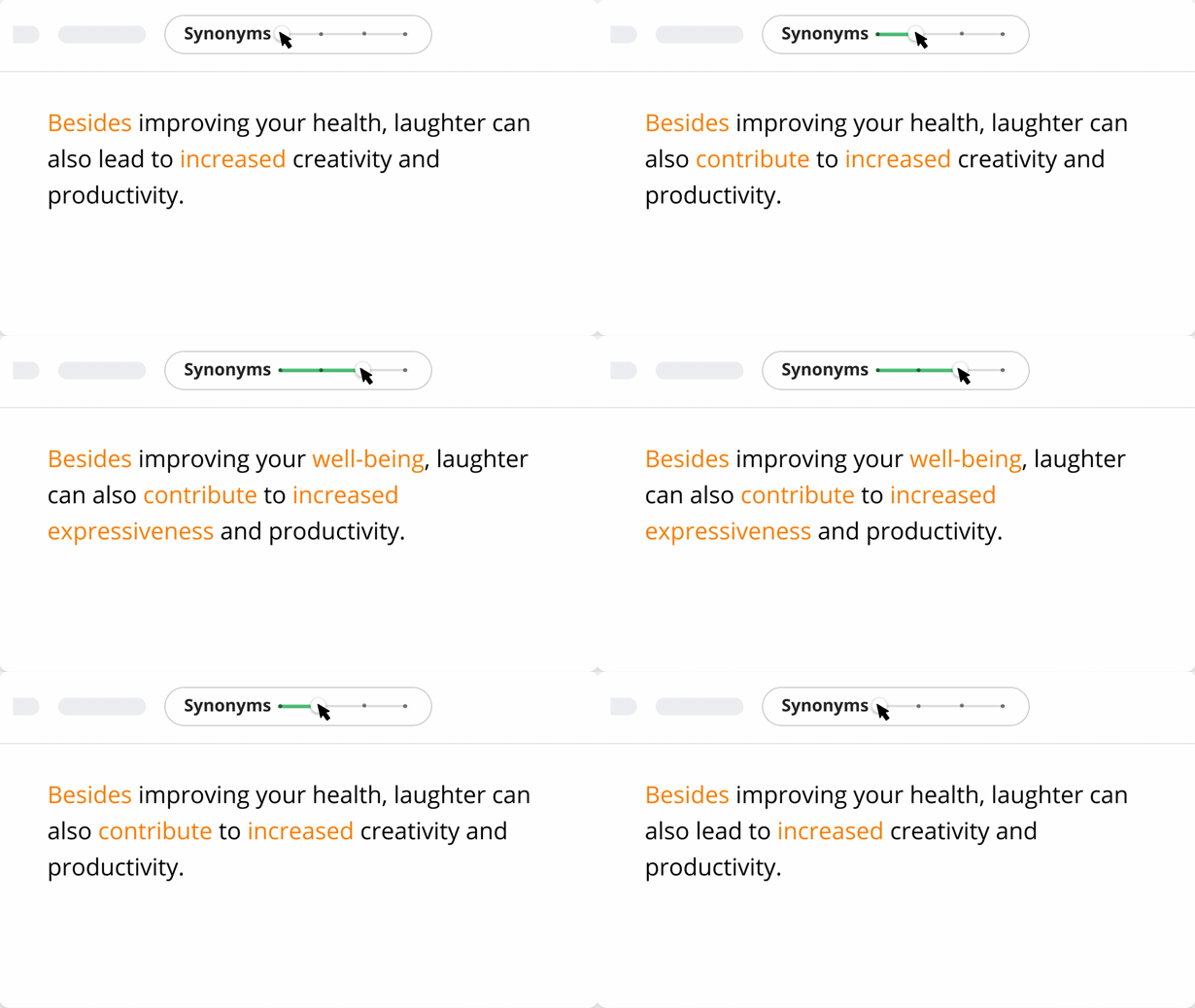
Siri, make this plagiarized essay sound more friendly.
Second, again, I’m having a hard time coming up with legitimate use cases that aren’t just shortcuts to avoid thinking. I use a grammar checker that makes style suggestions—more on that momentarily—but it doesn’t wholesale rewrite for me. Instead, it highlights choices that I can make as a knowledge worker. Quillbot calls itself a “paraphraser.” (Side note: Judging from the text on both sites, I’m guessing that “paraphrase” may be a good SEO term for both products.) Maybe there are some legitimate uses for a tool that can quickly paraphrase a longer document. If I write a follow-up post to this one, I may try using it on a previous post to see if anything useful comes out.
Then there are grammar checkers, which are mentioned but—again—never explored in “Does AI Spell the End of Education?” I use Grammarly Premium regularly. In fact, I am using it right now. It helps me catch mistakes and write clearer, punchier prose. Even though I am a pretty good writer, Grammarly improves almost everything I write (when I use it). But it is only useful to me because I know when—and why—I should ignore or overrule its suggestions. If I were to ask students in a writing class to use it, I would have to teach them to do the same. The problem is that I don’t know how Grammarly works. I can’t teach students how to anticipate all the mistakes it might make.
This is particularly true with students who have language patterns that Grammarly might not anticipate. For example, second-language learners whose native language is Chinese or Russian may write English sentences that drop certain types of words (like articles or pronouns), mix up verb tenses, mess up idiomatic expressions, and change the word order. And even fluent second-language learners may make mistakes that the grammar checker won’t diagnose correctly when the writers are stressed, such as when they are trying to express difficult ideas while writing under time pressure. In combination, these problems could confuse a grammar checker and cause it to make a bad suggestion.
As a result, I would have to think hard about whether, when, and how to use Grammarly as a teaching tool, even if I believed it would help most students improve their writing the majority of the time. As a writing teacher, my job isn’t to get students to produce better writing. It’s to teach them how to be better writers. As a writer, while I use Grammarly to help me edit my text more quickly and effectively, I also use it to help me make mindful decisions about when to break the rules. Good writers balance clarity against expressiveness all the time. Sometimes I override Grammarly not because its suggestion is wrong but because I have chosen to write a more challenging sentence to read to communicate a challenging idea more effectively.
I would have liked to read a researched article on this topic. I suspect John Ross could have written it. Journobot 2000 cannot.
The bottom line
The future of work is knowledge work. Knowledge work and learning are the same. Therefore, if we want to prepare students for the future of work, we need to teach them how to think and learn. Cheating is behavior intended to achieve a passing grade without learning. Cheating is bad because it leaves students ill-prepared for the future of work (not to mention for life). Tools or strategies that help knowledge workers (including students) avoid mindless work are probably good more often than not. Tools or strategies that help knowledge workers avoid thought work are probably bad. More often than not.
“Does AI Spell the End of Education?” raised (but did not explore) authentic assessment as one way out of the cheating problem. While I’m a fan of authentic assessment, the article itself is proof that it is not a panacea. Because it is, in fact, an authentic assessment of John Ross’s writing. As a writing portfolio artifact, the piece shows that the author could pass, i.e., get his article published, without learning anything new about the promise and perils of AI in education.
Many decent educators have faced the challenge of trying to break students out of algorithmic behaviors that have enabled them to pass without learning, whether the behavior is writing a robotic five-paragraph essay or memorizing physics equations without understanding them. If cheating is the set of behaviors designed to succeed without learning, then these behaviors, which have been taught to students as perfectly appropriate, are cheating just as much as copying somebody else’s answer is. It matters in the classroom, it matters in the workplace, it matters in the home, and it matters in the ballot booth. I hope the next article I read about AI and cheating will be about applying AI to solve that problem.