e-Literate

Present is Prologue

Tag: Higher Ed

  • The Most Thorough Summary (to date) of MOOC Completion Rates

    How many times have you heard the statement that ‘MOOCs have a completion rate of 10%’ or ‘MOOCs have a completion rate of less than 10%’? The meme seems to have developed a life of its own, but try to research the original claim and you might find a bunch of circular references or anecdotes of one or two courses. Will the 10% meme hold up once we get more data?

    While researching this question for an upcoming post, I found an excellent resource put together by Katy Jordan, a graduate student at The Open University of the UK. In a blog post from Feb 13, 2013, Katy described a new effort of hers to synthesize MOOC completion rate data – from xMOOCs in particular and mostly from Coursera.

    Via a combination of thinking about ‘what makes a successful MOOC?’, and looking for a topic for my final project on the Infographics MOOC, I decided to try to pull together the various statistics floating around online about MOOC completion rates. I’m trying to see if any differences emerge on the basis of platform or the assessment methods used.

    My draft graph synthesising everything I’ve found so far can be found here: http://www.katyjordan.com/MOOCproject.html

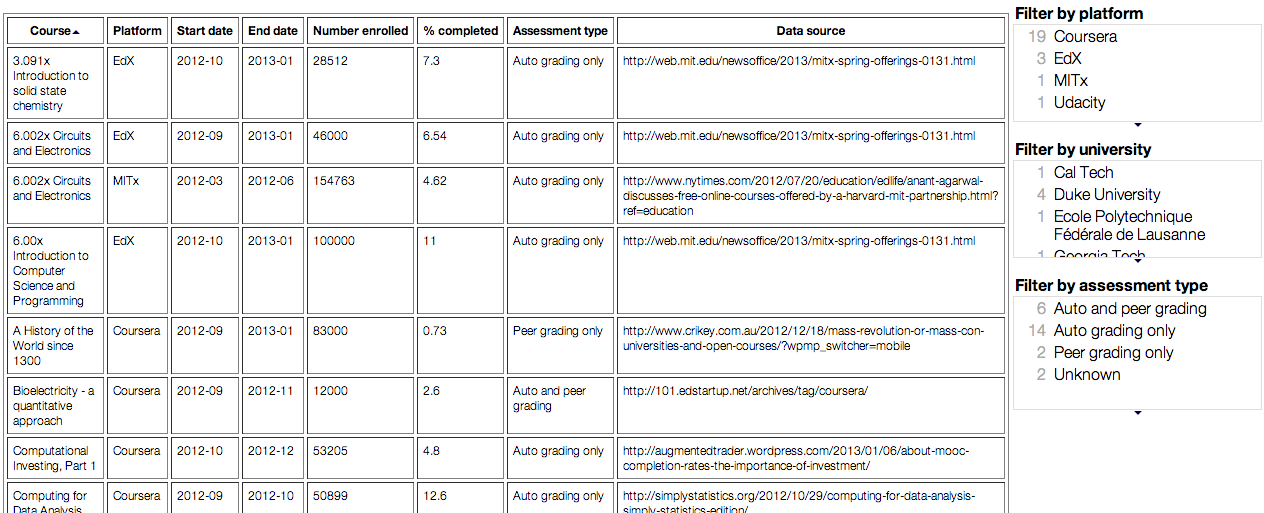
    What Katy has done so far is compile completion rate data from 24 MOOCs – 19 from Coursera, 3 from edX, 1 from Udacity and 1 from MITx (a precursor to edX). The data is available in a table format or in a graph.

    table


    (more…)

  • State of the Higher Education LMS Market: A Graphical View

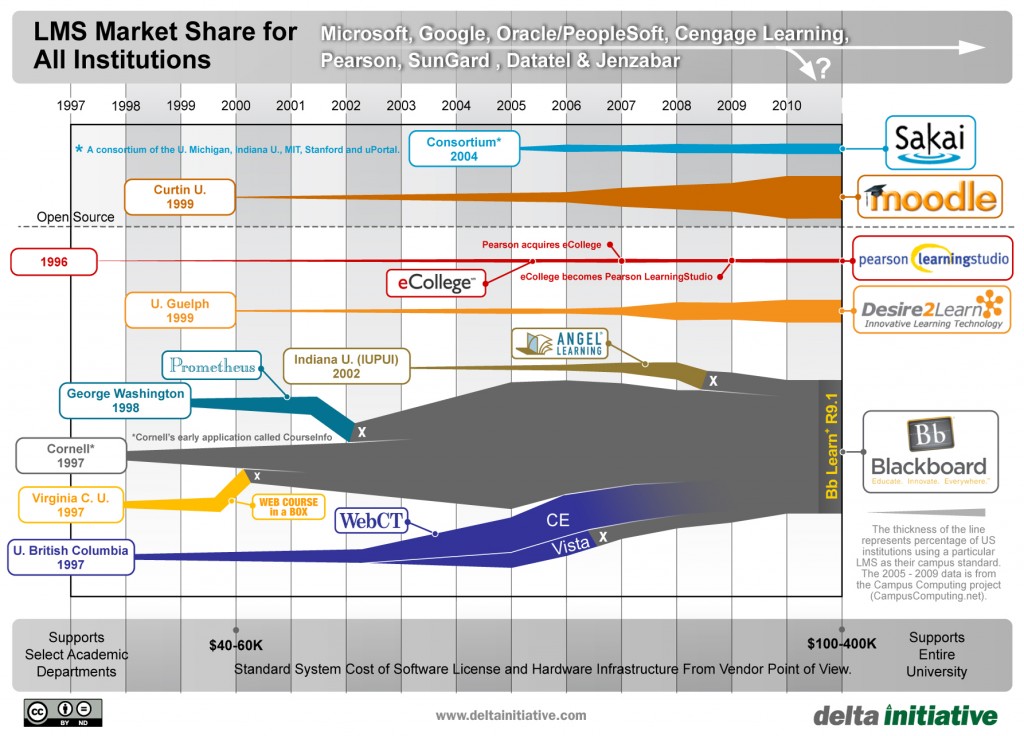
    The transformation of the higher education LMS market continues, and I expect more changes over the next 2 – 3 years. However, it seems time to capture the state of the market based on changes over the past year or two.

    I shared the most recent graphic summarizing the market in mid 2011. As with all previous versions, the 2005 – 2009 data points are based on the Campus Computing Project, and therefore is based on US adoption from non-profit institutions. This set of longitudinal data provides an anchor for the summary.

    The most significant changes over the past two years include the following.

    (more…)

  • Online Education and the College Crisis: A Student’s View

    There are a lot of useful opinions and debates on the role of online education in solving various problems of higher education, but I find that we too often lack the student’s view on the subject. Towards that end, I am sharing the comments from a student about affordable access to the courses needed for a degree and one role of online education. The student is my daughter, Hillary Hill, who is entering her second year at a California State University campus.

    “We should change the name of this [Sonoma State University Class of 2015] group to “Sonoma State University Class of 2056.”

    “I am not even a full time student…”

    “I’m not paying double what I used to to not get classes!”

    These are just a few of the Facebook posts I read from my friends on the day of open registration for Fall 2012 started. At 9 AM, MySSU [portal and administrative system] went live, and students scrambled to get units. Unfortunately, there were very few units to be had. People are stuck taking classes they don’t need or want just for the unit value, and even they are better off than the ones who couldn’t even register for 12 units (the amount which makes you a full-time student). To make matters worse, MySSU shut down before it even reached 10 AM. Students who had taken off work or postponed plans were stuck refreshing their webpages in the hopes they’d be the first person on when it came back.

    (more…)

  • We need a new Software Recruitment Paradigm: Software as a Mission

    Software procurement underwent radical change in the face of “the cloud.”  The paradigm of purchasing a static piece of software that met your requirements, installing it (or having it installed) locally, and then purchasing updates went out the window over the past decade.  Some organizations still follow the old model, but there are fewer and fewer of them and they are dying off.  CTOs who obstinately refuse the cloud out of security concerns are cowboys in a world of interstate highways, and old enterprise software vendors are carriage makers circa 1920.

    Software as a Service has been the new model.  Salesforce and many others have proved that Software is not a static product, it is a continually updating service.  Buying software is as easy as going to the dry cleaners, dropping off your dirty laundry and picking up clean, pressed sartorial concerns.  You can sign up for or subscribe to software for $50 bucks a month per user, sometimes basic products are free and additional functionality costs money (the fermium approach), others still are supported by selling information or eyeballs to advertisers.

    But in the past three years or so, there’s been an absolute explosion in software companies building tools on the Internet.  The sheer quantity of .coms .lys .ios . ins will just blow your mind.  Just read TechCrunch for a few days and your thumb will get tired from hooking up these new services to Facebook Connect or one of your other online identities.

    How do you evaluate companies that are three months old?  How can you prove efficacy to something that launched two weeks ago?  Why should you write a check to a bunch of people staring at computer screens that jam to techno and have dogs running around their office?

    Software as a Service is no longer an accurate description of the paradigm of innovation, of the relationship between customer and service provider.  We need a more accurate term.

    Software as a Mission.

    Software can move so fast that customers are not only not buying a static product anymore, they are also not subscribing to a defined service, they are now believers in a mission and hanging on for the ride.  And the ride is fast enough to be a bullet train, but can also be a roller coaster.  Companies that seem promising can suddenly get acquired, or go down in flames from premature scaling.  They can get a strong competitor coming out of left field.

    The question is no longer “Do you like the product?” As much as: “Do you believe in the company?  Do you believe in their direction?  Do you believe in the team?”

    And if you bet on the wrong horse, it’s not as big of a deal as it used to be.  You just take your credit card to the next one doing the thing you wanted doing.  No big deal.  The cost of implementation is usually just people hooking up their identities and choosing a password, at most uploading a spreadsheet.

    By the way, this also means you won’t just have one vendor for what your communities or teams need.  You’ll likely have several, and functionality will overlap.  We’re going to have to be Zen about that.

    So, let me ask you this question: think about your vendors.  Picture them.  Do you believe in the company?  Do you believe in their mission, their direction, their team?  Believing is so important because great teams can ship software really quickly, and what you have next year will not be what you have this year.  Believing is important because small teams of people can now produce software that millions of people use.  (At one point there were almost 2 Million Twitter users for every Twitter employee, same goes for Instagram.)  Designing and developing software is more of a craft than an assembly line.  Old paradigms of product development created McDonalds.  SaaS introduced the Olive Garden.  But let’s face it, we really want our software to come from organizations like the French Laundry.  We want our Software to be produced with great theory and execution, by a small team of people paying infinite attention to detail to provide an excellent experience.

  • The Need for Alternative Educational Models in California Illustrated in One Chart

    An earlier version of this article appeared at the Delta Initiative website

    There is a full-court press in the media regarding the California budget crisis and its likely impact on higher education. The most recent entry is in the New York Times.

    Class sizes have increased, courses have been cut and tuition has been raised — repeatedly. Fewer colleges are offering summer classes. Administrators rely increasingly on higher tuition from out-of-staters. And there are signs it could get worse: If a tax increase proposed by Gov. Jerry Brown is not approved this year, officials say they will be forced to consider draconian cuts like eliminating entire schools or programs.

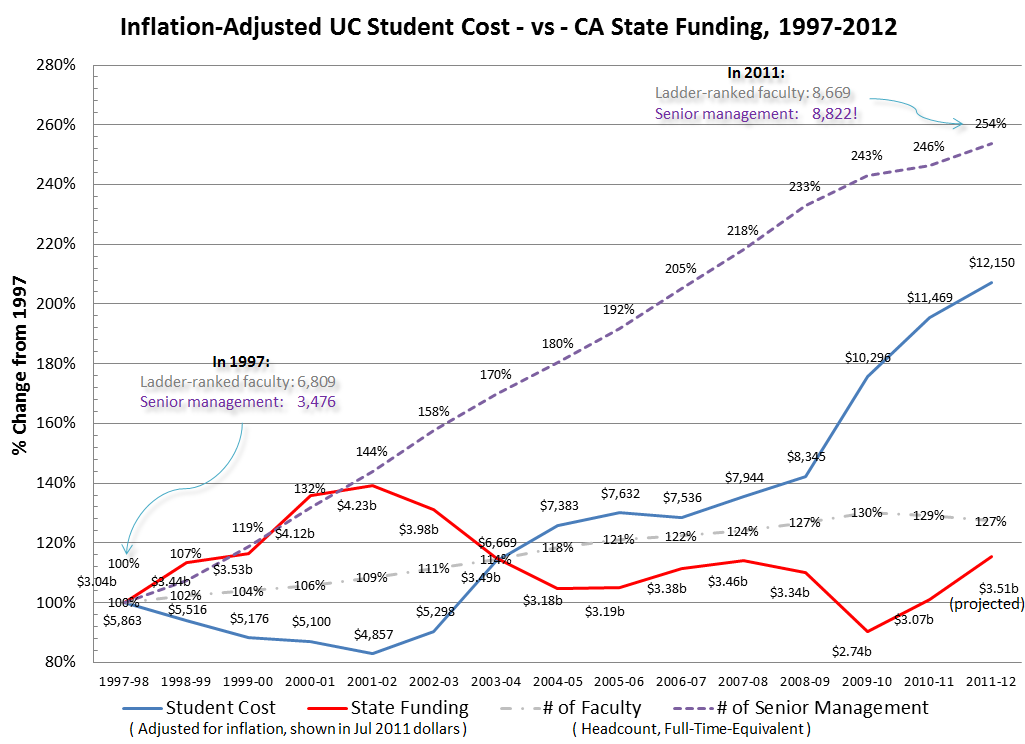
    While I’m not arguing the point that there is a crisis, I do think it is worth looking at historical trends to get perspective. Consider the following chart from the California Review (blog post here). It looks at inflation-adjusted budget numbers and faculty and senior management headcount from 1997 – 2011. [Click to expand]

    (more…)

  • What If OpenClass Succeeds in Disrupting LMS Market?

    Right now the e-Literate site is close to over-heating from Michael’s voluminous posts – all very thoughtful, but we’re going to need some WordPress coolant.

    During discussions over the past week in person and over blogs, I’ve had three people ask essentially the same question – will Pearson’s OpenClass LMS offering and associated corporate strategy lead to more competition or less competition in the LMS space for higher ed, or how will the competitive landscape change?  Obviously the nature of this question is speculative with no concrete answers, but I do think that technology market trends can help us with an educated guess.

    (more…)