
e-Literate

Present is Prologue

Tag: higher education

  • Update on 2U: First full quarterly earnings and insight into model

    2U, the online service provider that went public in the spring, just released its financial report for the first full quarter of operations as a public company. The company beat estimates on total revenue and also lost less money than expected. Overall, it was a strong performance (see WSJ for basic summary or actual quarterly report for more details). The basics:

    • Revenue of $24.7 million for the quarter and $51.1 m for the past six months, which represents year-over-year increase of 32 and 35%;
    • EBITDA Losses of $7.1 m for the quarter and $10.9 m for the past six months, which represents year-over-year increase of -2% and 12%; and
    • Enrollment growth of 31 – 34% year-over-year.

    Per the WSJ coverage of the conference call:

    “I’m very pleased with our second quarter results, and that we have both the basis and the visibility to increase all of our guidance measures for 2014,” said Chip Paucek, 2U’s Chief Executive Officer and co-founder. “We’ve reached a turning point where, even with continued high investment for growth, our losses have stopped accelerating. At the midpoint of our new guidance range, we now expect our full year 2014 adjusted EBITDA loss to improve by 17% over 2013. Further, we’ve announced a schedule that meets our stated annual goal for new program launches through 2015.”

    The company went public in late March at $14 / share and is still at that range ($14.21 before the quarterly earnings release – it might go up tomorrow). As one of only three ed tech companies to have gone public in the US over the past five years, 2U remains worth watching both for its own news and as a bellwether of the IPO market for ed tech.

    Notes

    The financials provide more insight into the world of Online Service Providers (OSP, aka Online Program Management, School-as-a-Service, Online Enablers, the market with no name). On the conference call 2U’s CEO Chip Paucek reminded analysts that they typically invest (money spent – revenue) $4 – $9 million per program in the early years and do not start to break even until years 3 – 4. 2U might be on the high side of these numbers given their focus on small class sizes at big-name schools, but this helps explain why the OSP market typically focuses on long-term contracts of 10+ years. Without such a long-term revenue-sharing contract, it would difficult for an OSP to ever break even.
    (more…)

  • To see how illogical the Brookings Institution report on student loans is, just read the executive summary

    il·log·i·cal
    i(l)ˈläjikəl/
    adjective
    1. lacking sense or clear, sound reasoning.  ((From Google’s definition))

    There have been multiple articles both accepting the Brookings argument that “typical borrowers are no worse off now than they were a generation ago” and those calling out the flaws in the Brookings report. I have written two articles here and here criticizing the report. The problem is that much of the discussion is more complicated that it needs to be. A simple reading of the Brookings executive summary exposes just how illogical the report is.

    College tuition and student debt levels have been increasing at a fast pace for at least two decades. These well-documented trends, coupled with an economy weakened by a major recession, have raised serious questions about whether the market for student debt is headed for a crisis, with many borrowers unable to repay their loans and taxpayers being forced to foot the bill.

    The argument is set up – yes, tuition and debt levels are going up, but how is a crisis defined? It’s specifically about “many borrowers unable to repay their loans”. Is there a crisis? That’s not a bad setup, and it is a valid question to address.

    Our analysis of more than two decades of data on the financial well-being of American households suggests that the reality of student loans may not be as dire as many commentators fear. We draw on data from the Survey of Consumer Finances (SCF) administered by the Federal Reserve Board to track how the education debt levels and incomes of young households evolved between 1989 and 2010. The SCF data are consistent with multiple other data sources, finding significant increases in average debt levels, but providing little indication of a significant contingent of borrowers with enormous debt loads.

    This is an interesting source of data. Yes, the New York Fed’s Survey of Consumer Finances tracks student debt, but this data is almost four years old due to triennial survey method.  ((Also note that we’re skipping the years with the highest growth in student debt.))

    But hold on – now we’re talking about “significant contingent of borrowers with enormous debt loads”? I thought the issue was ability to repay. What does “enormous” even mean other than being a scary word? (more…)

  • Early Review of Google Classroom

    Meg Tufano is co-Founder of SynaptIQ+ (think tank for social era knowledge) and leader of McDermott MultiMedia Group (an education consulting group focused on Google Apps EDU). We have been checking out Google Classroom – with her as the teacher and me as the student. I include some of Meg’s bio here as it is worth noting her extensive experience designing and teaching online courses for more than a decade.

    Meg posted a Google Slides review of her initial experiences using Google Classroom from a teacher’s perspective, which I am sharing below with minimal commentary. The review includes annotated slides showing the various features and Meg’s comments.

    I have not done as much work to show the student view, but I will note the following:

    • The student view does not include the link to the Chrome Store that Meg finds to be too confusing.
    • The biggest challenge I’ve had so far is managing my multiple Google accounts (you have to be logged into the Google Apps for Edu as your primary Google account to enter Classroom, which is not that intuitive to students).
    • I wonder if Google will continue to use Google tools so prominently in Classroom (primary GDrive, YouTube, GDocs) or if the full release will make it easier to embed non-Google tools.
    • I have previously written “Why Google Classroom won’t affect institutional LMS market … yet”, and after initial testing, nothing has changed my opinion.
    • I have one other post linking to video-based reviews of Google Classroom here.
  • CCSF Update: Accreditation appeal denied, but waiting for court date

    It looks like I’ll have the California trifecta for the past week, having already posted on Cal State and University of California news recently. Maybe I should find a Stanford or some other private university story.

    In my last post on CCSF from January:

    Last week, as expected, a California superior court judge ruled on whether to allow the Accrediting Commission for Community and Junior Colleges (ACCJC)  to end accreditation for City College of San Francisco (CCSF) as of July 31, 2014. As reported inmultiple news outlets, the judge granted an injunction preventing ACCJC from stripping CCSF’s accreditation at least until a court trial based on the city of San Francisco lawsuit, which would occur in the summer 2014 at the earliest. This means that CCSF will stay open for at least another academic term (fall 2014), and it is possible that ACCJC would have to redo their accreditation review.

     In the meantime, ACCJC reviewed CCSF’s appeal of the accrediting decision, and ACCJC is sticking to its guns on the decision, as described in the San Francisco Chronicle:

    City College of San Francisco remains out of compliance with eight accreditation standards, so the threat to revoke its accreditation stands, said the commission that set July 31 for the action that would shut the college down.

    Accreditation won’t be revoked on that date, however, because a judge delayed the deadline until an October trial can determine if the Accrediting Commission for Community and Junior Colleges properly conducted its 2012 evaluation of City College.

    In other words, ACCJC has changed its determination that CCSF should lose accreditation. There are only two caveats at this point:

    • The injunction that prevents ACCJC from revoking accreditation until the October court date; and
    • A new loophole called “restoration status”.

    (more…)

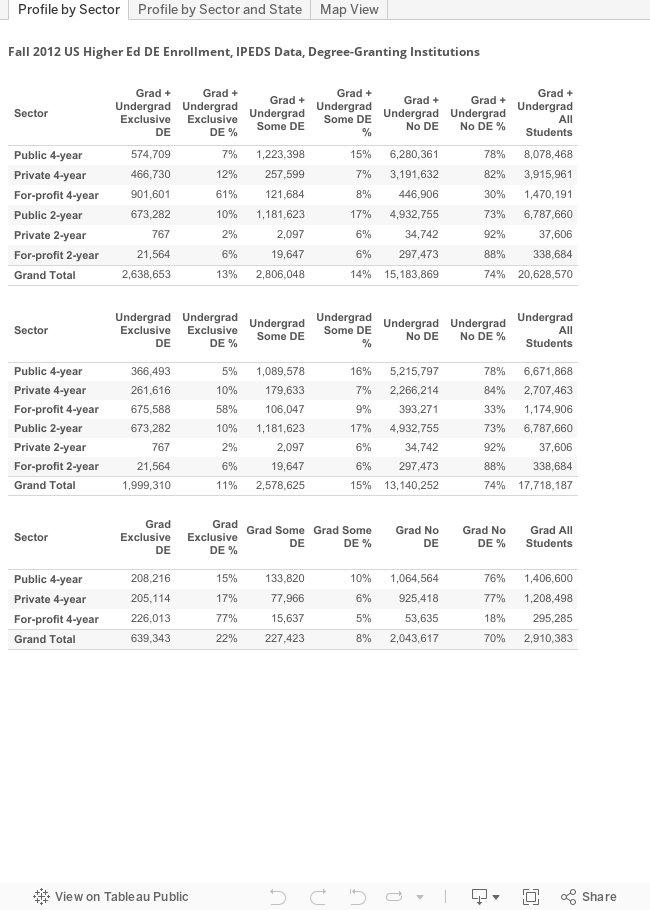
  • Fall 2012 US Distance Education Enrollment: Now viewable by each state

    Starting in late 2013, the National Center for Educational Statistics (NCES) and its Integrated Postsecondary Education Data System (IPEDS) started providing preliminary data for the Fall 2012 term that for the first time includes online education. Using Tableau (thanks to Justin Menard for prompting me to use this), we can now see a profile of online education in the US for degree-granting colleges and university, broken out by sector and for each state.

    Please note the following:

    • For the most part distance education and online education terms are interchangeable, but they are not equivalent as DE can include courses delivered by a medium other than the Internet (e.g. correspondence course).
    • There are three tabs below – the first shows totals for the US by sector and by level (grad, undergrad); the second also shows the data for each state (this is new); the third shows a map view.

  • Why Google Classroom won’t affect institutional LMS market … yet

    Yesterday I shared a post about the new Google Classroom details that are coming out via YouTube videos, and as part of that post I made the following statement [emphasis added]:

    I am not one to look at Google’s moves as the end of the LMS or a complete shift in the market (at least in the short term), but I do think Classroom is significant and worth watching. I suspect this will have a bigger impact on individual faculty adoption in higher ed or as a secondary LMS than it will on official institutional adoption, at least for the next 2 – 3 years.

    The early analysis is based on this video that shows some of the key features:

    (more…)

  • Google Classroom: Early videos of their closest attempt at an LMS

    For years the ed tech community has speculated about Google entering the LMS market, including Wave (discontinued, but some key features embedded in other tools), Apps for Education, and even incorrectly with Pearson OpenClass. Each time there is some possibilities, but Google has not shown interest in fully replacing LMS functionality.

    Google Classroom, announced in May and with new details coming out this week, is the closest that Google has come to fully providing an LMS. The focus is much more on K-12 than on higher education.

    For background on the concept, see this video from May which emphasizes roster integration (with some instructor setup required), document sharing through Google Drive, server and security through the cloud, discussions tied to assignments, and a focus on ‘letting teachers and students teach or learn their way’.

    Yesterday Google shared a new video that directly shows the user interface and some key features.

    (more…)