
e-Literate

Present is Prologue

Tag: higher education

  • Open Data: A case study using IPEDS for online education

    At e-Literate we’re planning to do more data journalism posts. Think of this along the lines of Harper Reed’s keynote last year as described in the Chronicle.

    Harper Reed, who served as chief technology officer in President Obama’s 2012 campaign, offered those people what he jokingly called “an intervention.”

    “Big Data is bullshit,” Mr. Reed said in a keynote speech on Tuesday.

    His point is not that there is no value in the large amounts of data available to the community, but that data analysis is getting democratized and doesn’t require huge investments.

    “The exciting thing is you can get a lot of this stuff done just in Excel,” he said. “You don’t need these big platforms. You don’t need all this big fancy stuff. If anyone says ‘big’ in front of it, you should look at them very skeptically … You can tell charlatans when they say ‘big’ in front of everything.”

    I would add one other aspect along with the democratization of data analysis – open data. Inspired by Audrey Watters and even her recent tweet, we are looking for ways to not only explore the open data available to the education community but also to share the data we use in our analyses.

    https://twitter.com/audreywatters/status/426541112527192064
    (more…)

  • Instructure releases their third public security audit

    In the fall of 2011 I made the following argument:

    We need more transparency in the LMS market, and clients should have access to objective measurements of the security of a solution.  To paraphrase Michael Feldstein’s suggestions from a 2009 post:

    • There is no guarantee that any LMS is more secure just because they say they are more secure
    • Customers should ask for, and LMS vendors should supply, detailed information on how the vendor or open source community has handled security issues in practice
    • LMS providers should make public a summary of vulnerabilities, including resolution time

    I would add to this call for transparency that LMS vendors and open source communities should share information from their third-party security audits and tests.  All of the vendors that I talked to have some form of third-party penetration testing and security audits; however, how does this help the customer unless this information is transparent and available?  Of course this transparency should not include details that would advertise vulnerabilities to hackers, but there should be some manner to be open and transparent on what the audits are saying. [new emphasis added]

    Inspired by fall events and this call for transparency, Instructure (maker of the Canvas LMS) decided to hold an public security audit using a white hat testing company, where A) the results of the testing would be shared publicly, and B) I would act as an independent observer to document the process. The results of this testing are described in two posts at e-Literate and by a post at Instructure.

    Instructure has kept up the practice and just released their third public security audit.

    (more…)

  • CCSF Accreditation Injunction: The decisions and implications

    Last week, as expected, a California superior court judge ruled on whether to allow the Accrediting Commission for Community and Junior Colleges (ACCJC)  to end accreditation for City College of San Francisco (CCSF) as of July 31, 2014. As reported in multiple news outlets, the judge granted an injunction preventing ACCJC from stripping CCSF’s accreditation at least until a court trial based on the city of San Francisco lawsuit, which would occur in the summer 2014 at the earliest. This means that CCSF will stay open for at least another academic term (fall 2014), and it is possible that ACCJC would have to redo their accreditation review.

    What was the actual decision and what are the implications for other schools?

    Law Suits

    The original issues found by ACCJC were raised in the 2006 review, leading to multiple follow-up reports and actions. By summer 2012 ACCJC issued a Show Cause ruling based on a new review – the one that is the crux of the lawsuits and injunction. The full 2012 report documented the new evaluation that in order to “fully meet each ACCJC Accreditation Standard and Eligibility Requirements [sic]”, the college must follow 14 recommendations by March 2013 to keep its accreditation. CCSF did not meet this timeline and ACCJC in July 2013 sent a letter stating that CCSF accreditation would be revoked as of July 31, 2014. For full background, read this post.

    Despite the seven-year buildup, CCSF finally got serious about changes in summer 2013, and they replaced their Board of Trustees with a “special trustee” (Robert Agrella) “with unilateral powers to try and save the school from losing accreditation in one year”.

    As CCSF is the largest college in California (85,000 students before 2012) and potentially the largest college ever to lose accreditation, the issue quickly became political. Three groups filed law suits seeking for force ACCJC to maintain CCSF accreditation – the City of San Francisco’s attorney Dennis Herrera, the American Federation of Teachers (AFT) Local 2121 and the California Federation of Teachers (CFT), and the Save City College Coalition (which was not part of last week’s ruling). Much of these three lawsuits’ arguments were based on a Department of Education notification from August 2013 that ACCJC was “out of compliance in several areas related to its sanctioning of City College”.

    (more…)

  • Ruling expected this week on court challenge to CCSF loss of accreditation

    Over the summer I covered the drama surrounding the impending shut down of the largest college in California – City College of San Francisco, or CCSF – due to termination of accreditation. The short version is that the Accrediting Commission for Community and Junior Colleges (ACCJC) voted to end accreditation for CCSF as of July 31, 2014. Unless reversed, the loss of accreditation would likely force the 80,000 student college to shut down. CCSF would be the largest US college to date to lose accreditation.

    Since this summer there have been several lawsuits, most notably by the City of San Francisco and the CCSF faculty union (California Federation of Teachers), seeking an injunction to stop ACCJC’s removal of accreditation. The DOE findings (documented here) form much of the basis of these lawsuits that will likely come to a head soon as the superior court judge is expected to rule on the injunction this week.

    Meanwhile, CCSF administration is actually supporting the accrediting commission regarding the lawsuits. As also reported by the San Francisco Chronicle, the CCSF administration is  attempting to reverse the decision by working within the ACCJC process by addressing the deficiencies.

    (more…)

  • The quiet revolution in college pricing effects

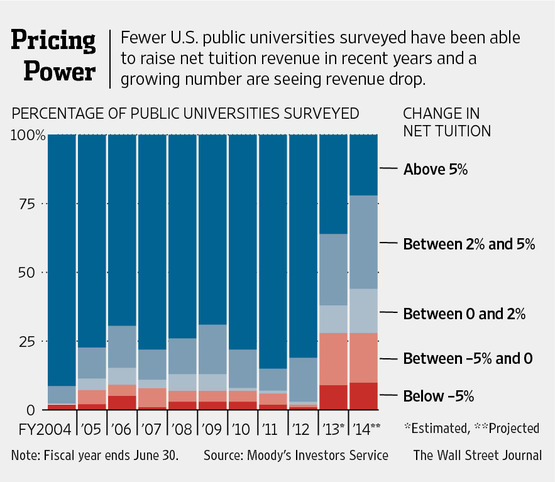
    Douglas Belkin wrote an article yesterday in the  Wall Street Journal based on a study from Moody’s Investors Service. The lede of the article is that “nearly half of the nation’s colleges and universities are no longer generating enough tuition revenue to keep pace with inflation”, which comes from Moody’s interest in institutional financial stability, but I think there are other lessons available. While the revolution in college pricing effects is quiet, it is profound.

    Tuition revenue

    It is worth noting that the big changes are based on FY2013 and 2014, which includes survey-based estimates and projections rather than hard data. The article is behind a paywall, but here are some relevant excerpts (read the whole article if you can).

    (more…)

  • SJSU research report confirms MOOCs are online courses

    By reading the SJSU research report (download actual report here), one item that really hits me is that however different the scaling model is for MOOCs, they are still online courses and have similar success factors. I am not trying to minimize the value of the report by the title of this post, because there is real value in letting objective data lead you to conclusions, even if hunches and assumptions would have led to similar results.

    First, however, it would be useful to understand the data and key terms – AOLE is Augmented Online Learning Environment, which represents the additional support structures and for-credit status for MOOCs.

    Out of a total of 274 students enrolled in AOLE courses, 249 students remained in the sample after data cleaning, which included removal of students enrolled in multiple courses and of those with no course activity. In addition, 36 students were removed who withdrew from the course or received a final grade of Incomplete. This left 213 students for the deeper analysis. This data set will be referenced throughout this report as a “research data file”.

    So this data does not include no-shows, withdraws or incompletes, making it more akin to analyzing a traditional college course after the add / drop period.

    (more…)

  • SJSU releases NSF-funded research report on Udacity pilot

    Back in late July we found out that San Jose State University was pausing their SJSU Plus pilot program using Udacity for-credit MOOCs due to low passing rates. While there was fairly extensive media coverage of the story broken by Inside Higher Ed, there was the promise of a National Science Foundation (NSF) funded research report based on the spring 2013 courses. I described why the research report was important, despite indications that the lessons learned aligned with well-known practices for online education.

    With this many known issues, which have also been documented in several excellent blog posts, why is it valuable for SJSU to use the external NSF-funded report?

    In my opinion, there will still be value in A) releasing the full data set and analysis, and B) getting others to understand key points.

    Many specialists might understand why the program failed, but many others do not. Campus leaders and policy makers need to learn many of the lessons that are already known in ed tech / higher ed community, and SJSU Plus will help in this area. Plus, I wouldn’t discount some unexpected findings (e.g. need for self-pacing in math courses as mentioned in student surveys). [snip]

    It is important for some of the new participants (and I would add foundations, state governments, university presidents, etc) to fully understand what worked and what didn’t work in this application of online education. The official report from SJSU will provide a valuable service to help with this learning process.

    There is also value in this very public case establishing a precedent of pausing pilots that don’t work, evaluating results early in the process, adjusting the course and support design based on findings, and focusing on student learning outcomes as the primary measure of success.

    After several delays, SJSU has now released the full NSF-funded research report on Elaine Collins’ official web page (she was the principal investigator). The full report can be downloaded here.

    (more…)