
e-Literate

Present is Prologue

Tag: Instructure

  • Instructure’s Current Market Position

    With the proliferation of so many privately funded educational technology companies, the quarterly earnings call of a publicly traded company like Instructure is a rare opportunity to get a detailed look at company performance and hear directly from executive leadership as they respond to analysts’ questions. Sometimes those responses can be guarded, at other times very frank. Regardless of which, it’s almost always very revealing.

    During Monday’s third quarter earnings conference call with Instructure we saw the company showing considerable confidence in their current market position and trajectory for the next couple of years. Quarterly revenues of $30.1M are up 44% over Q3 last year. Of that $25.8M (86%) is recurring revenue from subscriptions, the remaining $4.3 is derived from professional services.  In the domestic higher education market, CFO Steve Kaminsky cited research from e-Literate and MindWires that attributes a win rate of 77% to the Canvas LMS when it comes to new implementations and said that he expects that number to remain consistent over the next few years. With a current market share of 17-20% in the U.S. and Canadian higher education markets, Instructure said that they are expecting Canvas to gain another 10-30% of the market over the next 2-3 years. See Instructure’s full third quarter financial report here.  (more…)
  • Quick Update On LMS Subscription Service

    Our LMS Subscription Service has been out for more than three months now, and we’d like to give a quick update(see this page for details, pricing, online signup; or sign up on right column of blog site for listserv to find out more information).

    The e–Literate Big Picture subscription services are designed to help you track the changing landscape in important educational technology topics and make sure that the decisions you make today will still make sense tomorrow.

    Based on our joint research with LISTedTECH and market analysis, we just published an article in TechCrunch titled “The LMS Market Glacier Is Melting”. (more…)

  • Changes at D2L: A second-hand view from users conference

    As I have described to several executives at D2L, there is an interesting gap between the progress we have seen with the company’s product improvements and the reaction we hear from many of their customers. With the tighter integration with LeaP and the improved usability, particularly in content authoring, I would have expected to hear more customers react to the changes. But when talking directly to many of the institutions using the Brightspace LMS, staff describe D2L as if the company and product line had not changed in several years. What is not clear is whether this gap is due the company missing the mark (and my judgement of improvements not aligning with what colleges and universities want) or whether there is just a lag where it will take time for most customers to believe in and take advantage the new product designs and features.

    2016 has been an eventful year for D2L. COO Cheryl Ainoa, a longtime veteran of Yahoo! and most recently Intuit, joined the company in April. Although this move was not advertised through press releases or even blog posts, I believe this is a significant change to how the company operates. This is not the first time that D2L has reached outside the industry for a top executive, as they employed Dennis Kavelman from RIM / Blackberry as COO from 2012 – 2014 (the period where D2L raised $165 million in two mammoth funding rounds). But I have heard that the addition of Ainoa has already seen results internally. And in the ‘keeping work in perspective’ category, founder and CEO John Baker and his wife had their first child right before the Fusion Users Conference. (more…)

  • Instructurecon 2016: Why This Company is Still Formidable (and Misunderstood)

    When I talk to Instructure competitors or critics, I usually hear two complaints about them:

    1. They “open wash” or are “fauxpen.”
    2. They have no vision.

    Having attended Instructurecon 2016 a couple of weeks ago, my answer to the first complaint is that the critics don’t understand what Instructure and their customers mean by “openness.” In some respects, Canvas is the most open ed tech project I know of in ways that strongly differentiate it from its competitors. Full stop. The second complaint is more plausible. But if I were competing against Instructure, I wouldn’t take too much comfort in that.

    (more…)

  • MarketsandMarkets: Getting the LMS market wrong

    New LMS market analysis with a leader list that includes a company that is retiring its LMS and ignores the company who has a 5x lead in new implementations for its core market? Sign me up.

    Over the next week or two, we plan several posts at e-Literate based on the various LMS users conferences we recently attended. We already covered Sakai and Blackboard, and we will have commentary on Moodle, Schoology, D2L, and Canvas soon. But before we do so, I wanted to call out the recent analysis by MarketsandMarkets, which requires some commentary as it is leading to some media coverage that could misinform those trying to understand the LMS market. The headline of their recent market report:

    Learning Management System (LMS) Market Worth 15.72 Billion USD by 2021

    According to a new market research report, “Learning Management System Market by Application, Delivery Mode (Distance Learning and Instructor-Led Training), Deployment (On-Premises and Cloud), User Type (Academic and Corporate), Vertical, and Region – Global Forecast to 2021”, published by MarketsandMarkets, the LMS market size is expected to grow from USD 5.22 Billion in 2016 to USD 15.72 Billion by 2021, at a CAGR of 24.7%.

    (more…)

  • Previous LMS For Schools Moving to Canvas in US and Canada

    During the most recent quarterly earnings call for Instructure, an analyst asked an interesting question (despite starting off from the Chris Farley Show format).

    Corey Greendale (First Analysis Securities Corporation):  Awesome. A couple of other things on the, primarily on the Higher Ed space but I guess on education space, there’s a whole lot of couple questions about the competitive environment. When you’re and I don’t know if you will ever get into this level of granularity but when you got competitive wins against the Blackboard, are those predominantly from legacy ANGEL, are you getting those wins as much from Learn as well.

    Josh Coates (CEO of Instructure):  A lot of them are from Learn. Most, you know I don’t have the stats right off the top of my head. A lot of the ANGEL and WebCT stuff is been mopped up in the previous years and so, what’s left the majority of what’s left is Learn and our win rate against Blackboard it continues to be incredibly high, not just domestically but internationally as well.

    In fact, I think most of three out of the four international schools that we announced in this earnings where Blackboard Learn replacements, so yes Learn’s getting it.

    The question gets to the issue of whether Canvas is just picking up higher education clients coming off of discontinued LMSs (Angel, WebCT, etc) or if they are picking up clients from ongoing platforms such as Blackboard Learn. Beyond the obvious interest of investors and other ed tech vendors, this issue in general affects higher education institutions going through a vendor selection – for the system in consideration, are there many other schools considering the same migration path?

    Thanks to the work we’ve been doing with LISTedTECH and our new subscription service, we can answer this question in a little more detail. One of the charts we share shows higher education migrations over the past five years in the US and Canada. (more…)

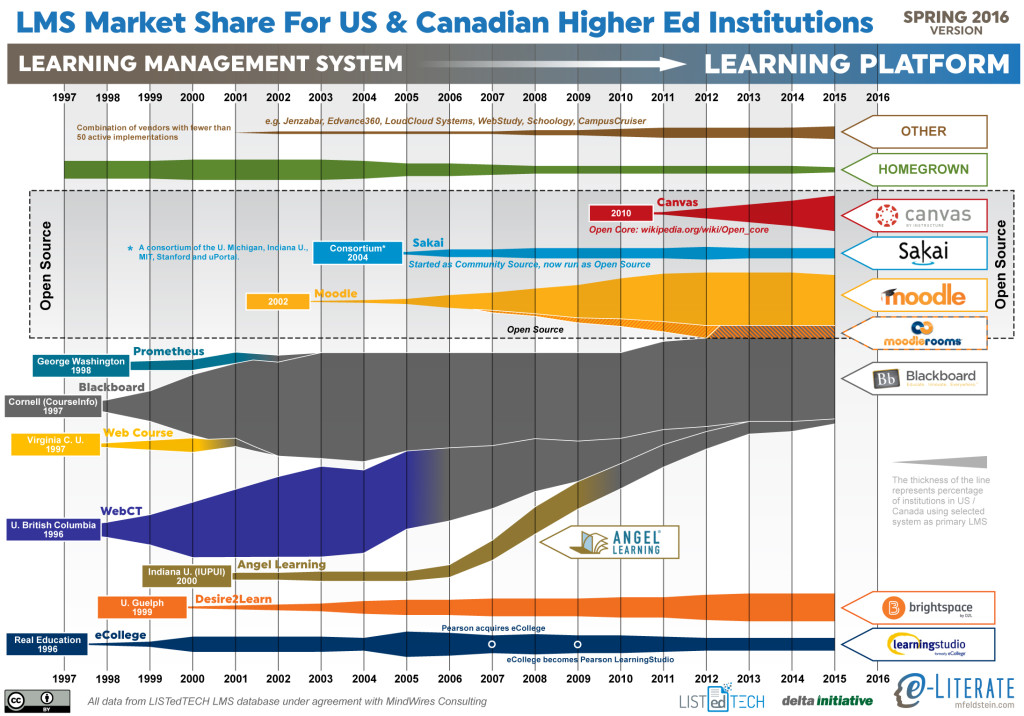
  • State of Higher Ed LMS Market for US and Canada: Spring 2016 Edition

    This is the eighth year I have shared the LMS market share graphic, commonly known as the squid graphic, for (mostly) US higher education. The original idea remains – to give a picture of the LMS market in one page, highlighting the story of the market over time. The key to the graphic is that the width of each band represents the percentage of institutions using a particular LMS as its primary system.

    This year marks a significant change based on our upcoming LMS subscription service. We are working with LISTedTECH to provide market data and visualizations. This data source provides historical and current measures of institutional adoptions, allowing new insights into how the market has worked and current trends. This current graphic gets all of its data from LISTedTECH. Where previous versions of the graphic used an anchoring technique, combining data from different sources in different years, with interpolation where the data was unavailable. Now, every year’s data is based on this single data source.

    This graphic has been in the public domain for years, however, and we think it best to keep it that way. In this way we hope that the new service will provide valuable insight for subscribers but also improve what we continue to share here on the e-Literate blog.

    Since we have data over time now and not just snapshots, we have picked the end of each year for that data. For this reason, the data goes through the end of 2015. We have 2016 data but chose not to share partial-year results in an effort to avoid confusion.

    LMS_MarketShare_20160316

    A few items to note:

    • As noted in previous years, the fastest-growing LMS is Canvas. There is no other solution close in terms of matching the Canvas growth.
    • Blackboard continues to lose market share, although the vast majority of that reduction over the past two years has been from customers leaving ANGEL. Blackboard Learn lost only a handful of clients in the past year.
    • While the end-of-life occurs next year, Pearson’s has announced LearningStudio’s end-of-life for the end of 2017.
    • With the new data set, the rapid rise and market strength of WebCT becomes much more apparent than previous graphics.
    • There is a growing line for “Other”, capturing the growth of those systems with less than 50 active implementations as primary systems; systems like Jenzabar, Edvance360, LoudCloud Systems, WebStudy, Schoology, and CampusCruiser.
    • While we continue to show Canvas in the Open Source area, we have noted a more precise description as an Open Core model.

    For a better description of the upcoming LMS subscription service, read this post and / or sign up for more information here.