

Caroline Hoxby from Stanford University just published a working paper for the National Bureau of Economic Research (NBER) claiming to analyze “The Returns to Online Postsecondary Education”. tl;dr This report is a hot mess that that conflates online students, enrollments, programs, institutions and uses a bizarre and misleading data set for its analysis.
Tag: IPEDS
-
College Scorecard: With victories like these, who needs failures?
Goldie Blumenstyk had a fascinating interview with the Depart of Education’s Ted Mitchell on Friday that is well worth reading and / or watching (they have video of the interview along with full transcript). One of Mitchell’s key points jumped off the page for me.
I think it [College Scorecard] was one of the department and the administration’s greatest victories
Really? I can see the consolidation of student loans, a strong focus on college affordability, shifting of conversation away from just elite schools, and significant push on funding public schools as worthy victories to mention. But the College Scorecard – I don’t buy it.
Blumenstyk pushed back on Mitchell, which led to this interesting exchange [emphasis added].
GOLDIE BLUMENSTYK: I’m glad you mentioned the College Scorecard. I was thinking about that a little bit. It’s probably one of the places where the department had perhaps its biggest defeat, or maybe you might consider it a retreat. We were originally envisioning the Scorecard as a tool for accountability. Obviously, a lot of colleges and a lot of other people opposed that idea. And it became a complicated process even to create the effective scorecard. What did you learn from that process?
TED MITCHELL: So I guess I would have a slightly different interpretation.
GOLDIE BLUMENSTYK: I would imagine. (more…)
-
Comparing Fully-Online vs Mixed-Course Enrollment Data
Mike Caulfield wrote a post yesterday about a new Blackboard report on design findings regarding online students. The focus of Mike’s post was that people often assume that the norm for an “online” student is taking all courses online, when in fact it is more common for students to take some courses online and some face-to-face (what Mike calls “Mixed-Course”). This distinction is important:
What shocks some people reading this, I think, is that online students would have face-to-face courses as a comparison or option, or that they would be consciously choosing between online and face-to-face in the course of a semester. But this is the norm now at state universities and community colleges; it’s only a secret to people not in those sorts of environments.
I agree that this is an important topic, so let’s look at the data in more detail (and for those wondering if you can connect to Tableau Public to edit online data visualizations while flying, the answer is yes if you’re patient). The best source of information is the IPEDS database, with the most recent data for Fall 2014. WCET put out an excellent report analyzing the distance education data in IPEDS – more on that later. Both IPEDS and WCET use the term “Some but not all” in the same manner as “Mixed-Course”. Based on overall data combining undergraduate and graduate students, Mike is right that more students are Mixed-Course than they are Fully-Online – 2.926 million vs. 2.824 million. (more…)
-
Fall 2014 IPEDS Data: Interactive table ranking DE programs by enrollment
Last week I shared a static view of the US institutions with the 30 highest enrollments of students taking at least one online (distance ed, or DE) course. But we can do better than that, thanks to some help from Justin Menard at LISTedTECH and his Tableau guidance.
The following interactive chart allows you to see the full rankings based on undergraduate, graduate and combined enrollments. And it has two views – one for students taking at least one online course and one for exclusive online students. Note the following:
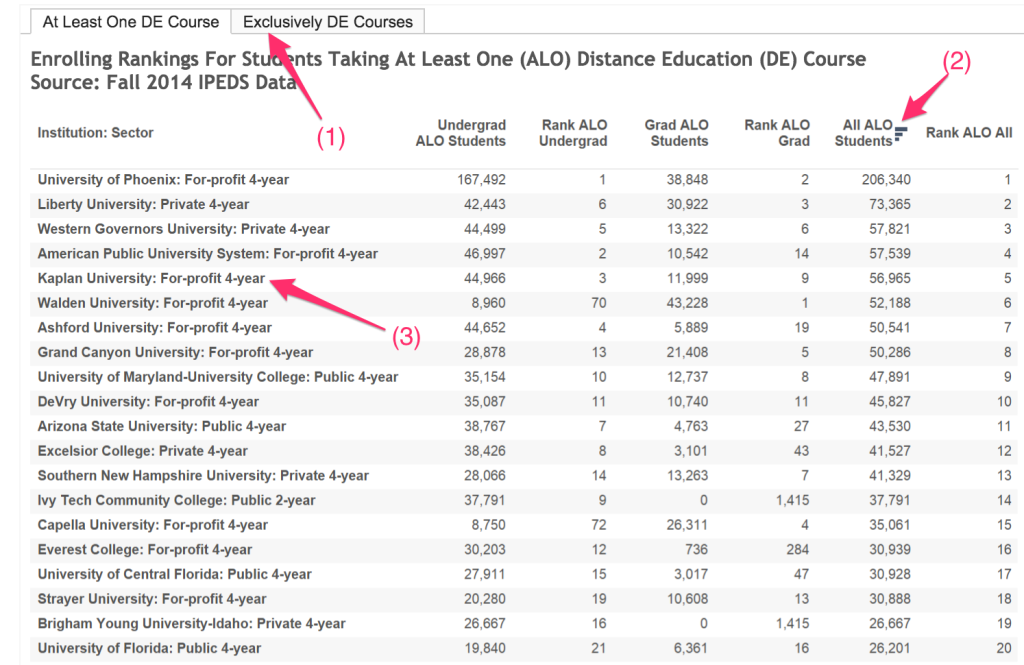
- (1) shows how you can change views by selecting the appropriate tab.
- (2) shows how you can sort on any of the three measures (hover over the column header).
- (3) shows the sector for each institution by the institution name.
-
Fall 2014 IPEDS Data: Top 30 largest online enrollments per institution
The National Center for Educational Statistics (NCES) and its Integrated Postsecondary Education Data System (IPEDS) provide the most official data on colleges and universities in the United States. This is the third year of data.
Let’s look at the top 30 online programs for Fall 2014 (in terms of total number of students taking at least one online course). Some notes on the data source:
- I have combined the categories ‘students exclusively taking distance education courses’ and ‘students taking some but not all distance education courses’ to obtain the ‘at least one online course’ category;
- Each sector is listed by column;
- IPEDS tracks data based on the accredited body, which can differ for systems – I manually combined most for-profit systems into one institution entity as well as Arizona State University[1];
- See this post for Fall 2013 Top 30 data and see this post for Fall 2014 profile by sector and state.
Fall 2014 Top 30 Largest Online Enrollments Per Institution (more…)
-
Fall 2014 IPEDS Data: New Profile of US Higher Ed Online Education
The National Center for Educational Statistics (NCES) and its Integrated Postsecondary Education Data System (IPEDS) provide the most official data on colleges and universities in the United States. I have been analyzing and sharing the data in the initial Fall 2012 dataset and for the Fall 2013 dataset. Both WCET and the Babson Survey Research Group also provide analysis of the IPEDS data for distance education. I highly recommend the following analysis in addition to the profile below (we have all worked together behind the scenes to share data and analyses).
- WCET’s initial analysis of Fall 2014 data
- WCET’s comparison of Fall 2014 to past years
- BSRG’s annual report on distance education using Fall 2014 data
- WCET’s update on the data quality issues with IPEDS data
Below is a profile of online education in the US for degree-granting colleges and university, broken out by sector and for each state. (more…)
-
College Scorecard: ED quietly adds in 700 missing colleges
It’s worth giving credit where credit is due, and the US Department of Education (ED) has fixed a problem that Russ Poulin and I pointed out where they had previously left ~700 colleges out of the College Scorecard.
When the College Scorecard was announced, Russ noticed a handful of missing schools. When I did the whole data OCD thing, I discovered that more than 700 2-year institutions were missing, including nearly 1-in-4 community colleges. Eventually we published an article in the Washington Post describing this (and other) problems.
The missing community colleges were excluded on purely statistical grounds. If the college granted more certificates (official awards of less than a degree) than degrees in a year, then they were excluded as they were not “primarily degree-granting” institutions. We label this the “Brian Criterion” after the person authoring two discussion board posts that explained this undocumented filter. (more…)