e-Literate

Present is Prologue

Tag: Learning Platform

  • Year-end Updates on e-Literate News Posts

    For my final 2014 post, I thought it would be interesting to provide year-end updates to some news posts on e-Literate over the past year. You’ll notice that there is somewhat of an emphasis on negative stories or implications. For most positive stories, companies and institutions are typically all too happy to send out press releases with the associated media paraphrasing, and we have little need here to cover as news. The following non-exhaustive list is in date order.

    D2L Growth Claims

    In December 2013 I described layoffs at Desire2Learn (now officially named D2L). The significance of this story is that it calls into question D2L’s growth claims and trumpeting of massive new investment of $85 million. Some updates:

    IPEDS Data on Online Learning

    (more…)

  • e-Literate Top 20 Posts For 2014

    I typically don’t write year-end reviews or top 10 (or 20) lists, but I need to work on our consulting company finances. At this point, any distraction seems more enjoyable than working in QuickBooks.

    We’ve had a fun year at e-Literate, and one recent change is that we are now more willing break stories when appropriate. We typically comment on ed tech stories a few days after the release, providing analysis and commentary, but there are several cases where we felt a story needed to go public. In such cases (e.g. Unizin creation, Cal State Online demise, management changes at Instructure and Blackboard) we tend to break the news objectively, providing mostly descriptions and explanations, allowing others to provide commentary.

    The following list is based on Jetpack stats on WordPress, which does not capture people who read posts through RSS feeds (we send out full articles through the feed). So the stats have a bias towards people who come to e-Literate for specific articles rather than our regular readers. We also tend to get longer-term readership of articles over many months, so this list also has a bias for articles posted a while ago.

    With that in mind, here are the top 20 most read articles on e-Literate in terms of page views for the past 12 months along with publication date.

    1. Can Pearson Solve the Rubric’s Cube? (Dec 2013) – This article proves that people are willing to read a 7,000 word post published on New Year’s Eve.
    2. A response to USA Today article on Flipped Classroom research (Oct 2013) – This article is our most steady one, consistently getting around 100 views per day.
    3. Unizin: Indiana University’s Secret New “Learning Ecosystem” Coalition (May 2014) – This is the article where we broke the story about Unizin, based largely on a presentation at Colorado State University.
    4. (more…)

  • Vendors as Traditional Revolutionaries

    In a post titled “The LMS for Traditional Revolutionaries,” Instructure’s VP of Research and Education for Canvas Jared Stein responded to my LMS rant with some numbers and some thoughts about the role of the vendor in encouraging progressive teaching practices. First, the numbers on the use of open education features in Canvas:

    • 3.8% of courses are “public”; you don’t need a login to see them.
    • 0.6% of courses are Creative Commons-licensed.
    • 4.0% of assignments are URL submissions (suggesting that students are completing their assignments on their blogs or elsewhere on the open web).

    On the one hand, as Jared acknowledges, these percentages are very low. On the other hand, as he points out, 4% of assignments is close to 250,000 assignments, which is non-trivial as an absolute number. And all of this raises the question: What is the role of the vendor in promoting progressive educational practices?

    Let’s take the best-case scenario. Suppose you’re a good person and a thoughtful educator who happens to work for a vendor at the moment. (For those of you who don’t know him, Jared enjoys just such a reputation, having spent a number of years as an excellent academic ed tech blogger and practitioner before joining Instructure.) What can you do? What is your role? On the one hand, you will get criticized by educators who want more and faster change for being too conventional. I certainly have leveled that sort of criticism at vendors before. And maybe those criticisms will sting particularly hard if you were one of those educators yourself before you joined the company (and maybe still are, in your heart of hearts). On the other hand, you are likely to be criticized as arrogant, high-handed, and unwilling to listen to your customers if you put yourself in the position of lecturing to educators (or, at worst, bullying them) about what you, as a vendor, define as best teaching practices. I certainly have leveled this sort of criticism as well.

    So what’s a vendor to do? Jared writes,

    These [open education features] are just a few examples of capabilities in Canvas that we believe add flexibility and encourage different approaches to teaching and learning. I recognize that sharing this data is a little risky; some may use it to argue that Canvas shouldn’t worry so much about the small percentage of educators who may take advantage of these fringe capabilities. After all, won’t teachers who are actually invested in open educational practices just eschew the LMS for their own platforms anyway?

    Focusing only on “users like us” and ignoring the others may work in the short-term, but for long-term success you have to build bridges, not walls.

    To help education improve itself for all teachers and learners we have to try to connect with those teachers who aren’t comfortable with radical shifts in pedagogy or technology. We believe that the best way to encourage positive change in educational practices across the broad landscape of content areas, learning objectives, and teaching philosophies is by providing tools that are easy-to-use, flexible, and comfortable to the majority of teachers and learners. The door to change must be open and the doorkeeper must be deposed.

    Some of the ways we do this is by having an open community, engaging with people who disagree with us, and investing in the open platform aspect of Canvas. We need both traditionalists, critical pedagogues, progressive researchers, and open educators to contribute to Canvas.That doesn’t have to be done through pull requests or by building LTI apps or integrations, though that’s a brilliant way to build solutions that are right for your context. But by dialoging what works in teaching and learning and what doesn’t. By debating what technology is best for, and when it leads us away from our shared goals of teaching and learning better in an open and connected world.

    Shorter Jared: We put capabilities to support progressive practices in our product in the hopes that our users will discover, adopt, and promote them, but it’s not our place to push our preferred educational practices on our customers.

    In many cases—particularly with a platform that serves a large and heterogeneous swath of the campus community—that’s the best attitude you can get from your vendor. That’s the most they can do without rightly pissing off (more) people.

    All of which brings me back to a single point: If you want better educational technology, then work to make sure that your colleagues in your campus community are asking for the things that you think would make educational technology better. If 40% rather than 4% of assignments created by your colleagues were on the open web, then learning platforms like LMSs would look and work differently. I guarantee it. Likewise, as long as most educators tend to use the technology to reproduce existing classroom practices, LMSs will look the same. I guarantee that too. And that’s not a vendor thing. That’s a software development thing. Community-developed open source learning platforms generally haven’t broken the mold, and the few that have tend to be the ones that you probably have never heard of because they don’t get adopted. They build what their community members ask for and what they think will attract other community members. So if you want better tech, then the best thing you can do to get it is to create demand for it among your colleagues.


  • LISTedTECH: New wiki site and great visualizations

    Last year I wrote about a relatively new site offering very interesting data and visualizations in the ed tech world. LISTedTECH was created by Justin Menard, who is Business Intelligence Senior Analyst at University of Ottawa. First of all, the site is broader in scope than just the LMS – there is a rich source of data & visualizations on MOOCs, university rankings, and IPEDS data. Most of the visualizations are presented by Tableau and therefore interactive in nature, allowing the user to filter data, zoom in on geographic data, etc. Since e-Literate is not set up for full-page visualizations, I have included screen shots below, but clicking on the image will take you to the appropriate LISTedTECH page.

    Top_Learning_Management_System__LMS__by_State_or_Province_-_LISTedTECH

    (more…)

  • New LMS Market Data: Edutechnica provides one-year update

    In Fall 2013 we saw a rich source of LMS market data emerge.

    George Kroner, a former engineer at Blackboard who now works for University of Maryland University College (UMUC), has developed what may be the most thorough measurement of LMS adoption in higher education at Edutechnica (OK, he’s better at coding and analysis than site naming). This side project (not affiliated with UMUC) started two months ago based on George’s ambition to unite various learning communities with better data. He said that he was inspired by the Campus Computing Project (CCP) and that Edutechnica should be seen as complementary to the CCP.

    The project is based on a web crawler that checks against national databases as a starting point to identify the higher education institution, then goes out to the official school web site to find the official LMS (or multiple LMSs officially used). The initial data is all based on the Anglosphere (US, UK, Canada, Australia), but there is no reason this data could not expand.

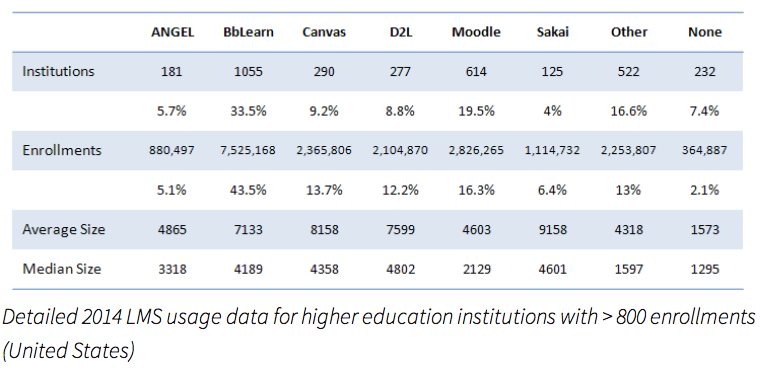
    There is new data available in Edutechnica’s one-year update, with year-over-year comparisons available as well as improvements to the methodology. Note that the methodology has improved both in terms of setting the denominator and in terms of how many schools are included in the data collection.

    The Fall 2014 data which now includes all schools with more than 800 enrollments:

    (more…)

  • Say What? Buzzfeed follows up on D2L story with solid reporting

    In a post last month I questioned the growth claims that D2L was pushing to the media based on their recent massive funding round. A key part of the article was pointing out the lack of real reporting from news media.

    It is worth noting that not a single media outlet listed by EDUKWEST or quoted above (WSJ, Reuters, Bloomberg, re/code, edSurge, TheStar) challenged or even questioned D2L’s bold claims. It would help if more media outlets didn’t view their job as paraphrasing press releases.

    I should give credit where it’s due: Education reporter Molly Hensley-Clancy at Buzzfeed has done some solid reporting with her article out today.

    In response to detailed questions from BuzzFeed News about figures to back up its claims of record growth in higher education and internationally, the company released a statement to BuzzFeed News, saying “As a private company, D2L does not publicly disclose these details. The past year has been one of record growth for D2L, culminating in the recent $85 million round of financing.” A representative declined to make the company’s CEO, or any other executive, available for an interview related to the company’s growth.

    The stonewalling didn’t come as a surprise to former employees with whom BuzzFeed News spoke.

    “The picture they’re painting of growth is not accurate,” said one former employee, who left the company within the last year and asked to remain anonymous, citing his confidentiality agreement with the company. “If you look at actual metrics, they tell a different story. They’re very likely not seeing growth in higher education.”

    (more…)

  • D2L raises $85 million but growth claims defy logic

    Yesterday D2L announced a second round of investment, this time raising $85 million (a mix of debt and equity) to go with their $80 million round two years ago (see EDUKWEST for a useful roundup of news and article links). While raising $165 million is an impressive feat, does this funding give us new information on the LMS market?

    First, here are the claims by D2L as part of this round of financing, from EdSurge:

    The deal comes on the heels of what the company calls “a year of record growth in the higher education, K-12 and corporate markets.” John Baker, founder and CEO, says the company currently serves 1,100 institutions and 15 million learners–up from 850 and 10 million, respectively, at this time last year. The company also recently opened offices in Latin America, Asia Pacific and Europe.

    That’s a 29% growth in the number of institutions and a 50% growth in the number of learners in just one year. Quite impressive if accurate.

    Yet the company went through a significant round of layoffs in late 2013 that let go more than 7% of its workforce, and according to both LinkedIn data and company statements they have had no significant growth in number of employees over the past year.  (more…)