e-Literate

Present is Prologue

Tag: LMS market

  • The Resilient Higher Ed LMS: Canvas is the only fully-established recent market entry

    For a few years starting in 2009, it seemed one of the best ways to raise VC funds or corporate internal investment was to say “we can beat Blackboard with a new cloud-based platform”. Witness Coursekit / Lore, Instructure / Canvas, OpenClass, LoudCloud Systems, Helix, and even more recently MOOC platforms. There were many articles written as these new systems entered the market, but what if we look back and ask whether the LMS market has actually changed recently? The picture that emerges is one of surprising resiliency by the established LMS providers.

    In fact, I would argue that in the past eight years (at least in North America) the only new system that has fully established itself in the LMS market is Canvas. Note that I have combined WebCT and ANGEL within the Blackboard umbrella, but even these systems established themselves more than a decade ago.

    (more…)

  • State of the Anglosphere’s Higher Education LMS Market: 2013 Edition

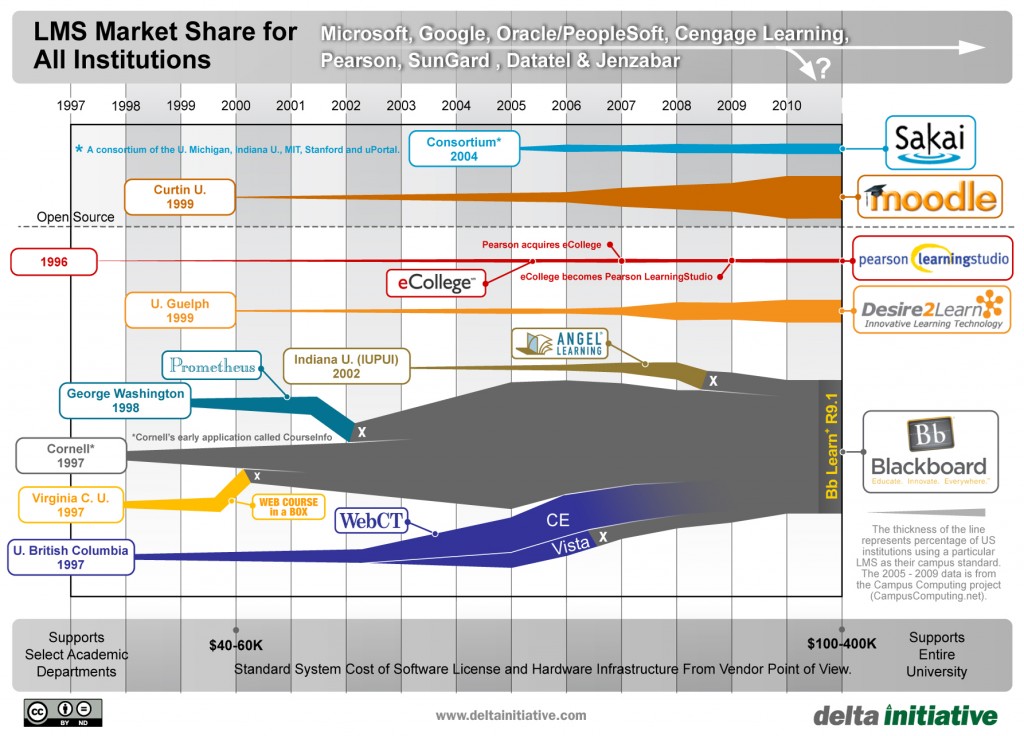
    I shared the most recent graphic summarizing the LMS market in September 2012, and thanks to new data sources it’s time for an update. As with all previous versions, the 2005 – 2009 data points are based on the Campus Computing Project, and therefore is based on US adoption from non-profit institutions. This set of longitudinal data provides an anchor for the summary.

    What I’ve been attempting to do lately is to expand the market definition beyond the US. Last year I used some heuristics:

    LMS_MarketShare_20121018-Home

    (more…)

  • Snapshot of LMS Market for Large Online Programs in the US

    The transformation of the higher education LMS market continues, and I expect more changes over the next 2 – 3 years. However, it seems time to capture a key segment of the market based on two recent announcements that directly impact large online programs.

    UMUC Selects Desire2Learn

    Following a multi-year strategic study and product selection, the University of Maryland University College (UMUC) selected Desire2Learn to replace the homegrown WebTycho LMS in use for over a decade. While there has been no press release, there are now official documents publicly available that describe this effort. Per the Faculty Advisory Committee (FAC) Newsletter:

    As announced last year, UMUC is planning to replace WebTycho with another learning management system. After a great deal of questions for the vendors, references checks and tests of functionality, Desire2Learn was chosen. More than 200 faculty, staff and students worldwide were part of the decision which was reported to have been by an overwhelming majority. The roll out will occur gradually over the next year or two. [snip]

    Not only is UMUC moving away from the WebTycho platform to the Desire2Learn (D2L) learning management system, but additional changes are in the works which will transform the online learning experience for our students and faculty.

    UMUC is part of the University of Maryland system, and it has a global focus – serving over 90,000 students worldwide.

    Mississippi Community Colleges Select Canvas

    The Mississippi Virtual Community College (MSVCC) provides the LMS for the system’s online program as well as for all 15 campuses. After a 6-month RFP process, MSVCC will be migrating from Blackboard Learn and Desire2Learn and implementing Canvas as the new LMS. From the press release:

    (more…)

  • Please Fill Out the Campus Computing Survey

    This is an incredible time of change in the United States higher education LMS market. Here are just some of the relevant developments that are driving big movements:

    • WebCT is in its last year of Blackboard support, forcing many campuses to migrate either to Blackboard or to something else.
    • Instructure is on an absolute tear, growing at an unprecedented rate.
    • Blackboard acquired Moodlerooms, the best known Moodle support vendor in this market.
    • Desire2Learn got a major infusion of cash, presumably based on their own market success.
    • Recent turmoil in the Sakai OAE project is causing the Sakai community to go through a period of reflection and retrenchment.
    • New LMS entrants are coming into the market right and left, including but not limited to MOOC platforms like Coursera.

    We all have our observations and intuitions about what all of this adds up to in terms of the big picture. But if you really want to know what is going on, there is only one place to go to get reliable, solid, proven data: the Campus Computing Project. I know that campus folk get inundated with surveys on top of the increasingly onerous workloads. But if you want a clear picture of what is going on in the LMS market today, then I urge you to fill out the Campus Computing survey or, if you are not the person responsible for doing so, then let the person on your campus who is responsible know just how important you think the survey is. The survey closes on October 24th and goes public at EDUCAUSE on November 7th.

    Please take this seriously.

  • State of the Higher Education LMS Market: A Graphical View

    The transformation of the higher education LMS market continues, and I expect more changes over the next 2 – 3 years. However, it seems time to capture the state of the market based on changes over the past year or two.

    I shared the most recent graphic summarizing the market in mid 2011. As with all previous versions, the 2005 – 2009 data points are based on the Campus Computing Project, and therefore is based on US adoption from non-profit institutions. This set of longitudinal data provides an anchor for the summary.

    The most significant changes over the past two years include the following.

    (more…)

  • The Search for Differentiated and Engaging Student Experience

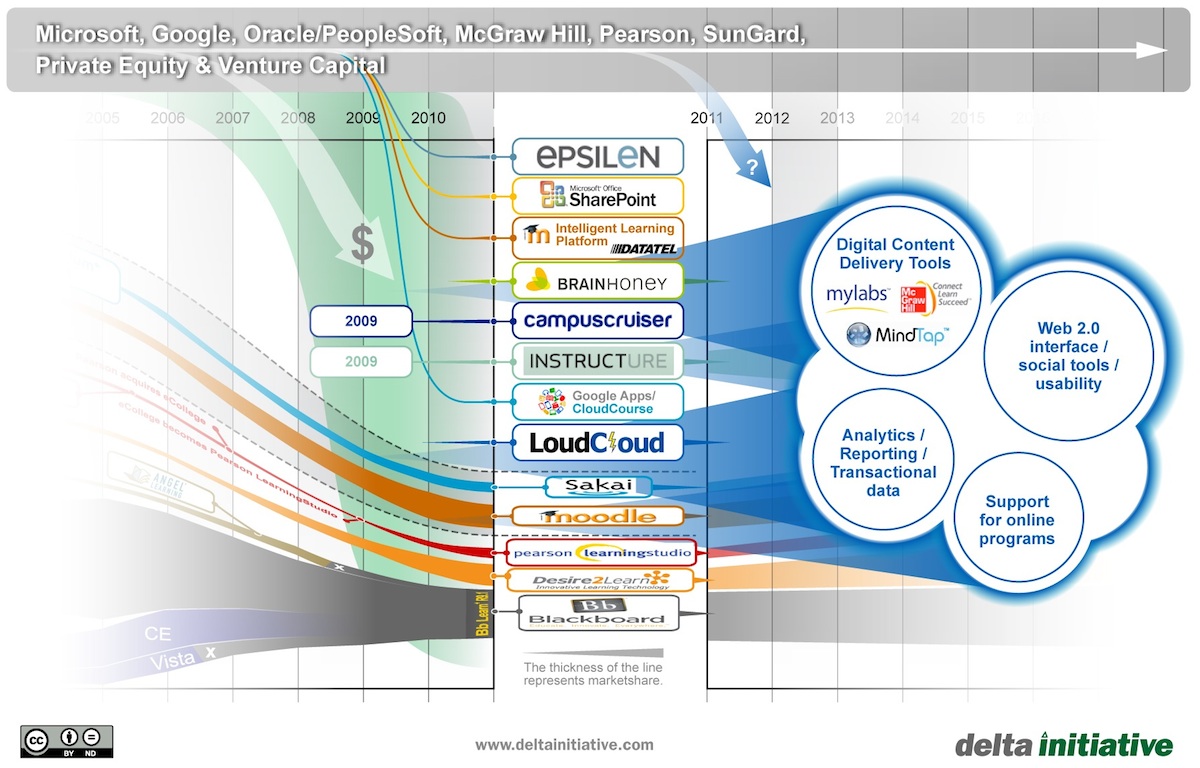
    One of the trends I highlighted last summer was that the LMS or learning platform market was overlapping the educational content market.

    The lines are blurring between content delivery systems (e.g. Cengage MindTap, Pearson MyLabs, etc) and LMS.  Content delivery and ability to keep students engaged within the content will drive much of the broader ed tech market.  This integration of markets is being seen as a strategically important issue for institutions, particularly for online programs.
    While I feel quite confident in having made that description, I did not have a model, or explanation, of what was driving the trend. Nine months later, I believe the trend has proven itself empirically, as more examples emerge: Apples iBooks2 / iTunesU App, Online Education Service Providers such as 2tor combining online programs with custom learning platforms, Pearson OpenClass, MOOC startups with custom platforms such Coursera, Udacity, etc.

    Last week Roger McNamee, co-founder and managing director with venture capital firm Elevation Partners, gave a presentation to the Mashable Connect conference titled “How to Revive the Web”. The presentation described how Apple won big by betting against the web and its prevailing culture (Mashable post here and Roger’s full presentation here). Roger’s theory is that Apple’s strategy was to move away from commoditized content, which most of the PC-based web (HTML4) assumed,  by delivering content in a differentiated, elegant manner – tightly combining content and the delivery mechanism. Furthermore, as HTML5 emerges, this move will accelerate.

    If this theory is correct, I think it helps explain the trend of the LMS market combining and blurring with the educational content market.

    (more…)

  • Blackboard Confronts Erosion of Market Share, Makes a Major Change in Strategy

    In a series of announcements that has the educational technology world buzzing, Blackboard reversed their strategy of their core LMS business.

    Most of the discussion in articles and blogs follows the meme of Blackboard entering open source, or even the meme of Blackboard acquiring competitors. I think the news is more significant than either of these two memes.

    Blackboard just did a 180-degree turn on their strategy for their core LMS business. They have moved from consolidating all customers into Learn 9.1 to providing products and services that are almost LMS-agnostic. As Dr. Chuck described:

    The notion that we will somehow find the “one true LMS” that will solve all problems is simply crazy talk and has been for quite some time.

    There is another aspect to this story not described in yesterday’s press releases and the associated articles and blogs. This is the first public strategic decision by Blackboard since they were acquired by Providence Equity Partners. I suspect that if you take all four of Blackboard’s announcements within the context of the private equity ownership, the underlying strategy and rationale make much more sense.

    (more…)