e-Literate

Present is Prologue

Tag: LMS

  • Exclusive: University of Phoenix moving from homegrown platform to Blackboard Learn Ultra

    The University of Phoenix has a history of using its scale to develop and rely on homegrown platforms, including the  adaptive learning platform branded as “Classroom”. I wrote about this investment in 2013.

    The full significance of the University of Phoenix bet on adaptive learning platforms goes beyond pure dollars and became clear when the school announced the closure of 115 of its 240 locations. The stated usage of the savings from campus closures is primarily to further invest in the platform as described by the Phoenix Business Journal.

    In early 2015 the University of Phoenix experienced “significant disruption with respect to our new online classroom platform”. By summer, the university’s parent company The Apollo Group announced to investors that it planned “to move away from certain proprietary and legacy IT systems”. CEO Greg Cappelli further described these changes in broad terms in the most recent earnings call. (more…)

  • New Visual From LISTedTECH Shows LMS Market By New Implementations

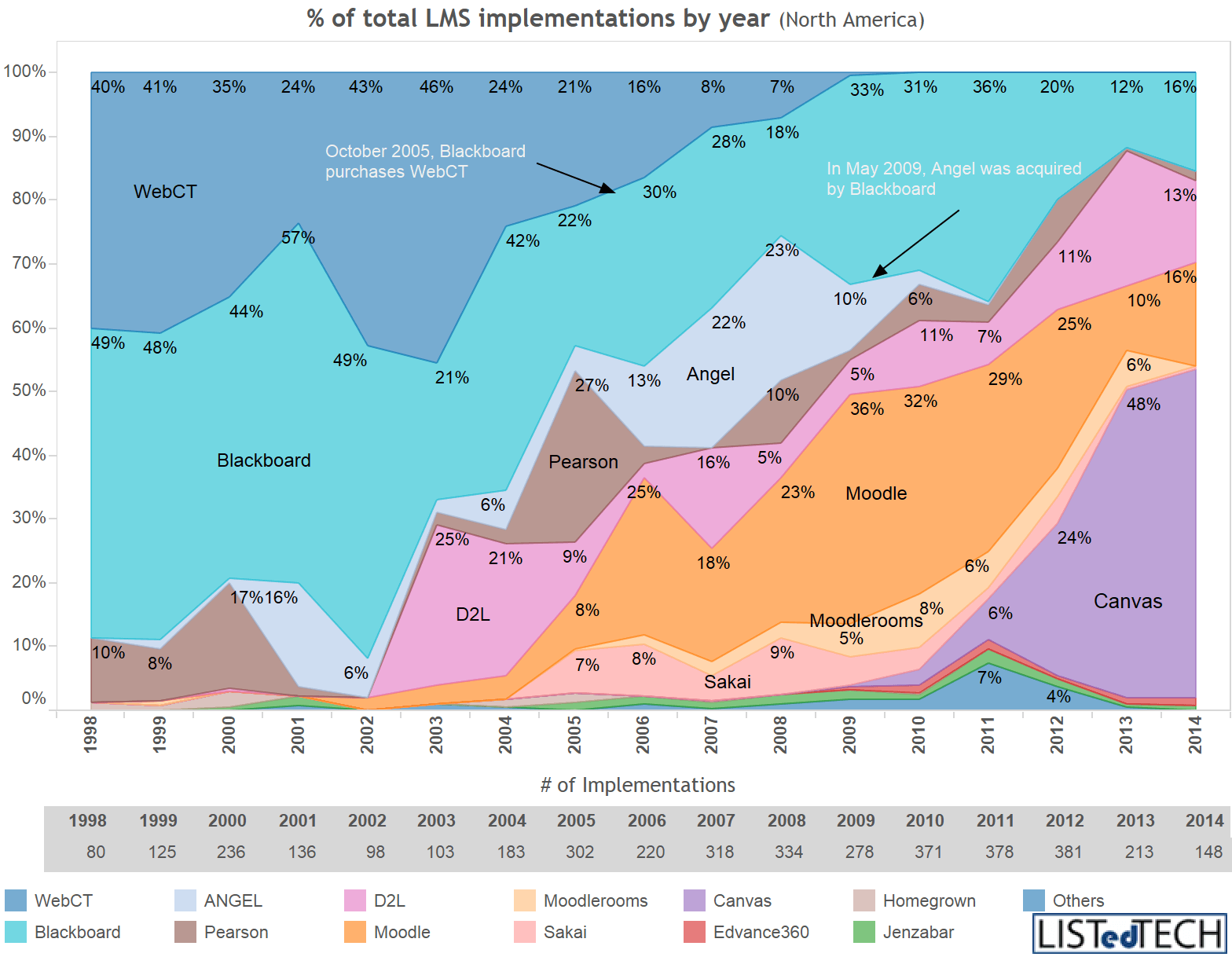
    Justin Menard and his team at ListEdTech have produced a great new visual on the LMS market in North America. Using his wiki-based data with 4,000+ institutions, he shows the percentage of LMS implementations per year (scaled to 100% for each year). While we are used to seeing LMS market share in terms of number or percentage of institutions using each LMS as primary system, this view highlights the dynamics of the market – which systems are getting adopted. See original post for full chart and additional description.

    LMS-Providers-Market-Share-by-Year1

    A few notes: (more…)

  • Interview with Josh Coates, CEO of Instructure, on today’s IPO

    Instructure, maker of the Canvas (higher ed and K-12 markets) LMS and Bridge (corporate learning market) LMS, held their Initial Public Offering today. Prior to the IPO, Wall Street analysts focused on the company’s growth, its large losses, and the challenges of the education market. The company was priced on the lower end of its range ($16.00), and closed up 12.5% at $18.00.

    This IPO and its lead up have been highly watched, particularly given the rapid growth in ed tech investments and questions on whether there are real businesses to emerge based on the investments. I had the opportunity to interview CEO Josh Coates today. What follows is an edited version of the interview, focusing mostly on how Instructure’s IPO will impact education markets and existing customers. I tried to capture as much of the Q&A verbatim as was feasible, but treat the answers below as a paraphrase.

    Q. What are your impressions on how the IPO has gone so far?

    A. The market in general has been a blood bath [ed. Dow down 585, or 3.3%, for the week], but we’re doing well so far. Given market conditions right now, we’re pleased as punch. We priced in range [ed. $16 – $18], and the market responding well. We’re really focused as a company 6-12 months down the road, but it is nice to get this IPO feedback. (more…)

  • What Schoology’s Venture Funding Means for the LMS Market

    LMS vendor Schoology just raised $32 million in Series D venture capital funding, bringing the total that they’ve raised to just over $57 million. If you’ve never heard of them, that’s because they have mostly been focused on K12, where they are doing very well. But they have turned their attention to US higher ed recently. They had a surprisingly big presence at EDUCAUSE, where CEO Jeremy Friedman told me that they are prepared to make an aggressive push. Their ability to get major funding was probably helped by Instructure going to market, and possibly by the leak that Blackboard is putting itself on the block as well. I don’t generally take money guys too seriously in their ability to predict ed tech, but they may be lucky on this one. I think there may be an opening the US higher ed LMS market for a new entrant.

    LMS selection for schools often works a little like the selection process that high school students typically go through when picking a college. Students looking at colleges usually have a favorite going in. Maybe their friends are going there. Or their big brother or sister. Or maybe they just heard that it’s cool. But they don’t apply to just one college, in case it doesn’t work out for one reason or another. So they have a second tier of schools that might be OK too. Generally, they don’t know much about your favorite school going in and they know even less about the “might be OK” schools. Depending on how cautious they are, they might throw in one or two “safety” schools that they really don’t want to go to but that they feel (or their parents feel) should be included for the sake of completeness.

    Likewise, colleges and universities frequently go into an LMS evaluation process with a favorite. Because the selection is generally done by a committee of stakeholders rather than just one person, there might be conflicting opinions on what the favorite is. But more often than not, there is a nascent majority or a consensus opinion about the likely winner, at least among the core selection committee. Back in the early to mid-aughts, the default favorite was usually Blackboard because it was considered to be the safe alternative that everybody was using. When Blackboard faltered, the favorite began to split between D2L and Moodle—and occasionally Sakai, particularly for larger public universities—with type of school and geography having a big influence on which one was likely to be the frontrunner. These days, the schools that Phil and I talk to report Instructure as the starting frontrunner at least four times out of five, across school types or geographies.

    But LMS selection processes still need their “might be OK” candidates. For one thing, most of them are mandated by policy or by law to do a real multi-vendor evaluation. And most evaluation committees genuinely do want to look at alternatives. Just because they have a sense going in of which alternative is most likely to be the best doesn’t mean that they are closed-minded. The trouble is that there aren’t many alternatives that selection committees feel hopeful about these days. Increasingly, Sakai and Moodle aren’t even making it to the serious evaluation stage in US higher ed evaluations; and even when they do, they are often treated like safety schools. Blackboard never fully recovered from reputational damage done under Michael Chasen and their failure to deliver on Ultra this year was a huge setback. At the moment, they are being treated like a safety school as often as not. If Ultra slips further—and maybe even if it doesn’t—they could start losing significant numbers of customers again. And we haven’t run into many schools that are particularly excited about D2L either. Probably the best I can say for them is that they are the least likely of the LMS companies that are not Instructure to be dismissed out-of-hand.

    I think there’s an opportunity for a new entrant to get a fair hearing from selection committees that want a real horse race but aren’t excited about any of the incumbents. Ironically, the rise and success of Instructure has probably reduced risk aversion among schools to go with a scrappy start-up. I don’t know if Schoology is going to be the one that gets a foothold in the market because of this opening, but their timing is definitely good.

  • Why Is Blackboard Laying Off Staff Despite Improved Market Share Position?

    Over the past two weeks Blackboard had another round of layoffs, likely due to the company missing financial targets. While one estimate places the number at roughly 200, from what I have heard the number is closer to 90 – 100 people let go. I asked the company for commentary on the layoffs and associated reorganization. By email they declined to comment on the number of employees let go but added this comment:

    These changes included the elimination of select positions across the company. We deeply appreciate the contributions made by the affected employees and are supporting them in their transition.

    This is not the first layoff at Blackboard since they were taken private in 2011; rather this is the latest in a series of cuts that have gone well beyond “trimming the fat”. Posts on thelayoff.com and glassdoor paint a picture of high attrition due to routine layoffs and many staff leaving by their own choice. We have written on several of these events here at e-Literate. 90 here, 100 there, 74 . . . it adds up, especially when combined with staff departures.

    To get another view into the company downsizing, consider that Blackboard recently signed a lease that will trim its corporate headquarters by 37%:

    Founded in a Dupont Circle row house in 1997, Blackboard, which has occupied 111,895 square feet at 650 Massachusetts Ave. since 2008, will move into Ogilvy Public Relations Wordwide’s former space on the eighth through 10th floors [70,482 square feet] beginning in December 2015.

    This follows a recent move in its Reston, Virginia facility that cuts its office space there by over 50%.

    In an ironic turn of events, the new headquarters move will put the company into the same building it occupied before 2008, and their neighbors in the building will include former CEO Michael Chasen’s SocialRadar and CBE provider FlatWorld.

    Why More Layoffs When US Market Share Finally Stabilizes?

    (more…)

  • State of the US Higher Education LMS Market: 2015 Edition

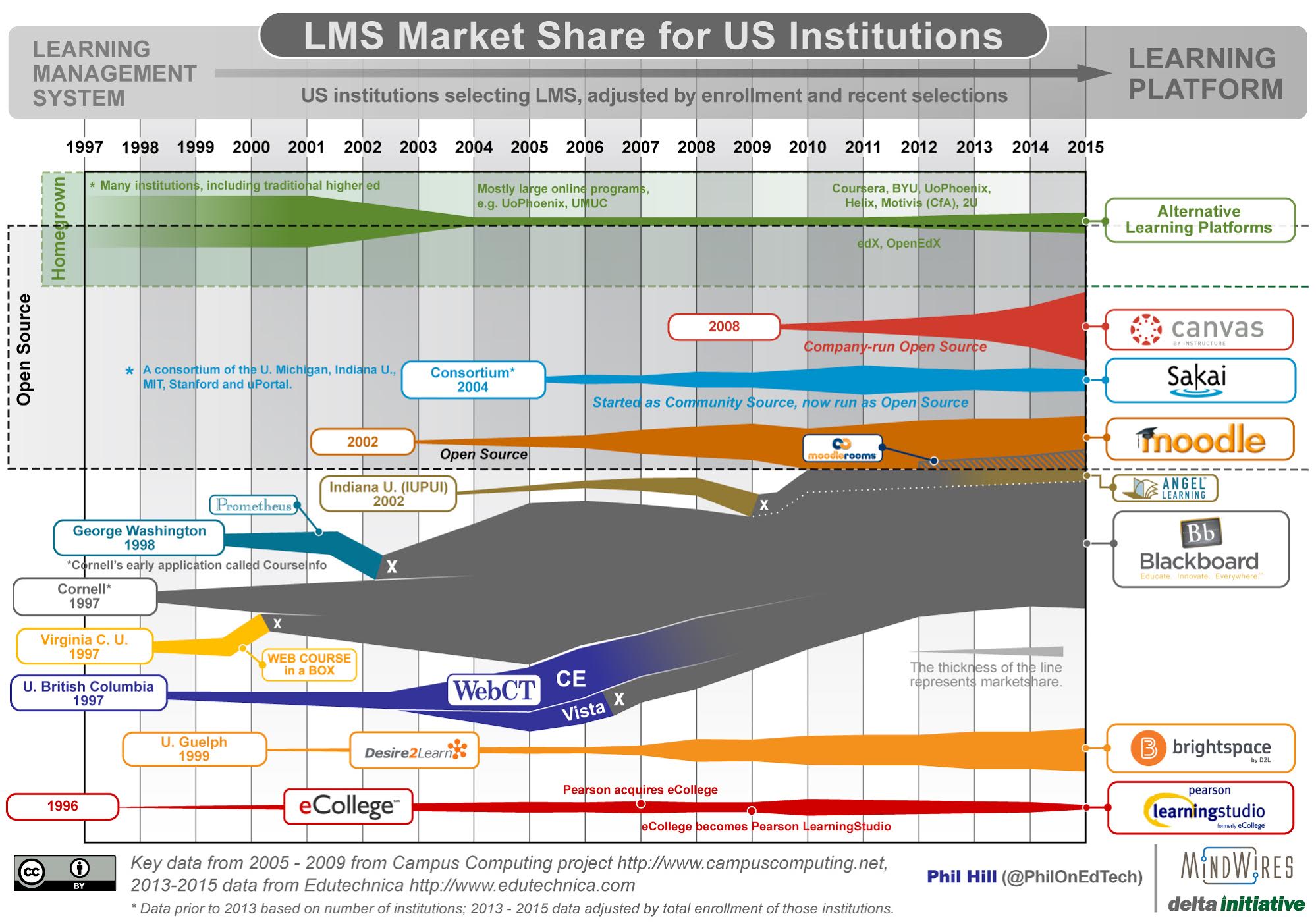
    I shared the most recent graphic summarizing the LMS market in October 2014, and thanks to revised data sources it’s time for an update. As with all previous versions, the 2005 – 2009 data points are based on the Campus Computing Project, and therefore is based on US adoption from non-profit institutions. This set of longitudinal data provides an anchor for the summary.

    The primary data source for 2013 – 2015 is Edutechnica, which not only does a more direct measurement of a larger number of schools (viewing all schools in IPEDS database with more than 700 FTE enrollments), but it also allows scaling based on enrollment per institution. This means that the latter years now more accurately represent how many students use a particular LMS. This post at Edutechnica provides the most recent data for Fall 2015.

    A few items to note:

    • The most important recent feature of the market – the rapid rise of Canvas, surpassing D2L and quickly closing in on Moodle – is quite visible now.
    • Blackboard Learn appears to have stopped its well-documented losses in US higher ed and has even risen in the past year. Its market share is far smaller than at its 2009 peak, but the company is no longer losing large numbers of clients each year.
    • D2L, Sakai, and Moodle have risen ever so slightly, but in effect have hit a plateau.
    • ANGEL and eCollege have lost market share.
    • There is a growing area of “Alternative Learning Platforms” that includes OpenEdX, 2U, Helix and Motivis (the newly commercialized learning platform from College for America).
    • While the data is more solid than 2012 and prior years, keep in mind that you should treat the graphic as telling a story of the market rather than being a chart of exact data.
    • Update (10/16): Removed “Curtin University as origin of Moodle based on Martin’s comments. Mea culpa – should have caught this earlier.
    • Update (10/23): Changed graphic title to refer to US and not North America.

    LMS_MarketShare_20151023

  • Instructure Files for IPO

    This doesn’t exactly come as a shock, but Instructure has filed for an IPO, and is expecting a post-IPO valuation of somewhere between $500 million and $800 million. Whenever a private company does this, they have to file a form called an S-1 with the SEC, which contains all kinds of financial and strategic information. You can find Instructure’s here.

    Also not a big surprise, but the numbers in the report show big growth. Subscription revenue rose 72% from 2013 to 2014. Coincidentally, Edutechinica just published its 3rd annual LMS Data Update. As you can see, Canvas went through the roof in US higher ed while the other major LMS players were either flat or close to it:

    But in order to achieve that growth, they have been running at a loss. The problem seems to be in high expenses rather than low revenues, which suggests that the losses are coming from the company bulking up rather than from them undercutting the competition on price. Also, most of those revenues still come from the US. Instructure has offices in London, Hong Kong, and Sydney. That’s not a huge international presence. And as it happens, Eductechnica has data for the UK and Australia:

    You can see that Instructure has not made a major dent yet in either country. (You can also see that their biggest competitor by far in those two countries is Blackboard, particularly when you consider that Blackboard now owns major Moodle hosting operations in both countries.)

    One last bit that jumped out at me after a quick scan of the S-1 wasn’t financial. Their characterization of analytics was interesting. Throughout the document, they try to make the case that high user engagement and utilization lead to better learning analytics. For example,

    Strong User Engagement Leads to Robust Data Analytics

    Given today’s focus on accountability and performance, both academic institutions and companies are striving to improve learning outcomes. To do so, an organization must first understand the variables that impact results, such as attendance metrics, user engagement, and the efficacy of various learning content and technologies for individual learners. A learning management system has the potential to provide significant insight to educators and administrators on their students’ and employees’ progress toward meeting learning objectives and the factors impacting performance. In addition, such learning management systems can facilitate insightful benchmarking to allow organizations to explore other drivers of learning outcomes.

    Strong user engagement with learning management systems is critical to maximize the potential of data analytics. High utilization enables the learning management system to capture more data, and leads to more insightful analyses on user behavior, quality of individual courses and effectiveness of digital content. Better analytics enables instructors and administrators to make more informed decisions about instruction and materials that in turn drive improved learning outcomes and performance for individuals and companies. This virtuous cycle among user engagement, data analytics and learning outcomes represents the evolution of learning technology. We believe that the market increasingly is demanding learning management software that delivers both robust analytics and strong user engagement.

    They later go on to say,

    Over eight million instructors, students and employees have used our software over the 12 months ended June 30, 2015. According to self-reported data in an ECAR 2014 survey, 58% of faculty in higher education use a learning management system to share content with students, while our internal analysis of higher education institutions using Canvas shows that 71% of faculty use Canvas to share content with students.

    But their claim in terms of what they actually have for data analytics is fairly weak:

    Our platform provides users with open API access to data analytics. We deliver the analytics in an easy to understand and consumable way, that is optimized for independent analysis. This open visibility allows learners to view their own progress in real-time, educators to adjust programs and personalize curricula for maximum effectiveness and organizations to benchmark user data internally and respond to patterns observed.

    They are not arguing that they have good analytics, but rather that the high utilization of the software plus open APIs will enable customers to build good analytics themselves.