Last Thursday I participated in a Future Trends Forum, hosted on the Shindig platform, with host Bryan Alexander on the topic of “What’s next with the LMS?”. I have to admit this was one of the best virtual discussions I’ve had, and more than half of the session was driven by audience questions. You can check out the Twitter discussion, Storified , or listen to an audio recording of the whole session, thanks to Roxanne Riskin. Update: See YouTube video of event posted at end.
As Bryan described in his blog post:
Yet maybe the conversation won’t stop there, at 3:05 pm EDT on June 29th. Because when we broke we had more than thirty (!) unanswered questions remaining from the Forum community. I’d like to share those now, so that Phil can respond, but also so that anyone can dive in, whether or not you participated yesterday.
I don’t have enough time to address all the of the questions, but I would like to tackle a few. We’re also talking about having a part 2 and bringing in Michael in late August. In the meantime . . .
- Competitiveness – Is the lack of competitiveness due to a lack of innovation or because IT decision makers are looking for consistency/ease of support?
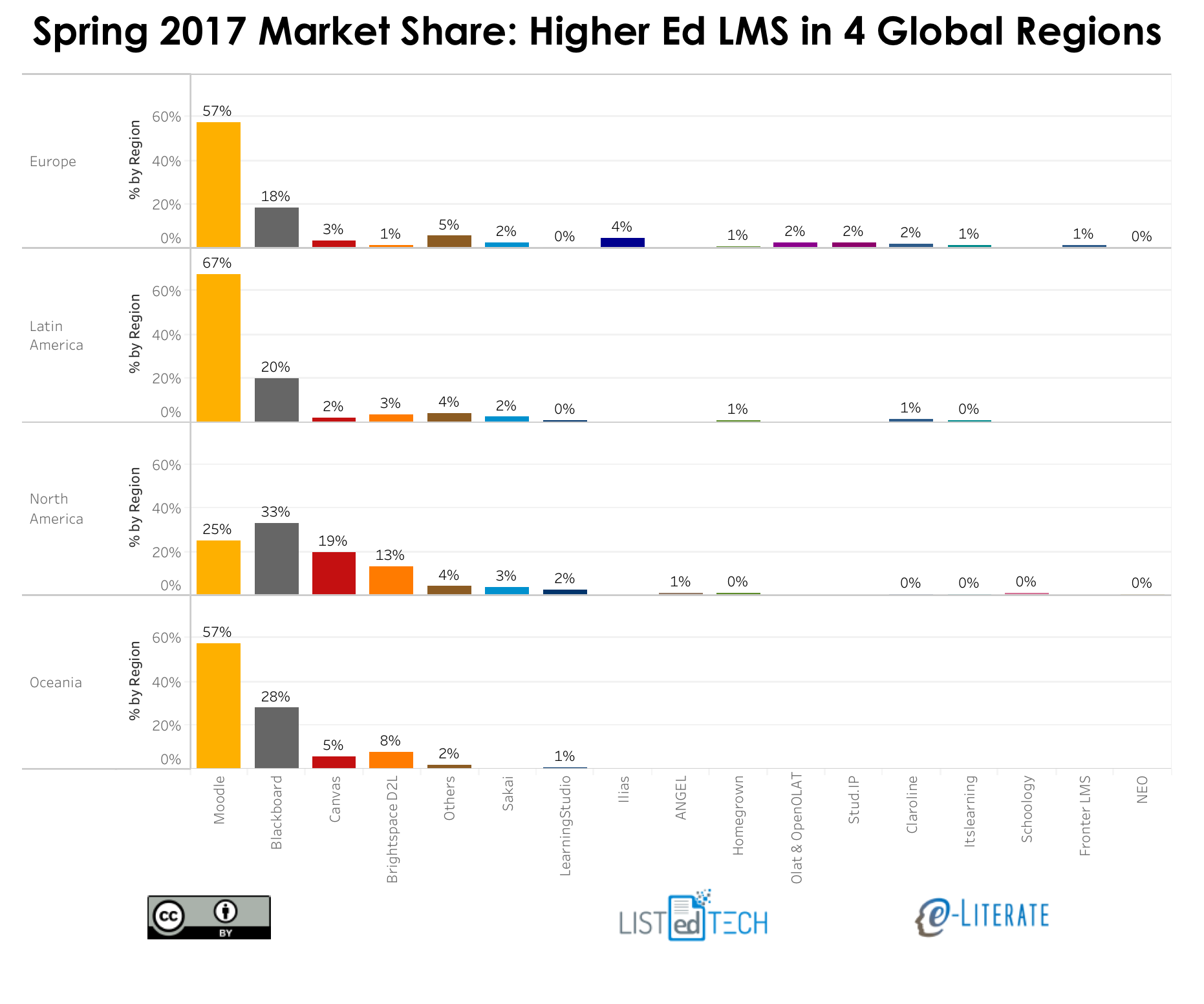
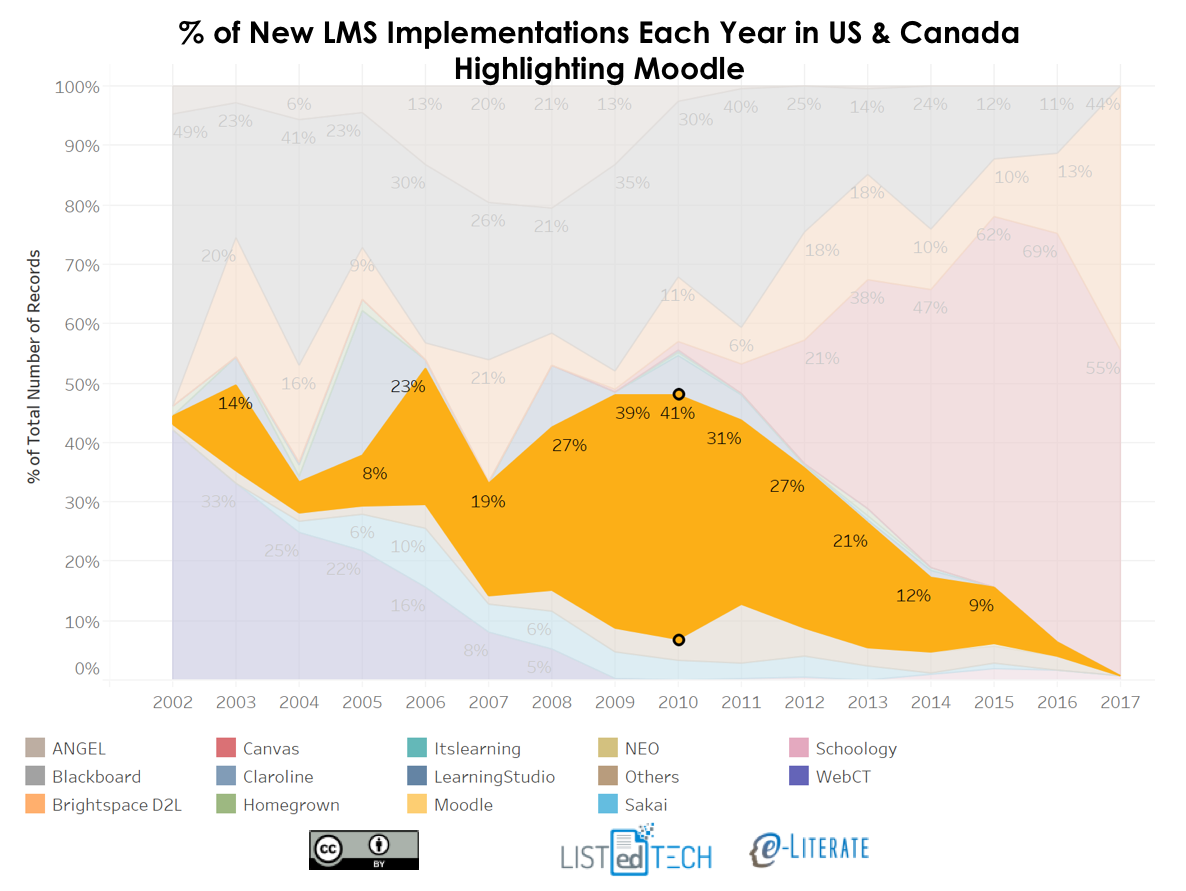
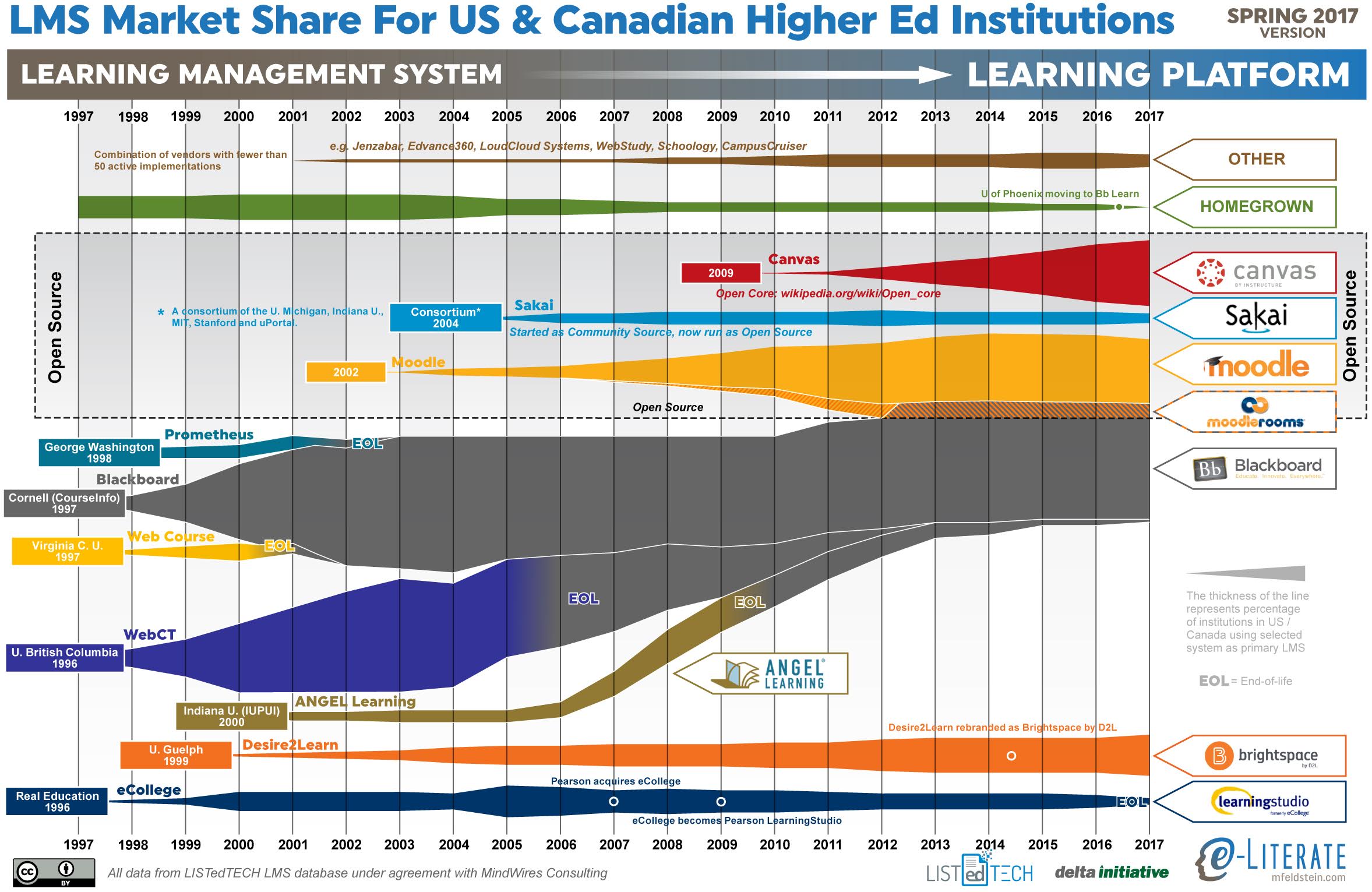
This question refers to the point I made in this blog post that in four global regions we have two companies dominating the installed base (Moodle, Blackboard), one dominating new implementations (Canvas) with one gaining recent momentum (D2L Brightspace). That’s four solutions dominating across the globe for higher education, hence the “lack of competitiveness” in the question.
While I think the market needs more innovation, I don’t think that’s the primary cause of this emerging four-way oligopoly. One issue more important than pure innovation is that ed tech is a difficult market in terms of scaling a business, and it is difficult to remain profitable. Canvas is growing fastest, and Instructure (parent company) plans to be cash-flow positive in 2018. As in, Instructure is not profitable yet. Just two years ago Moody’s changed their outlook on Blackboard to negative due to very high debt to EBITDA ratios and “stagnating revenues”. We have little public information on D2L, but I have pointed out company layoffs occurring after the large investment rounds. Moodle is open source and not directly a system with profits. This comes at a time when the expectations for competitive LMS offerings is rising in terms of cloud hosting and interoperability and intuitive user experience. This is not an easy business.
- What are your thoughts about competency-based education (CBE)? In particular, with Elliucian leaving the space, do you see a market for a CBE-targeted LMS? And, which products do you see as leaders? or potential leaders?
- CBE – You’ve brought up CBE a few times. Do you feel there is slower than expected growth for colleges/univ for CBE. Hence, the sun setting of Ellucian’s platform. Or, perhaps, are they force fitting the current LMS to be their CBE LMS?
See this post describing the very slow growth of CBE platforms. If you think the institutional LMS market is difficult, try the CBE platform market. We do not have the same level of market data for CBE as we do for LMS, but anecdotally I believe that Sagence Learning (formerly FlatWorld) has won the greatest number of CBEN platform selections in the past year or two.
- Have you seen any trends in terms of schools with more than one LMS – are places consolidating or fracturing? (always surprised by number of institutions that have more than one)
There is a general, low-level trend in higher education to have fewer cases of secondary LMS usage. Mostly consolidating while aiming to increase the number of third-party apps working alongside the primary system.
- hosted vs. not hosted – For those LMSs that aren’t open source, do you have any thoughts on how institutions are managing systems – are they choosing to host themselves or are they choosing to use vendor hosting (or other options)?
In all four global regions we have covered (North America, Europe, Latin America, Oceania), there is a move towards managed and cloud hosting and away from self-hosting. In North America, more than 90% of new LMS selections are going straight to managed or cloud hosting. Europe trends the same direction but is roughly 50 / 50 for new implementations. And I should point out that these trends exist for open source solutions – maybe not to the same level, but in the same direction.
- K-12 – following up on Schoology and google classroom, what force is K-12 going to be in the future of higher ed LMS? can the teaching energy and innovation of K-12 energize higher ed teaching…?
I have written several posts on Google Classroom, although I need to do an update. The general answer is that neither Google Classroom or Facebook Classroom show significant signs of affecting the higher ed market. There is some interest in both platforms, but mostly from a small number of individual faculty. And neither platform is designed to solve the gradebook or system integration needs of higher ed. Yet.
We have several posts on Schoology, which has a bigger potential impact on higher ed for a K-12 based system.
- Finally, we partially discussed a set of question from Fred Beshears, summarized in this new post. The general topic is around CBE platforms and whether LMS systems are moving to support “massive student information profiles” (across courses for large numbers of students) or whether this is being relegated to student record systems. We partially address these questions in the Future Trends Forum, but not entirely. Hopefully we’ll see others jumping into the online discussion. Update: See discussion thread at Bryan’s post for discussion on this topic.
- (Update: Finally, finally) I answered two questions in the session about the potential of the LMS as an integration hub, bringing in third-party apps rather than being monolithic systems. The answers were admittedly aspirational. George Station made a good point on Twitter that there is another side to the LMS impact on pedagogy:
In administrative vs. pedagogical, @PhilOnEdTech is being very idealistic. I see #elemess miring pedagogical decisions in 1990s. #ftte
— George Station (@harmonygritz) June 29, 2017
I do agree that this has happened, as covered further in replies to that tweet.