e-Literate

Present is Prologue

Tag: Martin-Dougiamas

  • Moodle’s Sanctimony on Openness is Moot

    Moodle’s Sanctimony on Openness is Moot

    Phil Hill has a great post up on the latest chapter in the Moodle partner soap opera. You should read the whole thing if you care about the LMS world, but the gist is this:

    • Moodle, in addition to being open-source software, is also an Australian for-profit company called Moodle Pty. Said company exerts a great deal of control over the development of the software and whose business model is licensing the Moodle trademark to partners who provide Moodle-related services in exchange for a percentage of their Moodle-related revenue.
    • Moodle creator and company owner Martin Dougiamas was very unhappy when Blackboard bought some of the biggest Moodle Partners some years back. After a lot of drama and tension, Blackboard left or was ejected from the Moodle Partner program. (Details vary depending on which party is telling the story.) Since Moodle Pty owns the trademark to the Moodle name, it revoked Blackboard’s permission to call its Moodle-based product “Moodle” or to use the Moodle logo.
    • Blackboard renamed their Moodle-based product OpenLMS, which it eventually sold to a company called Learning Technologies Group (LTG).
    • Somehow LTG or one of its subsidiaries was apparently a Moodle Partner at this time. It’s a little hard to follow because Moodle Pty has had some ongoing drama with LTG in their Moodle Partner program as well. At any rate, LTG continued Blackboard’s strategy of buying up Moodle Partners.
    • This week, after a lot of drama and tension, Moodle Pty ejected LTG from the Moodle Partners program, accusing LTG of creating lock-in with proprietary extensions in violation of the principle of “Openness” (which probably has some truth to it, but…well…more on that in a bit).
    • In parallel, OpenLMS announced its own policyabout what it will release as open-source and what it will keep as proprietary.
    • Recriminations between the two companies have been flying back and forth about a variety of topics, including whether OpenLMS’s openness policy is open enough.

    When e-Literate changed editorial focus in 2019, it largely stepped away from (a) providing coverage of the LMS market as an end in itself and (b) taking on one of its primary missions as policing vendor behavior. I have been very happy with both of those decisions. I’m going to make an exception to both here mainly because I want to make a point about “Openness” (where, as you will see, the choice of capitalization is not mine).

    Moodle is a vendor for which openness is a tool

    Over the years, I’ve tended to go easy on Moodle because it, and Martin, have accomplished enormous good in the world. Whatever one thinks about the LMS as a product category, it has enabled online education at scale, a development whose value has been spotlighted by the global pandemic. Moodle, by virtue of its design, license, and community, has brought these capabilities to communities and regions that no other vendor has deemed profitable enough to serve. Moodle has genuinely made the world a better place. And although I am pointedly and repeatedly going to emphasize Moodle Pty’s nature as a for-profit company, I fully believe it is a mission-oriented company that has prioritized impact.

    Corporate structures, business models, trademark laws, and software licenses are all inventions. They are artificial constructs we design in order to have specific effects on the world. Many of these constructs are specific kinds that we collectively refer to as “intellectual property” or “IP.” IP is simply an idea that somebody legally owns. That ownership can be legally expressed in a variety of ways, such as a patent for an invention, copyright for content, or a trademark for a company or product name or logo.

    (Update: IP is a little more complicated than that, as a couple of early critics of this post have pointed out. The degree to which the ownership is of the idea itself or the particular expression of it varies by type of IP. A process patent is different than copyright. This is a nuance that is beside the points I’m making here, but I’m noting it in the interest of precision.)

    IP in all its forms is a tool. In the United States, our Constitution specifically framed it this way. Here in the US, IP is a temporary monopoly that Congress can grant in order to provide financial motivation for the creation of new ideas and works. For example, you may be granted a copyright so that the years of your life writing the Great American Novel will pay off in the form of royalties, thus enabling you to contribute art to the world and, perhaps, to even be able to afford to start working on your next novel.

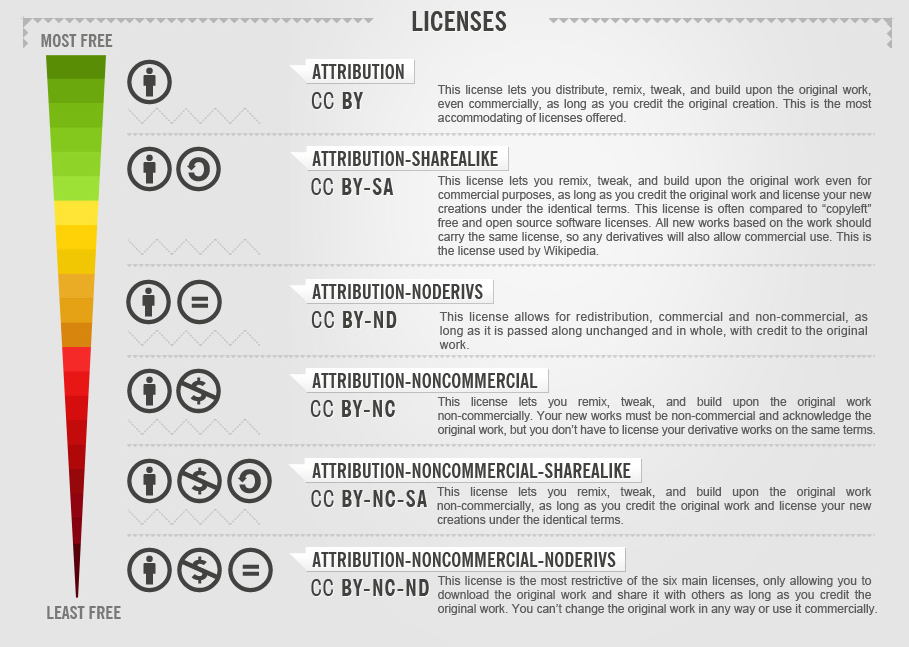
    Open licenses along the lines of open-source and Creative Commons are hacks of this system but do not depart from its essential purpose. Thir underlying insight is that sometimes existing IP licenses are hindrances to the desirable activities they are intended to encourage. For example, I publish this blog for free because I want to share knowledge. I want people to create new works using mine as building blocks. All I want in return is credit for my contribution. If I made every person who wanted to quote e-Literate explicitly ask my permission—as copyright law requires—then that extra effort might discourage some from adding to our educational knowledge. So I publish the blog under a Creative Commons license that lets people use my content without having to ask me as long as they properly attribute it.

    Some people who use open licenses view this kind of sharing as an inherent value. I personally tend toward the utilitarian. I have an affinity for openness and believe that, all else being equal, open is better than not. But I view openness as subordinate to other values such as educational impact. This is a matter of personal philosophy; other folks legitimately feel differently. But even as an end in itself, those who are immersed in topics like open-source or Creative Commons licenses know that the definition of “openness” and the value that it represents are very much contested territory among advocates.

    One way to divide the territory is into open licenses, which are specific legal contracts with well-defined terms, and “openness,” which is a squishy concept with a mix of utilitarian and moral connotations that vary from person to person. Well-written open licenses are clear-cut in their requirements and limitations. They often support, but do not necessarily define, commitments to a specific definition of openness as a value.

    Let’s focus on the utilitarian part for a moment. Martin created Moodle Pty with a particular revenue model, a particular open-source license, and a particular approach to using the Moodle Trademark as intellectual property. These pieces all fit together into a machine for growing “Moodle,” by which I mean both the adoption of the software and the company that Martin owns. It’s a model that served the Moodle mission and sustainability goals well at the time it was created. Many small schools, colleges, and other organizations all over the world had no access to any tool for centrally supporting online and technology-enabled learning. The Moodle software is free and easy to run (up to a point). Moodle Pty created a network of small, local businesses supporting support schools that did not have the capability to run Moodle on their own. Moodle Pty collected (and still collects) a percentage of revenues from these local vendors. This money went toward the development of the Moodle software, promotion of Moodle and its partners, paying salaries, and so on. At the time, the model worked incredibly well, making Moodle far and away the most popular LMS around the globe outside of the US and Canada.

    But the world has changed. Moodle was created before cloud computing and before online learning became mission-critical at scale across large swathes of the globe. These changes broke Moodle’s business model. It has been broken for quite some time. It arguably broke when a Moodle Partner called MoodleRooms, before it was eventually acquired by Blackboard, demonstrated that it could support one million simultaneous users on a single multi-tenant instance. This was a cloud version of Moodle, even if that term wasn’t popular at the time. Once a cloud version of Moodle existed, the power balance between Moodle Pty and its customers…er…partners shifted, and the number of customers from which it could collect revenues was destined to shrink. Rather than being a supplier to many small businesses, Moodle increasingly became the supplier for a few large businesses, each of which became increasingly important for its revenues. Again, read Phil’s post if you want a detailed breakdown of the Moodle model’s…um…breakdown.

    Open is as Open does

    Back to the present. Remember, LTG’s OpenLMS (which it purchased from Blackboard) made an announcement this week about which parts of their code they would release under an open-source license and which parts they would keep as proprietary. Phil Hill asked Martin to comment on OpenLMS’s announcement about their openness policy as part of the reporting for Phil’s blog post. Here is Martin’s reponse:

    Our actions have obviously been a factor in causing this, which I count as a good thing for everyone.   Please note, though, that their stated direction is to sell the integration of the full suite of LTG products – and none of those other things are open or planned to be.  Clients will still have the same lock-in to LTG as before (as desired by LTG).    https://www.youtube.com/watch?v=mBFShI8OYe4

    Not even all the “Open LMS” SaaS product will be actually open either.   I don’t know exact figures, so I’m estimating, but the OpenLMS service is probably 90% Moodle, with perhaps 10% other stuff, and they’re going to make only perhaps half of that other stuff available under GPL, so 5%.   It’s not a big deal and honestly, the least they could do.

    Moodle’s Dispute with LTG and its Growing Suite of Former Moodle Partners 

    Meh.

    News flash: All vendors try to make their customers want to stay by adding features or services they can’t get anywhere else. Some strategies are more ethical than others. Moodle Pty., like many vendors, uses its proprietary intellectual property to create what could arguably be called lock-in. Moodle Pty’s customers are Moodle Partners. Its intellectual property is its trademark. Martin has, on multiple occasions, exercised the threat of withholding that valuable IP when its customers have left or when they have behaved in ways that he believes are contrary to the interests of Moodle.

    There is nothing inherently wrong with this. Moodle has a mission that depends on revenues to sustain. Moodle Pty gets revenues from mostly smaller Moodle vendors. It uses its IP in the form of its trademark as kind of a soft lock-in to its customers (or “Partners”). If the customers walk away, they can still use the Moodle code. They just can’t use the Moodle trademark, which has value because it is recognized and trusted.

    LTG and its subsidiaries, eThink Education and OpenLMS, also provide value-added intellectual property to differentiate themselves, attract prospective customers, and hold onto existing customers. Moodle had earlier ejected eThink from the partner program for not being sufficiently “Open”:

    The Learning Technologies Group (LTG) announcement of the acquisition of eThink Education represents LTG’s intention to move customers into the Open LMS platform, which is not truly Open at all. Their extensions to Moodle are not downloadable, and not available from other service providers. Once on their platform, it is harder for institutions or organisations to move to a different provider, or to their own servers. This goes directly against Moodle’s values of openness. Consequently, as of 18 December 2020, eThink Education is no longer a Moodle Certified Partner or otherwise associated with or recommended by us at Moodle.

    Moodle’s Dispute with LTG and its Growing Suite of Former Moodle Partners 

    Martin’s definition here of “Open” has always been problematic. A lot of software is designed to integrate with or even run on other software. If somebody runs Moodle on a Windows server, does Moodle cease to be “Open” because Windows is not? If a school integrates Zoom—which is not downloadable and is not available from other service providers—as an “extension” to Moodle, does Moodle cease to be open source?

    Of course not. Heck, I would bet money that he personally has written code in Moodle that enables proprietary vendors to integrate their products deeply into Moodle. Further, the cloud has made this situation vastly more prevalent. How many of the software products you integrate as “extensions” to your LMS are downloadable to run on your institution’s servers? How much do you care? Instructure, whose source code to Canvas is largely (though not completely) open-source, has had vanishingly few institutions choose to download and run Canvas on their own servers or seek out an alternative provider. That’s because the virtue that drove customers to Canvas was its nature as cloud software, which means it is designed precisely so that nobody would have to download the software and run it on their own servers. It turns out that schools are not typically great at running mission-critical software applications with no hiccups and no downtime. The cloud has diminished the utility of “openness” (with a lower-case “o”) for many institutions.

    Now, it’s perfectly fine for Moodle Pty to hold that as a requirement for its partners and assert that their version of openness a value. Certainly, if its mission is to prioritize those parts of the world where affordability dictates either self-hosting or a small operation that can’t write its own cloud harness for Moodle, then the company certainly is within its rights to make a decision about that. If so, they should say that.

    By the way, Moodle Pty does have a cloud version of Moodle called, aptly enough, MoodleCloud. If their cloud-enabled version of Moodle has been released as open-source, I have not been able to find it. Again, I take a utilitarian view of any decisions that Moodle Pty makes in this regard. In my view, it’s a good decision to the degree that produces desirable results for educational equity and effectiveness. My concern is with Martin’s apparent hypocrisy, which is underlined by a tone that I read as sanctimonious.

    Likewise, if LTG is alleged to have violated Moodle’s open-source license or infringed on its trademark—in other words, if LTG stands accused of stealing Moodle Pty’s IP—then Moodle Pty should be clear about that accusation. The fact that they have not done so is suggestive. If LTG’s extensions legally violated Moodle’s open-source license’s “openness” requirements, then Moodle Pty would (and should) sue. They have not sued, which suggests to me that LTG’s code is cleanly separable. It may not be as clear-cut as Zoom or Windows, but it appears to be clear-cut enough that Moodle Pty has not pursued legal recourse.

    This is not to say that LTG couldn’t be playing games with features that (a) customers do not know are proprietary and (b) would have a hard time leaving behind if they migrated. I don’t know LTG’s offerings well enough to have an opinion on the matter. Martin could conceivably make a specific argument along these lines. Not a legal one, mind you. Moodle Pty’s trademark lock-in is relatively weak and circumscribed. But he could try to make an ethical argument that LTG’s extensions trick customers into lock-in. He seems to insinuate that.

    But he has not actually made the case. In fact, his waving away of OpenLMS’s statement about what they are opening as “the least they could do,” speculating about the percentage of code that remains proprietary rather than pointing to explicit features that concern him, suggests that he is not particularly interested in making that argument. He wants to make an argument about Openness in some pure and absolute sense.

    I have two problems with that. First, it comes across as hypocritical. Again, I don’t have any problem with Moodle Pty setting terms for its resellers, kicking out resellers that violate those terms, and enforcing the terms by withholding use of the Moodle trademark. But let’s not pretend that Moodle Pty has eschewed all IP, like some sort of corporate Buddhist, or that it has declined to assert that IP to protect its interests. I assume that Martin has a set of principles regarding openness that he is following. They must be more nuanced than “Openness is judged by the percentage of code is downloadable and available from other vendors.” He should state his principles clearly, not as the Proper definition of Openness but as Moodle Pty’s objective and concrete commitments and rationale. In fact, the OpenLMS statement that he dismissed so blithely does exactly this. Martin has enjoyed a position of assumed moral privilege for too long. If he wants to serve “Openness,” however he defines it, he should start by defining it in serious, testable, and internally consistent terms.

    Second, I reject the notion that Openness is a well-defined and absolute virtue by which others are Judged. ((Two can play the Capitalization Game.)) I always have and always will. Martin is far from the only person to wield an “opener than thou” attitude as a weapon in educational communities. He’s also far from the worst offender. But the way in which he’s choosing to communicate his decisions about the Moodle Partner program is particularly harmful because of his global stature. People who are deep into any of the various open communities—open-source, OER, open access—have inevitably been exposed to the complex and nuanced debates about the pros and cons of different licenses. These debates are fundamentally about the values and affordances of different definitions of openness, as expressed in those licenses. I understand that participants in these debates have passionate views on the subject. I don’t doubt Martin’s own passion. But by presenting the matter as cut-and-dried, he flattens this useful debate instead of taking the opportunity to raise awareness and literacy regarding its nuances. In the process, he risks coming across as naive at best and manipulative at worst.

    Martin could also take another (simpler) approach, which is to explicitly require Moodle Partners to adhere to Moodle Pty’s limitations around permitted extensions and reserve the right, without sanctimony or high dudgeon, to eject Partners that don’t adhere to the Terms and Conditions. I have no problem with that.

    Ironically, I have never been able to see a copy of the Moodle Partner Terms and Conditions, even though I explicitly asked to see them at one point. Apparently, they are (or were) considered to be proprietary IP of Moodle Pty and are (or were) not to be shared.

    I hate this crap

    Ugh.

    As I write these words, I am 50/50 on whether I will hit the “publish” button. If you are reading this post, it means I decided the discussion of the larger principle justifies wading into a topic that I largely don’t care about to criticize a person and organization whose accomplishments I respect. I don’t care about the LMS market per se. I have no real opinion about the dispute between Moodle Pty and LTG. Nor do I care enough to put in the work required to form one, at least based on what I’ve heard so far. I harbor no ill will toward Moodle Pty or Martin Dougiamas. Truly, I have a long list of topics that I would relish writing about instead of this one.

    All that said, I find the way that Martin is publicly characterizing the nature of the dispute to be disturbing and harmful, just as I found it to be disturbingly simplistic when he used the same rhetoric with Blackboard. If he truly believes that there is a clear moral definition of “Openness” (which he chose to turn into a proper noun through capitalization) then he should define it and articulate his argument for it. Alternatively, he could simply state that these are the conditions for Moodle Partnership without the air of moral superiority. Either option would be fine with me.

    We should be able to have thoughtful and productive discussions about how different definitions of openness can support or hinder different aspirations and values. My desire to do so is my motivation to write this piece and characterize the rhetoric coming from Martin and Moodle Pty in such strong terms. I am writing because I believe that Martin’s language is doing more to obscure the values and goals of “Openness” than it is to support and illuminate them. I find that to be particularly upsetting because I believe that Moodle has historically advanced goals and values that I cherish. In my view, Martin’s current rhetoric risks damaging that good work while diminishing the value of openness as a tool for future good work.


  • Fear and Loathing in the Moodle Community

    Fear and Loathing in the Moodle Community

    Moodle News responded to our recent coverage regarding the platform’s declining market share by pushing back hard with an article that simultaneously insinuates bias on our part and attempts to use our numbers to draw the opposite conclusions from the ones that we have put forward. This presented us with something of a dilemma. As professional analysts, we try very hard to be undefensive when we are critiqued. If people think we are biased, they are entitled to their opinions. If people question our data or analysis, we try to respond only if we think their critique of us has merit. If we don’t think it does, we generally let our original work speak for itself unless we have a specific reason to do otherwise. So, from this perspective, our default editorial position is to let Moodle News have their say and leave it alone. I will add that our overall impression of Moodle News has been that it is generally a fair and thoughtful outlet. We have no particular desire to pick a fight with them.

    On the other hand, we are not just analysts. One of the more common compliments we get from people who trust our work is that they believe it is animated by a concern for improving education. I take these comments to mean more than just that we “care” in some abstract sense. Rather, they seem to be saying that our choices of what stories we cover and how we cover them are animated by our desire for our analysis to be a tool for educators to help improve education. From that perspective, it’s hard for me personally to let the Moodle News story go unanswered. I care about what happens to Moodle, not so much because I care about Moodle in and of itself but because I care about the good that the platform and the community do for education across the globe.

    Sometimes when we poke at a group because of a problem, it’s partly because we want to call their attention to it in the hopes that they fix it. If we poke harder, it may be because we’re not convinced that they’re paying attention to the dangers that we see. (See, for example, Phil’s recent Unizin coverage.)

    Beyond the Moodle News piece and the occasional (but energetic) challenges we get from Moodle advocates when we present our numbers at conferences, the case for poking here is bolstered by Martin Dougiamas’ periodic public questioning of our analysis, including his comment on that aforementioned last post. The bulk of that comment was as follows:

    I get that you are a fan of certain companies and that is fine, but I don’t understand the highly negative and uninformed spin from you lately. Look at the title of this article! These feel like intentional attacks, to be honest, and I have to wonder why.

    The fact is your entire article here is based on the false supposition that our business model is a) static and b) based entirely on higher ed. However, we already have a number of new and exciting initiatives that you clearly don’t know about (MoodleCloud, MoodleNet, LearnMoodle, MoodleServices as well as new things not announced yet) that are supporting our current and future growth.

    Sustainability of Open Source and all Open initiatives is something we care about deeply and is part of everything we do.

    Again, readers have to come to their own conclusions regarding the quality of and motivations for our posts. From our perspective, we tend to write negative headlines when we see negative news. We tend to get more negative in our tone when we think the people we are trying to reach are not hearing us (or are not honest, though that is not an accusation that I am making here).

    As somebody who has been very directly involved with and committed to open source projects myself, I have learned that the very passion which drives participation can also cause advocates to dismiss any bad news as “fake news.” This can be fatal to a project. Moodle has massive market share, a fresh infusion of cash, and plenty of talent. There is time to address any challenges that the project faces. But only if those challenges are faced.

    I have decided to take one more run at this topic because I would like to see the Moodle community succeed, and in order to do that, I believe it will have to grapple with challenges that I don’t see evidence that it is fully grappling with yet.

    The Passion Play of Open Source in Crisis

    While the role I have chosen for myself in the ed tech ecosystem has required me to be ecumenical in recent years, I had previously been an active participant in two different open source LMS projects. The first was a system called dotLRN, which came into existence around 2000 and seems to have died around 2010. (The web site is still up, but nobody appears to be home.) From a functional perspective, dotLRN was fantastic. In retrospect, it was a decade ahead of its competition in a number of ways. But its technology stack was quirky. It was written in a programming language called TCL—which stands for “tool command language” but is referred to by its proponents as “tickle”—and ran on top of an early open source application server called AOLServer. I was told by people I trusted that these were perfectly valid technical choices that had distinct advantages over contemporary alternatives. As a newbie to software development and a non-engineer, I had no reason to doubt those assessments.

    But while I didn’t know much about technology, I did know how to listen. Over time, it became clear to me that attracting new developers and winning the confidence of university IT departments would be hard. Nobody seemed to think that learning a programming language called “tickle” and an application server called “AOLServer” seemed like a path to a career on the cutting edge. I grew more confident in that assessment as it became clear that adoption growth of the platform had hit a wall and it wasn’t even getting considered as an option in most cases. I raised this concern with the community, but many of the engineers continued to insist that the superiority of their choices would win in the end. And they could point to all the strengths of their platform relative to the competition as evidence for their case.

    The problem came to a head one day for me when I made a discovery about one of those strengths. There was a situation—I’ve long since forgotten the details—where the dotLRN developers decided to turn one of the capabilities of the platform into a web service. I asked, “How hard was that to do?” The answer? “Trivial. It’s just configuration. We can turn pretty much any API call into a web service with the flip of a switch.”

    I was stunned. This seemed like the way out! Let the dotLRN core continue to be developed by a limited number of specialized engineers, similarly to how web servers like Apache were being written in C by a small number of hard-core specialized developers. Develop a new front end using a more popular language, which at that time would have likely been PHP, Python, or Java. Use web services to communicate between the two. This was before REST and JSON had really hit the scene, so they would have been XML-based web services. But the point was, nobody would have to learn TCL. It would change everything, I thought.

    The dotLRN developer community was less enthusiastic. They believed their development approach was technically superior. Why should they pander to the least common denominator by promoting an awful, inelegant language like PHP? Besides, they had a huge installation in Brazil. Things were looking up, they said.

    It turns out that many open source communities, when faced with declining adoption that is forcing consideration of unpalatable choices, become some version of David Hasslehoff. “I may be the butt of jokes in the US, but I’m huge in Germany!” That is a bad place to be. Before you know it, the only things people remember you for are your deeply unfortunate “drunken stupor” YouTube video and your cameo in the SpongeBob movie.

    Could a switch to web services have saved dotLRN? I don’t know. It would have been tough no matter what. But the point is that open source communities are often driven by the passion of the participants. While it was exactly that commitment to the mission that attracted me to dotLRN at a time when the proprietary alternatives made me very queasy, it was that very same emotion that blinded some of the most passionate and committed community members to problems that turned out to be existential.

    When I left the dotLRN community, it was in the process of tearing itself apart. There was a lot of internal debate about whether anything needed to be done for the health of the project and, if so, what. One particularly bright and charismatic young leader in the community became offended that there was resistance to the direction that he (and his company) wanted to take dotLRN. So he left. (I hear he has since gone on to do great work under the auspices of the Mozilla community.) There was a sense among the remaining members that their suffering was externally inflicted. How could the world fail to appreciate the wonderful things that they had built and shared for everyone’s benefit? They were the victims, sacrificed by the unappreciative mob as thanks for their self-sacrificing effort. And now….

    I have seen similar challenges, albeit to a much lesser degree, in the Sakai community. By and large, that community has a more realistic grasp of where their challenges are and what their niche is. They also appear to be fairly stable at the moment.

    But passion can blind the Sakai community members from time to time too. (“We’re big in Spain!”) I can remember a time not too many years ago when people in that community—smart people who I respect and whose livelihoods depended on the health of the platform—who thought everything was just fine. One in particular told me that all Sakai needed was a refresh of the grade book and the test engine. Otherwise, everything was just great. (I’m not sure whether this was before or after Sakai finally fixed a fundamental problem where the platform broke the browser back button, but if it was after, it wasn’t long after.)

    That guy is now the CTO for a company that is not Sakai-focused.

    More recently, the last time I was at an Apereo conference, I attended a session whose abstract said the presenters would talk about how they welcome RFP processes and have kept Sakai competitive at their schools. I was curious. What followed was a litany of the presenters raising every imaginable obstacle to choosing Sakai over competitors, including many reasonable ones, and off-handledly dismissed them one by one. Perhaps inevitably, they came around to Phil’s squid diagram. They clearly didn’t know either that I was connected to the graph or that I had previously served on the Sakai Foundation Board of Directors. I didn’t say anything; I hadn’t gone to the session to ambush the poor guys. But others in the room knew who I was. All eyes turned to me, and several people pointed to me. The guy presenting in the moment rehearsed his arguments.

    ”That graph is based on old data, right?”

    No, you just have an old version. The latest version is up on the blog, and it doesn’t look any better.

    ”But this is just a small sample.”

    About 90% of US and Canadian institutions.

    You get the idea.

    No organization can remain healthy and effective if it doesn’t balance its passion with a healthy dose of skepticism and self-reflection.

    Which brings us to the Moodle News piece.

    Getting the Numbers Right

    There appear to be three sources of misunderstanding in the article in question. The first is not understanding our point about the intersecting trends of the collapse of new implementations (meaning very few new schools choosing to adopt Moodle in a particular year) with an increase in decommissions (meaning more schools replacing Moodle with another LMS). In North American higher education, we are already seeing a decline in total Moodle institutions of 45 – 50 (depending on when you measure). This is roughly equal to the 1% rounding number that we mentioned in the post (i.e., 1% of 4,500+ institutions in North America dataset).

    The Moodle News author is correct in noting that for the horse race view, Blackboard and Moodle are closer than ever when measured by percentage of institutions using as primary system. However, this is mainly because Blackboard’s market share has collapsed much faster than Moodle’s. Arguing that this shows Moodle is strong is a little bit like arguing that MySpace is strong because it has surpassed Napster’s market share (though I will grant that a slow decline is better than a fast one).

    The second problem is in not understanding the difference between new implementations and installed base. The chart I referenced in my last Moodle post measures the percentage of new implementations in each year moving towards Moodle – this is where (at the time of article) 0% of 2017 new implementations went to Moodle, 55% went to Canvas, and 44% to D2L. (To be fair, we’ve detected a few new implementations since that last piece; we will include them in our next periodic update of the graphs.)

    The author then asks:

    All of which leaves us to wonder: How can an LMS have no growth while its close competitors show increases of 55% and 44% (for D2L, now with a 15% market share), and end the year with its market share unchanged?

    Market share is based on installed base—the percentage of institutions having a particular LMS as its primary system as measured in a point of time. To get this number, we add new implementations, subtract decommissions, account for the changing denominator in the total number of institutions (there are a lot of consolidation and closings happening in the US), and round to the nearest whole percentage.

    So the answer to the author’s question is that Moodle has lost 45 – 50 net institutions in North American higher education. In other words, roughly equal to the 1% rounding number.

    The third problem is not understanding the difference between primary institutional adoptions, which is the measure that we use in our analysis, and the measure of the number of registered sites in Moodle.org’s stats. We don’t, for example, count the sites that may be self-run by an individual professor or department and that may be registered with Moodle.org. The latter may be important to the community from a mission perspective, but those adoptions do not impact the financial resources available for development of the platform. You can’t combine the two numbers.

    Speaking of which, the situation looks even worse for Moodle the closer we get to counting things that directly translate into revenues. The numbers that we track in many of our charts and graphs are the numbers of institutions that adopt different platforms. But the numbers that really matter for the financial health with most of these platforms is the number of students, because institutions pay their vendors, including the Moodle Partners that bankroll Moodle HQ, by the enrollment. For example, Southern New Hampshire University (which is moving to D2L) and Glendale Career College (which is on Moodle) each count as one institutional customer. But SNHU has over 100,000 students, while GCC has 300.

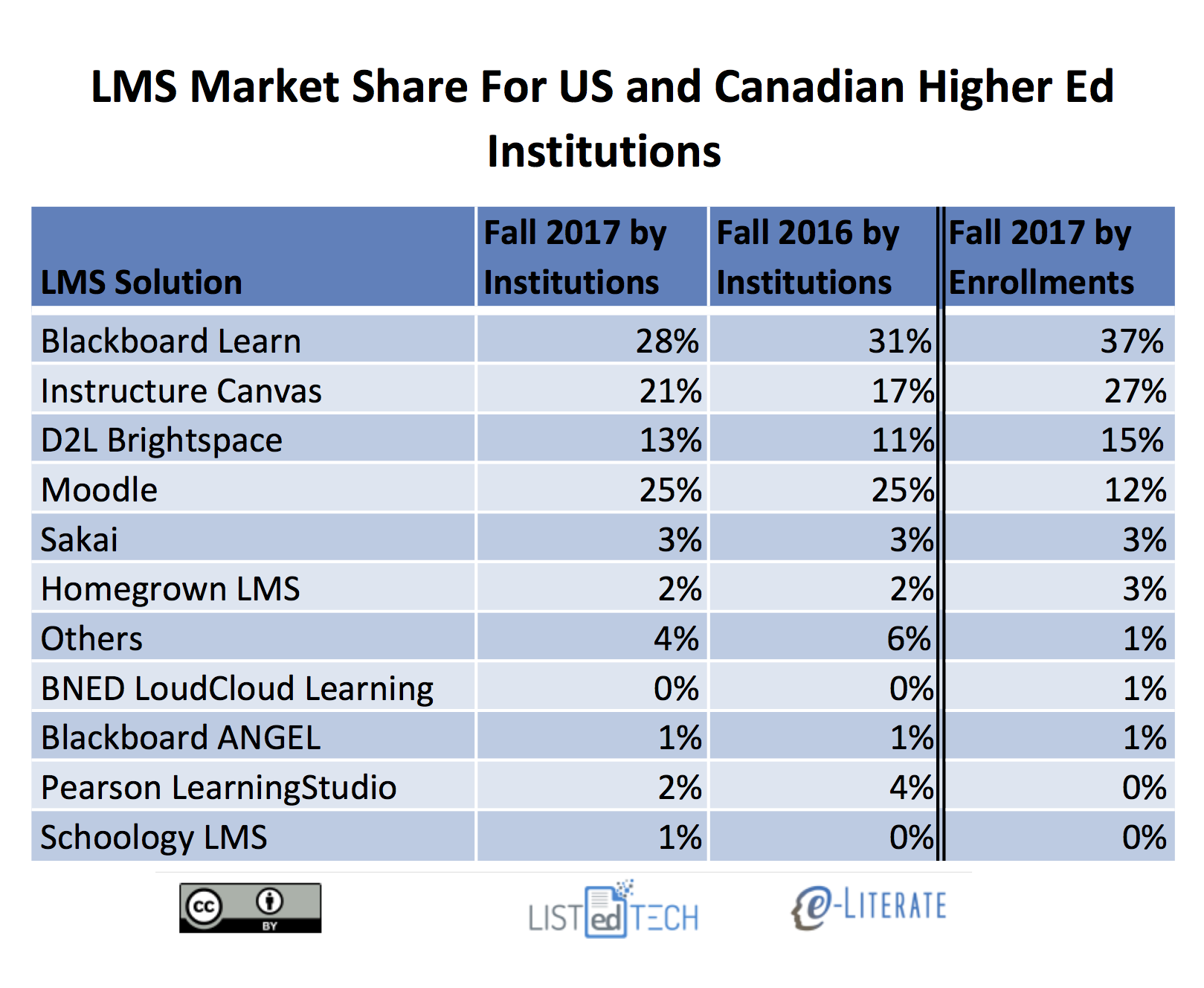
    When measuring by numbers of students, Moodle is fourth in the US and Canada, behind Blackboard Learn, Canvas, and Brightspace—and these numbers do not include future losses from the University of Minnesota and other schools that have chosen to migrate off of Moodle in the near future. Note the numbers in the right-most column of this chart:

    If, as our data show, the Moodle market share in US and Canada is much smaller when measured by numbers of students versus institutions, even as the number of Moodle institutions is shrinking, that is a bad picture for Moodle HQ’s financial health. If you care about Moodle, then you should be worried about these numbers.

    A Healthy Skepticism of Skepticism

    Is it possible that we at e-Literate are biased against Moodle? Of course it is. While we try our best to be objective, we are humans, and humans can be biased. The Moodle News author spends a fair bit of energy insinuating that we have a preference for other platforms. I’m not going to address that question, partly because I’m not the best judge of my own biases and partly because it’s not the question that Moodle advocates should be asking. Rather, the main question they should be worried about and should be investigating with as much absence of bias as they can muster, is the following:

    Is e-Literate’s analysis true?

    Could we be wrong? Of course we could. I very much doubt that we are off by much in the US and Canada, where we our data are the strongest. The margin of error increases as we get to parts of the world where our coverage is less complete (or, in some cases, non-existent). Those areas should be clear—and, in fact, are referenced in the Moodle News article—because we quantify the data fidelity in our regional analyses. If Moodle is huge in Germany, or China, or Myanmar, we might not be picking that up in our data.

    There is one person who may well have better data than we have, and Moodle advocates have reason to believe that he is not biased against Moodle. His name is Martin Dougiamas. He argued in the comment quoted at the top of the post that we don’t really understand or have visibility into the business model of Moodle Pty. If that is true, then we would like to be enlightened. And the Moodle community should want that too, for peace of mind.

    Moodle Pty could provide the community with two kinds of information that would help its advocates understand how much they should be worried (or not). First, Moodle Partners likely give Moodle Pty counts of customers by institution and numbers of students. (I don’t know this for certain, but I’m not sure how Moodle Pty could verify that they are being properly paid by the partner without this information.) The company could publish this information, aggregated by country so that individual customers and partners have some degree of anonymity while still giving the community a sense of the inputs that fund Moodle development. A second disclosure that Moodle Pty could offer is direct revenue numbers that are transparent enough for community members and other interested parties to independently verify the company’s financial health. While Moodle Pty is not legally obligated to provide any of these numbers, there are disclosure models in both non-profit foundations and for-profit companies that the company could choose to follow. At the moment, the status of Moodle Pty as a private corporation shields it from transparency requirements of either non-profit foundations or publicly traded corporations. But that doesn’t mean that the company, as the main engine of sustainability for a huge open source project that, despite current growth challenges, remains by far the world’s most widely adopted academic LMS, couldn’t or shouldn’t choose to be transparent about numbers that are critical to the project’s sustainability.

    If Moodle News really wants to check our numbers, then they should be asking Moodle Pty for adoption numbers of Moodle Partner-supported installations by institution, headcount, and/or revenues. And their biggest concern, as Moodle advocates, should not be whether some US analysts are talking smack about their favorite platform. It should be about how healthy and sustainable that platform truly is.

  • Why Moodle Supporters Should be Concerned

    Why Moodle Supporters Should be Concerned

    In Phil’s last post, in which he explained our data gathering methods for our LMS analysis work, he started with a quote from Moodle leader Martin Dougiamas that suggested our numbers were primarily US-based. Because it captured a common misconception about our data (and was based on a fair question), it was a good launching point for the post. But there was more to Martin’s comments on the subject, and we’ve heard various objections from some Moodle advocates about why our numbers are either inaccurate or irrelevant. ((The Moodle community is no more monolithic than any other; we have of course heard a wide range of opinions from Moodle advocates about the state of the union.))

    I’d like to review those arguments here. While Moodle is still by far the most widely adopted LMS in higher education globally and is no danger of disappearing any time soon, I believe that our data should give the Moodle community cause for considerable concern about their long-term future and should trigger some soul searching about how the community can ensure it continues to have the development resources necessary to continue to be relevant in the long term.

    The Data

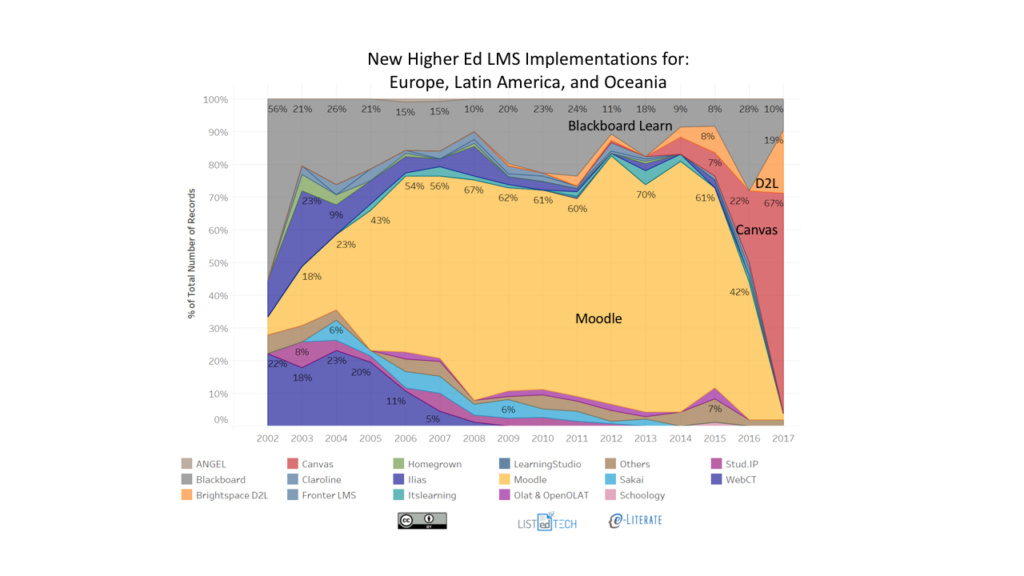
    Let’s start by reminding ourselves of the data in question. It really boils down to this one chart:

    Notice the scope of the chart: It does not include the US and Canada. This is data for Europe, Latin America, and Oceania. So this chart is not biased in any way by US-centric trends.

    There are two important caveats here. First, as Phil states in his post, our coverage of these areas of the world are not as complete as they are in the US and Canada, so trends we see in our data for these parts of the world should be considered directional and somewhat provisional rather than pinpoint accurate. That said, we only publish data for regions where we have enough coverage to be confident that our sample is representative. We don’t yet cover China or Africa for this reason. We believe the chart above is directionally correct, but there is a margin of error because we have a sample rather than a close-to-100% complete data set.

    The second caveat is that the chart shows new adoptions. When we look at installed base, Moodle still looks formidable:

    So the issue we’re talking about is not that Moodle is disappearing but rather that it is losing ground during new adoption cycles.

    The three most common arguments we hear from Moodle advocates are the following:

    1. The e-Literate numbers aren’t global or aren’t accurate.
    2. e-Literate is using the wrong adoption measure.
    3. e-Literate’s numbers are irrelevant, because an open source project doesn’t need to worry about growth in the same way that a profit-motivated company does.

    Phil’s earlier post addressed the first objection by describing the data we have, how we get it and validate it, and how we try to be transparent about its limitations.

    I’d like to address the other two objections in this post.

    The Wrong Measure?

    We measure higher education institutional adoptions. That means there are Moodle adoptions that we don’t measure or don’t report. We don’t have counts K12 or corporate adoption at all; Moodle has significant uptake in both of these areas. While we have data on secondary higher education adoptions (e.g., adoption by a school of education at a university that uses a different LMS for the rest of the institution), we don’t report these numbers. Nor do we report adoption by individual faculty. All of these are meaningful numbers and we do not dismiss them.

    But institutional higher education adoption is a particularly meaningful measure for Moodle’s long-term health. While Moodle is open source, Martin Dougiamas’ company Moodle Pty—more widely known within the Moodle community as Moodle HQ—does most of the development of the core Moodle code and maintains tight control over which code submitted by third parties gets accepted into the code base. This is what is sometimes known as the “benevolent dictator” model of open source, which was popularized by Linus Torvalds, the creator and development leader of the Linux kernel.

    Under the current way of doing things, both the direction of Moodle development and velocity at which occurs are largely controlled by Moodle Pty. However much input the company may take from the community, the ultimate decisions and, perhaps more importantly for this post, the work of implementing those decisions, fall under the purview of Moodle Pty, a for-profit company that must generate revenue to pay the employees who actually write that code. Moodle Pty’s revenues mostly come from Moodle Partners, which are companies that are licensed to use the Moodle trademark by Moodle Pty in return for a percentage of their Moodle-related gross revenues.

    If Moodle Partners lose paying customers, then Moodle Pty loses revenue. If Moodle Pty loses enough revenue, then at some point it would have to start laying off developers. If Moodle Pty starts laying off developers, then the pace of Moodle development will slow. If the pace of Moodle development slows, then the loss of Moodle-adopting schools may accelerate, creating a vicious cycle.

    While we don’t know the percentage of Moodle’s revenues that come from higher education (as opposed to K12 and corporate), we know it’s significant. The anecdotes I have heard from various sources suggest that it may well be the substantial majority of the total financial resources that fund the development of Moodle’s core platform. So, while other kinds of adoption may be great and may bring in new participants to the Moodle community, Moodle advocates should be concerned with higher education institutional adoption if they are concerned with having development resources for the Moodle platform in the long term.

    Irrelevant?

    Another argument we hear sometimes is that the Moodle community doesn’t need to care about these numbers because, as an open source project, it will fulfill its purpose if meets the needs of its adopters and doesn’t need growth for its own sake the way that a for-profit project does. Martin himself made this argument in the comments referenced above:

    Martin ended his comment on this topic by saying what makes our project different is that we are not driven by numbers. We are driven by the needs of our users and that he would be happy if there were only 100 universities using Moodle if we are following that approach.

    From an abstract philosophical perspective, this is undeniably true (or was at the time the comment was made, at any rate). An open source project does not need to satisfy investors or meet revenue targets. It just needs to attract enough developer resources to keep the code base viable and up-to-date. But there are a few serious problems with this argument in Moodle’s specific case.

    First, Moodle’s growth model was spectacularly successful in its first decade in part because it was a Robin Hood model. In richer countries, adopters could afford to pay hosting or management companies to run their mission-critical instances. A portion of this money would flow back to Moodle Pty and get invested in the salaries of developers who would improve Moodle and continue to release it under an open source license. In poorer countries, they could adopt Moodle themselves without paying a hosting or support vendor. Moodle has always been unusually easy to install and run on even modest hardware relative to its competition, so poorer schools could still manage to adopt it with the resources that they had. But if Moodle is losing ground in the richer countries (or, more accurately, the countries that can invest and are investing more dollars in educational technology), then it is also losing its development revenue base.

    (I would add that the message, “Hey, it’s no big deal to us if we lose some adopters” is not a great one for members of the community who feel like their needs are not being met.)

    But the problem is potentially worse for Moodle, because we’re beginning to see a pattern take hold in international markets as they reach a certain level of maturity, and it’s not good a good one for Moodle. In the US and Canada, the big hurdle to LMS migration was the move from self-hosted to cloud. Once institutions became comfortable with cloud hosting, the market changed rapidly, with Canvas in particular taking a strong lead and Moodle (among others) losing ground.

    We are seeing early evidence that the same pattern may be beginning to take hold in Europe now. While the data we have are not definitive yet, they are suggestive and are supported by the qualitative research we are doing. And this pattern could easily take hold elsewhere as well. For example, my colleague O’Neal Spicer and I recently had the good fortune to visit Brazil, where Moodle is still very much dominant. But consider this: Seventy-five percent of Brazil’s college students go to for-profit universities, and those businesses are enormous and growing. For example, Kroton, the country’s largest university, has about 2 million students. Given that these organizations are companies with investors and profit motives, there is no particular reason to believe that they are ideologically inclined toward open source. The fact that both Instructure and D2L have offices in São Paolo suggest that they believe they have an opportunity to win over the Brazilian market now that it has gotten big enough to be profitable for them. In other words, Moodle’s Robin Hood model is under threat because whenever a market becomes rich enough to generate significant revenue for Moodle Pty, it also becomes rich enough for universities to consider switching to cloud hosting by one of Moodle’s commercial competitors.

    Adding to this pressure is the fact that Moodle Pty just took $6 million in investment money. This is not a grant; it is an investment. However well-aligned and patient those investors may be, they still will eventually need to see a return on their $6 million. When investors do not see the return they expected, they eventually begin to put pressure on the company management to take steps that improve the finances. I don’t know enough about the terms of this particular investment relationship to know what kind of leverage Leclercq has to push for changes in Moodle Pty if they are not happy with its performance, but the fact of the matter is that Moodle Pty now has financial performance targets to meet.

    Put all this together, and it strongly suggests that members of the Moodle community should be concerned about the adoption trends we are seeing, for both mission and strategic reasons.

    Moodle’s Role

    I want to return to the example of Brazil for a moment to show why this matters not just to Moodle advocates but to anyone who cares about education. According to the 2016 Analytic Report of Distance Learning in Brazil published by Brazil’s premiere distance learning association, the Associação Brasileira de Educação a Distãncia (ABED), about three-quarters of a million Brazilians took online or blended courses in 2016. According to our analysis, Moodle has over 80% of Brazil’s higher education institutional LMS market share. It’s entirely possible that we would not have seen that kind of growth in access to education if Moodle had not existed. Yes, one or more other open source LMSs might have been adopted, but the existence of that Robin Hood sustainability engine built by Martin Dougiamas ensured that significant developer resources went to developing a high-quality globally adoptable LMS that could be deployed by even poor institutions. It has been an engine of educational growth.

    If the data patterns we are observing hold, then that engine may be under long-term threat. While Moodle has far too broad an installed base to disappear any time soon and just received an infusion of investor money, the fact is that its sustainability model is now in question. That’s bad for everyone. It’s bad for Moodle advocates, it’s bad for people who care about improving educational access for the developing world and economically challenged people in general, and it’s bad for those educational technology companies that have depended on international maturation of markets that open up new commercial opportunities for them.

    For everyone’s sake, I hope that the Moodle community—and particularly its leadership—owns up to this potential challenge to its sustainability model and confronts it head-on.


  • MoodleMoot US 16: Playing small-ball

    At the MoodleMoot in late June in Los Angeles, which serves as close to a users conference for the open source Moodle LMS community as any other event, there was a strong sense of continuity and general improvements. Rather than aggressive rearchitectures and product lineup changes, the Moodle roadmap is based on hitting singles and running the bases and not worrying about getting the big hits.

    In an interview with Moodle HQ founder and CEO Martin Dougiamas last fall, I asked him to respond to my observation that Moodle is at an inflection point based on Blackboard acquisitions of Moodle Partners, the creation of the Moodle Association, and Remote Learner leaving the Moodle Partner program. Martin’s response was interesting and is consistent with the message at the conference this summer. (more…)

  • Launch Of Moodle Users Association: 44 members sign up, mostly as individuals

    The Moodle Users Association (MUA), a crowd-funding group for additional Moodle core development, announced today that it is open for members to join. Technically the site was internally announced on its web site last Friday, but the press release came out today. As of this writing (Thurs evening PST), 44 members have signed up: 37 at the individual level, 1 at the bronze level, 3 at the silver level, 2 not sharing details, and Moodle Pty as the trademark holder. This equates to $8,680 – $22,580 of annual dues, depending on what level the two anonymous members chose.

    Update (1/25): As of Monday morning, the numbers are 51 members: 44 at the individual level, 1 bronze, 3 silver, 2 not sharing details, and Moodle Pty as trademark holder; leading to $8,960 – $22,860 of annual dues.

    Moodle News was the first outlet to describe the new organization (originally called Moodle Association but changed to Moodle Users Association when the organization was formalized), and in early December they summarized the motivation:

    As mentioned recently in an article on e-Literate, it’s possible that a majority of all funding to Moodle.org originates from Blackboard. While this may be ironic, knowing the history of Blackboard, it is appropriate since the LMS company has quietly become the largest Moodle Partner by number of clients through acquisitions and growth over the last few years. (more…)

  • Moodle Moves Give Hints of What a Post-Fork World Could Look Like

    Phil and I have written about the growing tension between the interests of Moodle HQ and a those of a couple of the bigger Moodle Partners, most notably Blackboard. There are a number of ways that this tension could be resolved, but one of the more dramatic possibilities would be a fork of Moodle. While we are not predicting it will happen, a couple of developments hit the wires last week that give us some idea of what the world might look like if there were a real and permanent split between the two groups.

    (more…)

  • Is Moodle “Bigger than Martin”?

    In his recent post on why Moodle matters, Phil wrote,

    For a large portion of our readers who deal mostly with US higher education, it could be easy to dismiss Moodle as an LMS and an idea past its prime.[…]And yet no other academic LMS solution comes close to Moodle in terms of worldwide deployments and learners enrolled.

    Likewise, if you’re not embedded in the Moodle community, you may not know how central Moodle creator Martin Dougiamas is to that project, or even know who he is. And yet, he is huge. I can name maybe a handful of people who are relatively widely known and respected in educational technology. I can name only a few who are admired and even beloved. I can name very few indeed who are not working for universities (although that’s changing a little, now that Jim Groom and David Wiley have both joined commercial ventures). Within the circle that knows him, Martin’s many admirers have been fiercely loyal to and protective of him, trusting him absolutely to steer Moodle the product, Moodle the community, and Moodle the brand. When you add to that the size of Moodle’s adoption footprint, one can make the case that Martin Dougiamas is one of the most consequential figures in the history of educational technology.

    Which is why it is so remarkable that Phil and I are hearing, for the first time ever, from a number of different, independent sources, the phrase, “Moodle is bigger than Martin now.” It is another indicator that Moodle is reaching an inflection point.

    (more…)