
e-Literate

Present is Prologue

Tag: Martin-Dougiamas

  • Why Moodle Matters

    For a large portion of our readers who deal mostly with US higher education, it could be easy to dismiss Moodle as an LMS and an idea past its prime. Market data from Edutechnica shows that since 2013 the number of adopting US institutions has hit a plateau, but the total number of students served (number of institutions using Moodle as primary LMS scaled by enrollment) has actually decreased. Gone are the days of UCLA, LSU, Athabasca, North Carolina Community Colleges, UNC Charlotte and other high-profile Moodle selections from the late 2000s. ((Disclosure: I helped UCLA with their LMS selection.)) Pop quiz: name the last significant LMS decision process in US higher ed that selected Moodle as a replacement for another system.

    . . .

    And yet no other academic LMS solution comes close to Moodle in terms of worldwide deployments and learners enrolled. Even if you’re a US college or university, consider several reasons why Moodle matters.

    Most Common LMS For Small Schools

    Again using Edutechnica data (this time from early 2014), for US institutions with enrollments of 2,500 FTE or less Moodle is the market leader, surpassing Blackboard Learn.
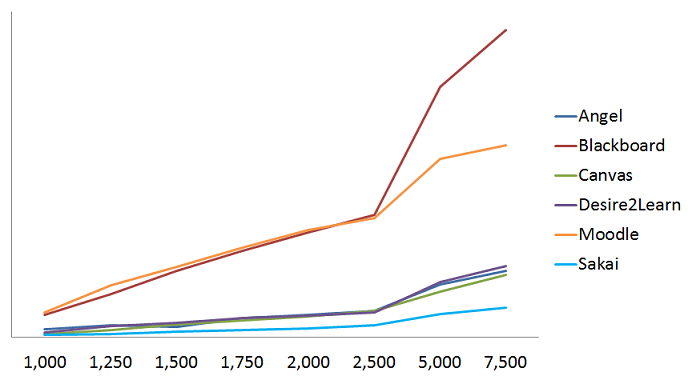
    Edutechnica Spring 2014 Small

    Most Prevalent LMS In The World Based On Self-Reported Data

    (more…)

  • Breaking: Totara LMS Forks From Moodle And Changes Relationship

    What interesting timing. Just as I published my interview with Martin Dougiamas, I was notified that Totara LMS, a Moodle derivative aimed at the corporate learning market, has forked from Moodle and is changing its relationship with the Moodle Community. From their newsletter released today (Sept 3 Australia time):

    The relationship between Totara and Moodle is changing

    We have made the carefully considered decision that from 2016 Totara LMS will no longer be in lockstep with Moodle. This will free the team at Totara Learning to focus on big leaps forward in usability and modernising the framework for our enterprise customers.

    Further down, Richard Wyles wrote an additional post explaining the fork, starting with his long-term relationship with Moodle. He then explains:

    Why are we forking?

    From 2016 onwards we will no longer be in lockstep. Totara LMS will progressively diverge from its Moodle foundations. (more…)

  • Interview With Martin Dougiamas On Changes To Moodle Community This Year

    In my post last week on Blackboard’s Moodle strategy in Latin America, I made the following observation:

    At the same time, this strategy and growth comes at a time where the Moodle community at large appears to be at an inflection point. This inflection point I see comes from a variety of triggers:

    • Blackboard acquisitions causing Moodle HQ, other Moodle Partners, and some subset of users’ concerns about commercialization;
    • Creation of the Moodle Association as well as Moodle Cloud services as alternate paths to Moodle Partners for revenue and setup; and
    • Remote-Learner leaving the Moodle Partner program and planning to join the Moodle Association, with its associated lost revenue and public questioning value.

    I’m working on a follow-up post that looks more deeply at these changes to the Moodle community, and as part of the research I’ve interviewed Martin Dougiamas, Moodle Founder and CEO, by email. Given Martin’s role, I wanted to avoid the risk of having his answers get buried within my upcoming analysis post; therefore, I’ve decided to publish the interview in full. The only changes I have made are for clarity: showing and correcting ((Changing references to “Remote Learner” to follow the proper “Remote-Learner” usage)) full names instead of acronyms ((For example, replacing “BB” with “Blackboard”, “NS” with “Nivel Siete”, etc)), correcting grammar, and reordering questions to show follow-up discussions in context.

    Phil: Given Blackboard’s trend in acquisitions for Moodle (Remote-Learner UK, X-Ray Analytics, Nivel Siete), and assuming these are not the last, how do these moves affect the Moodle community and future (including roadmap, Moodle HQ funding, whatever)? What are the biggest benefits and / or what are the risks and downsides?

    Martin: In any community there’s always going to be some concern about any one organisation trying to gain dominance. Our certified Moodle Partner program was designed specifically to avoid these kind of risks by building a large global network of different companies (currently 68 and growing, including Moonami and Elearning Experts recently in the US) who are committed to supporting Moodle HQ. The recent Blackboard acquisitions don’t bring any benefits to Moodle as a whole.
    (more…)

  • Moodle Association: New pay-for-play roadmap input for end users

    As long as we’re on the subject of changes to open source LMS models . . .

    Moodle is in the midst of releasing a fairly significant change to the community with a new not-for-profit entity called the Moodle Association. The idea is to get end users more directly involved in setting the product roadmap, as explained by Martin Dougiamas in this discussion thread and in his recent keynotes (the one below from early March in Germany).

    [After describing new and upcoming features] So that’s the things we have going now, but going back to this – this is the roadmap. Most people agree those things are pretty important right now. That list came from mostly me, getting feedback from many, many, many places. We’ve got the Moots, we’ve got the tracker, we’ve got the community, we’ve got Moodle partners who have many clients (and they collect a lot of feedback from their paying clients). We have all of that, and somehow my job is to synthesize all of that into a roadmap for 30 people to work on. It’s not ideal because there’s a lot, a lot of stuff going on in the community. (more…)

  • Two-Year Anniversary of Blackboard Acquisition of Moodlerooms and NetSpot

    Two years ago today, Blackboard made a dramatic change of course with a series of public announcements:

    At the time I described these changes:

    Most of the discussion in articles and blogs follows the meme of Blackboard entering open source, or even the meme of Blackboard acquiring competitors. I think the news is more significant than either of these two memes.

    Blackboard just did a 180-degree turn on their strategy for their core LMS business. They have moved from consolidating all customers into Learn 9.1 to providing products and services that are almost LMS-agnostic.

    Archive of Statements

    Given this dramatic turn of events, I wrote an additional post that captured the public statements (press releases, blog posts) from Blackboard, Moodlerooms, NetSpot, and even Blackboard competitors for the purpose of checking to see if the acquisitions really did signal a true change in strategy and support for open source. This two-year anniversary seems the perfect time to check up.

    Bb’s Previous Open Source View

    Just how big of a change did the announcements represent? Consider Blackboard’s moves regarding alternative LMS solutions in the previous six years. (more…)

  • The Future of Sakai: My View

    As a member of the Sakai Foundation Board, I have at least the appearance of conflict of interest in any analysis I write about Sakai. That’s why I encouraged Phil to write his own, independent analysis of the recent developments around Sakai OAE. I was happy to support him as one source for the article but not as editor. In fact, in keeping with his previous coverage of the Sakai OAE woes, Phil did not show me his post draft before he published it. This is as it should be. We strive for objectivity and independence here at e-Literate.

    But now that Phil has done his work, I would like to offer up my own personal reflections on the current state of the Sakai software and community and where they could go from here. In the process, I will do my best to make my relationship to the project clear.

    (more…)

  • Blackboard and MoodleRooms: An insight to private equity

    There has been speculation about Blackboard’s acquisition of MoodleRooms and its announcements about support of open-source learning systems. This is also an opportunity to see decision-making by Blackboard owner Providence Equity. The motivation of a private equity firm is rapid increase in the value of its assets. Some of Blackboard initiatives may take several years to take final form; perhaps longer than private equity objectives permit.

    Blackboard describes their software business saying: “We typically license our individual software applications either on a stand-alone basis or bundled as part of one of our six product lines: Blackboard Learn Blackboard Transact Blackboard Connect Blackboard Mobile Blackboard Collaborate and Blackboard Analytics.” Professional services account for 8% of revenue; product for 92%.

    (more…)