
The recent ASU Education Innovation Summit, which brought together venture capitalists with aspiring ed tech entrepreneurs, created quite a stir in the edublogosphere and the edutwitterverse. A lot of the reaction came from people who were watching from a distance via video. Audrey Watters, for example, wrote an epic rant on her frustrations. There were many angry tweets from a number of quarters. First-hand reporting was relatively scarce, though. George Siemens, who attended the conference live, wrote a thoughtful and nuanced post on the topic. The question of how entrepreneurs can productively play a role in educational progress, innovation, and reform is a topic that I think about a lot. In fact, I already had a post planned in my backblog from an interview I did with the Instructure founders and CEO on this very topic. So now that e-Literate has successfully migrated to a new host, and before Blackboard buying somebody else forces me to write another post series, I’d like to take some time to lay out my thoughts on the topic.
Tag: Martin-Dougiamas
-
The Blackboard Announcements, Part 2: Can Open Source Be Bought?
I have gotten a lot of email from folks who moved to Moodle (often from Blackboard CE) because they wanted to get away from Blackboard and they thought that open source was “safe.” In my first post on the announcements, I noted there are reasons to believe that Moodlerooms customers may do just fine under the new corporate ownership. But still, what does the announcement mean? Did Blackboard buy Moodle? What about open source can be for sale? What protection does it afford from corporate acquisition, and what are the limits of those protections?
I’ll try to outline some of the ins and outs in this post.
-
Interview with Martin Dougiamas
Here it is! All about the past, present, and future of Moodle:
It’s interesting to compare Moodle’s trajectory with Sakai’s. On the one hand, there’s evidence that the Moodle and Sakai communities are moving toward each other in terms of vision. The design principles that Martin describes as having guided Moodle development from the beginning are similar in approach and overlapping in content with the “lenses” that the Sakai community is adopting to guide Sakai 3 design:
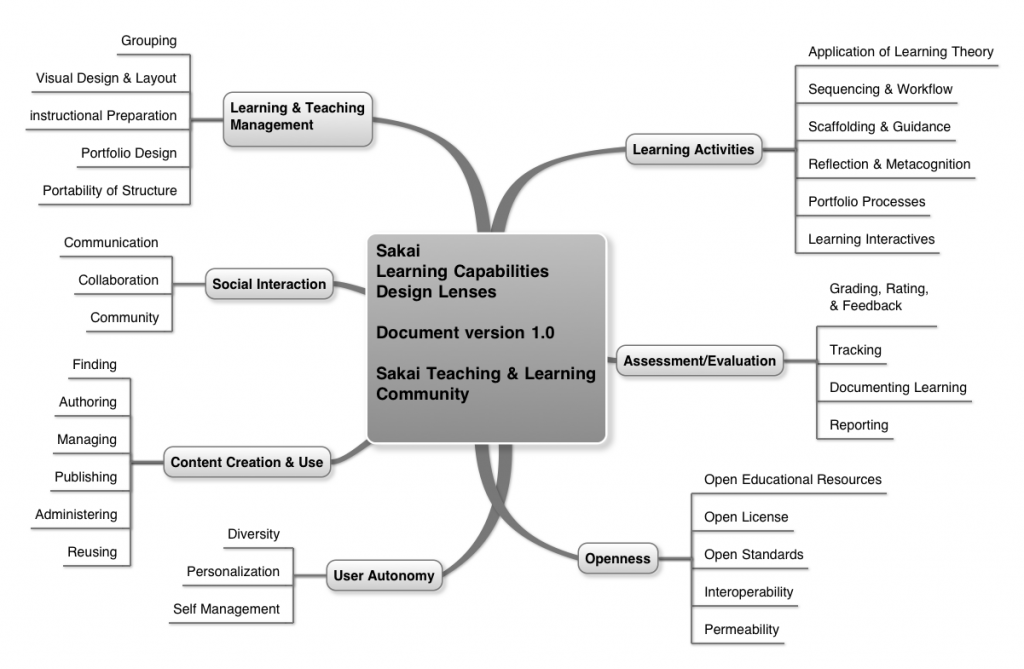
Sakai Learning Capabilities Design Lenses At the same time, the description that Martin gives of his early thinking about the design goals for Moodle 3, as well as its relationship to current-generation learning management, is quite similar to the path that the Sakai community has taken with Sakai 3, particularly vis-a-vis Sakai 2.
On the other hand, the Moodle and Sakai sustainability and governance models are quite different from each other and show no signs of converging. Moodle’s model puts a company with a strong central manager in charge of most core development. Money flows from adopting schools, through Moodle support partners, and into Moodle Pty., under Martin’s direction, to pay for the core developers. Sakai, in contrast, works on a consortial model with a foundation at its center. Both approaches have pros and cons, but the point is that they are quite different and have different risks for adopting schools to manage. We tend to talk about the choice between private source and open source as if the latter were monolithic, but actually there’s huge variety in the ways that these projects work. You have to evaluate the strengths and risks associated with each open source support ecosystem individually, just as you would evaluate the strengths and risks associated with each private source vendor individually.
Anyway, many thanks to Martin for an illuminating discussion.
-
Moodle Developer Martin Dougiamas Honored at OSCON 2008
This is a guest post by Jim Farmer.
Martin Dougiamas was named Best Education Enabler at last week’s OSCON (Open Source Conference) 2008 in Portland. The Google-O’Reilly Open Source award was made for his contribution to Moodle, an open source learning system. This is the first year anyone from education was nominated for the annual awards.
Other awards this went to Chris Messina as Best Community Amplifier, Angela Byron, as Best Contributor (Drupal), Andrew Tridgell for Best Interoperator (Samba and Rsync), and Harald Welte, gplviolations.org, as Defender of Rights.
Accepting the award for Dougiamas, Remote-Learner.net CEO Bryan Williams “Thanked Google and O’Reilly for the award and their support of Moodle, and expressed Martin’s regrets for not being able to attend the conference in person. He was honored by this award.”
“Moodle has a vibrant community of teachers, professors and business trainers collaborating on ways to improve learning. Moodle.org has become a real community of practice over the years for the advancement of online instructional design and student management.”
The Moodle Foundation is located in Perth, Australia. Remote-Learner.net is a Moodle Partner.