
e-Literate

Present is Prologue

Tag: MOOC

  • California SB 520 Could Define a New Right Right for Students – Access to Courses

    I previously shared the text of SB 520, the proposed California legislation that would identify and approve a set of up to 50 online courses that the three public systems would accept as credit for admitted students. In my notes for the press conference introducing the bill, there are updated links to most major press articles on the bill as select blog posts. Michael shared his analysis  of the bill and where he thinks changes are needed.

    The more time I have to think about this news, the more I’m convinced that if successful, the passage of this bill (or an amended version substantially meeting the stated aims described in the press conference) could have an impact much bigger than California students taking online courses. This bill aims to establish a new right – for admitted students to have access to the courses they need.

    The right for admitted students to have courses available

    The real significance of SB 520 is that it focuses on the student, not the institution, and specifically on admitted students. When the Master Plan was adopted in California starting in 1960, the basic premise was to guarantee students a place within one of the three public systems based on their high school record. It was assumed that by having a place in a public institution, the student would have access to needed courses.
    For various reasons, this assumption is no longer valid.

    (more…)

  • California SB 520 – Text of Proposed Draft Bill for Online Education Platform

    Thanks to Ry Rivard at Inside Higher Ed, we have a copy of the draft bill as of March 8, 2013. With cooperation of Caffeine-Fueled Transcriptions, Inc, I thought it would be useful to share the full text. Please note that this is a draft bill that will be amended over time. I have added formatting (indents) to help with readability. See previous post for description of press conference (including Q&A) and press coverage.

    *************************************************************

    SECTION 1. The Legislature finds and declares all of the following:

    (a) In recent years, California’s public higher education institutions have faced skyrocketing demand for enrollment at a time when they lack capacity to provide students with access to courses necessary for program completion and success.

    (b) In the 2012 – 13 academic year, 85 percent of California Community Colleges (CCC) reported having waiting lists for their fall 2012 course sections, with a statewide average of more than 7,000 students on waiting lists per college.

    (c) Similarly, impacted courses have contributed significantly to difficulties within the University of California (UC) and California State University (CSU) systems, with figures indicating that only 60 percent and 16 percent of students, respectively, are able to earn a degree within four years, with lack of access to key courses a factor in increased time-to-degree.

    (d) With rapidly developing innovation in online course delivery models, California’s public institutions of higher education have a unique opportunity to meet critical demands for enrollment and reduce time-to-degree by providing students with access to high-quality, alternative, online pathways to successfully complete and obtain credit for the most impacted lower division courses.

    (e) California could significantly benefit from a statutorily enacted, quality-first, faculty-led framework allowing students in online courses in strategically selected lower division majors and general education fields to be awarded credit at the UC, CSU, and CCC systems. While providing easy access to these courses, these systems could also continually assess the value of the courses and grates of student success in utilizing these alternative online pathways.

    (more…)

  • Proposed California Legislation for Statewide Online Education Courses – The Basics

    Outside of the Vatican, the big news this week in higher education is the proposed legislation in California that would identify and approve a set of up to 50 online courses that the three public systems would accept as credit for admitted students. Senate President Pro Tem Darrell Steinberg is co-authoring SB520 that addresses popular, introductory courses for which students cannot get access from their University of California, California State University, or California Community College campus. The pre-coverage of the event included the following:

    As described in the NY Times:

    Legislation will be introduced in the California Senate on Wednesday that could reshape higher education by requiring the state’s public colleges and universities to give credit for faculty-approved online courses taken by students unable to register for oversubscribed classes on campus.

    If it passes, as seems likely, it would be the first time that state legislators have instructed public universities to grant credit for courses that were not their own — including those taught by a private vendor, not by a college or university.

    “We want to be the first state in the nation to make this promise: No college student in California will be denied the right to move through their education because they couldn’t get a seat in the course they needed,” said Darrell Steinberg, the president pro tem of the Senate, who will introduce the bill. “That’s the motivation for this.”

    Update 3/14: Text of bill here

    Senate President Pro Tem Steinberg held a press conference today via Google Hangout and video streaming (archive available soon on site) to announce the package of legislation. I have attempted to summarize the press conference below (any mistakes in note-taking are my own, and I’ll update as needed). While Michael and I will both have analysis of this proposal soon, I wanted to first share the information directly.

    (more…)

  • Emerging Student Patterns in MOOCs: A (Revised) Graphical View

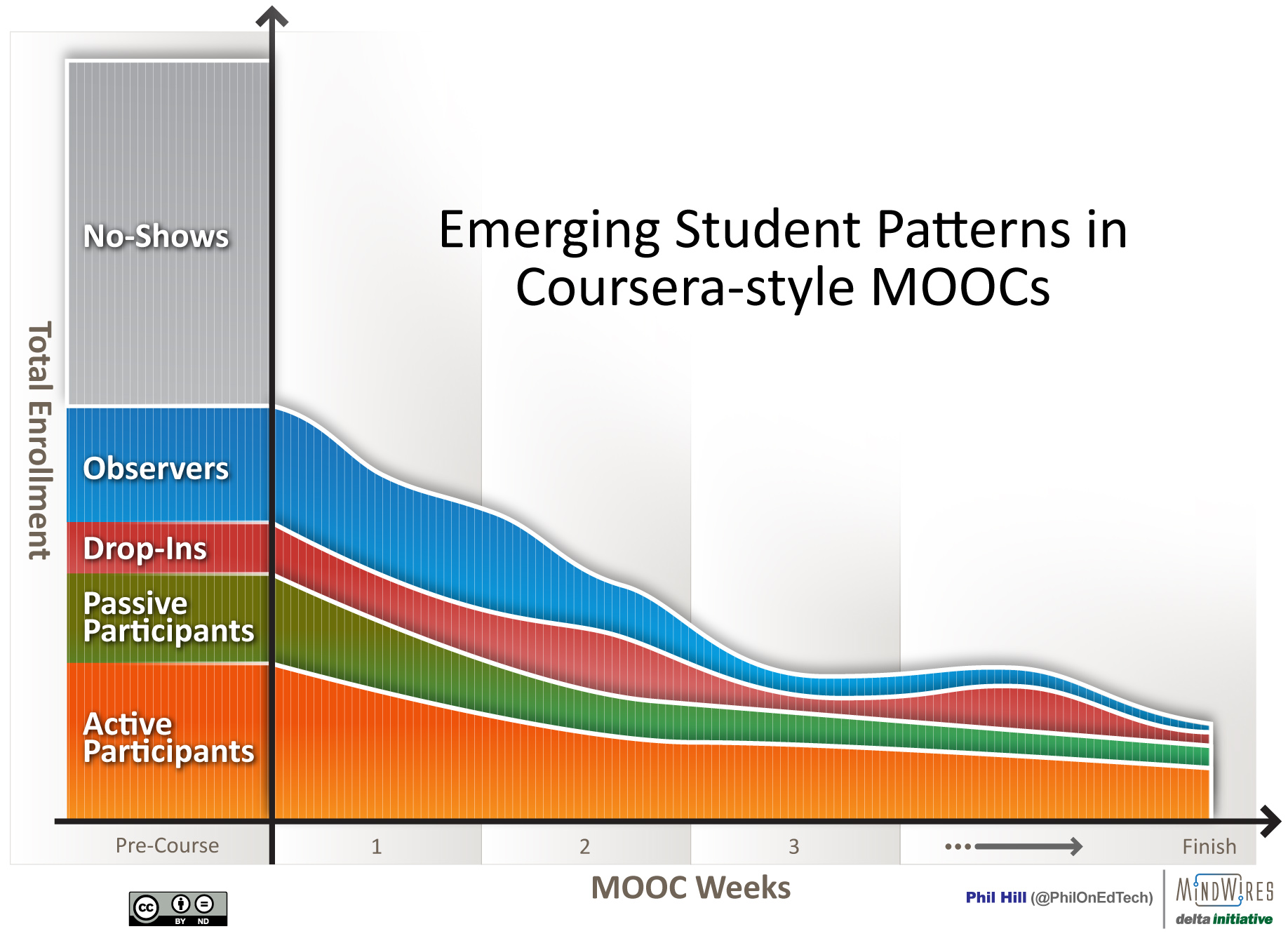
    In part 1 of this series of posts on MOOC student patterns, I shared an initial description of four student patterns emerging from Coursera-style MOOCs based on new data from professors. In part 2, I revised the description based on some feedback and added a graphical view. The excellent feedback has continued, primarily through comments to both posts mentioned above as well as a separate Google+ discussion. This process has helped identify a fifth pattern, clarify the pattern description, and improve the associated graphic. In particular, I want to thank Debbie Morrison, Colin Milligan, John Whitmer, Charles Severance and Kevin Kelly – as well as other commenters for the great discussion.

    The primary changes involve clarifying the previously-described Lurker category. I have separated out a new No-Show category and renamed the Lurkers as Observers. There are also tighter descriptions of each pattern that help define potential data collection that would identify these groupings. Here are the new descriptions and updated graphic.

    No-Shows – These students appear to be the largest group of those registering for an Coursera-style MOOC, where people register but never login to the course while it is active.

    Observers – These students login and may read content or browse discussions, but do not take any form of assessment beyond pop-up quizzes embedded in videos.

    Drop-Ins – These are students who perform some activity (watch videos, browse or participate in discussion forum) for a select topic within the course, but do not attempt to complete the entire course. Some of these students are focused participants who use MOOCs informally to find content that help them meet course goals elsewhere.

    Passive Participants – These are students who view a course as content to consume. They may watch videos, take quizzes, read discuss forums, but generally do not engage with the assignments.

    Active Participants – These are the students who fully intend to participate in the MOOC and take part in discussion forums, the majority of assignments and all quizzes & assessments.

    studentPatternsInMoocs3-2


  • Emerging Student Patterns in MOOCs: A Graphical View

    Update (3/10): Patterns and descriptions have been updated based on feedback in a new post. Added links to Astronomy, AI Planning courses.

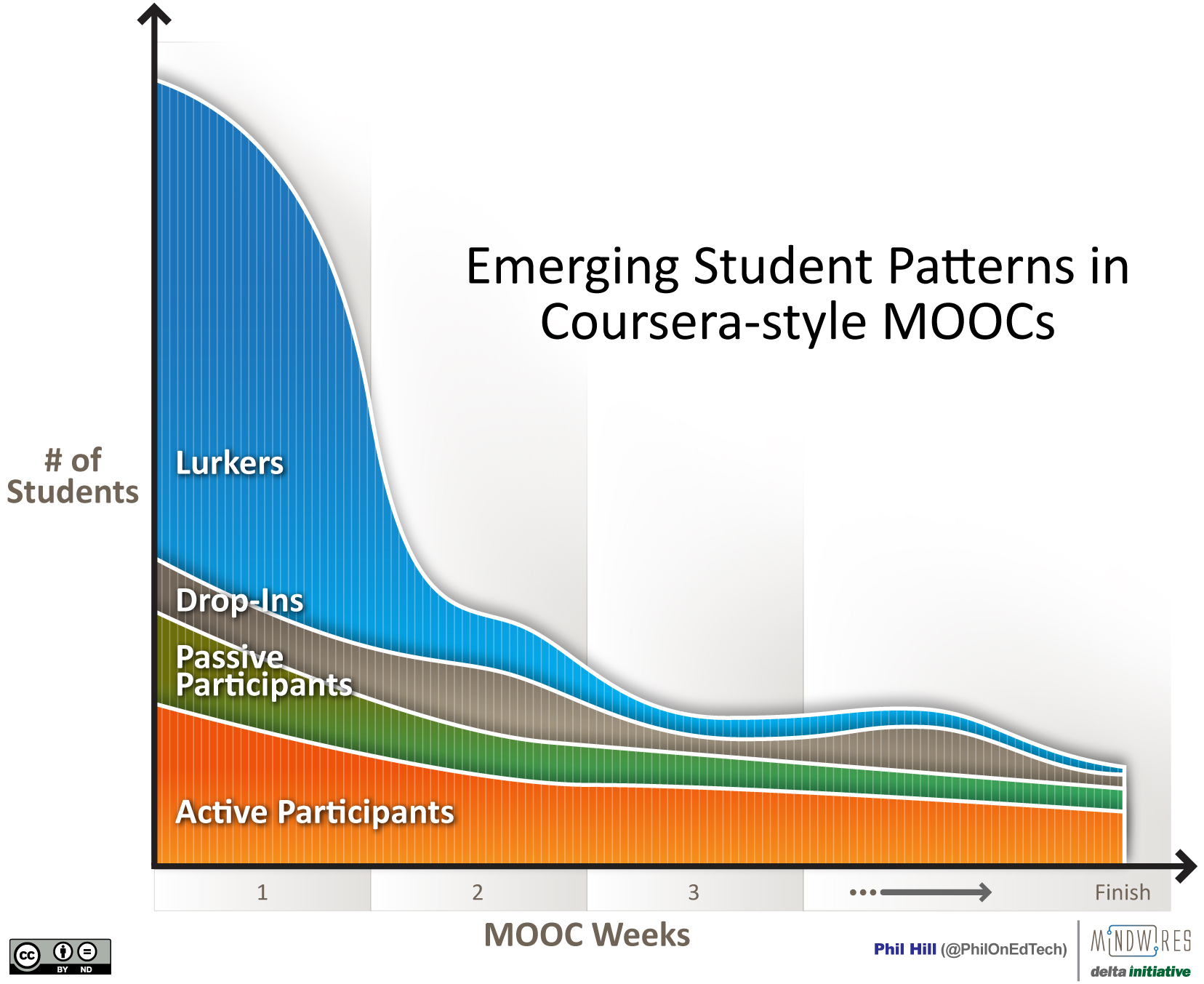
    Thanks to feedback from my last post, I have modified the proposed description of patterns for students engaged in MOOCs. I also want to introduce a graphic to visually represent these patterns.

    studentPatternsInMoocs2

    • I have removed the language comparing passive participants to traditional students based on the idea that they expect others to define academic goals for them and ‘expect to be taught’ (thanks to Colin Milligan for description). While this distinction between passive and active participants is important, I have removed the direct reference to traditional students – the reader can apply their own comparisons.
    • I have removed the usage of the term archetype. As Satia Renee put it so well on Google+, archetype implies “more an internal personality type expressing itself in patterns of behavior” when I am trying to capture the patterns of behavior. Thus I’m sticking with the less loaded term of patterns.
    • I have added language, thanks to Kevin Kelly, that captures the growing case of Drop-Ins as students focused on a particular topic within a MOOC for usage outside of that MOOC.
    • Finally, I have moved Drop-Ins right after Lurkers based on Colin’s comments and to help with the graphical view below.

    (more…)

  • The OpenClass Vision: An Example

    In my last post, I described a vision for combining elements of MOOC-like scale with a more traditional face-to-face classroom experience, as articulated by Pearson’s Adrian Sannier. (Full disclosure: Pearson is a client of MindWires Consulting.) A couple of months ago, I suggested in an interview with Josh Kim for Inside Higher Education that this is where MOOCs would go next:

    Question 6. Will MOOCs replace accredited curriculum? Why or why not?

    I don’t know how to answer this question, because I’m not convinced that we know what a MOOC is yet. Will there be massive elements that are integral to many curricula? Almost certainly, although I don’t know how much of it we will see in 2013. Will the curricula be all massive? Probably not in most cases. Will we consider the mix of massive and non-massive elements to be “MOOCs”? I don’t know.

    The problem that we have right now is that we have very few models for how this might work. So when Sannier mentioned a course called Habitable Worlds being developed by Professor Ariel Anbar and Lev Horodyskyj at Arizona State University that will eventually be brought to OpenClass to support this model, I asked to speak with Professor Anbar in order to get some specifics. The conversation shed some light not only on possibilities for the mixed model, but also on possible futures for the liberal arts and the role of the professor.

    (more…)

  • The Four Student Archetypes Emerging in MOOCs

    The Four Student Archetypes Emerging in MOOCs

    Update (3/10): Patterns and descriptions have been updated based on feedback in a new post.

    As discussed in my last post, the focus on “completion rates” in MOOCs is somewhat misplaced, as open education is not simply an extension of traditional education. As several others have noted, not every student is attempting to complete a course, and in fact different students have different goals while participating in the same open course. This holds true for both cMOOCs and xMOOCs.

    Does this mean that we should throw out the completion rate data? No. As Katy Jordan described quite well in the comments:

    A lot of people have asked whether completion rates are the right way of framing the success of a MOOC; I agree that there is much more to the potential positive impacts of MOOCs for students than completion rate but, at the moment, completion rate is what the providers are measuring most consistently.

    In my mind, we should augment the models we use to evaluate MOOCs rather than throw the baby out with the bathwater. The challenge, therefore, is to move beyond the simplistic view of one type of student with one type of goal (course completion), and find patterns of student behavior that will give additional insight into the different goals and therefore different measures we should have in evaluating whether MOOCs are effective.

    (more…)