
e-Literate

Present is Prologue

Tag: MOOC

  • Online Educational Delivery Models: A Descriptive View

            This article was originally published at EDUCAUSE Review.

    Update (11/25): This post has been bumped and amended to include the full article.

    Although there has been a long history of distance education, the creation of online education occurred just over a decade and a half ago—a relatively short time in academic terms. Early course delivery via the web had started by 1994, soon followed by a more structured approach using the new category of course management systems.1 Since that time, online education has slowly but steadily grown in popularity, to the point that in the fall of 2010, almost one-third of U.S. postsecondary students were taking at least one course online.2 Fast forward to 2012: a new concept called Massive Open Online Courses (MOOCs) is generating widespread interest in higher education circles. Most significantly, it has opened up strategic discussions in higher education cabinets and boardrooms about online education. Stanford, MIT, Harvard, the University of California–Berkeley, and others have thrown their support—in terms of investment, resources, and presidential backing—behind the transformative power of MOOCs and online education. National media outlets such as the Wall Street Journal, the New York Times, and The Atlantic are touting what David Brooks has called “the campus tsunami” of online education.3

    Unfortunately, a natural side effect of this new interest in education and educational technology is an increase in hype and in shallow descriptions of the potential for new educational models to replace the established system. All too often, the public discussion has become stuck in a false dichotomy of traditional vs. online—a dichotomy that treats all online models as similar and that ignores blended or hybrid approaches. This false dichotomy is even more evident now that discussions are spilling into national media forums. But in fact, as my colleague Molly Langstaff has described, educational technology is interacting with innovative educational courses and programs to create not only new language but also multiple models for delivering education.4
    (more…)

  • Is Coursera Facebook, Amazon, or Pets.com?

    Before I get started, let me just say that Phil can vouch for the fact that I had already planned to use “Pets.com” in the title of this post before MIT Technology Review used it in their article on Minerva. As we’ll see, there are reasons to reach for that particular analogy at this particular moment in educational technology.

    Anyway, it’s an uncomfortable truth for educational folks that one of the principal innovations of the xMOOC is the store front. It is the ability to find courses in a catalog. If you look at what Coursera is right now from a platform perspective, it is primarily a store front on top of an LMS. The same could be said of edX. And as Phil and I have both written about recently, this is also the primary innovation in Instructure’s Canvas Network. I don’t expect that innovations in MOOC platforms to stay confined to the store front in the long run; for example, Daphne Koller, the co-CEO of Coursera, is also a leading expert in Bayesian machine learning. I think the scale of usage will drive other innovations. But right now, it’s the store front that is the most obvious differentiator between an LMS and a MOOC platform. As we game out which of the various xMOOC entrants will be successful, it’s important to understand how the store front works and the degree to which the growth of one dominant platform could impact the ways that colleges and universities function. I think there are at least three possibilities.

    (more…)

  • Canvas Network – Are the LMS and MOOC Markets Colliding?

    Six weeks ago I posted a new graphic on the LMS market which included MOOCs in the same view as traditional LMS solutions.

    In the comments to the post there was an interesting note from Josh Coates (Instructure CEO) in response to whether MOOCs should be so closely aligned with the LMS market:

    i agree with you [fellow commenter Bob Puffer] that MOOCs aren’t the same thing as an LMS and should be accounted for differently.

    With the recent news of the Coursera / Antioch partnership as well as Instructure’s release of the Canvas Network, I believe we are starting to see the LMS market overlap with the MOOC market, although I do not see them completely merging. After offering to fix Josh’s broken shift key, I’d like to explore the prospects for the Canvas Network to compete in the MOOC marketplace.

    (more…)

  • Is Higher Education Ready For Rapid Evolution of xMOOCs?

    Recently I wrote a post arguing that xMOOCs such as Coursera, edX and Udacity will likely evolve and that “while the current examples of massive online courses are interesting, the real potential of MOOCs will be revealed in future generations.”

    Today Antioch College announced that it is creating a new MOOC-for-credit partnership with Coursera. The key points as summarized by Tony Bates (via Inside Higher Ed article):

    This article reports on an interesting deal signed between Coursera and Antioch University. Antioch is a well-established private university with campuses in four different states, with around 4,000 mainly adult students. Under this deal:

    • Antioch University will pay Coursera for the rights to offer MOOCs from 33 universities for credit as part of its third year undergraduate program, focusing particularly on students transferring in from community colleges (the fourth year will be on campus)
    • Antioch will charge a lower tuition fee for these courses (closer to community college fee levels than public universities’)
    • Antioch will assign a faculty member to provide learner support for Antioch-registered students in each MOOC-based course, with about 20 students per instructor (as for on-campus classes)
    • Students will take an exam at the end of each course for credit from Antioch
    • Coursera will pay rights to the universities contributing MOOC courses to Antioch.

    (more…)

  • Requiem for a Heavyweight – Lessons to Learn from the Problems at UC Online

    In 2009, the University of California finally decided to offer online education with a system-wide initiative called UC Online. Based on an article in the Chronicle that echoes a previous article in the Daily Californian, we learn that just three years later, UC Online is facing significant hurdles to survive the pilot phase and establish a sustainable online option. After raising just 1/8 of the promised private funding that would have avoided significant internal UC investment, UC Online has already borrowed $6.9 million from the system and is facing expenses of $7 million budget over the next year. Despite plans for 20 courses as of January 2012 for current UC students, UC Online has just eight courses available this fall (although only three are listed today). As the pilot expands in January 2013, there are serious questions about the feasibility of enrolling the thousands of non-UC students needed to avoid additional budget shortfalls.

    Given the supposed tsunami of online education that many claim to be revolutionizing higher education, how could such a high-profile initiative from an elite system face such problems?

    Despite an otherwise excellent article, the answers lie not so much in xMOOCs (e.g. Coursera, Udacity, edX), but rather in the underlying assumptions about what constitutes quality. Elite brand names may draw hordes of people willing to sample free content, but that doesn’t mean brand names will automatically draw tuition-paying students looking for credit.

    (more…)

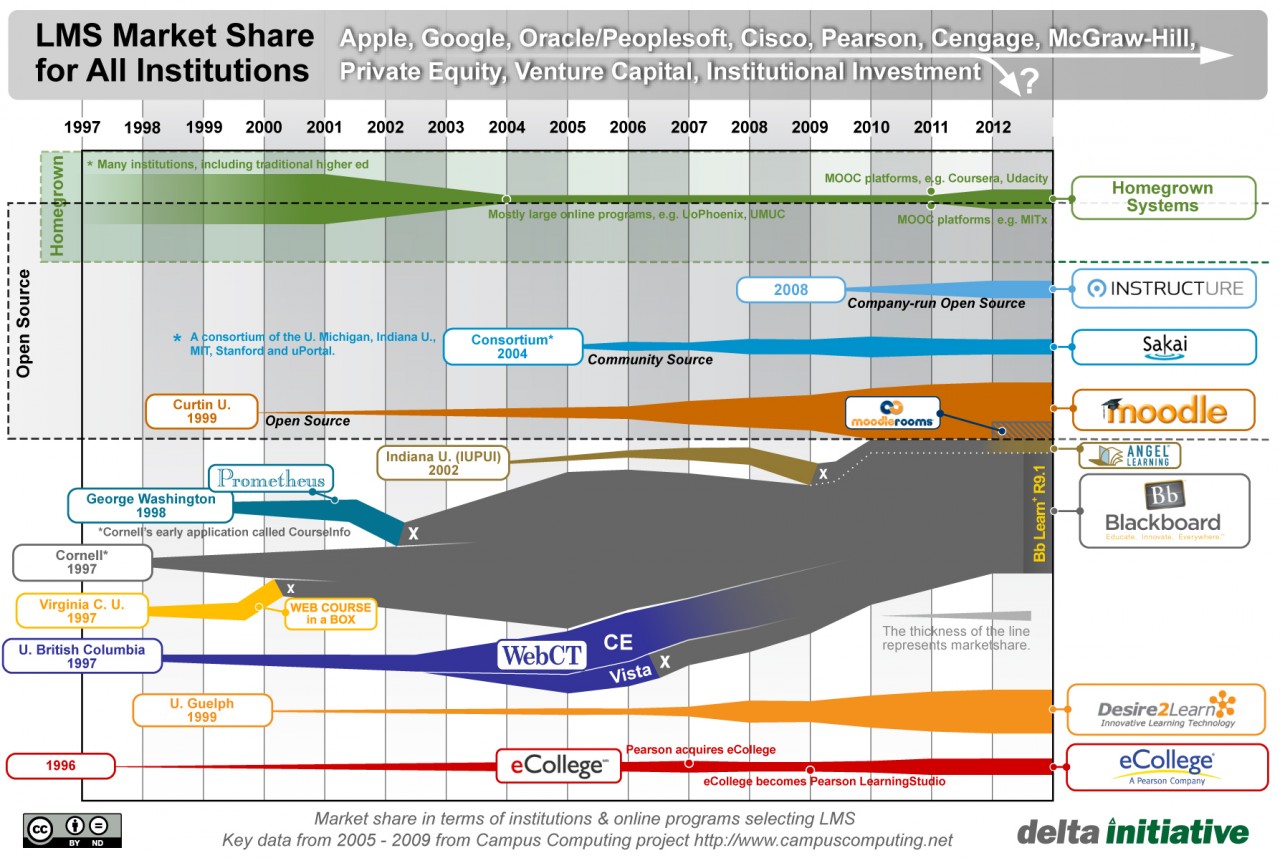
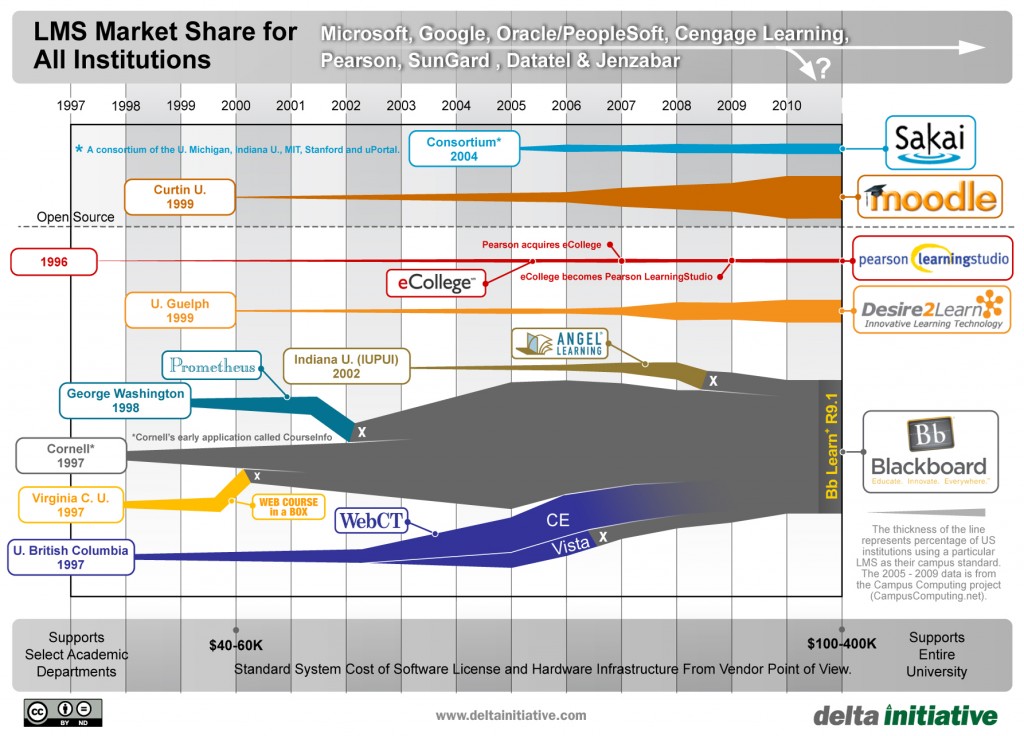
  • State of the Higher Education LMS Market: A Graphical View

    The transformation of the higher education LMS market continues, and I expect more changes over the next 2 – 3 years. However, it seems time to capture the state of the market based on changes over the past year or two.

    I shared the most recent graphic summarizing the market in mid 2011. As with all previous versions, the 2005 – 2009 data points are based on the Campus Computing Project, and therefore is based on US adoption from non-profit institutions. This set of longitudinal data provides an anchor for the summary.

    The most significant changes over the past two years include the following.

    (more…)

  • Google Introduces Course Builder, an Open Source Project Targeted at MOOCs (but the Real Competitor Might Be Amazon)

    Google quietly made an educational technology announcement yesterday about the release of Course Builder, an “open source project” targeted at massive open online courses (MOOCs). This platform follows on the heels of Google’s own MOOC this summer. We should find out more information over the coming months, but here are my initial observations after reading the Research Blog on Google’s site:

    In July, Research at Google ran a large open online course, Power Searching with Google, taught by search expert, Dan Russell. The course was successful, with 155,000 registered students. Through this experiment, we learned that Google technologies can help bring education to a global audience. So we packaged up the technology we used to build Power Searching and are providing it as an open source project called Course Builder. We want to make this technology available so that others can experiment with online learning.

    We really shouldn’t be surprised at Google’s interest in the MOOC movement, since Peter Norvig, their Director of Research making the announcement, was one of the two professors at Stanford, alongside Sebastian Thrun, to develop and teach the influential Artificial Intelligence course (CS221). This course started the Stanford branch of MOOCs (also known as xMOOCs). Coursera and Udacity spun out as venture-funded startup companies based on the internal Stanford MOOC courses.

    (more…)