
In organizing the resignation of University of Virginia President Theresa Sullivan, Rector Helen E. Dragas may have expressed the concerns of many higher education boards of directors about the impact and effective use of education technology. Other Presidents and Chancellors may now have a similar career-threatening incentive. History in technology suggests a wave of implementation of “online courses” will follow when decision-makers are presented with similar press enthusiasm for a technology.
Tag: MOOC
-
Four Barriers That MOOCs Must Overcome To Build a Sustainable Model
Given the hype of national media coverage of massive open online courses (MOOCs), it is refreshing to see more recent analysis looking at important attributes such as revenue models, dropout rates, and instructional design. Steve Kolowich at Inside Higher Ed wrote a revealing and important article looking at early demographic data. Jeff Young at the Chronicle wrote an excellent article about Coursera’s contract with the University of Michigan, along with key insights into Coursera’s and the university’s motivations. Audrey Watters, in response to an article in the Atlantic, asks the tough question of whether we should care about the high dropout rates of current courses offered in this new model.
When analyzing the disruption potential of MOOCs, it is easy to forget that the actual concept is just 4 or 5 years old. Furthermore, the actual definition of the concept has undergone a significant change in the past 12 months as an entirely new branch has emerged.
While the current examples of massive online courses are interesting, the real potential of MOOCs will be revealed in future generations. (more…)
-
MOOCs: Two Different Approaches to Scale, Access and Experimentation
In part 1 of this series, I described a new landscape of educational delivery models. In part 2 I described the master course concept and how it presents a cultural barrier that most traditional institutions cannot cross, at least without a dedicated online organization or an outsourced partnership.
Why does it matter that we describe these educational delivery models with finer granularity than just traditional and online? Because the aims of the models differ, as do the primary methods of how these models are created and delivered.
With all of the recent interest in Massive Open Online Courses (MOOCs), it would be worth summarizing the two branches of MOOCs including recent posts or interviews by the founders of the concept.
Scale and Access
In most online programs, at least those with more than few thousand students, the delivery method of this scale is the duplication of course sections in the manner of tract housing (for a better description, see part 2). But are there other methods to achieve scale (and therefore access) without duplicating sections? MOOCs represent an alternate approach where the actual course itself provides scale, allowing essentially unlimited enrollment in the single course section in the manner of a large apartment building.
-
The Master Course: A Key Difference in Educational Delivery Methods
In part 1 of this series of posts I presented a view of different educational delivery models based on course design and modality.
Why does it matter that we describe these educational delivery models with finer granularity than just traditional and online? Because the aims of the models differ, as do the primary methods of how these models are created and delivered.
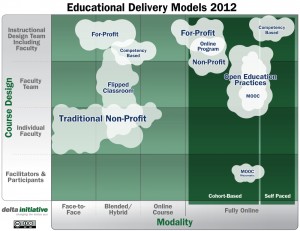
To show an example of how the methods differ, let’s look at one of the most significant, but overlooked, concepts in this landscape – the master course. This concept of the master course changes the educational delivery methods of an institution, and in my opinion is the real differentiator between traditional institutions and for-profit institutions (both blended and fully online) and even non-profit fully-online organizations.
-
The Emerging Landscape of Educational Delivery Models
Part 2 in this series, on a key difference in educational delivery methods, can be found here.
Traditional education or online education. In the past decade it seems that the dominant conversation has been around the potential for online learning, both from for-profit and non-profit options, to disrupt education as an industry.
What I believe we are seeing in 2011 and 2012 is a transition to an educational system no longer dominated by traditional education and one or two alternative models. As my colleague Molly Langstaff has described, educational technology and new educational courses and programs are interacting to create new language and models for education. What does this emerging landscape of educational delivery models look like?
While I do not claim to be able to solve this problem, I would like to offer a more descriptive view than the dichotomy of traditional and online education describes.
-
Social Learning Tools Are Fine, But Not Critical For All Educational Models
We are in a high point of investment and interest in the application of technology to innovate education, and a lot of attention has been paid to the new class of learning platforms that have social tools at the center of the platform design – think Instructure, Coursekit, OpenClass, etc. I have written about several new solutions and how they could disrupt our traditional LMS markets. However, the discussions about the potential of different learning platforms too often ignore some key differences in the models of education that are the targets for educational technology. One result is that some systems are often dismissed out of hand for not having any real social or collaboration tools – think the new iTunesU app or Khan Academy.
There is a big divide, in my opinion, between the application of technology to support and improve traditional models of education and the application of technology to create or enable new models of education. Whether social and collaboration features are critical depends on the educational model, not on the technology available.
Improving Traditional Education
In this case, the role of educational technology is to bring the benefits of technical features of social, mobile, big data, consumerization, etc to the classroom model that has existed for hundreds of years. The obvious example is bringing learning platforms and other tools to improve how well students learn in a classroom setting. I would include in this model the goals of the flipped classroom as well as online courses designed by individual faculty members. In all these cases, the usage of technology is to reduce the administrative burden, make the best usage of classroom time, and supporting pedagogical designs of the class. The technology replicates – hopefully in a compelling manner – the traditional role of tranmitting information, cohort-based learning and interaction, self-assessment such as quizzes, and official assessments such as tests and grading.
-
The Zone of Proximal Curiosity
Gardner Campbell has a great piece at Campus Technology that asks the following question:
What if we took another tack, specifying that students should not only remember information but also demonstrate increased curiosity?
I have enormous sympathy for this line of inquiry. In this post, I’m going to cover why I think it’s so important, how educating for curiosity interacts with other sorts of educational goals, and how we might begin to encourage it.
