
e-Literate

Present is Prologue

Tag: MOOC

  • Coursera CEO Interview: Mike Caulfield nailed it two months ago

    Two months ago Mike Caulfield lamented the inability for many people in online education, especially massive online initiatives, to honestly learn from the past. In the post Mike referred to the failed AllLearn initiative and the seminal post-mortem written up in University Business.

    How does that relate? A paragraph from the 2006 post-mortem of AllLearn really stuck out for me:

    Oxford, Yale, and Stanford have kept quiet about the collapse of their joint e-learning venture…[h]owever, AllLearn’s closure could offer an unprecedented opportunity to step back and discuss the strengths and weaknesses of the business model… Further research into the series of collapsed online ventures may shed some light on what makes a successful distance education program, and enable some of the surviving online providers to redefine their business models and marketing strategies accordingly

    Of course they don’t delve into these things honestly, and as a result most people in these institutions are unaware of them. Like Leonard, the institutions alter the record of the past. They wake up the next day with amnesia, consult a set of dramatically altered notes, and wonder why no one has tried massive Ivy League courses yet. The PR push to cover one’s tracks ends up erasing the institutional knowledge that could build a better initiative.

    Little did Mike realize that he was writing a script.

    One month later Coursera hired Richard Levin as its new CEO. As president of Yale, Levin was one of the key figures in the creation of All Learn in 2000, and after the 2006 collapse of the initiative Levin was one of the key figures directly responsible for the Open Yale Courses initiative.
    (more…)

  • Coursera and edX Hire New Executives: What about online experience?

    Today’s big news is the concurrent change in leadership at two of the big three MOOC providers. First, Coursera announced they had hired Richard Levin, former president of Yale University, to be the company’s new CEO. Besides being a big-name college executive, Levin also led (or at least was president during) the development of Open Yale Courses. As reported by the New York Times:

    Mr. Levin, who has been an adviser to Coursera since January, has been experimenting with online education for years, beginning in 2000 in a partnership with Stanford and Oxford. In 2007, he started Open Yale Courses to make dozens of classes taught by Yale professors available without cost.

    “The main thing we will work on is to establish this model so our partner universities feel that offering large-scale MOOCs is an important part of their mission that helps faculty expand their reach, and benefits the world,” Mr. Levin said.

    Mr. Levin, who has extensive experience in China, will also work on expanding Coursera’s presence there. Already, he said, China is the second-biggest source of Coursera enrollment, after the United States.

    Meanwhile, the Coursera founders and previous president are taking on new roles. Daphne Koller will become president, Andrew Ng will become chairman of the board of directors and chief evangelist, and Lila Ibrahim will become chief business officer.

    On the same day, coincidentally, edX announced they had hired Wendy Cebula as the company’s new president and chief operating officer. According to the company’s web site: (more…)

  • MOOCs and Academic Exchanges Now Allowed for Iranian Students

    One development covered here at e-Literate this year has been the US State Department and Treasury Department forcing the MOOC providers to block access for students in Iran, Sudan, Cuba and Syria. Kris Olds has also provided excellent coverage as well as Carl Straumsheim at Inside Higher Ed. In late January Coursera had to start blocking students in these four countries while edX continued working with these students. Then in early March edX had to start blocking students in Iran, Sudan and Cuba.

    Today’s news is that OFAC has granted a General License G to allow academic exchanges such as MOOCs to operate within Iran.

    (more…)

  • edX forced to block access to students in Cuba, Iran and Sudan

    In late January I wrote here and here about the US Treasury Department, through the Office of Foreign Assets Control (OFAC), blocking access to Coursera courses by students in Syria, Cuba, Iran and Sudan (also see Kris Olds article here and IHE article here). The reason for the decision appears to be that MOOCs were classified as educational services instead of informational materials. At the time, edX was permitted to operate in those countries based on their reliance on getting licenses approved by OFAC, whereas Coursera was relying on a broad interpretation by OFAC. edX president Anant Agarwal even posted on a blog a somewhat congratulatory note:

    At edX, we are pleased to announce that no one, in any country, is blocked from taking one of our courses, and we have never blocked students from receiving education on the edX platform because of where they live.

    EdX has worked for many months with the U.S. Office of Foreign Assets and Control (“OFAC”) and the U.S. State Department to determine how we can assure that no one in any country is blocked from taking an edX course.

    Now comes word that edX has been forced by OFAC to block access to several courses for students in Cuba, Iran and Sudan. From The Harvard Crimson late yesterday:

    (more…)

  • A response to New Yorker article on ‘A MOOC Mystery’

    The New Yorker published an article yesterday titled “A MOOC Mystery: Where Do Online Students Go?” which tried to explain low MOOC completion rates by comparing the situation to the General Educational Development (GED) exam. Right off the bat, the article conflates MOOCs with “online students”. MOOCs are but one form of online education, and a very recent one at that. Worse, however, is that the entire basis for the article is quite flawed – GED results do not give much insight into MOOC students patters, and it turns out there is not much of a mystery in the first place.

    The hook in this article seems to be the coincidence of two numbers [emphasis added]:

    (more…)

  • e-Literate TV Interviews from MRI13 Now Available

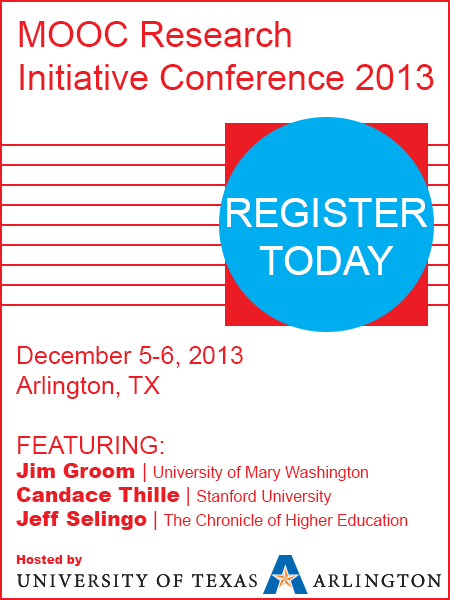
    In December 2013 Michael I attended the MOOC Research Initiative Conference (aka #MRI13 or “The greatest MOOC conference in the history of MOOCs”). Thanks to a grant funded by the Gates Foundation through Athabasca University, we are creating three episodes of an upcoming e-Literate TV series based on the conference. We expect to release these episodes in March.

    MRI

    As part of developing material for the episodes, we interviewed a number of research grantees and ed tech luminaries. We had some great guests who spoke about what we have learned from MOOCs, what the potential applications are, what the downsides are, and where open education could and should go in the future. It was a unique opportunity to get so many well-informed people in one place on a common topic.

    Today we releasing these videos through the e-Literate TV YouTube channel. These videos all carry a Creative Commons license to facilitate sharing and repurposing of the material.

    (more…)

  • The Resilient Higher Ed LMS: Canvas is the only fully-established recent market entry

    For a few years starting in 2009, it seemed one of the best ways to raise VC funds or corporate internal investment was to say “we can beat Blackboard with a new cloud-based platform”. Witness Coursekit / Lore, Instructure / Canvas, OpenClass, LoudCloud Systems, Helix, and even more recently MOOC platforms. There were many articles written as these new systems entered the market, but what if we look back and ask whether the LMS market has actually changed recently? The picture that emerges is one of surprising resiliency by the established LMS providers.

    In fact, I would argue that in the past eight years (at least in North America) the only new system that has fully established itself in the LMS market is Canvas. Note that I have combined WebCT and ANGEL within the Blackboard umbrella, but even these systems established themselves more than a decade ago.

    (more…)