e-Literate

Present is Prologue

Tag: Moodle

  • Moodle’s Sanctimony on Openness is Moot

    Moodle’s Sanctimony on Openness is Moot

    Phil Hill has a great post up on the latest chapter in the Moodle partner soap opera. You should read the whole thing if you care about the LMS world, but the gist is this:

    • Moodle, in addition to being open-source software, is also an Australian for-profit company called Moodle Pty. Said company exerts a great deal of control over the development of the software and whose business model is licensing the Moodle trademark to partners who provide Moodle-related services in exchange for a percentage of their Moodle-related revenue.
    • Moodle creator and company owner Martin Dougiamas was very unhappy when Blackboard bought some of the biggest Moodle Partners some years back. After a lot of drama and tension, Blackboard left or was ejected from the Moodle Partner program. (Details vary depending on which party is telling the story.) Since Moodle Pty owns the trademark to the Moodle name, it revoked Blackboard’s permission to call its Moodle-based product “Moodle” or to use the Moodle logo.
    • Blackboard renamed their Moodle-based product OpenLMS, which it eventually sold to a company called Learning Technologies Group (LTG).
    • Somehow LTG or one of its subsidiaries was apparently a Moodle Partner at this time. It’s a little hard to follow because Moodle Pty has had some ongoing drama with LTG in their Moodle Partner program as well. At any rate, LTG continued Blackboard’s strategy of buying up Moodle Partners.
    • This week, after a lot of drama and tension, Moodle Pty ejected LTG from the Moodle Partners program, accusing LTG of creating lock-in with proprietary extensions in violation of the principle of “Openness” (which probably has some truth to it, but…well…more on that in a bit).
    • In parallel, OpenLMS announced its own policyabout what it will release as open-source and what it will keep as proprietary.
    • Recriminations between the two companies have been flying back and forth about a variety of topics, including whether OpenLMS’s openness policy is open enough.

    When e-Literate changed editorial focus in 2019, it largely stepped away from (a) providing coverage of the LMS market as an end in itself and (b) taking on one of its primary missions as policing vendor behavior. I have been very happy with both of those decisions. I’m going to make an exception to both here mainly because I want to make a point about “Openness” (where, as you will see, the choice of capitalization is not mine).

    Moodle is a vendor for which openness is a tool

    Over the years, I’ve tended to go easy on Moodle because it, and Martin, have accomplished enormous good in the world. Whatever one thinks about the LMS as a product category, it has enabled online education at scale, a development whose value has been spotlighted by the global pandemic. Moodle, by virtue of its design, license, and community, has brought these capabilities to communities and regions that no other vendor has deemed profitable enough to serve. Moodle has genuinely made the world a better place. And although I am pointedly and repeatedly going to emphasize Moodle Pty’s nature as a for-profit company, I fully believe it is a mission-oriented company that has prioritized impact.

    Corporate structures, business models, trademark laws, and software licenses are all inventions. They are artificial constructs we design in order to have specific effects on the world. Many of these constructs are specific kinds that we collectively refer to as “intellectual property” or “IP.” IP is simply an idea that somebody legally owns. That ownership can be legally expressed in a variety of ways, such as a patent for an invention, copyright for content, or a trademark for a company or product name or logo.

    (Update: IP is a little more complicated than that, as a couple of early critics of this post have pointed out. The degree to which the ownership is of the idea itself or the particular expression of it varies by type of IP. A process patent is different than copyright. This is a nuance that is beside the points I’m making here, but I’m noting it in the interest of precision.)

    IP in all its forms is a tool. In the United States, our Constitution specifically framed it this way. Here in the US, IP is a temporary monopoly that Congress can grant in order to provide financial motivation for the creation of new ideas and works. For example, you may be granted a copyright so that the years of your life writing the Great American Novel will pay off in the form of royalties, thus enabling you to contribute art to the world and, perhaps, to even be able to afford to start working on your next novel.

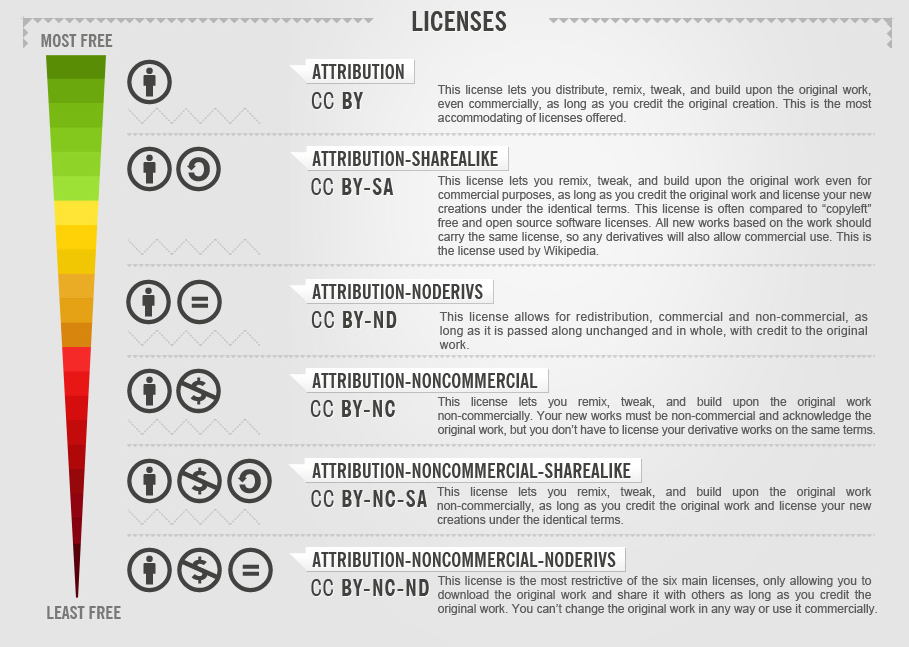
    Open licenses along the lines of open-source and Creative Commons are hacks of this system but do not depart from its essential purpose. Thir underlying insight is that sometimes existing IP licenses are hindrances to the desirable activities they are intended to encourage. For example, I publish this blog for free because I want to share knowledge. I want people to create new works using mine as building blocks. All I want in return is credit for my contribution. If I made every person who wanted to quote e-Literate explicitly ask my permission—as copyright law requires—then that extra effort might discourage some from adding to our educational knowledge. So I publish the blog under a Creative Commons license that lets people use my content without having to ask me as long as they properly attribute it.

    Some people who use open licenses view this kind of sharing as an inherent value. I personally tend toward the utilitarian. I have an affinity for openness and believe that, all else being equal, open is better than not. But I view openness as subordinate to other values such as educational impact. This is a matter of personal philosophy; other folks legitimately feel differently. But even as an end in itself, those who are immersed in topics like open-source or Creative Commons licenses know that the definition of “openness” and the value that it represents are very much contested territory among advocates.

    One way to divide the territory is into open licenses, which are specific legal contracts with well-defined terms, and “openness,” which is a squishy concept with a mix of utilitarian and moral connotations that vary from person to person. Well-written open licenses are clear-cut in their requirements and limitations. They often support, but do not necessarily define, commitments to a specific definition of openness as a value.

    Let’s focus on the utilitarian part for a moment. Martin created Moodle Pty with a particular revenue model, a particular open-source license, and a particular approach to using the Moodle Trademark as intellectual property. These pieces all fit together into a machine for growing “Moodle,” by which I mean both the adoption of the software and the company that Martin owns. It’s a model that served the Moodle mission and sustainability goals well at the time it was created. Many small schools, colleges, and other organizations all over the world had no access to any tool for centrally supporting online and technology-enabled learning. The Moodle software is free and easy to run (up to a point). Moodle Pty created a network of small, local businesses supporting support schools that did not have the capability to run Moodle on their own. Moodle Pty collected (and still collects) a percentage of revenues from these local vendors. This money went toward the development of the Moodle software, promotion of Moodle and its partners, paying salaries, and so on. At the time, the model worked incredibly well, making Moodle far and away the most popular LMS around the globe outside of the US and Canada.

    But the world has changed. Moodle was created before cloud computing and before online learning became mission-critical at scale across large swathes of the globe. These changes broke Moodle’s business model. It has been broken for quite some time. It arguably broke when a Moodle Partner called MoodleRooms, before it was eventually acquired by Blackboard, demonstrated that it could support one million simultaneous users on a single multi-tenant instance. This was a cloud version of Moodle, even if that term wasn’t popular at the time. Once a cloud version of Moodle existed, the power balance between Moodle Pty and its customers…er…partners shifted, and the number of customers from which it could collect revenues was destined to shrink. Rather than being a supplier to many small businesses, Moodle increasingly became the supplier for a few large businesses, each of which became increasingly important for its revenues. Again, read Phil’s post if you want a detailed breakdown of the Moodle model’s…um…breakdown.

    Open is as Open does

    Back to the present. Remember, LTG’s OpenLMS (which it purchased from Blackboard) made an announcement this week about which parts of their code they would release under an open-source license and which parts they would keep as proprietary. Phil Hill asked Martin to comment on OpenLMS’s announcement about their openness policy as part of the reporting for Phil’s blog post. Here is Martin’s reponse:

    Our actions have obviously been a factor in causing this, which I count as a good thing for everyone.   Please note, though, that their stated direction is to sell the integration of the full suite of LTG products – and none of those other things are open or planned to be.  Clients will still have the same lock-in to LTG as before (as desired by LTG).    https://www.youtube.com/watch?v=mBFShI8OYe4

    Not even all the “Open LMS” SaaS product will be actually open either.   I don’t know exact figures, so I’m estimating, but the OpenLMS service is probably 90% Moodle, with perhaps 10% other stuff, and they’re going to make only perhaps half of that other stuff available under GPL, so 5%.   It’s not a big deal and honestly, the least they could do.

    Moodle’s Dispute with LTG and its Growing Suite of Former Moodle Partners 

    Meh.

    News flash: All vendors try to make their customers want to stay by adding features or services they can’t get anywhere else. Some strategies are more ethical than others. Moodle Pty., like many vendors, uses its proprietary intellectual property to create what could arguably be called lock-in. Moodle Pty’s customers are Moodle Partners. Its intellectual property is its trademark. Martin has, on multiple occasions, exercised the threat of withholding that valuable IP when its customers have left or when they have behaved in ways that he believes are contrary to the interests of Moodle.

    There is nothing inherently wrong with this. Moodle has a mission that depends on revenues to sustain. Moodle Pty gets revenues from mostly smaller Moodle vendors. It uses its IP in the form of its trademark as kind of a soft lock-in to its customers (or “Partners”). If the customers walk away, they can still use the Moodle code. They just can’t use the Moodle trademark, which has value because it is recognized and trusted.

    LTG and its subsidiaries, eThink Education and OpenLMS, also provide value-added intellectual property to differentiate themselves, attract prospective customers, and hold onto existing customers. Moodle had earlier ejected eThink from the partner program for not being sufficiently “Open”:

    The Learning Technologies Group (LTG) announcement of the acquisition of eThink Education represents LTG’s intention to move customers into the Open LMS platform, which is not truly Open at all. Their extensions to Moodle are not downloadable, and not available from other service providers. Once on their platform, it is harder for institutions or organisations to move to a different provider, or to their own servers. This goes directly against Moodle’s values of openness. Consequently, as of 18 December 2020, eThink Education is no longer a Moodle Certified Partner or otherwise associated with or recommended by us at Moodle.

    Moodle’s Dispute with LTG and its Growing Suite of Former Moodle Partners 

    Martin’s definition here of “Open” has always been problematic. A lot of software is designed to integrate with or even run on other software. If somebody runs Moodle on a Windows server, does Moodle cease to be “Open” because Windows is not? If a school integrates Zoom—which is not downloadable and is not available from other service providers—as an “extension” to Moodle, does Moodle cease to be open source?

    Of course not. Heck, I would bet money that he personally has written code in Moodle that enables proprietary vendors to integrate their products deeply into Moodle. Further, the cloud has made this situation vastly more prevalent. How many of the software products you integrate as “extensions” to your LMS are downloadable to run on your institution’s servers? How much do you care? Instructure, whose source code to Canvas is largely (though not completely) open-source, has had vanishingly few institutions choose to download and run Canvas on their own servers or seek out an alternative provider. That’s because the virtue that drove customers to Canvas was its nature as cloud software, which means it is designed precisely so that nobody would have to download the software and run it on their own servers. It turns out that schools are not typically great at running mission-critical software applications with no hiccups and no downtime. The cloud has diminished the utility of “openness” (with a lower-case “o”) for many institutions.

    Now, it’s perfectly fine for Moodle Pty to hold that as a requirement for its partners and assert that their version of openness a value. Certainly, if its mission is to prioritize those parts of the world where affordability dictates either self-hosting or a small operation that can’t write its own cloud harness for Moodle, then the company certainly is within its rights to make a decision about that. If so, they should say that.

    By the way, Moodle Pty does have a cloud version of Moodle called, aptly enough, MoodleCloud. If their cloud-enabled version of Moodle has been released as open-source, I have not been able to find it. Again, I take a utilitarian view of any decisions that Moodle Pty makes in this regard. In my view, it’s a good decision to the degree that produces desirable results for educational equity and effectiveness. My concern is with Martin’s apparent hypocrisy, which is underlined by a tone that I read as sanctimonious.

    Likewise, if LTG is alleged to have violated Moodle’s open-source license or infringed on its trademark—in other words, if LTG stands accused of stealing Moodle Pty’s IP—then Moodle Pty should be clear about that accusation. The fact that they have not done so is suggestive. If LTG’s extensions legally violated Moodle’s open-source license’s “openness” requirements, then Moodle Pty would (and should) sue. They have not sued, which suggests to me that LTG’s code is cleanly separable. It may not be as clear-cut as Zoom or Windows, but it appears to be clear-cut enough that Moodle Pty has not pursued legal recourse.

    This is not to say that LTG couldn’t be playing games with features that (a) customers do not know are proprietary and (b) would have a hard time leaving behind if they migrated. I don’t know LTG’s offerings well enough to have an opinion on the matter. Martin could conceivably make a specific argument along these lines. Not a legal one, mind you. Moodle Pty’s trademark lock-in is relatively weak and circumscribed. But he could try to make an ethical argument that LTG’s extensions trick customers into lock-in. He seems to insinuate that.

    But he has not actually made the case. In fact, his waving away of OpenLMS’s statement about what they are opening as “the least they could do,” speculating about the percentage of code that remains proprietary rather than pointing to explicit features that concern him, suggests that he is not particularly interested in making that argument. He wants to make an argument about Openness in some pure and absolute sense.

    I have two problems with that. First, it comes across as hypocritical. Again, I don’t have any problem with Moodle Pty setting terms for its resellers, kicking out resellers that violate those terms, and enforcing the terms by withholding use of the Moodle trademark. But let’s not pretend that Moodle Pty has eschewed all IP, like some sort of corporate Buddhist, or that it has declined to assert that IP to protect its interests. I assume that Martin has a set of principles regarding openness that he is following. They must be more nuanced than “Openness is judged by the percentage of code is downloadable and available from other vendors.” He should state his principles clearly, not as the Proper definition of Openness but as Moodle Pty’s objective and concrete commitments and rationale. In fact, the OpenLMS statement that he dismissed so blithely does exactly this. Martin has enjoyed a position of assumed moral privilege for too long. If he wants to serve “Openness,” however he defines it, he should start by defining it in serious, testable, and internally consistent terms.

    Second, I reject the notion that Openness is a well-defined and absolute virtue by which others are Judged. ((Two can play the Capitalization Game.)) I always have and always will. Martin is far from the only person to wield an “opener than thou” attitude as a weapon in educational communities. He’s also far from the worst offender. But the way in which he’s choosing to communicate his decisions about the Moodle Partner program is particularly harmful because of his global stature. People who are deep into any of the various open communities—open-source, OER, open access—have inevitably been exposed to the complex and nuanced debates about the pros and cons of different licenses. These debates are fundamentally about the values and affordances of different definitions of openness, as expressed in those licenses. I understand that participants in these debates have passionate views on the subject. I don’t doubt Martin’s own passion. But by presenting the matter as cut-and-dried, he flattens this useful debate instead of taking the opportunity to raise awareness and literacy regarding its nuances. In the process, he risks coming across as naive at best and manipulative at worst.

    Martin could also take another (simpler) approach, which is to explicitly require Moodle Partners to adhere to Moodle Pty’s limitations around permitted extensions and reserve the right, without sanctimony or high dudgeon, to eject Partners that don’t adhere to the Terms and Conditions. I have no problem with that.

    Ironically, I have never been able to see a copy of the Moodle Partner Terms and Conditions, even though I explicitly asked to see them at one point. Apparently, they are (or were) considered to be proprietary IP of Moodle Pty and are (or were) not to be shared.

    I hate this crap

    Ugh.

    As I write these words, I am 50/50 on whether I will hit the “publish” button. If you are reading this post, it means I decided the discussion of the larger principle justifies wading into a topic that I largely don’t care about to criticize a person and organization whose accomplishments I respect. I don’t care about the LMS market per se. I have no real opinion about the dispute between Moodle Pty and LTG. Nor do I care enough to put in the work required to form one, at least based on what I’ve heard so far. I harbor no ill will toward Moodle Pty or Martin Dougiamas. Truly, I have a long list of topics that I would relish writing about instead of this one.

    All that said, I find the way that Martin is publicly characterizing the nature of the dispute to be disturbing and harmful, just as I found it to be disturbingly simplistic when he used the same rhetoric with Blackboard. If he truly believes that there is a clear moral definition of “Openness” (which he chose to turn into a proper noun through capitalization) then he should define it and articulate his argument for it. Alternatively, he could simply state that these are the conditions for Moodle Partnership without the air of moral superiority. Either option would be fine with me.

    We should be able to have thoughtful and productive discussions about how different definitions of openness can support or hinder different aspirations and values. My desire to do so is my motivation to write this piece and characterize the rhetoric coming from Martin and Moodle Pty in such strong terms. I am writing because I believe that Martin’s language is doing more to obscure the values and goals of “Openness” than it is to support and illuminate them. I find that to be particularly upsetting because I believe that Moodle has historically advanced goals and values that I cherish. In my view, Martin’s current rhetoric risks damaging that good work while diminishing the value of openness as a tool for future good work.

  • Moodle Workplace: A new product and change in open source deployment

    Moodle Workplace: A new product and change in open source deployment

    Moodle unveiled its new product, Moodle Workplace, at the the Learning Technologies conference in London three weeks ago. While the open source Moodle LMS has been used by companies and organizations for employee training for years (approximately 40% of Moodle implementations worldwide according to this 2015 interview), Workplace represents a new approach for Moodle’s usage of open source deployment.

    Moodle Workplace

    Based on an email interview with Moodle Pty Ltd (aka Moodle HQ) CEO and founder Martin Dougiamas, Moodle Workplace is a “a series of well-written plugins that sit cleanly on top of the standard core distribution” and is being released under an open source GPL license. The plugins add functionality to:

    • Create training paths;
    • Create departmental structures and reporting;
    • Automate enrollment, certificates and other back end processes; and
    • Customize reporting and report delivery.

    From first reading, the Workplace functionality is a subset of the features available in other products, notably Totara Learning. That solution is also based on Moodle core, although Totara forked its code base more than three years ago. ((At the time of the fork, Totara management also predicted Moodle was planning to offer the market ‘Moodle for Workplace’.)) Workplace appears to be a solid, if somewhat unremarkable platform for organizational training delivery which can provide compliance tracking, learning pathways, and other business-focused features. For organizations looking to add training features to existing stock Moodle, Workplace should offer an easier migration path than Totara.

    The bigger news is the change in the distribution and business model as described by Dougiamas.

    We are restricting distribution to Moodle Partners for now so that we can give more value back to our Moodle Partners who invested time and money into it.

    Similar to Totara’s business model, there are limitations put on the Moodle Partners to prevent modification or distribution of the code. By providing Workplace only as a SaaS solution, Moodle is using the same distribution loophole in the GPL. ((For those unfamiliar with the peculiarities of open source licensing, Moodle and Workplace are released under the General Public License (GPL). The GPL requirement to release the source code ONLY applies if you are providing someone a copy of the binary. Providing software as a service does not constitute “distribution” under the GPL. This is how Google, Amazon, Facebook and all the other major internet players can build on open source, but not release their source code.)) The upshot is that if a company or organization wants to use Moodle Workplace, they have to work through a Moodle Partner and cannot download and install the software for free.

    The business model around Moodle Workplace is clearly a departure from the norm for Moodle, where the core GPL code is available to anyone, anytime, for free. But it is not clear whether this change in model for Workplace is a limited play or has broader applications that may impact education markets. In our interview, Dougiamas directly addressed our question on whether we should expect similar changes to Moodle core:

    No, we remain intensely committed to developing and improving Moodle core as a GPL product with the same license, open source practices and active community as now.

    He further stated:

    Our team developing Workplace have been contributing features (the more general ones) into core at the same time, and the plan is that any Workplace features that also supports sectors like Higher Ed or schools will always be migrated into core this way.

    So, what are educational institutions to make of the new business model around Moodle Workplace? We’re not entirely sure at this point. At a minimum, it would appear to be an attempt to better monetize the large installed base – a move to satisfy investors and to replace the Blackboard revenue after cancellation of their Moodle Partner agreement. At a more strategic level, it could be an attempt to stay competitive with peers, particularly SumTotal and Totara, who are going after the corporate learning space.

    If Workplace is successful, it will create a new revenue stream for Moodle HQ, potentially accelerating the development of the core educational product. A Moodle Partner we interviewed for this piece claimed they were already seeing increased lead generation from the announcement. The small and medium business (SMB) market is larger and generally has faster sales cycles than the education market, which could drive partner revenue and cash flows. The partners who are able to create sales momentum in both spaces and find their product / market niche are likely to see some accelerated growth. If this is successful, Moodle HQ should capture additional revenue and accelerate the product and service roadmap. This move directly addresses the issue Michael raised in the Fall about the termination of the Blackboard contract and revenue stream.

    For Moodle, everything rides on their ability to grow alternative sources of revenue. The company has been touting newer offerings such as MoodleCloud, MoodleNet, LearnMoodle, and MoodleServices. Since we don’t have any external evidence that these are material sources of revenue for the company, and since the company itself has not shared numbers that we can independently evaluate, it’s very hard to tell what their chances are. Moodle has a huge installed base, which gives the project a lot of momentum. But the company that drives most of the core platform development has a business model that has not aged well and is in the process of diversifying into business models that are as yet unproven. I remember enough physics to know that momentum and acceleration are not the same thing. I think the risks are probably greater for Moodle Pty. than they are for Blackboard. But both sides of the equation bear watching.

    Moodle Workplace as a monetization strategy seems to be a stronger bet than the previous offerings.

    The risk for education institutions, however, is that the Workplace development roadmap pulls resources from making investments in core Moodle necessary to keep pace with better-funded rivals. At worst case, Workplace fails to find a market niche and position itself in a crowded field. The opportunity cost of investing in Workplace vs other potential investments in the core education product and cloud services could end up having larger knock on effects downstream.

    What we have observed over the past 6 – 9 months is an increased customer focus by Moodle HQ, acknowledging the importance of market messaging (e.g. first-time presence at EDUCAUSE, announcing Workplace at London conference) and better understanding and satisfying business needs of revenue-generating Moodle Partners. The jury is still out on how these changes will impact financial sustainability and competitiveness of Moodle in education markets, but there is little doubt that there are changes in behavior.

    In the end, this is another example of corporate financial health issues having an outsized impact on the LMS market in 2018 – 2019. And one that bears watching, coming from the LMS provider with the world’s largest installed base.

    Update 3/6: Changed naming throughout to Moodle HQ instead of Moodle Pty to reflect more accurate and common usage. Also edited footnote about ‘Moodle for Workplace’ prediction to remove the implication of Moodle Workplace being a copy of Totara code.

  • Is Microsoft or Google your next LMS? The view from BETT

    Is Microsoft or Google your next LMS? The view from BETT

    The following is a guest post from Jason Cole, a longtime colleague and freelance consultant who recently moved back to London. Previously, Jason was Vice Chancellor for IT at the Peralta Community College District, and before that was CEO and Board Chair at Remote-Learner. [ed]

    I recently spent a day at BETT (formerly known as the British Educational Training and Technology show), the UK’s largest educational technology show. The show tends to skew towards the primary and further education market (k-12 and community college in the US), but there is also significant higher education presence. If you are looking for a US equivalent, its more akin to ISTE than EDUCAUSE.

    For those who haven’t been to BETT, it can be a bit overwhelming. There are over 34,000 attendees and 900 exhibitors from 138 countries. The massive show floor hosts everyone from national trade organizations from Denmark, Spain, UAE and Egypt to little ed tech startups that will probably evaporate in a few years.

    Everything is in one giant exhibition hall, with auditoriums scattered amongst the vendor booths. You can hear the noise of the conference space everywhere, even in the main event auditorium.

    For all of the activity, what was noticeable was the absence of the major LMS vendors besides Instructure Canvas. The company sponsored talks and roundtable lunches, but it didn’t have a traditional marketing booth. Their presence and sponsorship, however, meant they were the only LMS vendor anyone was talking about. D2L, Moodle, the UK Moodle partners, and Blackboard had no discernible presence. WebAnywhere is now focused on the SchoolJotter product and corporate Totara market. Synergy had small table in the back with one small Moodle Partner badge. Why – is BETT just a bad bet for lead generation and branding for the LMS providers? The large schools presence may mean less traffic for the higher ed (HE) focused LMS providers. But there are HE attendees, and Moodle had a strong schools presence. Some might argue the limitations of GDPR make lead generation difficult in European shows, but the presence of 900 exhibitors seems to imply there is some return on investment.

    On the other side of the spectrum, Google and Microsoft had large crowds in their large multi-plot booths. Each company had case study talks by users, how-to’s for teachers, and partner ecosystem mini-booths. Most of the hands-on presentations by these two tech giants were near capacity when I checked in throughout the day, as were most of the case study discussions.

    Every presentation in the Microsoft booth had real-time captioning displayed directly above the slides, and every presentation had real-time translation into multiple languages. Microsoft is obviously confident in both services, and from what I could see these services were remarkably accurate.

    It may have been the (AI-recommended) Microsoft Kool-aid ((Somehow an AI tied to a screen with a camera judged my reactions to three pictures, and estimated my age and gender and then labelled me an “Empowerer”. It’s recommendation was a rather refreshing apple cucumber drink with Spirulina distributed for free by two attendants. I have no idea why empowerers need cucumber, nor was there any falsifiable alternatives to getting a different flavour. Would the Innovator beverage make me more creative? Ah, the joys of inscrutable machine logic!)), but it appears Google and Microsoft are edging their way into the LMS space. Their presence at a K-12 focused show suggests they are finding traction at the younger grades. But as their education offerings grow in sophistication, and their ecosystem advantages start to accelerate, I believe a more concerted push in the higher ed space is inevitable.

    When Microsoft makes their push, the learning system won’t look like an LMS, but it will look like Teams. Teams is Microsoft’s central communication application for business, rolling in Skype and other business lines. There is an education version for teachers. Students with courses in Teams access their materials, communicate with the instructor and each other, and collaborate using Office and other tools online.

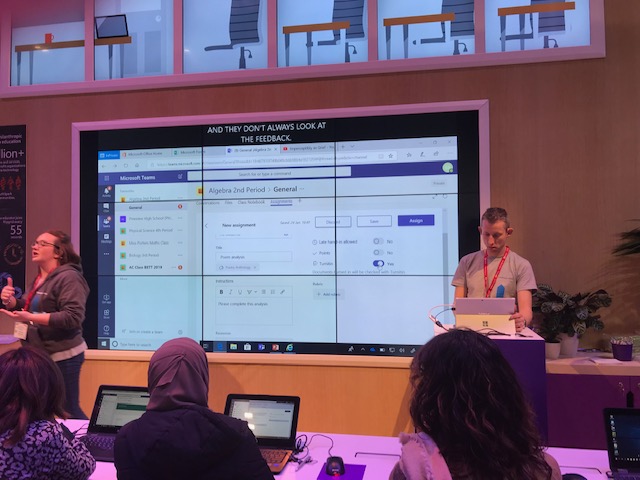
    View of Microsoft Teams demo

    The early indicator of Microsoft’s intent is their recently released Assignments for Teams for Education. Assignments gives teachers an easy to use tool to create either quizzes (using Forms) or submissions (using the Office suite). The student work can be graded using either a straight score or a rubric. Students see the results in their Teams, and teachers can download the grades for all the Assignments to Excel. It’s an interesting feature that signals a definite intent from Microsoft to meet the needs of teachers in the education version.

    Teams is not ready to replace or compete with the LMS yet, but it isn’t terribly far away. The Teams interface for classrooms needs some reorganization, it needs a centralized grade book that isn’t reliant on export to Excel, and it needs a slightly better authoring experience to combine the features together in learning modules. Teams and Sharepoint would also need a clear content strategy enable integration with publisher tools and content. But none of these challenges are impossible, and some Microsoft partners already have pieces of the solution.

    The ecosystem around Teams and Office will give Microsoft an increasingly interesting story. Microsoft is rapidly integrating service platforms for email, calendar, business logic, business intelligence, AI, device management, and cloud services into the Teams platform. There is enormous potential for educational organizations to leverage these capabilities to deliver a unified student experience. The “learning management” features move into the background, while students interact with a single application and message flow.

    While the potential is there, there are a few hurdles on the way. Moving into the learning and teaching side of the HE market requires a different channel strategy than the current focus on the productivity and infrastructure side of the house. Microsoft relies on a combination of direct account management and partner sales in a complex selling process. The Microsoft partners who would need to engage in the sales process and own customer relationship tend not to have academic sales experience, nor do they have the brand recognition of Canvas, Moodle, D2L and Blackboard among faculty. Given the sales costs and margins, a higher education focused Microsoft partner would have difficulty achieving scale. I would watch for more bottoms up adoption, pressure from students coming to HE from Google and Microsoft schools, and adoption outside of the traditional HE context as early indicators of a market shift.

    Other observations:

    • By sheer number of vendors, apparently every school in the EU is going to have a robotics lab and a maker space in the next few years. Lots of Arduino, 3D printers, and so… many… robots.
    • A few VR and AR vendors were making a splash (and inducing large scale motion sickness) with headsets and learning simulations.
    • Newton Rooms, modular, pre-packaged hands on science learning rooms, designed in Norway are one of my new favourite things.
  • State of Higher Ed LMS Market for US and Canada: 2018 Year-End Edition

    State of Higher Ed LMS Market for US and Canada: 2018 Year-End Edition

    This is the eleventh year I have shared the LMS market share graphic, commonly known as the squid graphic, for US and Canadian higher education. This past year we at e-Literate shifted our LMS Market Analysis reports from Spring / Fall to Mid-Year / End-of-Year to better allow analysis of entire years. With the release of our end-of-2018 report last week to subscribers, it’s time for us to look at updates on the institutional LMS market for North America (US and Canada) higher education. Note that our coverage for the market analysis includes Europe, Latin America, Oceania (Australia, New Zealand, and surrounding island countries) as well as emerging coverage of the Middle East.

    We present the following data “by institutions”, with market share as a percentage of the total number of institutions using each LMS as a primary system, and “by enrollments”, where we scale the institutions by its total enrollment. The latter better captures the business of the LMS market, since most licensing deals are based the number of students.

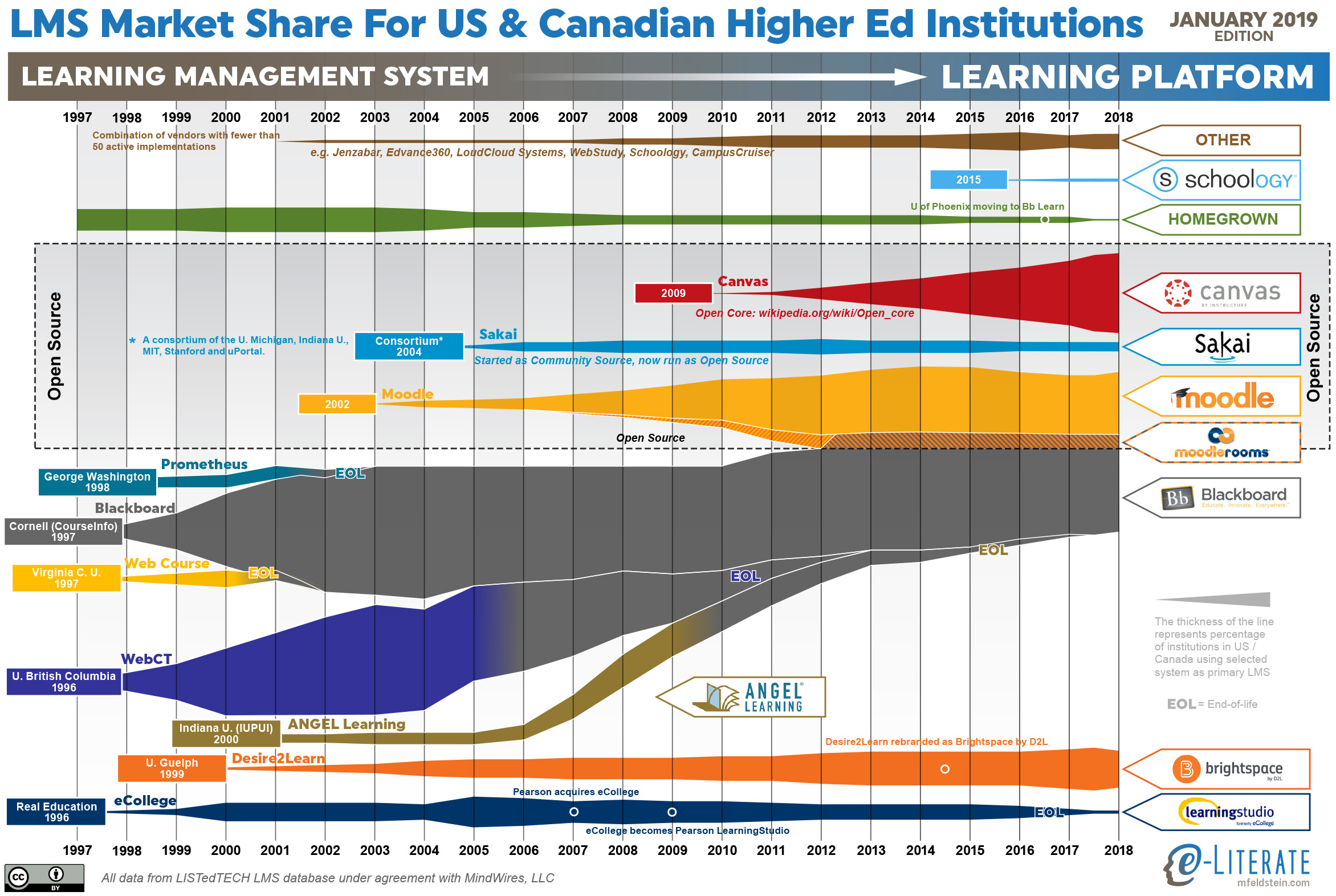
    But first, let’s look at an updated LMS market share graphic, commonly known as the squid graphic, for US and Canadian higher education. The original idea remains – to give a picture of the LMS market in one page, highlighting the story of the market over time. The key to the graphic is that the width of each band represents the percentage of institutions using a particular LMS as its primary system.

    Higher ed LMS market share for US and Canada, January 2019

    This year there are two inter-related trends that deserve a broader explanation -the LMS market slowed down with less activity overall, and Canvas and Blackboard continue to be neck-and-neck in the top spot of this market.

    We recently described the overall market activity slowdown in that there are fewer LMS formal evaluations taking place since mid 2018, with initial data pointing to a 20 – 25% drop from a year earlier. This slowdown seems to be a type of plateau rather than a continuing trend, and we are watching to see if it is temporary or not.

    Last summer we shared the symbolic passing of the torch where Canvas surpassed Blackboard in US market share, which was the first time Blackboard was not the top system since the market emerged two decades ago. What is interesting is that half a year later, the two systems are still neck-and-neck. In the US Canvas is still slightly ahead, and in North America (adding in Canada), Blackboard remains in the top spot by 0.4% (26.8% to 26.4%). Why is Canvas not continuing to extend its lead? Looking at the underlying data, there seems to be three reasons to consider:

    • The overall market slowdown means that there are fewer deals for Canvas to win lately.
    • Blackboard continues its University of Phoenix implementation, which still includes dozens of campuses despite its enrollment drop.
    • The shutdown in December of the for-profit Education Corporation of America (Virginia College and Brightwood College systems) meant that Canvas lost several dozen campuses.

    The latter two points should fully play out in the next three months, possibly making this a one-time change in trends, but it is important to call this situation out.

    Some other notes:

    • The market continues to consolidate around the Big Four – Blackboard, Canvas, D2L Brightspace, and Moodle.
    • The Homegrown option for LMS usage is going away, at least in a statistical sense. Only a handful of schools even consider this option.
    • D2L shares the challenge of having picked up several large for-profit systems that are closing campuses and therefore hurting market share. In D2L’s case, the biggest one is the former EDMC schools – the Art Institutes, Argosy University, and South University – that were sold out of bankruptcy to a non-profit entity and have closed dozens of campuses over the past year. These losses offset many of D2L’s wins in 2018.
    • Moodle had a few new wins in North America.

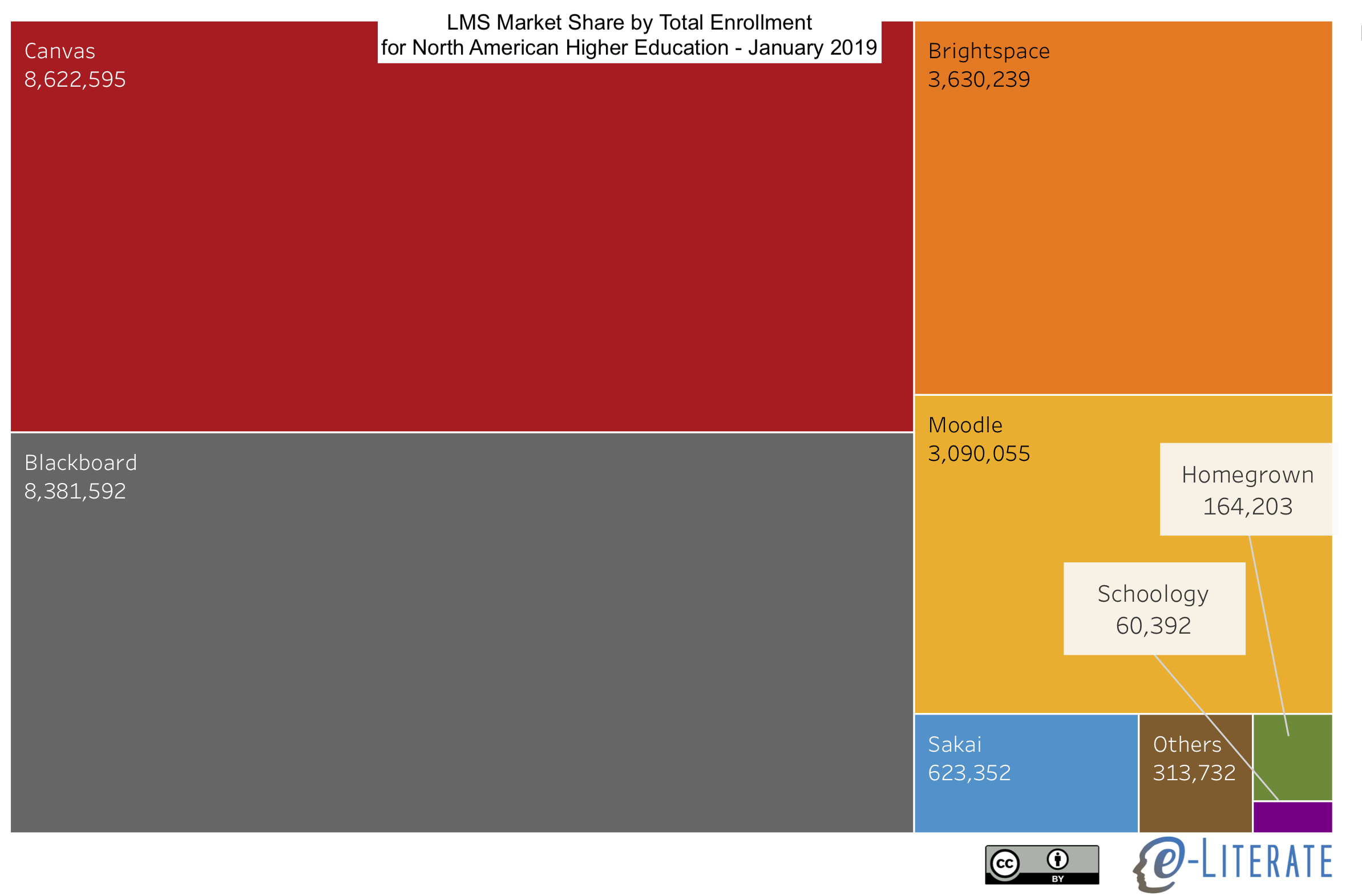
    Sticking with North America, we can also show LMS market share scaled by the enrollment of each institution, giving a different measure worth considering.

    NA LMS Market Share by Enrollment

    We’ll share more information on other global regions in the coming months.

  • Contrasting LMS Adoption Patterns in Four English-Speaking Countries

    Contrasting LMS Adoption Patterns in Four English-Speaking Countries

    The article is Cross-posted at LISTedTECH.

    One of the trends we have been covering is the gradual consolidation of global LMS markets in higher education around “the Big Four”, Moodle, Blackboard, Canvas, and D2L Brightspace. While there are market similarities in terms of this consolidation along with the broader move to the cloud, it would be a mistake to view various global regions as having the same same trends overall, even in a subset of English-speaking countries.

    By taking a step back and looking at institutional market share per country per year since 2000 (i.e. the percentage of higher education institutions having a particular LMS as their primary system), different adoption patterns become more apparent. In this case we’re looking at Australia / New Zealand (see note below), the United Kingdom, the US, and Canada. Note ahead of time that Blackboard acquired WebCT in 2004 and ANGEL in 2009 – this view separates out the product lines regardless of ownership, thus “Blackboard” means “Blackboard Learn / Academics Suite”. Also note that his is just one subset of the global market intended to show different patterns.

    Historical LMS adoption in US, Canada, UK, Australia & New Zealand

    • While the very early market was practically a duopoly, the preference for WebCT vs. Blackboard varied significantly.
    • Australia and New Zealand have a rich history of homegrown LMS development, including CECIL (University of Auckland in New Zealand), which some argue was the very first web-based LMS. There was still quite a bit of Homegrown LMS activity in the early 2000s along with a strong early preference for WebCT over Blackboard. Australia is the home country for Moodle (Perth), yet it lagged the UK in terms of late 2000s adoption of that system.
    • The UK showed a preference for Blackboard over WebCT, while also having significant Homegrown LMS adoptions early in the 2000s. Starting in 2003 we see the most rapid shift towards Moodle of any of these four countries, followed by a more recent move towards Canvas starting in 2013, starting with the Birmingham University adoption.
    • Canada is the home country for both WebCT (Vancouver, British Columbia) and D2L Brightspace (Kitchener, Ontario), and accordingly we see the highest percentages for both systems. This country also shows the slowest market gains for Canvas compared to the other three. Overall, early in the market, Homegrown solutions were much more common.
    • The US – home country to Blackboard, Pearson, Canvas, and Sakai –  is seen as an outlier by not having Moodle as the dominant system in terms of installed base. Pearson LearningStudio, formerly eCollege, was quite important in the US market, largely due to its position in the for-profit sector. And this is the leading country in terms of Canvas installed base and growth.

    There are other patterns to see in the data, but the overall point is to note how different adoption patterns can be in the LMS market, even for a subset of English-speaking countries since 2000. ((Disclosure: Blackboard, D2L, Moodle HQ, Instructure are all subscribers to our LMS Market Analysis service.))

    Update 27 Nov: We have duplicated the x axis to show on both levels for clarify. The data is based on number of institutions and represent running totals of active implementations where we have implementation / decommission dates – approximately 75% of all known active systems. The current totals used for each country are approximately 200 for Australia, 250 for Canada, 700 for the UK, and 3,500 for the US.

    Update 30 Nov: In an embarrassing mistake I credited CECIL to Australia when it was based at the University of Auckland in New Zealand. We have since updated the graphic to include both countries combined and edited the description of that region’s Homegrown activity. The article now combines Australia and New Zealand and treats as one country for the purposes of this analysis.

  • Notes on EDUCAUSE 2018

    Notes on EDUCAUSE 2018

    I recently finished three weeks of travel to ed tech conferences – Online Learning in Toronto, WCET in Portland, and EDUCAUSE in Denver. Given the size of EDUCAUSE and its history of being the place to see the greatest number of vendors in one location, that conference is a good trigger to cover general ed tech market news.

    Official photo of EDUCAUSE exhibit hall from promotional tweet
    Source: https://twitter.com/educause/status/1034810456584740864

    EDUCAUSE By the Numbers

    John O’Brien, president and CEO of EDUCAUSE, described in his welcoming speech and in an interview how this was the largest conference yet for the organization, with more than 8,000 registered attendees including more than 3,000 first-timers. I asked O’Brien about the changing and more crowded environment for ed tech conferences – with WCET, ASU/GSV, Online Learning, various vendor conferences, SXSWedu, and others – and he indicated that more is better. In other words, EDUCAUSE does not see a need to change due to competition, as there is room for multiple conferences with different emphases.

    The direction that EDUCAUSE is going can be seen in O’Brien’s recent article “Strategic IT: What Got Us Here Won’t Get Us There”. In this view, technology is integrated, so the organization and conference must bring in decision-making from outside the IT organization.

    To fully realize the value of information technology as the strategic asset it is, we must embrace strategic IT. What got us here, a remarkable utility mindset, will no longer suffice. Instead, higher education leaders must consider the role and placement of information technology in the strategic fabric of their institutions.

    Based on interviews with O’Brien as well as multiple sponsoring vendors on the exhibit hall, these are the key numbers:

    • Total attendance of 8,018
    • Of these almost 5,900 opted to share registration info, implying that 2,100 opted out of sharing info (and I assume that the vast majority of the 2,100 are from higher ed schools)
    • Just over 3,000 were first-time attendees
    • Almost 2,700 were from vendors, both as sponsors / exhibitors and paying attendees to walk around; another 200 or so were from foundations, media, associations, and other organizations
    • Therefore 5,000 – 5,100 attendees were from institutions of higher ed, with more than 300 of those attendees from outside the US

    In 2017:

    • Total attendance of 8,000
    • More than 1,600 first-time attendees
    • More than 6,900 opted to share registration info

    There is somewhat of a disconnect, however, in that the exhibit hall certainly didn’t feel crowded or busy, at least compared to previous years. Most vendors I talked to described traffic at booths somewhat healthy but not at a peak for this conference. I also do not know why the registration list from last year had more 1,000 more than this year. I have asked EDUCAUSE for commentary or clarification on the attendance numbers; while their PR firm did respond to my email, I have not received any updates on the numbers other than saying “it cannot be assumed that the opt-outs were from higher education schools”.

    One other disconnect was noted by Josh Kim at Inside Higher Ed in his post about the EDUCAUSE Top Ten IT Issues list released at the conference.

    Curious About the Lack of Overlap with the ELI 2019 Key Issues in Teaching and Learning List:

    Perhaps the existence of the ELI Key Issues list exempts the EDUCAUSE mothership from putting teaching and learning related issues on its list. I still read the lack of teaching and learning issues as curious. How could it be that academic transformation is everywhere in the ELI community, and nowhere to be found in the IT list? Maybe the EDUCAUSE list should have one entry that says “see the ELI list.”

    I see the same issue where the EDUCAUSE “mothership” in many ways does not directly speak to teaching and learning issues, which is confusing given the direction the organization is taking. When I asked John O’Brien about this situation, he indicated that they have been increasing their emphasis on T&L issues at the leadership level. The answer is not that EDUCAUSE wants to point all T&L issues to ELI, but the integration is a work in progress, I suppose.

    Big Tech Companies

    Moving beyond the numbers, what struck me the most was the increasing presence of Big Tech at the conference. Amazon, Microsoft, Google, IBM were all there in force, with an increased focus on education as a vertical market. Only Apple was missing.

    The question, especially for Google, is how much they plan to fully jump into higher education as opposed to dabbling in the market with a ‘let’s see how this tech gets used’ approach of the past. I get conflicting messages in this regard, at least for Google. For example, I asked a sales lead in the booth about Google Classroom and whether they plan to push this into the higher ed LMS market. He answer was clear that Classroom belongs in the K-12 market, but in higher ed they have no need to try and displace Canvas, Blackboard, D2L, Moodle, et al. For higher ed, they plan to use Course Kit, their set of tools integration G Suite with the campus LMS, to incrementally get more exposure. When I talked to one well-known university CIO, however, he said that Google is responding to his push to fully jump in and even expand Classroom usage as an LMS alternative. Don’t treat this as a full description of the issues but rather one example of mixed messages.

    Microsoft and Amazon, however, are really expanding their higher ed solutions and market presence.

    In years past, EDUCAUSE exhibit hall was dominated by the ERP companies plus Blackboard and the publishers. In the ERP space, Oracle, Workday, Ellucian, and Jenzabar had large booths and aggressive marketing presence. Yes, I mention Jenzabar in that group, at least in terms of conference booth and marketing presence. Expect more on that story in the coming months.

    Moodle Presence

    For the first time, Moodle HQ had their own booth at the conference rather than solely relying on Moodle Partners for messaging. In fact there was a mini-Moodle alley at the left side of the hall, with eThink, Moodle HQ, and Moonami all together. This marketing move is significant after last year’s funding round of $6 million for Moodle HQ and this year’s news of Blackboard / Moodlerooms leaving the Moodle Partner program. I don’t know how far this new marketing spend will go in influencing LMS decision-making at colleges and universities, but it is significant that the world’s largest LMS is now spending money to raise awareness of what Moodle currently offers and what it can be.

    Additional Notes

    • If you ever wondered how many 20-somethings you could possibly fit in one large conference booth, I hope you visited Splunk to see the answer.
    • Cybersecurity – both in terms of protection / audit services as well as content for training and certificates – was another area with increased emphasis this year.
    • In a strange way, video is becoming a crowded market (again). Lecture capture, streaming, synchronous collaboration tools, etc. Where did this new market investment come from?
    • At the booth with the punching bag game, I should have invited 35-year-old Phil to be competitive with the eThink and Moodle guys. At least, I’ll pretend that this was the issue.

    Update 11/21: Clarified response status from EDUCAUSE at their request.

  • The Moodle/Blackboard Breakup: The Long and the Short of It

    The Moodle/Blackboard Breakup: The Long and the Short of It

    One piece of news we never circled back to after the crush of LMS conference season updates was the ending of the Blackboard’s membership in the Moodle Partner program. To recap, Moodle Pty., the company that runs Moodle development and owns the Moodle trademark, suddenly announced right around BbWorld that it was ending Blackboard’s membership in the Moodle Partner program. Blackboard scrambled to put out a press release saying the decision was mutual. What really happened, and what will happen next?

    The decision was mutual but the messaging wasn’t

    Blackboard’s partnership agreement was up for renewal. From what we can tell, both sides recognized that the discussion around terms wasn’t going well and were starting to contemplate the contingencies in the event that the negotiations failed. Moodle creator Martin Dougiamas made a unilateral decision to call it and announce the break-up, but I think the handwriting was on the wall already.

    The timing was clearly bad for Blackboard from a publicity perspective. Coming at the end of BbWorld, it basically stepped on any announcements they had. That timing could have been deliberate or coincidental; the contract renewal date was set, so the timing was already set to a certain degree. That said, the fact that Moodle did not warn Blackboard or work with them on a joint statement suggests that, at the very least, it was not as amicable a breakup on Moodle’s side as their press release and both sides’ public comments suggest. Which makes the timing of the announcement look a little more likely to have been planned. To be clear, (a) that’s speculation on my part, and (b) I really don’t know enough of the details of the negotiations to piece together exactly what was said or done by whom at what point for what reason. These sorts of negotiations are always complex, and the Blackboard/Moodle relationship was particularly fraught for a number of reasons. But partly for that exact reason, you should take the amicable language on both sides with a grain of salt. Just because somebody doesn’t want to talk trash in public about their ex doesn’t mean that there aren’t…feelings.

    The tick-tock and emotional valences of the break-up are not ultimately consequential. The real question is what happens next for both organizations. On the Blackboard side, Moodle has been an engine of international growth for them. Over the years, they have acquired major Moodle hosting providers in North America, South America, Europe, and Australia and rolled them into their Moodlerooms business (which was itself an acquisition). While the ending of the relationship doesn’t prevent Blackboard from continuing to use the open source Moodle software (or acquire more Moodle service providers), it does raise branding concerns for them in the immediate term and risks of diverging—forking—from that code base in the longer term.

    On the Moodle side, Blackboard’s acquisitions meant that, increasingly, Moodle Pty was financially dependent on Blackboard. Historically speaking, the primary revenue model for the company has been to collect a percentage of Moodle-related revenues from Moodle hosting and support providers in their Moodle Partners program. As Blackboard acquired the larger and more successful Moodle Partners, they also acquired major sources of Moodle Pty’s revenue. At one point, we estimated they accounted for half or more of the company’s total revenues (although Moodle Pty has not publicly disclosed enough financial details for us to make this sort of estimation with a high degree of accuracy).

    So what happens to Moodle and Blackboard post-breakup?

    Short term: Probably not much

    The most immediate short-term consequence for Blackboard is that they have had to change their product name. While they can continue to use the Moodle source code under the terms of its open source GPL license, Moodle Pty owns the trademark to the Moodle name. So Blackboard has had to change its product name to Blackboard Open LMS. They are able to say things like “Blackboard Open LMS is based on Moodle,” but they can’t actually call their product Moodle. That’s a tricky messaging problem for them in a couple of ways. First, a big part of the company’s sales strategy is to convert self-hosted Moodle customers to Blackboard’s SaaS product, arguing that such a move provides customers with an easy migration and all the benefits of Moodle plus the stability of SaaS and the value-added features that Blackboard bundles with the product. With the product name change, the company has taken pains to emphasize that they remain committed to “an easy on-ramp and an easy off-ramp” for Moodle schools through continuing compatibility.

    The second question is the degree to which Blackboard’s customers have specific brand loyalty to open source, Moodle, or Martin Dougiamas’ leadership. Blackboard reports some customer push-back in Southern Europe and little customer concern about the transition elsewhere. We have not yet seen evidence of large-scale concern from Blackboard’s MoodleRooms customers about the transition, although such concerns would be not necessarily be visible to us this quickly if they exist. Blackboard’s Moodle-derived business—I think I can still call it that—is not likely to contract in the short term as a result of the break-up and may or may not experience a slow-down in growth. We don’t see any indicators of a slow-down at this time, but we’ll keep an eye on it. (We’re getting better at detecting switches from self-hosted Moodle to Blackboard Open LMS, so our ability to track Blackboard’s growth on this platform will continue to improve.)

    On Moodle’s side, Moodle Pty. received $6 million AUD in investment money in the recent past. We don’t know how much revenue they company lost with the ending of the Blackboard partnership, but the company has cash to burn if it needs to do so. This leads to at least two significant consequences. First, Moodle Pty’s ability to pay developers to work on the platform is unlikely to be disrupted in the medium term. Second, unless the company changes its disclosure policy, it will be a while before we know how much the loss of Blackboard’s partnership revenue impacted Moodle Pty and how well they have been able to compensate with new sources of revenue. If the company performs well, we may never know. If they are burning cash to cover for the loss of revenue, we won’t see evidence of that until the cash runs out. Which could be a couple of years, even if things are not going particularly well.

    Any visible impacts are likely two or three years out

    For Blackboard, there are a few longer term risks. First, the rebranding and Moodle relationship may complicate their story enough that it creates more of an opening for competitors when self-hosted Moodle schools decide to move to external hosting. Second, there may be a quiet dissatisfaction with the rift among current customers that won’t be visible until contracts come up for renewal. It’s hard to gauge the size of these risks because there wouldn’t be many visible signs of them this early. A lot will depend on the strength of Moodle’s brand versus Blackboard’s marketing and customer service execution. The longer term threat is that it becomes harder for Blackboard to retain Moodle compatibility as their code bases drift apart. That risk has more like more a four- or five-year time horizon, and a lot can happen in that time to change the potential impact of that risk. For Blackboard, the breakup may not have a major impact on their business. We’ll see.

    For Moodle, everything rides on their ability to grow alternative sources of revenue. The company has been touting newer offerings such as MoodleCloud, MoodleNet, LearnMoodle, and MoodleServices. Since we don’t have any external evidence that these are material sources of revenue for the company, and since the company itself has not shared numbers that we can independently evaluate, it’s very hard to tell what their chances are. Moodle has a huge installed base, which gives the project a lot of momentum. But the company that drives most of the core platform development has a business model that has not aged well and is in the process of diversifying into business models that are as yet unproven. I remember enough physics to know that momentum and acceleration are not the same thing. I think the risks are probably greater for Moodle Pty. than they are for Blackboard. But both sides of the equation bear watching.

    This story feels like it’s significant. But at this point, there’s little hard evidence to show whether it will be, and if so, how. We’ll just have to wait and see.