
Today Moodlerooms announced a partnership with Cambridge Global Grid for Learning that allows faculty and students to access content from Cambridge University Press, Reuters, Corbis, and other content providers from within Moodlerooms’ Joule platform. As far as I can tell, this partnership is roughly similar to ones that Blackboard has previously announced with McGraw Hill and NBC. I expect to see more of these going forward, so it seems worthwhile to take a little time and look at the details of how these deals work for everybody.
Tag: Moodle
-
The Evolving LMS Market, Part II
I have gotten a lot of very nice compliments in the last 24 hours about the first post in this two-part series. I do want to emphasize that a huge portion of the value in that post comes from the great survey work that Casey Green does. All I did was tease out a few implications and make a few new graphs (which, I admit, were very pretty). If you want to see analysis like this continue in future years, then support the Campus Computing Project.
In this next part, we’re going to go “off-road” a little and see what we can figure out in areas where we don’t have quantitative data that is as solid as Casey’s. As I wrote in the previous post in this series, there are roughly 875 WebCT and ANGEL customers who will have to migrate to a new LMS in the next few years, in an environment of strong budget pressures. This creates an atmosphere in which more and different schools may be in play than has typically been the case. But evaluating options and choosing to move are two different things. What happens in the next few years is likely to shape the LMS landscape for years to come, at least in North America.
Let’s see if we can read the tea leaves.
(more…)
-
The Evolving LMS Market, Part I
As Casey Green said in my recent interview with him, the LMS space is a “market in transition.” In 2005, the year that Blackboard acquired WebCT, the two platforms had a combined total of 75.6% U.S. higher education market share, and the next closest competitor had barely cracked 2% market share. Today, the situation is substantially different and changing rapidly. But the narratives around exactly what’s happening tend to be off. Typically, I hear the frame as being a contest between Blackboard and “open source.” Has “open source” (by which we mean Moodle and Sakai, the two open source LMSs with significant market share in the United States) made inroads into the market? If you read what the majority of sell-side financial analysts ((Sell-side analysts are financial analysts who work for major brokerage houses and provide stock analysis to retail investors. Comments by analysts that you read in business news articles are typically from sell-side analysts.)) are writing, you may see the claim that “open source” is not putting a major dent in Blackboard. If you talk to Moodle or Sakai advocates, you might hear that they are crushing the company in sales. Neither account is really capturing what’s happening in the market, so I’m going to try to explain what we know about what’s really going on in a two-part series. In this post, I’ll talk about what the data are telling us so far about the recent shifts in the market, describe how colleges and universities come to decide that they need to go to market for an LMS, and assess the degree to which we may see an uptick in the number of schools that decide to look around and evaluate their options. In the second post, I’ll describe how the next four years of market transition may be different than the previous four and what signs we should be watching for to see which way the market is going to break.
(more…)
-
Moodle and Sakai: A Trainer’s Perspective
Here’s an interesting presentation from Mark Drechsler of NetSpot Pty, an Australian company that is both a Moodle partner and a Sakai Commercial Affiliate (and the first company to be both, as far as I know):
-
Interview with Martin Dougiamas
Here it is! All about the past, present, and future of Moodle:
It’s interesting to compare Moodle’s trajectory with Sakai’s. On the one hand, there’s evidence that the Moodle and Sakai communities are moving toward each other in terms of vision. The design principles that Martin describes as having guided Moodle development from the beginning are similar in approach and overlapping in content with the “lenses” that the Sakai community is adopting to guide Sakai 3 design:
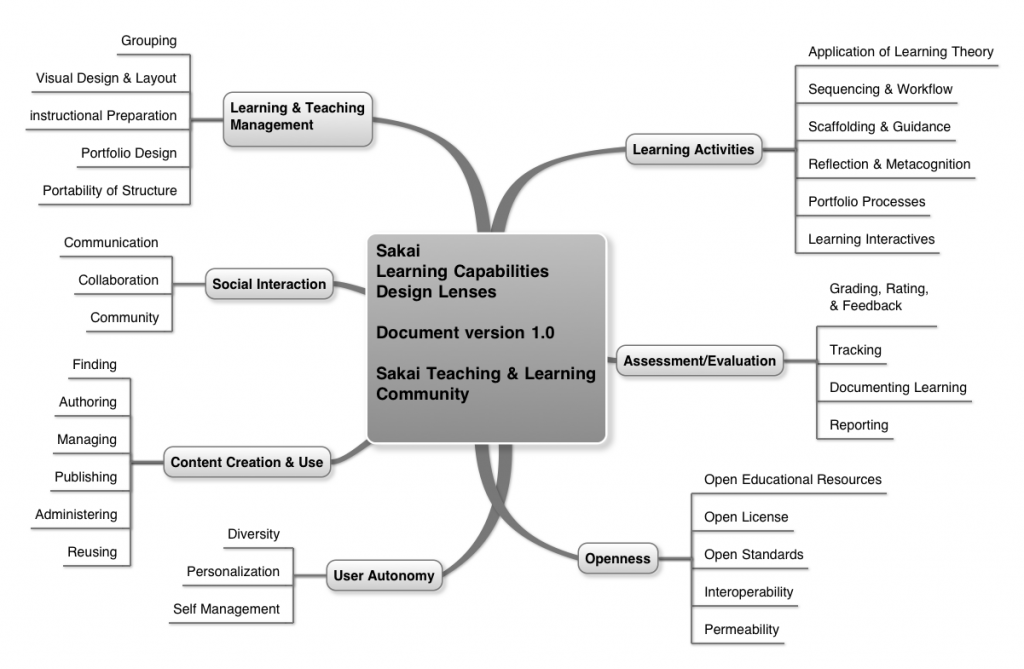
Sakai Learning Capabilities Design Lenses At the same time, the description that Martin gives of his early thinking about the design goals for Moodle 3, as well as its relationship to current-generation learning management, is quite similar to the path that the Sakai community has taken with Sakai 3, particularly vis-a-vis Sakai 2.
On the other hand, the Moodle and Sakai sustainability and governance models are quite different from each other and show no signs of converging. Moodle’s model puts a company with a strong central manager in charge of most core development. Money flows from adopting schools, through Moodle support partners, and into Moodle Pty., under Martin’s direction, to pay for the core developers. Sakai, in contrast, works on a consortial model with a foundation at its center. Both approaches have pros and cons, but the point is that they are quite different and have different risks for adopting schools to manage. We tend to talk about the choice between private source and open source as if the latter were monolithic, but actually there’s huge variety in the ways that these projects work. You have to evaluate the strengths and risks associated with each open source support ecosystem individually, just as you would evaluate the strengths and risks associated with each private source vendor individually.
Anyway, many thanks to Martin for an illuminating discussion.
-
Interview With Casey Green
The 2010 Campus Computing survey is out, and it’s chock full of interesting information. I was fortunate to be able to sit down with Casey Green, the Founding Director of the Campus Computing Project, and talk about some of the highlights and a few related topics. I apologize for the abrupt ending; my camera ran out of disk space in the middle of Casey’s last answer. In any event, there’s good stuff here about the transition happening in the LMS market, the challenges of getting good survey data, ((Many thanks to the ever-thoughtful Scott Siddall for suggesting this line of inquiry.)) and more.
You should definitely also read the survey report. It covers a lot of topics that we didn’t even touch on in the interview.
-
How to Sell a Migration to Moodle
The folks at Wesleyan University have a blog up that is a stellar example of how to evangelize for an LMS platform to faculty when you’re facing the front end of a migration. ((Another great example is UNC’s Sakai pilot blog.)) For starters, their FAQ is rich with information, including analysis by peer schools.
Here’s a sample: