e-Literate

Present is Prologue

Tag: Moodle

  • New look at LMS data for US small colleges

    Last fall I mentioned two new non-survey data sources available to track LMS adoption within higher ed. While surveys for subjective, attitudinal information still make sense, surveys of hard data are losing their value over time. Analyses of automatically collected system data place less of a burden on the organizations providing the information, and these analyses also allow a more agile approach to refining the data collection and viewing from different angles. Today Edutechnica released a new report on LMS adoption that demonstrates these benefits.

    When we provided our initial analysis of LMS usage in fall of 2013, one point of feedback that we heard loud and clear is that because our data only included institutions with greater than 2000 enrollments, we excluded a fair number of community colleges, career colleges, and liberal arts colleges. To the credit of those who provided this feedback, they were absolutely correct. Three-quarters of all recognized higher education institutions in the United States have fewer than 2500 FTE – a critical demographic as the majority of universities in the US are of this size or smaller. To more fairly represent LMS usage we needed to include data on smaller schools.

    We are now excited to be able to provide analysis of a data set for institutions with greater than 1000 students.

    The team presents the raw data for schools above 1,000 FTE, calling out some of the differences from their earlier report. But one key view they provided is looking at institutional LMS adoption per school enrollment size.

    Seeing Moodle’s increased usage prompted us to investigate Moodle further. An interesting thing happens below 2500 FTE; Moodle actually exceeds Blackboard’s market  share.  Only after this point do the demographic segments diverge. (more…)

  • The Resilient Higher Ed LMS: Canvas is the only fully-established recent market entry

    For a few years starting in 2009, it seemed one of the best ways to raise VC funds or corporate internal investment was to say “we can beat Blackboard with a new cloud-based platform”. Witness Coursekit / Lore, Instructure / Canvas, OpenClass, LoudCloud Systems, Helix, and even more recently MOOC platforms. There were many articles written as these new systems entered the market, but what if we look back and ask whether the LMS market has actually changed recently? The picture that emerges is one of surprising resiliency by the established LMS providers.

    In fact, I would argue that in the past eight years (at least in North America) the only new system that has fully established itself in the LMS market is Canvas. Note that I have combined WebCT and ANGEL within the Blackboard umbrella, but even these systems established themselves more than a decade ago.

    (more…)

  • State of the Anglosphere’s Higher Education LMS Market: 2013 Edition

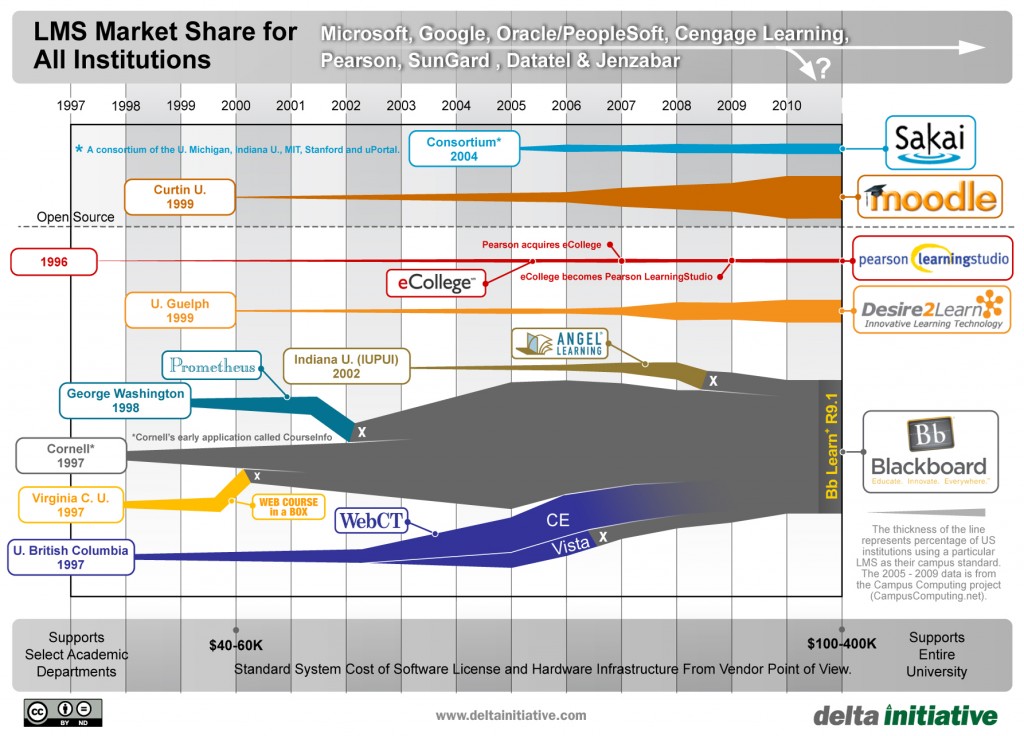
    I shared the most recent graphic summarizing the LMS market in September 2012, and thanks to new data sources it’s time for an update. As with all previous versions, the 2005 – 2009 data points are based on the Campus Computing Project, and therefore is based on US adoption from non-profit institutions. This set of longitudinal data provides an anchor for the summary.

    What I’ve been attempting to do lately is to expand the market definition beyond the US. Last year I used some heuristics:

    LMS_MarketShare_20121018-Home

    (more…)

  • Layoffs and reorganization at Blackboard

    Bill Flook, who covers the DC technology scene for Business Journals, just interviewed Blackboard CEO Jay Bhatt about last week’s layoff. The full article can be found here. From a quick read, it looks like Blackboard is executing on two key priorities:

    • Trimming the fat caused by years of acquisitions and redundant operations; and
    • Completing the acquisitions by centralizing core functions, particularly under new management.

    From the article:

    Blackboard Inc. carried out a round of layoffs last week as part of a broader reorganization by CEO Jay Bhatt, the latest in a string of actions aimed at revitalizing the 16-year-old ed-tech behemoth.

    Bhatt, in an interview Tuesday evening, confirmed the job cuts, which he described as “a very small action we took to take some costs out of the business, primarily on things that don’t allow us to get where we need to go.” He declined to specify the number of layoffs.

    As for the priority of trimming the fat, it is now fairly clear that Blackboard is not set to divest any major product lines, but rather will follow a path of centralization. The new management team is a key part of the reorganization plans.

    (more…)

  • Moodle has quietly become the dominant LMS for online service providers

    One subject that we have not covered much at e-Literate lately is the market position of Moodle. Given the significant LMS market changes over the past two years, it might be worth considering how institutions are adopting and using Moodle. In the US at least, there has been a significant change – whereas in previous years Moodle growth came primarily from institutions moving away from Blackboard, today much of the growth appears to have shifted to online service providers.

    Traditional US Market

    From 2006 – 2011 Moodle grew quickly in the US, both in terms of the number of users (students, faculty) and in terms of the number of schools adopting Moodle. This growth appears to have slowed considerably since 2011, although the data can be difficult to interpret since the system is open source – anyone can download for free and run Moodle, without even notifying Moodle headquarters or often the institution.

    While the data is inconclusive, my assumption is that traditional Moodle growth – institutions adopting the LMS as the campus standard, typically moving away from Blackboard or WebCT – has significantly slowed from its peak growth in 2009 – 2011. I’ll write a separate post on this subject in the future.

    New Growth Model

    While the traditional growth may have slowed, there is a market segment in the US where Moodle is quietly dominating – as the preferred learning platform (or LMS) for online service providers.

    (more…)

  • Everybody Wants to MOOC the World

    You may have seen this week’s announcement from Instructure of their new Canvas Network to support MOOCs and other open courses. Blackboard has already been dipping its toe in this water, having had Curtiss Bonk run a MOOC on CourseSites. I also find it significant that Blackboard (somewhat awkwardly) made an attempt to remind the market of this fact on the same day as Instructure’s announcement. I predict that “MOOC” will reach the same level of hype at this year’s EDUCAUSE conference that “open” did last year.

    But hype aside, it’s worth asking what it means for the traditional LMS players to be marketing themselves as platforms for MOOCs and other open courses.

    (more…)

  • State of the Higher Education LMS Market: A Graphical View

    The transformation of the higher education LMS market continues, and I expect more changes over the next 2 – 3 years. However, it seems time to capture the state of the market based on changes over the past year or two.

    I shared the most recent graphic summarizing the market in mid 2011. As with all previous versions, the 2005 – 2009 data points are based on the Campus Computing Project, and therefore is based on US adoption from non-profit institutions. This set of longitudinal data provides an anchor for the summary.

    The most significant changes over the past two years include the following.

    (more…)