
e-Literate

Present is Prologue

Tag: Moodle

  • Launch Of Moodle Users Association: 44 members sign up, mostly as individuals

    The Moodle Users Association (MUA), a crowd-funding group for additional Moodle core development, announced today that it is open for members to join. Technically the site was internally announced on its web site last Friday, but the press release came out today. As of this writing (Thurs evening PST), 44 members have signed up: 37 at the individual level, 1 at the bronze level, 3 at the silver level, 2 not sharing details, and Moodle Pty as the trademark holder. This equates to $8,680 – $22,580 of annual dues, depending on what level the two anonymous members chose.

    Update (1/25): As of Monday morning, the numbers are 51 members: 44 at the individual level, 1 bronze, 3 silver, 2 not sharing details, and Moodle Pty as trademark holder; leading to $8,960 – $22,860 of annual dues.

    Moodle News was the first outlet to describe the new organization (originally called Moodle Association but changed to Moodle Users Association when the organization was formalized), and in early December they summarized the motivation:

    As mentioned recently in an article on e-Literate, it’s possible that a majority of all funding to Moodle.org originates from Blackboard. While this may be ironic, knowing the history of Blackboard, it is appropriate since the LMS company has quietly become the largest Moodle Partner by number of clients through acquisitions and growth over the last few years. (more…)
  • Solving the Ed Tech Patent Problem

    You may have heard that Khan Academy has filed for several patents. Audrey Watters has written a really strong piece providing the details of the filings in the context of the history of ed tech patents and showing why some academics feel that the patent system clashes with the values upon which academia was built. In the process, she excavates some of my personal history in the Blackboard patent war. While I am sympathetic to arguments against ed tech or software patents on principle, my own personal reasons for getting involved with that fight were more utilitarian. I believed then, as I do now, that patents threaten to kill innovation in educational technology due to the specific characteristics of the market. The outcome of Blackboard v. Desire2Learn did not end that threat, although it did temporarily reduce it. The conversation being provoked by Khan Academy’s filings offers a new opportunity to come up with a more permanent solution. (more…)

  • What Blackboard’s New CEO Needs to Do Now (and how you can tell if he’s doing it)

    As Phil noted in his post, Blackboard has hired a new CEO, a guy by the name of Bill Ballhaus. We don’t know much about him yet, other than that he came from outside education. (That shouldn’t be considered a disqualifier, by the way. Instructure CEO Josh Coates also came from outside education, for example, and he has kept most of his customers very happy so far.) We’ll learn more about him over the next days, weeks, and months. In the meantime, it’s worth taking some time to consider the challenge he has in front of him.

    (more…)

  • Unizin RFP For LMS: An offering to appease the procurement gods?

    Well this was interesting:

    In a blog post from Monday, Unizin announced a public Request For Proposals (RFP) to solicit bids for an enterprise and multitenant LMS. The RFP states its purpose:

    We seek to identify a qualified vendor (“vendor”) to make available an enterprise and multitenant learning management system and related services (collectively, the “LMS”) to Member Institutions.

    Say what? (more…)

  • LMS Market Updates, Dec 2015

    There seems to be a series of news and analysis on the LMS higher education market worth summarizing.

    Major Adoption News

    I posted last weekend about University of Phoenix (UoP) and their LMS. UoP is well-known for being the biggest user of a homegrown LMS for well over a decade, but in the past several years they rolled out “Classroom”, an entirely new adaptive-learning based design. In a major strategic change, UoP is abandoning this effort and moving to a commercial provider.

    What we can now confirm at e-Literate is that the “learning platform” selected by the University of Phoenix is Blackboard Learn Ultra. This is the cloud-based redesign of Learn that Michael and I have described in several posts. Even with the University of Phoenix’s reduced enrollment, I consider this news to be the most important new client acquisition for Blackboard since at least 2011.

    Today Campus Technology reported that Stanford is moving to adopt Canvas as their campus-wide LMS. Previously Stanford was a founding member of Sakai, with its implementation called CourseWork.

    The university has been piloting Instructure Canvas since the 2014-2015 academic year. The vice provost for teaching & learning (VPTL) said in a statement that about 80 percent of faculty in the pilot reported being “very or somewhat satisfied” with the new platform; even more students (94 percent) found it “very or somewhat easy” to use.

    Alongside the pilot, two Stanford schools had already adopted the application independently. The Graduate School of Education moved to Canvas in 2013-2014, and the Graduate School of Business did so in 2014. Both adoptions were considered successes.

    During this school year, the migration was accelerated. Some 300 classes switched to Canvas. And the plan is to migrate the remaining 4,200 classes still using the legacy LMS software over the next academic year.

    (more…)

  • Moodle Moves Give Hints of What a Post-Fork World Could Look Like

    Phil and I have written about the growing tension between the interests of Moodle HQ and a those of a couple of the bigger Moodle Partners, most notably Blackboard. There are a number of ways that this tension could be resolved, but one of the more dramatic possibilities would be a fork of Moodle. While we are not predicting it will happen, a couple of developments hit the wires last week that give us some idea of what the world might look like if there were a real and permanent split between the two groups.

    (more…)

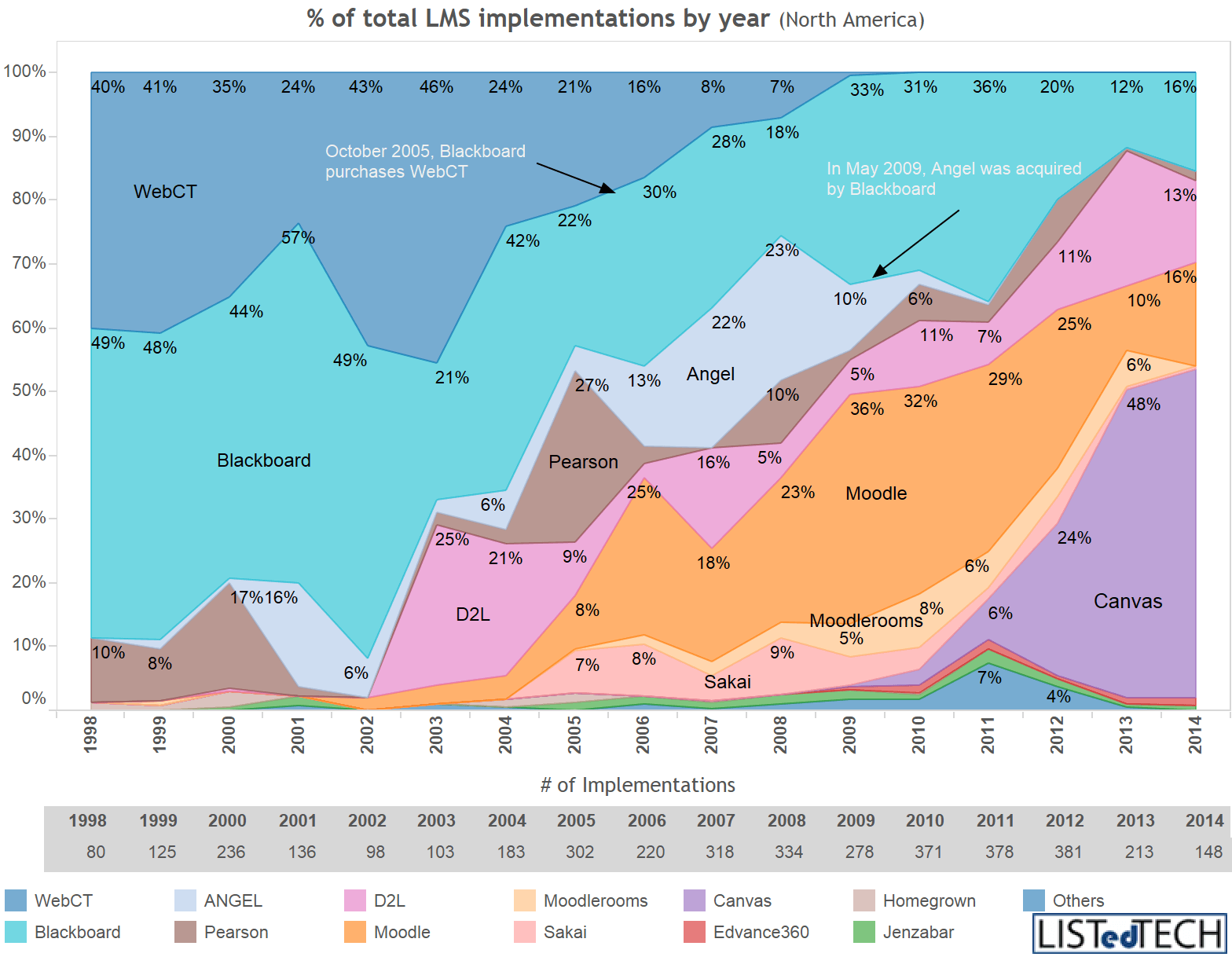
  • New Visual From LISTedTECH Shows LMS Market By New Implementations

    Justin Menard and his team at ListEdTech have produced a great new visual on the LMS market in North America. Using his wiki-based data with 4,000+ institutions, he shows the percentage of LMS implementations per year (scaled to 100% for each year). While we are used to seeing LMS market share in terms of number or percentage of institutions using each LMS as primary system, this view highlights the dynamics of the market – which systems are getting adopted. See original post for full chart and additional description.

    LMS-Providers-Market-Share-by-Year1

    A few notes: (more…)