
e-Literate

Present is Prologue

Tag: Moodle

  • What Schoology’s Venture Funding Means for the LMS Market

    LMS vendor Schoology just raised $32 million in Series D venture capital funding, bringing the total that they’ve raised to just over $57 million. If you’ve never heard of them, that’s because they have mostly been focused on K12, where they are doing very well. But they have turned their attention to US higher ed recently. They had a surprisingly big presence at EDUCAUSE, where CEO Jeremy Friedman told me that they are prepared to make an aggressive push. Their ability to get major funding was probably helped by Instructure going to market, and possibly by the leak that Blackboard is putting itself on the block as well. I don’t generally take money guys too seriously in their ability to predict ed tech, but they may be lucky on this one. I think there may be an opening the US higher ed LMS market for a new entrant.

    LMS selection for schools often works a little like the selection process that high school students typically go through when picking a college. Students looking at colleges usually have a favorite going in. Maybe their friends are going there. Or their big brother or sister. Or maybe they just heard that it’s cool. But they don’t apply to just one college, in case it doesn’t work out for one reason or another. So they have a second tier of schools that might be OK too. Generally, they don’t know much about your favorite school going in and they know even less about the “might be OK” schools. Depending on how cautious they are, they might throw in one or two “safety” schools that they really don’t want to go to but that they feel (or their parents feel) should be included for the sake of completeness.

    Likewise, colleges and universities frequently go into an LMS evaluation process with a favorite. Because the selection is generally done by a committee of stakeholders rather than just one person, there might be conflicting opinions on what the favorite is. But more often than not, there is a nascent majority or a consensus opinion about the likely winner, at least among the core selection committee. Back in the early to mid-aughts, the default favorite was usually Blackboard because it was considered to be the safe alternative that everybody was using. When Blackboard faltered, the favorite began to split between D2L and Moodle—and occasionally Sakai, particularly for larger public universities—with type of school and geography having a big influence on which one was likely to be the frontrunner. These days, the schools that Phil and I talk to report Instructure as the starting frontrunner at least four times out of five, across school types or geographies.

    But LMS selection processes still need their “might be OK” candidates. For one thing, most of them are mandated by policy or by law to do a real multi-vendor evaluation. And most evaluation committees genuinely do want to look at alternatives. Just because they have a sense going in of which alternative is most likely to be the best doesn’t mean that they are closed-minded. The trouble is that there aren’t many alternatives that selection committees feel hopeful about these days. Increasingly, Sakai and Moodle aren’t even making it to the serious evaluation stage in US higher ed evaluations; and even when they do, they are often treated like safety schools. Blackboard never fully recovered from reputational damage done under Michael Chasen and their failure to deliver on Ultra this year was a huge setback. At the moment, they are being treated like a safety school as often as not. If Ultra slips further—and maybe even if it doesn’t—they could start losing significant numbers of customers again. And we haven’t run into many schools that are particularly excited about D2L either. Probably the best I can say for them is that they are the least likely of the LMS companies that are not Instructure to be dismissed out-of-hand.

    I think there’s an opportunity for a new entrant to get a fair hearing from selection committees that want a real horse race but aren’t excited about any of the incumbents. Ironically, the rise and success of Instructure has probably reduced risk aversion among schools to go with a scrappy start-up. I don’t know if Schoology is going to be the one that gets a foothold in the market because of this opening, but their timing is definitely good.

  • Why Is Blackboard Laying Off Staff Despite Improved Market Share Position?

    Over the past two weeks Blackboard had another round of layoffs, likely due to the company missing financial targets. While one estimate places the number at roughly 200, from what I have heard the number is closer to 90 – 100 people let go. I asked the company for commentary on the layoffs and associated reorganization. By email they declined to comment on the number of employees let go but added this comment:

    These changes included the elimination of select positions across the company. We deeply appreciate the contributions made by the affected employees and are supporting them in their transition.

    This is not the first layoff at Blackboard since they were taken private in 2011; rather this is the latest in a series of cuts that have gone well beyond “trimming the fat”. Posts on thelayoff.com and glassdoor paint a picture of high attrition due to routine layoffs and many staff leaving by their own choice. We have written on several of these events here at e-Literate. 90 here, 100 there, 74 . . . it adds up, especially when combined with staff departures.

    To get another view into the company downsizing, consider that Blackboard recently signed a lease that will trim its corporate headquarters by 37%:

    Founded in a Dupont Circle row house in 1997, Blackboard, which has occupied 111,895 square feet at 650 Massachusetts Ave. since 2008, will move into Ogilvy Public Relations Wordwide’s former space on the eighth through 10th floors [70,482 square feet] beginning in December 2015.

    This follows a recent move in its Reston, Virginia facility that cuts its office space there by over 50%.

    In an ironic turn of events, the new headquarters move will put the company into the same building it occupied before 2008, and their neighbors in the building will include former CEO Michael Chasen’s SocialRadar and CBE provider FlatWorld.

    Why More Layoffs When US Market Share Finally Stabilizes?

    (more…)

  • State of the US Higher Education LMS Market: 2015 Edition

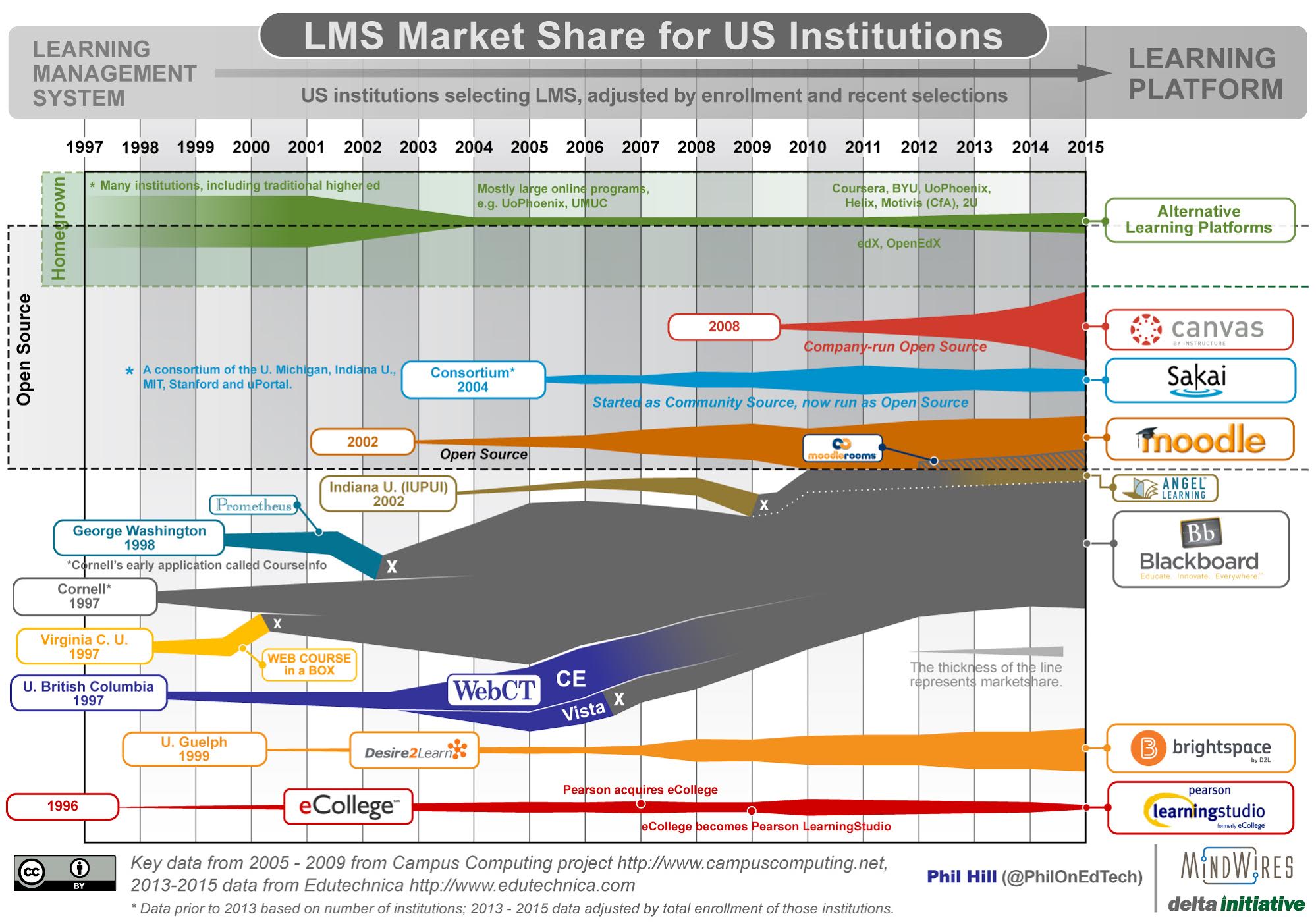
    I shared the most recent graphic summarizing the LMS market in October 2014, and thanks to revised data sources it’s time for an update. As with all previous versions, the 2005 – 2009 data points are based on the Campus Computing Project, and therefore is based on US adoption from non-profit institutions. This set of longitudinal data provides an anchor for the summary.

    The primary data source for 2013 – 2015 is Edutechnica, which not only does a more direct measurement of a larger number of schools (viewing all schools in IPEDS database with more than 700 FTE enrollments), but it also allows scaling based on enrollment per institution. This means that the latter years now more accurately represent how many students use a particular LMS. This post at Edutechnica provides the most recent data for Fall 2015.

    A few items to note:

    • The most important recent feature of the market – the rapid rise of Canvas, surpassing D2L and quickly closing in on Moodle – is quite visible now.
    • Blackboard Learn appears to have stopped its well-documented losses in US higher ed and has even risen in the past year. Its market share is far smaller than at its 2009 peak, but the company is no longer losing large numbers of clients each year.
    • D2L, Sakai, and Moodle have risen ever so slightly, but in effect have hit a plateau.
    • ANGEL and eCollege have lost market share.
    • There is a growing area of “Alternative Learning Platforms” that includes OpenEdX, 2U, Helix and Motivis (the newly commercialized learning platform from College for America).
    • While the data is more solid than 2012 and prior years, keep in mind that you should treat the graphic as telling a story of the market rather than being a chart of exact data.
    • Update (10/16): Removed “Curtin University as origin of Moodle based on Martin’s comments. Mea culpa – should have caught this earlier.
    • Update (10/23): Changed graphic title to refer to US and not North America.

    LMS_MarketShare_20151023

  • Is Moodle “Bigger than Martin”?

    In his recent post on why Moodle matters, Phil wrote,

    For a large portion of our readers who deal mostly with US higher education, it could be easy to dismiss Moodle as an LMS and an idea past its prime.[…]And yet no other academic LMS solution comes close to Moodle in terms of worldwide deployments and learners enrolled.

    Likewise, if you’re not embedded in the Moodle community, you may not know how central Moodle creator Martin Dougiamas is to that project, or even know who he is. And yet, he is huge. I can name maybe a handful of people who are relatively widely known and respected in educational technology. I can name only a few who are admired and even beloved. I can name very few indeed who are not working for universities (although that’s changing a little, now that Jim Groom and David Wiley have both joined commercial ventures). Within the circle that knows him, Martin’s many admirers have been fiercely loyal to and protective of him, trusting him absolutely to steer Moodle the product, Moodle the community, and Moodle the brand. When you add to that the size of Moodle’s adoption footprint, one can make the case that Martin Dougiamas is one of the most consequential figures in the history of educational technology.

    Which is why it is so remarkable that Phil and I are hearing, for the first time ever, from a number of different, independent sources, the phrase, “Moodle is bigger than Martin now.” It is another indicator that Moodle is reaching an inflection point.

    (more…)

  • Why Moodle Matters

    For a large portion of our readers who deal mostly with US higher education, it could be easy to dismiss Moodle as an LMS and an idea past its prime. Market data from Edutechnica shows that since 2013 the number of adopting US institutions has hit a plateau, but the total number of students served (number of institutions using Moodle as primary LMS scaled by enrollment) has actually decreased. Gone are the days of UCLA, LSU, Athabasca, North Carolina Community Colleges, UNC Charlotte and other high-profile Moodle selections from the late 2000s. ((Disclosure: I helped UCLA with their LMS selection.)) Pop quiz: name the last significant LMS decision process in US higher ed that selected Moodle as a replacement for another system.

    . . .

    And yet no other academic LMS solution comes close to Moodle in terms of worldwide deployments and learners enrolled. Even if you’re a US college or university, consider several reasons why Moodle matters.

    Most Common LMS For Small Schools

    Again using Edutechnica data (this time from early 2014), for US institutions with enrollments of 2,500 FTE or less Moodle is the market leader, surpassing Blackboard Learn.

    Edutechnica Spring 2014 Small

    Most Prevalent LMS In The World Based On Self-Reported Data

    (more…)

  • Breaking: Totara LMS Forks From Moodle And Changes Relationship

    What interesting timing. Just as I published my interview with Martin Dougiamas, I was notified that Totara LMS, a Moodle derivative aimed at the corporate learning market, has forked from Moodle and is changing its relationship with the Moodle Community. From their newsletter released today (Sept 3 Australia time):

    The relationship between Totara and Moodle is changing

    We have made the carefully considered decision that from 2016 Totara LMS will no longer be in lockstep with Moodle. This will free the team at Totara Learning to focus on big leaps forward in usability and modernising the framework for our enterprise customers.

    Further down, Richard Wyles wrote an additional post explaining the fork, starting with his long-term relationship with Moodle. He then explains:

    Why are we forking?

    From 2016 onwards we will no longer be in lockstep. Totara LMS will progressively diverge from its Moodle foundations. (more…)

  • Interview With Martin Dougiamas On Changes To Moodle Community This Year

    In my post last week on Blackboard’s Moodle strategy in Latin America, I made the following observation:

    At the same time, this strategy and growth comes at a time where the Moodle community at large appears to be at an inflection point. This inflection point I see comes from a variety of triggers:

    • Blackboard acquisitions causing Moodle HQ, other Moodle Partners, and some subset of users’ concerns about commercialization;
    • Creation of the Moodle Association as well as Moodle Cloud services as alternate paths to Moodle Partners for revenue and setup; and
    • Remote-Learner leaving the Moodle Partner program and planning to join the Moodle Association, with its associated lost revenue and public questioning value.

    I’m working on a follow-up post that looks more deeply at these changes to the Moodle community, and as part of the research I’ve interviewed Martin Dougiamas, Moodle Founder and CEO, by email. Given Martin’s role, I wanted to avoid the risk of having his answers get buried within my upcoming analysis post; therefore, I’ve decided to publish the interview in full. The only changes I have made are for clarity: showing and correcting ((Changing references to “Remote Learner” to follow the proper “Remote-Learner” usage)) full names instead of acronyms ((For example, replacing “BB” with “Blackboard”, “NS” with “Nivel Siete”, etc)), correcting grammar, and reordering questions to show follow-up discussions in context.

    Phil: Given Blackboard’s trend in acquisitions for Moodle (Remote-Learner UK, X-Ray Analytics, Nivel Siete), and assuming these are not the last, how do these moves affect the Moodle community and future (including roadmap, Moodle HQ funding, whatever)? What are the biggest benefits and / or what are the risks and downsides?

    Martin: In any community there’s always going to be some concern about any one organisation trying to gain dominance. Our certified Moodle Partner program was designed specifically to avoid these kind of risks by building a large global network of different companies (currently 68 and growing, including Moonami and Elearning Experts recently in the US) who are committed to supporting Moodle HQ. The recent Blackboard acquisitions don’t bring any benefits to Moodle as a whole.
    (more…)