e-Literate

Present is Prologue

Tag: NCES

  • Fall 2014 IPEDS Data: New Profile of US Higher Ed Online Education

    The National Center for Educational Statistics (NCES) and its Integrated Postsecondary Education Data System (IPEDS) provide the most official data on colleges and universities in the United States. I have been analyzing and sharing the data in the initial Fall 2012 dataset and for the Fall 2013 dataset. Both WCET and the Babson Survey Research Group also provide analysis of the IPEDS data for distance education. I highly recommend the following analysis in addition to the profile below (we have all worked together behind the scenes to share data and analyses).

    Below is a profile of online education in the US for degree-granting colleges and university, broken out by sector and for each state. (more…)

  • About the Diverging Textbook Prices and Student Expenditures

    This is part 3 in this series. Part 1 described the most reliable data on A) how much US college textbook prices are rising and B) how much students actually pay for textbooks, showing that the College Board data is not reliable for either measure. Part 2 provided additional detail on the data source (College Board, NCES, NACS, Student Monitor) and their methodologies. Note that the textbook market is moving into a required course materials market, and in the immediate series I use both terms somewhat interchangeably based on which source I’m quoting. They are largely equivalent, but not identical.

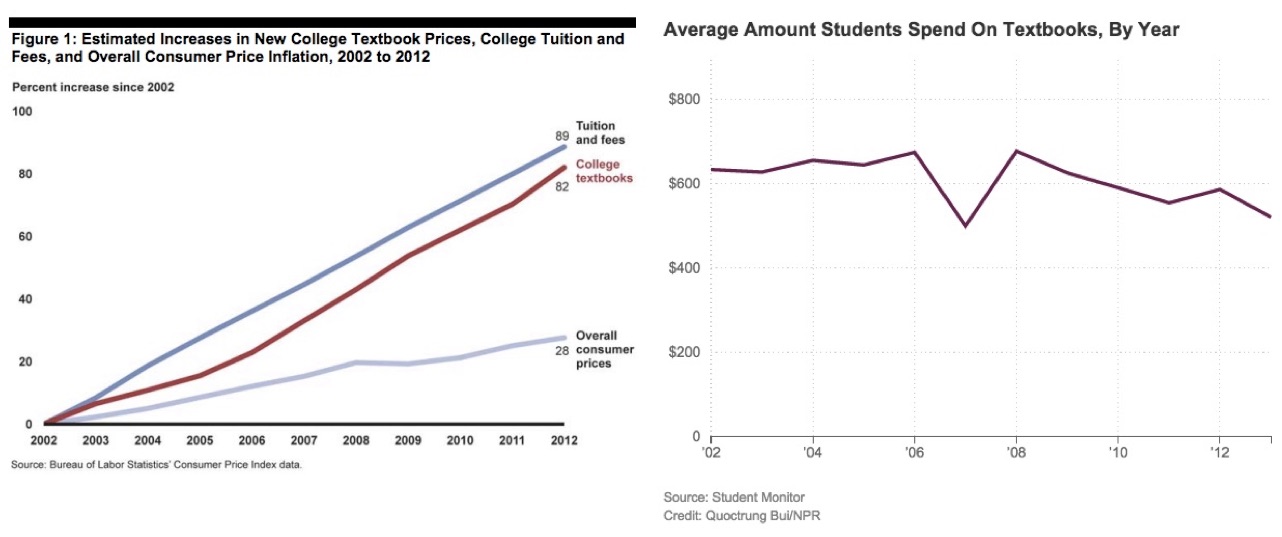
    Based on the most reliable data we have, the average college textbook prices are rising at three times the rate of inflation while average student expenditures on textbooks is remaining flat or even falling, in either case below the rate of inflation. Average student expenditures of approximately $600 per year is about half of what gets commonly reported in the national media. The combined chart comes from this GAO Report (using CPI data) and this NPR report (using Student Monitor data).

    Combined Chart

    Does this indicate a functioning market, and does this indicate that we don’t have a textbook pricing problem? No, and no. (more…)

  • Postscript on Student Textbook Expenditures: More details on data sources

    There has been a fair amount of discussion around my post two days ago about what US postsecondary students actually pay for textbooks.

    The shortest answer is that US college students spend an average of $600 per year on textbooks despite rising retail prices.

    I would not use College Board as a source on this subject, as they do not collect their own data on textbook pricing or expenditures, and they only use budget estimates.

    <wonk> I argued that the two best sources for rising average textbook price are the Bureau of Labor Statistics and the National Association of College Stores (NACS), and when you look at what students actually pay (including rental, non-consumption, etc) the best sources are NACS and Student Monitor. In this post I’ll share more information on the data sources and their methodologies. The purpose is to help people understand what these sources tell us and what they don’t tell us.

    College Board and NPSAS

    My going-in- argument was that the College Board is not a credible source on what students actually pay:

    The College Board is working to help people estimate the total cost of attendance; they are not providing actual source data on textbook costs, nor do they even claim to do so. Reporters and advocates just fail to read the footnotes.

    Both the College Board and National Postsecondary Student Aid Study (NPSAS, official data for the National Center for Education Statistics, or NCES) currently use cost of attendance data created by financial aid offices of each institution, using the category “Books and Supplies”. There is no precise guidance from DOE on the definition of this category, and financial aid offices use very idiosyncratic methods for this budget estimate. Some schools like to maximize the amount of financial aid available to students, so there is motivation to keep this category artificially high. (more…)

  • No Discernible Growth in US Higher Ed Online Learning

    By 2015, 25 million post-secondary students in the United States will be taking classes online. And as that happens, the number of students who take classes exclusively on physical campuses will plummet, from 14.4 million in 2010 to just 4.1 million five years later, according to a new forecast released by market research firm Ambient Insight.

    Campus Technology, 2011

    On the positive side, Moody’s notes that the U.S. Department of Education projects a 20-percent growth in master’s degrees and a 9-percent growth in associate degrees, opportunities in both online education and new certificate programs, and a rising earnings premium for those with college degrees.

    Chronicle of Higher Ed, 2014

    Q.  How likely would it be that this fraction [% students taking online courses] would grow to become a majority of students over the next five years? A [from institutional academic leaders]. Nearly two-thirds responded that this was “Very likely,” with an additional one-quarter calling it “Likely.” [That’s almost 90% combined]

    Grade Change, Babson Survey 2013

    More than two-thirds of instructors (68 percent) say their institutions are planning to expand their online offerings, but they are split on whether or not this is a good idea (36 percent positive, 38 percent negative, 26 percent neutral).

    Inside Higher Ed 2014

    Still, the [disruptive innovation] theory predicts that, be it steam or online education, existing consumers will ultimately adopt the disruption, and a host of struggling colleges and universities — the bottom 25 percent of every tier, we predict — will disappear or merge in the next 10 to 15 years.

    Clayton Christensen in NY Times 2013

    You could be forgiven for assuming that the continued growth of online education within US higher ed was a foregone conclusion. We all know it’s happening; the questions is how to adapt to the new world.

    But what if the assumption is wrong? Based on the official Department of Education / NCES new IPEDS data for Fall 2013 term, for the first time there has been no discernible growth in postsecondary students taking at least one online course in the US. (more…)

  • Fall 2013 IPEDS Data: New Profile of US Higher Ed Online Education

    The National Center for Educational Statistics (NCES) and its Integrated Postsecondary Education Data System (IPEDS) provide the most official data on colleges and universities in the United States. Last year they released data on distance education (essentially online courses) starting with the Fall 2012 term. Last week they released new data for the Fall 2013 term. Below is a profile of online education in the US for degree-granting colleges and university, broken out by sector and for each state.

    Please note the following:

    • For the most part distance education and online education terms are interchangeable, but they are not equivalent as DE can include courses delivered by a medium other than the Internet (e.g. correspondence course).
    • I have provided some flat images as well as an interactive graphic at the bottom of the post. The interactive graphic has much better image resolution than the flat images.
    • There are three tabs below in the interactive graphic – the first shows totals for the US by sector and by level (grad, undergrad); the second also shows the data for each state; the third shows a map view.
    • Please note that along with Russ Poulin from WCET we have identified some significant problems with IPEDS data validity – see this article for more information.

    (more…)

  • Fall 2013 IPEDS Data: Top 30 largest online enrollments per institution

    The National Center for Educational Statistics (NCES) and its Integrated Postsecondary Education Data System (IPEDS) provide the most official data on colleges and universities in the United States. Last year they released data on distance education (essentially online courses) starting with the Fall 2012 term. Last week they released new data for the Fall 2013 term.

    Let’s look at the top 30 online programs for Fall 2013 (in terms of total number of students taking at least one online course) while showing both 2012 and 2013 data. Some notes on the data source:

    • I have combined the categories ‘students exclusively taking distance education courses’ and ‘students taking some but not all distance education courses’ to obtain the ‘at least one DE’ category;
    • The ‘All Students’ category combines those taking DE course with those taking no DE courses;
    • I have highlighted in red the not-for-profit sectors;
    • IPEDS tracks data based on the accredited body, which can differ for systems – I manually combined most for-profit systems into one institution entity as well as Arizona State University ((ASU splits into various entities although the online programs are coordinated.)); and
    • Please note that along with Russ Poulin from WCET we have identified some significant problems with IPEDS data validity – see this article for more information.

    (more…)

  • Investigation of IPEDS Distance Education Data Highlights System Not Ready for Modern Trends

    This article is cross-posted to the WCET blog.

    After billions of dollars spent on administrative computer systems and billions of dollars invested in ed tech companies, the U.S. higher education system is woefully out of date and unable to cope with major education trends such as online & hybrid education, flexible terms, and the expansion of continuing and extended education. Based on an investigation of the recently released distance education data for IPEDS, the primary national education database maintained by the National Center for Education Statistics (NCES), we have found significant confusion over basic definitions of terms, manual gathering of data outside of the computer systems designed to collect data, and, due to confusion over which students to include in IPEDS data, the systematic non-reporting of large numbers of degree-seeking students.

    In Fall 2012, the IPEDS (Integrated Postsecondary Education Data System) data collection for the first time included distance education – primarily for online courses and programs. This data is important for policy makers and institutional enrollment management as well as for the companies serving the higher education market.

    We first noticed the discrepancies based on feedback from analysis that we have both included at the e-Literate and WCET blogs. One of the most troubling calls came from a state university representative that said that the school has never reported any students who took their credit bearing courses through their self-supported, continuing education program.  Since they did not include the enrollments in reporting to the state, they did not report those enrollments to IPEDS. These were credits toward degrees and certificate programs offered by the university and therefore should have been included in IPEDS reporting based on the following instructions. (more…)