
e-Literate

Present is Prologue

Tag: Online Education

  • Four numbers to consider from 2U’s IPO filing

    With the emergence of large-scale MOOCs over the past few years, it has become common to hear discussions of online education in terms of access and scale – access to low or no cost courses and scale of tens or hundreds of thousands of students. Of course MOOCs are but one form of online ed, and with 2U, Inc filing for an IPO in 2014, we have another example of a very different, and lucrative, approach to online education. 2U’s model extends high-tuition, elite programs to a small group of students. To get a sense of this approach, consider four remarkable numbers that are based on 2U’s S-1 filing.

    To provide context for these numbers, 2U’s model is somewhat unique, as described in Techonomy:

    . . . 2U offers weekly live online (synchronous) classes and a sophisticated social networking platform that lets students and instructors interact. Most degrees offered through 2U also require completion of physical components such as global MBA residencies, student teaching apprenticeships, and, for nursing students, operating room training on campus and clinical experience in their communities. [snip]

    Another difference is that 2U classes are small—just 10 to 15 students and a professor onscreen in a Brady Bunch grid—so admission is selective.

    2U makes $10,000 – $15,000 in revenue per student per year

    From our inception through December 31, 2013, a total of 8,540 unique individuals have enrolled as students in our clients’ programs. [p 1]

    For the years ended December 31, 2011, 2012 and 2013, our revenue was $29.7 million, $55.9 million and $83.1 million, respectively. [p 2]
    (more…)

  • Villanova Distance Learning Task Force: A case study in missing attribution

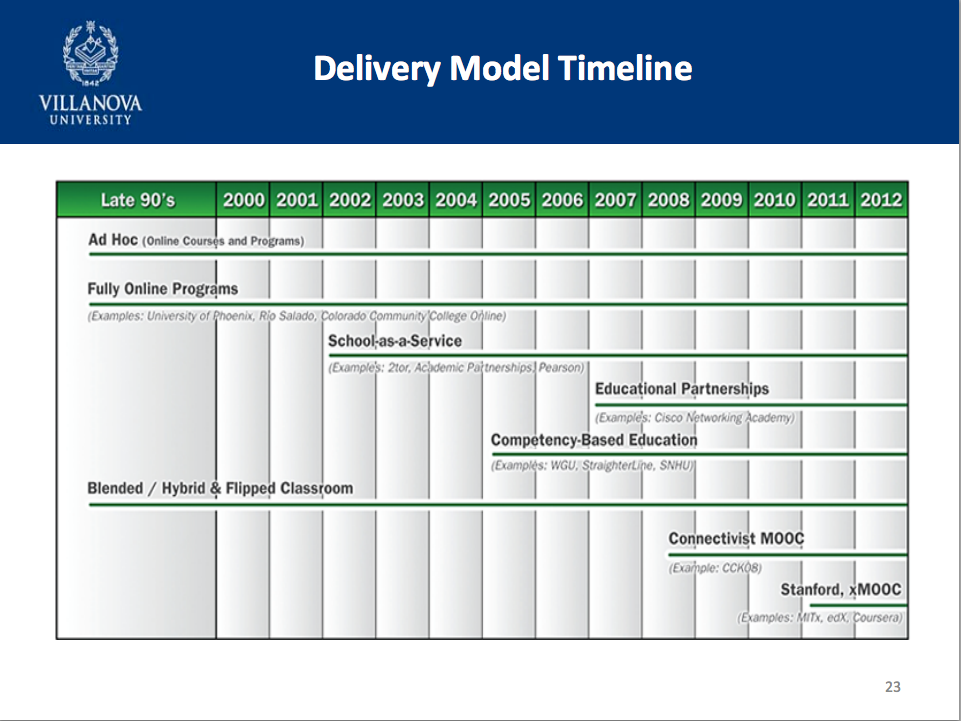
    While doing research for a blog post about 2U filing for an IPO, I ran across a presentation given last year by the Villanova University Distance Learning Task Force for a Faculty Forum. In this presentation I found one of my graphics that was shared on e-Literate and in EDUCAUSE Review.

    Slide 1I’m flattered that they would find this information useful, and this usage is why I usually include a footer to many of the graphics showing that they are licensed under creative commons to facilitate sharing. All I ask is for attribution and occasionally no derivatives.

    However, not only was there no attribution in the presentation, but the footer has been stripped off (I do not know if this was done by Villanova personnel or if they found a stripped-down version). Maybe that was just an unfortunate situation.

    But wait, just five slides down I find another graphic, same situation. (more…)

  • 2U registration for IPO offers insight into Online Service Provider market

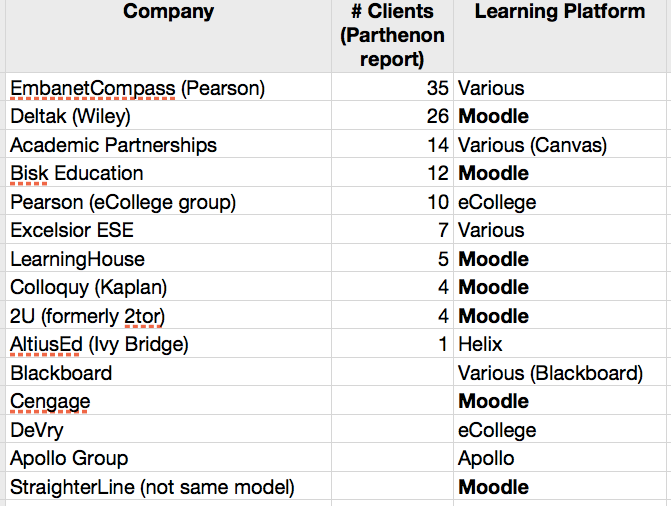
    One of the biggest growth areas in education has been the Online Service Provider market. Alternatively known as Online Education Service Provider (OESP), School-as-a-Service, or Online Program Management (OPM), this market offers services to traditional colleges and universities that are creating online programs. In August I listed the LMS used by the top OSP providers, and while the data for this table is a year old, it does give a sense of who the major players are.

    SaaS LMS Chart 2


    How big are these companies? EmbanetCompass had estimated 2012 revenues of $130 million when Pearson acquired the company for $650 million. Deltak had estimated 2012 revenues of $54 million when Wiley acquired the company for $220 million. Academic Partnerships had estimated 2012 revenues of $43 million. I don’t have updated 2013 numbers, but various estimates have this market growing at 50% or more per year.

    Yesterday 2U, Inc submitted a S-1 document with the SEC, registering the company’s intention to go public in 2014. (more…)

  • UF Online: What it is and what it isn’t

    Several weeks ago the University of Florida Online program opened for the Spring 2014 semester, accepting 600 transfer students, and the new program will accept Freshmen starting August 2014. This announcement comes just 2 years after the Florida legislature commissioned a study from the Parthenon Group on how to best leverage online programs in the state, and this program is probably one of the highest profile new online programs in the US within the past few years (along with California’s online initiative, Open SUNY, SJSU / Udacity and GaTech / Udacity).

    I had the opportunity to interview the executive director of UF Online, Dr. Betty Phillips, for additional background information. I’ll describe that interview along with my observations in a future post.

    In the e-Literate TV episode on online learning, Michael described the importance of focusing on the problem to be solved (at the 9:44 mark).

    The key, really, is to look at the problem you’re solving in the context of the particular college or university—what they have in terms of their strengths and resources, and what they’re missing—and then figure out what’s the best match between the problem and the solution.

    With that view in mind, let’s explore what UF Online is and what it isn’t.

    Background

    Two years ago the Florida state legislature funded the state university system’s Board of Governors to study online education in Florida, and by extension, to recommend how to expand online programs in a centralized fashion.  The Parthenon Group’s report was delivered in November 2012, and the state Strategic Planning Committee made the following recommendations in February 2013. (more…)

  • Online Education in US Public 2-year Institutions, focus on Michigan

    Last week I shared data tables for online education at US public 4-year institutions, with additional data for Florida. Now that I’m getting the process reasonably efficient for analyzing this data, there is some room for requests (hmm, slippery slope here).

    https://twitter.com/econproph/status/432308481786253313

    Since Jim teaches in Michigan, let’s review the 2-year data with additional data on his state.

    (more…)

  • Open Data: A case study using IPEDS for online education

    At e-Literate we’re planning to do more data journalism posts. Think of this along the lines of Harper Reed’s keynote last year as described in the Chronicle.

    Harper Reed, who served as chief technology officer in President Obama’s 2012 campaign, offered those people what he jokingly called “an intervention.”

    “Big Data is bullshit,” Mr. Reed said in a keynote speech on Tuesday.

    His point is not that there is no value in the large amounts of data available to the community, but that data analysis is getting democratized and doesn’t require huge investments.

    “The exciting thing is you can get a lot of this stuff done just in Excel,” he said. “You don’t need these big platforms. You don’t need all this big fancy stuff. If anyone says ‘big’ in front of it, you should look at them very skeptically … You can tell charlatans when they say ‘big’ in front of everything.”

    I would add one other aspect along with the democratization of data analysis – open data. Inspired by Audrey Watters and even her recent tweet, we are looking for ways to not only explore the open data available to the education community but also to share the data we use in our analyses.

    https://twitter.com/audreywatters/status/426541112527192064

    (more…)

  • Response from Babson Survey author on differences with IPEDS

    I have written a series of posts on the new IPEDS data, including two that showed how this data seems to be quite different from the pervasive Babson Survey Research Group (BSRG) data (formerly known as the Sloan Survey). In particular, there were two findings, one on the number of students taking online courses:

    And no, there aren’t 7.1 million [from Babson] US higher ed students taking at least one online course. There are closer to 5.5 million [from IPEDS] as of Fall 2012.

    and one on the number of institutions offering online education:

    The big difference that should be obvious is that the Babson data shows less than half the number of institutions with no online offerings than the IPEDS data – 15% compared to 31%.

    Who has an online offering?

    I have been in contact with Jeff Seaman, one of the two authors of the BSRG reports, to get his analysis on the differences, including sharing my spreadsheets used for analysis of the two data sets. Jeff has graciously reviewed the data and provided the following analysis of why BSRG data is so different from IPEDS data.

    (more…)