
e-Literate

Present is Prologue

Tag: Online Education

  • Investigation of IPEDS Distance Education Data Highlights System Not Ready for Modern Trends

    This article is cross-posted to the WCET blog.

    After billions of dollars spent on administrative computer systems and billions of dollars invested in ed tech companies, the U.S. higher education system is woefully out of date and unable to cope with major education trends such as online & hybrid education, flexible terms, and the expansion of continuing and extended education. Based on an investigation of the recently released distance education data for IPEDS, the primary national education database maintained by the National Center for Education Statistics (NCES), we have found significant confusion over basic definitions of terms, manual gathering of data outside of the computer systems designed to collect data, and, due to confusion over which students to include in IPEDS data, the systematic non-reporting of large numbers of degree-seeking students.

    In Fall 2012, the IPEDS (Integrated Postsecondary Education Data System) data collection for the first time included distance education – primarily for online courses and programs. This data is important for policy makers and institutional enrollment management as well as for the companies serving the higher education market.

    We first noticed the discrepancies based on feedback from analysis that we have both included at the e-Literate and WCET blogs. One of the most troubling calls came from a state university representative that said that the school has never reported any students who took their credit bearing courses through their self-supported, continuing education program.  Since they did not include the enrollments in reporting to the state, they did not report those enrollments to IPEDS. These were credits toward degrees and certificate programs offered by the university and therefore should have been included in IPEDS reporting based on the following instructions. (more…)
  • Update on 2U: First full quarterly earnings and insight into model

    2U, the online service provider that went public in the spring, just released its financial report for the first full quarter of operations as a public company. The company beat estimates on total revenue and also lost less money than expected. Overall, it was a strong performance (see WSJ for basic summary or actual quarterly report for more details). The basics:

    • Revenue of $24.7 million for the quarter and $51.1 m for the past six months, which represents year-over-year increase of 32 and 35%;
    • EBITDA Losses of $7.1 m for the quarter and $10.9 m for the past six months, which represents year-over-year increase of -2% and 12%; and
    • Enrollment growth of 31 – 34% year-over-year.

    Per the WSJ coverage of the conference call:

    “I’m very pleased with our second quarter results, and that we have both the basis and the visibility to increase all of our guidance measures for 2014,” said Chip Paucek, 2U’s Chief Executive Officer and co-founder. “We’ve reached a turning point where, even with continued high investment for growth, our losses have stopped accelerating. At the midpoint of our new guidance range, we now expect our full year 2014 adjusted EBITDA loss to improve by 17% over 2013. Further, we’ve announced a schedule that meets our stated annual goal for new program launches through 2015.”

    The company went public in late March at $14 / share and is still at that range ($14.21 before the quarterly earnings release – it might go up tomorrow). As one of only three ed tech companies to have gone public in the US over the past five years, 2U remains worth watching both for its own news and as a bellwether of the IPO market for ed tech.

    Notes

    The financials provide more insight into the world of Online Service Providers (OSP, aka Online Program Management, School-as-a-Service, Online Enablers, the market with no name). On the conference call 2U’s CEO Chip Paucek reminded analysts that they typically invest (money spent – revenue) $4 – $9 million per program in the early years and do not start to break even until years 3 – 4. 2U might be on the high side of these numbers given their focus on small class sizes at big-name schools, but this helps explain why the OSP market typically focuses on long-term contracts of 10+ years. Without such a long-term revenue-sharing contract, it would difficult for an OSP to ever break even.

    (more…)

  • Fall 2012 US Distance Education Enrollment: Now viewable by each state

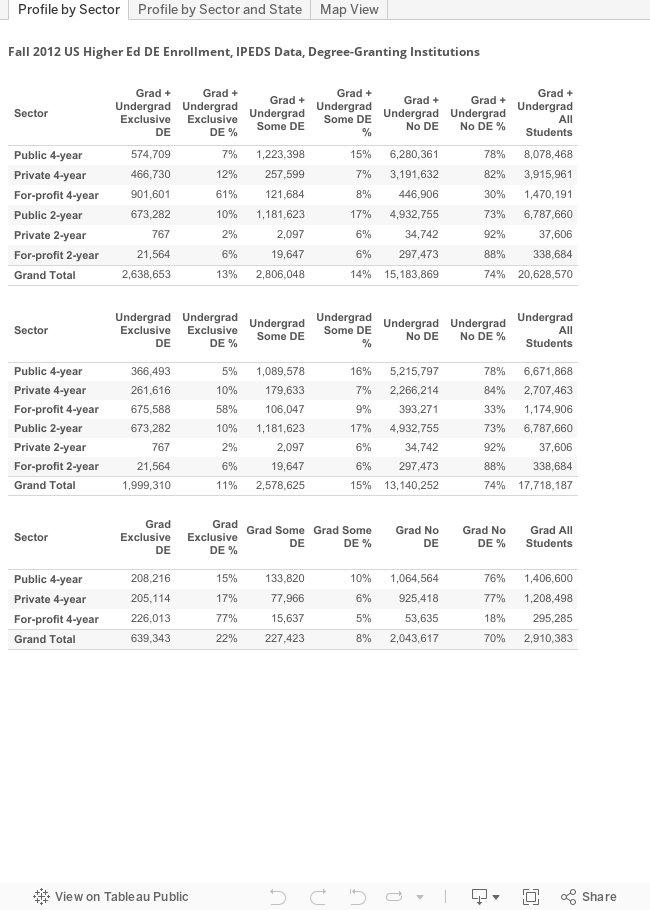
    Starting in late 2013, the National Center for Educational Statistics (NCES) and its Integrated Postsecondary Education Data System (IPEDS) started providing preliminary data for the Fall 2012 term that for the first time includes online education. Using Tableau (thanks to Justin Menard for prompting me to use this), we can now see a profile of online education in the US for degree-granting colleges and university, broken out by sector and for each state.

    Please note the following:

    • For the most part distance education and online education terms are interchangeable, but they are not equivalent as DE can include courses delivered by a medium other than the Internet (e.g. correspondence course).
    • There are three tabs below – the first shows totals for the US by sector and by level (grad, undergrad); the second also shows the data for each state (this is new); the third shows a map view.

  • Is the DOE backing down on proposed State Authorization regulations?

    Now witness the firepower of this fully written and delivered WCET / UPCEA /Sloan-C letter!

    – D. Poulin

    One of the policies that we’re tracking at e-Literate is the proposed State Authorization regulation that the US Department of Education (DOE) has been pushing. The latest DOE language represents a dramatic increase in federal control of distance education and in bureaucratic compliance required of institutions and states. In the most recent post we shared a letter from WCET, UPCEA and Sloan-C to Secretary Duncan at the DOE.

    What does it take to get all of the higher education institutions and associations to agree? Apparently the answer is for the Department of Education to propose its new State Authorization regulations. [snip]

    Here’s what is newsworthy – the idea and proposed language is so damaging to innovation in higher ed (which the DOE so fervently supports in theory) and so burdensome to institutions and state regulators that three higher ed associations have banded together to oppose the proposed rules. WCET (WICHE Cooperative on Educational Technologies), UPCEA (University Professional and Continuing Education Association) and Sloan-C (Sloan Consortium) wrote a letter to Secretary Arne Duncan calling for the DOE to reconsider their planned State Authorization regulations.

    While it is unclear how direct an impact the letter had, yesterday brought welcome news from Ted Mitchell at the DOE: they have effectively paused their efforts to introduce new State Authorization regulations. As described at Inside Higher Ed: (more…)

  • WWW-based online education turns 20 this summer

    I’m a little surprised that this hasn’t gotten any press, but Internet-based online education turns 20 this summer. There were previous distance education programs that used networks of one form or another as the medium (e.g. University of Phoenix established its “online campus” in 1989), but the real breakthrough is the use of the world wide web (WWW), effectively creating what people most commonly know as “the Internet”.

    To the best of my knowledge (correct me in comments if there are earlier examples), the first accredited school to offer a course over the WWW was the Open University in a pilot Virtual Summer School project in the summer of 1994. The first course was in Cognitive Psychology, offered to 12 students, as described in this paper by Marc Eisenstadt and others involved in the project (the HTML no longer renders):

    In August and September 1994, a Virtual Summer School (VSS) for Open University undergraduate course D309 Cognitive Psychology enabled students to attend an experimental version of summer school ‘electronically’, i.e. from their own homes using a computer and a modem. VSS students were able to participate in group discussions, run experiments, obtain one-to-one tuition, listen to lectures, ask questions, participate as subjects in experiments, conduct literature searches, browse original journal publications, work in project teams, undertake statistical analyses, prepare and submit nicely formatted individual or joint written work, prepare plenary session presentations, and even socialize and chit-chat, all without ever leaving their homes. The term ‘Virtual Summer School’ was used to mean that the software packages supplied to students emulate many aspects of a residential summer school, but without requiring physical attendance. As with many other Open University activities, we feel that face-to-face tuition and peer group interaction would still be preferable if it could be achieved. However, there are sometimes circumstances which preclude physical attendance, so we want to provide the best possible alternative. Virtual Summer School was a first step in this direction. This year, it was only an experimental option for a dozen already-excused students, which gave us a low-risk entry in order to assess the viability of the approach.

    There is even a concept video put together by the Open University at the end of 1994 that includes excerpts of the VSS course.

    And now for your trip down memory lane, I have taken the paper, cleaned up the formatting, and fixed / updated / removed the links that no longer work. The modified paper is below for easier reading: (more…)

  • WCET, UPCEA & Sloan-C call on DOE to change State Authorization proposal

    What does it take to get all of the higher education institutions and associations to agree? Apparently the answer is for the Department of Education to propose its new State Authorization regulations.

    As part of DOE’s negotiated rulemaking process over the past half year representatives from schools (Columbia University, Youngstown State University, Benedict College, Santa Barbara City College, Clemson University, MIT, Capella University) to higher ed associations (WCET) were unanimous in their rejection of the proposed State Authorization rules. As Russ Poulin wrote for WCET:

    On Tuesday May 20, the Committee we had our final vote on the proposed language. I voted “no.” I was joined in withholding consent by all the representatives of every higher education sector. Nine out of sixteen negotiators voting “no” is a high ratio.

    Note that only one of the mentioned groups is a for-profit university – the purported offenders causing the need for the regulations. I wrote a post arguing that the proposed rules represented a dramatic increase in control over distance education that would cause a significant increase in compliance and administrative overhead for both colleges / universities and for states themselves.

    In the end, predictably, the rulemaking process ended in a lack of consensus that allows the DOE to propose whatever language they desire. The latest proposal was from DOE, and it would make sense for the final proposal to follow this language closely.

    Here’s what is newsworthy – the idea and proposed language is so damaging to innovation in higher ed (which the DOE so fervently supports in theory) and so burdensome to institutions and state regulators that three higher ed associations have banded together to oppose the proposed rules. WCET (WICHE Cooperative on Educational Technologies), UPCEA (University Professional and Continuing Education Association) and Sloan-C (Sloan Consortium) wrote a letter to Secretary Arne Duncan calling for the DOE to reconsider their planned State Authorization regulations. As the intro states [emphasis added]: (more…)

  • A response to new NCES report on distance education

    By Phil Hill and Russ Poulin, cross-posted to WCET blog

    Last week the National Center for Education Statistics (NCES) released a new report analyzing the new IPEDS data on distance education. The report, titled Enrollment in Distance Education Courses, by State: Fall 2012, is a welcome addition to those interested in analyzing and understanding the state of distance education (mostly as an online format) in US higher education.

    The 2012 Fall Enrollment component of the Integrated Postsecondary Education Data System (IPEDS) survey collected data for the first time on enrollment in courses in which instructional content was delivered exclusively through distance education, defined in IPEDS as “education that uses one or more technologies to deliver instruction to students who are separated from the instructor and to support regular and substantive interaction be- tween the students and the instructor synchronously or asynchronously.” These Web Tables provide a current profile of enrollment in distance education courses across states and in various types of institutions. They are intended to serve as a useful baseline for tracking future trends, particularly as certain states and institutions focus on MOOCs and other distance education initiatives from a policy perspective.

    We have previously done our own analysis of the new IPEDS data at both e-Literate and WCET blogs. While the new report is commendable in its improved access to the important dataset, we feel the missing analysis and potentially misleading introductory narrative takes away from the value of this report.

    Value of Report

    The real value of this report in our opinion is the breakdown of IPEDS data by different variables such as state jurisdiction, control of institution, sector and student level. Most people are not going to go to the trouble of generating custom tables, so including such data in a simple PDF report will go a long way towards improving access to this important data. As an example of the data provided, consider this excerpt of table 3:

    NCES Table 3 excerpt

    The value of the data tables and the improved access to this information are precisely why we are concerned about the introductory text of the report. These reports matter.
    (more…)