e-Literate

Present is Prologue

Tag: open source

  • The Resilient Higher Ed LMS: Canvas is the only fully-established recent market entry

    For a few years starting in 2009, it seemed one of the best ways to raise VC funds or corporate internal investment was to say “we can beat Blackboard with a new cloud-based platform”. Witness Coursekit / Lore, Instructure / Canvas, OpenClass, LoudCloud Systems, Helix, and even more recently MOOC platforms. There were many articles written as these new systems entered the market, but what if we look back and ask whether the LMS market has actually changed recently? The picture that emerges is one of surprising resiliency by the established LMS providers.

    In fact, I would argue that in the past eight years (at least in North America) the only new system that has fully established itself in the LMS market is Canvas. Note that I have combined WebCT and ANGEL within the Blackboard umbrella, but even these systems established themselves more than a decade ago.

    (more…)

  • State of the Anglosphere’s Higher Education LMS Market: 2013 Edition

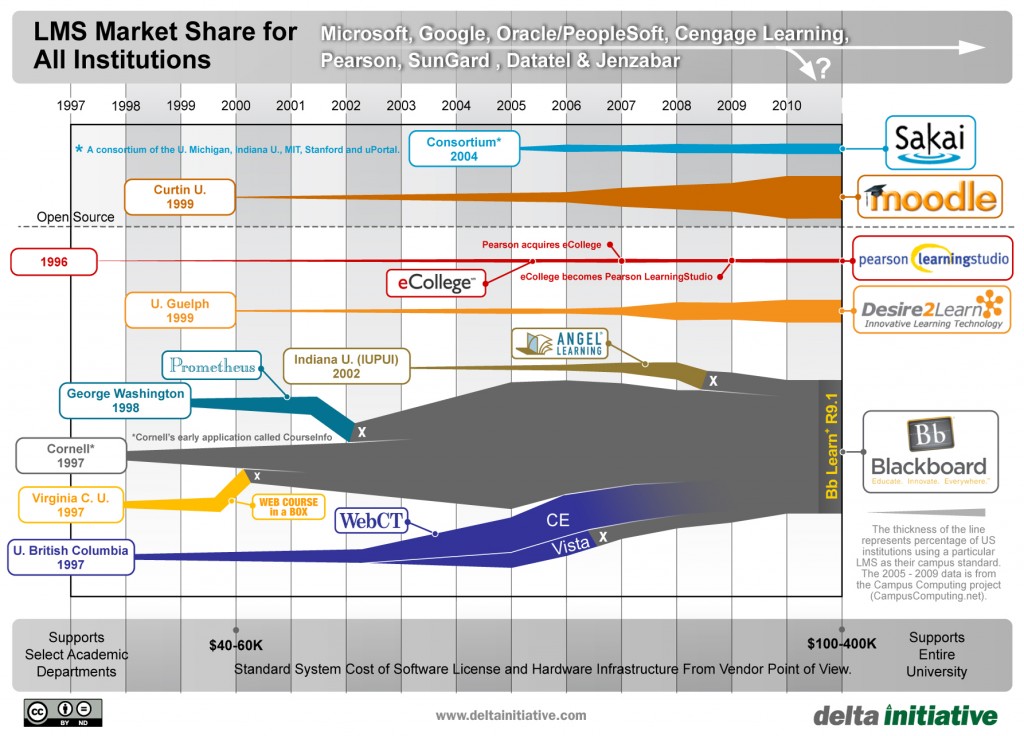
    I shared the most recent graphic summarizing the LMS market in September 2012, and thanks to new data sources it’s time for an update. As with all previous versions, the 2005 – 2009 data points are based on the Campus Computing Project, and therefore is based on US adoption from non-profit institutions. This set of longitudinal data provides an anchor for the summary.

    What I’ve been attempting to do lately is to expand the market definition beyond the US. Last year I used some heuristics:

    LMS_MarketShare_20121018-Home

    (more…)

  • The Death and Rebirth of Sakai OAE

    Last fall, when Indiana University, University of Michigan, UC Berkeley, and Charles Sturt University all pulled out of the Sakai OAE project, it looked like the end for the Sakai community’s next-generation platform effort. The vastly reduced project team, consisting mainly of Cambridge, Georgia Tech, and Marist College, went into quiet mode as they attempted to figure out what could be salvaged. Now, about nine months later, they have re-emerged with a late beta of a completely re-architected system, promising a 1.0 release in early July. They have also rebranded them project as Apereo OAE, named after the new organization that is the merger of the Sakai and Jasig Foundations, and signaling clearly that the project is not intended to be a successor to Sakai but instead is its own separate project with its own separate destiny.

    In retrospect, it turns out that the breakup of the grand coalition and resulting near-death experience may be the best thing that ever happened to the project.

    (more…)

  • State of the Higher Education LMS Market: A Graphical View

    The transformation of the higher education LMS market continues, and I expect more changes over the next 2 – 3 years. However, it seems time to capture the state of the market based on changes over the past year or two.

    I shared the most recent graphic summarizing the market in mid 2011. As with all previous versions, the 2005 – 2009 data points are based on the Campus Computing Project, and therefore is based on US adoption from non-profit institutions. This set of longitudinal data provides an anchor for the summary.

    The most significant changes over the past two years include the following.

    (more…)

  • Now UC Berkeley and Charles Sturt University Leave Sakai OAE

    Just three months ago, the University of Michigan and Indiana University made a joint decision to “pause investment” in the Sakai OAE project. The latest news is that the University of California Berkeley and Charles Sturt University (in Australia) have also decided to leave the Sakai OAE project. The only schools remaining as part of the Sakai OAE Steering Group are New York University, Cambridge University, and Georgia Tech.

    Ken Romeo from Stanford has an excellent post summarizing the Berkeley and Sturt announcement and resulting community discussions, based on his first-person experience in the early version of OAE. It is worth reading his entire post, but I’ll quote a few key sections.

    (more…)

  • Instructure Goes Open Source

    Update: The video was briefly broken as Instructure inexplicably chose the day after their big announcement to change their YouTube account. I have updated the post with the new URL and it should be working now. Note that anybody else who linked to Instructure’s videos before today is going to have the same problem. The new channel for Instructure’s videos is http://www.youtube.com/canvaslms.

    Instructure has just announced that they will be releasing an open source version of their Canvas LMS product. Between this announcement, the winning of the Utah Education Network contract (109,000 college students and 40,000 K12 students), and the oh-so-ever-brief lawsuit by Desire2Learn about that win, Instructure has been making quite a splash lately. In this post, I’m going to look a little more closely at the company, the software, and the business model.

    (more…)

  • Blackboard Contributing Code to Open Source Project

    According to Scott Rosenbaum, a business intelligence consultant, Blackboard has given him permission to contribute code back back to the Eclipse Business Intelligence and Reporting Tools (BIRT) project (or, more accurately, they are contributing the code as separate open source projects that can be “used by the community”). The project that generated this contribution is not entirely clear from Scott’s blog post, but I infer that it’s reporting tools that are used in the Blackboard product itself. So, it looks like (a) Blackboard may be incorporating open source code into their product, and (b) they are contributing some of the modifications they made to that code back under an open source license. (Any clarification on any of these points by Scott or by Blackboard is welcome.)

    Nice!