e-Literate

Present is Prologue

Tag: Pearson

  • Pearson’s Born-Digital Move and Frequency of Updates

    Pearson’s Born-Digital Move and Frequency of Updates

    There’s been a bit of an uproar over Pearson’s announcement that they are switching entirely to a digital-first model and will be updating their editions more frequently as a result. ((Full disclosure: Pearson is both a current sponsor of the Empirical Educator Project and a current consulting client.)) The prevailing take in the media write-ups so far has been fear of increasing prices. I’m not doing as much of that sort of analysis as I used to anymore. As usual, if you want a clear write-up of it, a good place to check is with PhilonEdTech. I do have a somewhat different take on the economics than the current hand-wringing would suggest and will use a graph from Phil’s post to make a brief point about it. The middle of this post will be about the difference between print and digital and how that drives different reasons for updating an “edition.” And the last part will be about drawing larger lessons from the tendency in ed tech to tell stories that are more based on past traumas than analysis of current situations.

    The horse is out of the barn on pricing

    Phil’s post contains this graph showing the publishers’ competition with other sources for textbook rentals:

    Graph of textbook rental distribution from PhilonEdTech, sourced from NACS

    The textbook publishers have a lot to gain by controlling the distribution channel for their products. If they can cut out Amazon and Chegg, then they can get a larger percentage of each sale. So they definitely have a lot to gain economically from this.

    But I don’t get the sense that any of the major publishers believe they can raise prices again. They all read the OER faculty attitude surveys very carefully. The prevailing sense in the industry is that, in addition to the strong price sensitivity and ingenuity that has existed among students for some time, there is now increasing price awareness and sensitivity among academics that is not going away. I don’t think this is about that.

    In fact, while there are immediate economic reasons for publishers to make this move—if remember correctly, McGraw Hill made the same move a while ago—there are also product-related reasons for doing so.

    Analog vs digital updates

    Many folks in the sector have a reflex reaction to the phrase “textbook edition” based on the old print tradition of updating a book every three years whether it needed updating or not. In some subjects, a three-year update is warranted. Programming languages change, for example. Linear algebra, on the other hand? Not so much. Textbook publishers gained a somewhat justified reputation for updating books every three years just to thwart the used book market. Which they then reinforced by raising prices every year, driving students to the used book market and giving publishers further incentives to update editions for purely economic reasons.

    That said, in the digital world, there are legitimate reasons for product updates that don’t exist with a print textbook. First, you can actually get good data about whether your content is working so that you can make non-arbitrary improvements. I’m not talking about the sort of fancy machine learning algorithms that seem to be making some folks nervous these days. I’m talking about basic psychometric assessment measures that have been used since before digital but are really hard to gather data on at scale for an analog textbook—how hard are my test questions, and are any of the distractors obviously wrong?—and page analytics on the level that’s not much more sophisticated that I use for this blog—is anybody even reading that lesson? Lumen Learning’s RISE framework is a good, easy-to-understand example of the level of analysis that can be used to continuously improve content in a ho-hum, non-creepy, completely uncontroversial way.

    (I stress this because there’s been an elevated level of concern about intrusive analytics among a segment of the e-Literate readership and I want to be clear that one can do quite a bit without coming anywhere near the touchy areas.)

    At the same time, unlike paper books, digital products have functionality, and there is always a continuous list of features that students and teachers want or need. Just keeping up with accessibility requirements is a never-ending job. Then, instructors in different subjects want different quiz question types. Or the ability to author those question types. Or different configurations on the number of tries that students can have for the questions. Or the number of hints they can have. Or integration with some discipline-specific tool that they like to use. Or a tool that the students like to use. It goes on and on and on.

    Are all of these updates good updates? That’s an impossible generalization to make. People who have no use for a software product category in the first place generally tend to think that the updates to a pointless product are pointless. So if you’re already cynical about courseware, you’ll probably be cynical about courseware functionality updates. If you find courseware useful, then your attitude will be closer to that of any other software user, which is to say that you’ll look at whether the particular update fits your need. Since functionality in courseware platform often is differentially useful across disciplines, chances are that you will like some updates a lot and find others completely uninteresting (or even a step backwards for your particular needs). If you are a builder of digital platforms that need to support a wide range of academic disciplines, as Pearson now is, you have a lot of surface area that you have to cover. Hence the need for frequent updates.

    Motivation

    Ed tech news cycles often feel like fighting the last war to me. We’re always building our Maginot Line. Some vendor does something, and everybody rushes to write the hand-wringing story about how this might be just like the last disaster. The last trauma. Nobody asks, “What’s changed since then?”

    Analogously to default story trope with the LMS vendors, the default story tropes about the publishers all come from past traumas about pricing and don’t take into account how the economics of the industry have changed completely in the last decade, or how going from print to digital changes what it even means to update an edition.

    Nor do these trauma stories take into account what is changeable. They are typically written as if vendors are implacable forces of nature or all-powerful multi-national corporations. Pearson, one of the largest companies in the sector, is just 2.5% the size of Exxon Mobil. Even assuming the worst regarding the intent of the company management, the industry could not have maintained such high price points if faculty had simply started to select books based on price. Vendors respond to the signals customers send about what matters to them.

    Faculty had the power to change the industry. Whether knowingly or not, they chose not to exercise it. They chose not to even ask about the price in the majority of cases for many, many years. This is not to let companies off the hook for their decisions but rather to say that when we choose to retell trauma stories without interrogating them, we may miss opportunities to choose to play roles other than victims. And if you are going to choose to have a relationship with a vendor, why wouldn’t you choose for that relationship to be something other than victim?

    Five years ago, I wrote a post about how people who complained bitterly about how unhappy they were with their LMS vendors tended to ignore the procurement practices of their colleagues and their institution that all but guaranteed their dissatisfaction. That post was called Dammit, the LMS. It received quite a bit of attention. Even people who hated it admitted to me that they thought it was correct.

    Sadly, not much has changed since then.
  • Top Hat’s OER Announcement: Doubling down on faculty engagement

    Top Hat’s OER Announcement: Doubling down on faculty engagement

    Several months ago I wrote a post looking at the Top Hat’s push into digital curricular materials through their Textbook product and Marketplace for digital course content. Leading up to that post, I had been planning to cover the Open Educational Resources (OER) angle, as the Marketplace included a number of openly-licensed material, much of it from OpenStax, and Top Hat had already begun marketing itself as an OER provider. At the time, the OER strategy seemed a work in progress. In fact, I found that some of my questions for company staff about OER basics – the role of Creative Commons licenses, community dynamics exhibited at the OpenEd conference, etc – led to a lack of answers, and at the time there was no export capability to get OER out of the platform.

    To Fee or Not to Fee

    The situation has changed since January, and with last month’s announcement of Top Hat’s Open Content Initiative the company is taking a stand on whether it is appropriate to charge for platform access. The idea of hosting and modifying OER on a fee-based platform became a big topic last year. Lumen Learning pioneered the Red Hat type model in 2014, and last year there was a big movement with Cengage, Knewton, OpenStax, Macmillan, and Top Hat all offering OER within their platforms. In many cases, the OER content itself has been redesigned from traditional textbook-in-PDF format to learning objective-driven content with aligned assessments. ((Disclosure: Lumen is a client of MindWires, and I recently gave a paid keynote at a Top Hat user’s conference.))

    Top Hat has now removed the student platform fees and added an export-to-epub feature. As evidenced in a company blog post by CEO Mike Silagadze, they are not shy about it either.

    At Top Hat, we’ve been working on making education more effective and affordable since 2009. Now, we’re happy to make a move that delivers on both fronts. Beginning April 12, with the launch of our Open Content Initiative, we’re offering completely free access to thousands of textbooks and other Open Educational Resources (OER)—freely accessible and openly licensed learning materials—on the Top Hat Marketplace.

    It’s about time. Students have been forced to weigh the pros and cons of emptying their wallets and draining their financial aid to buy textbooks for far too long. [snip] Just as bad, digital publishing platforms and e-readers have been charging a toll to students—disguised as a platform fee—to access free, openly licensed OER.

    Enough is enough.

    I asked Silagadze about a point I noted when describing Cengage’s OpenNow product:

    For each course [VP of Content Strategy] Constantini estimates that the modifications take $50k – $100k of internal work, including verifying of licenses for embedded elements. I would note a certain irony here in that OpenStax produces more-or-less traditional digital textbooks requiring publishers or OER services companies like Lumen to break apart and realign to competencies or outcomes.

    Silagadze brushed off this description and stated that the modifications made by other providers were far smaller and easier to make than is being claimed. We now have a third variation in the OER market, with the provision of wrap-around platform and a clear argument that these platforms not only will be free on Top Hat, but that they should be free as a matter of principle.

    • Free content, not dependent on specific platform
    • Free and modified content, available on a paid platform, content available for export
    • Free and lightly modified content, available on a free platform, content available for export

    While this is a marketing position by one of the competitors in a new field, this move by Top Hat is a further sign of the OER movement breaking into different branches. From our perspective, the fractures in the OER community have been widening for the past several years, but to a degree this is a sign of success. Openly-licensed content usage is becoming more and more common in education, and even traditional publishers mostly accept the value of OER.

    Faculty Engagement

    Perhaps more significantly, at least in terms of understanding Top Hat as a company, is that the OER initiative doubles down on their bet on faculty engagement. A well-known issue with OER (and even with non-open content) is that few faculty end up taking advantage when given the ability to modify the course materials in any significant manner. In theory many people talk about open pedagogy in terms of faculty modification and collaboration on content, but in practice this rarely happens. Top Hat’s view is that the barrier has been flat content and cumbersome platforms, as best described in an eLearning Inside interview.

    “We think the promise of OER has fallen down,” said Nina Bilimoria Angelo, VP of product and customer marketing at Top Hat. The Toronto-based company has created a platform to house, customize, and share OER and other educational resources. It has been used by over 2.8 million students to date.

    “The promise was there’s a community that continues to build on open materials,” Angelo said. “But when those materials are trapped behind static PDFs, and then people are making changes to it on their own without a mechanism to share it back, that’s where things fall flat. We really wanted to create a system where things can be improved in real time, not over a 3 or 4 year cycle like with traditional publishers.”

    “Discoverability is a challenge with OER,” Angelo said. “Quality can be perceived as uneven which is probably why OER adoption has stalled at the 5-10% level for instructors. There’s a lot of skepticism amongst higher educators. We’re trying to make sure all the high quality material is available in the Marketplace. Once it’s adopted, it’s really customizable. But then those customizations – this is the magic – those customizations can be shared back with the author and the team so that they can improve upon what they’ve created.”

    This is the best way to interpret Top Hat’s OER move, in my opinion, and you can see more details in my January post about the Marketplace to better understand the customization and sharing capabilities of the platform.

    According to an internal Top Hat survey of users, 89% of adopters make changes to digital textbooks that they adopt, with 22% reporting “lots of customization”. If this internal data is representative, there may be some indicators that faculty can be more involved in modifying and sharing content. Top Hat is betting on faculty engaging with content, modifying it, sharing it, updating it. And they are betting that this model will drive faculty adoption decisions.

    There are a lot of unknowns about faculty adoption and modification of OER content through the Top Hat Open Content Initiative, but it is clear that the company is positioning itself differently than other providers. The transformation of digital curricular materials continues.

  • Top Hat Marketplace: What is it and should we care?

    Top Hat Marketplace: What is it and should we care?

    When Top Hat announced their latest round of financing a year ago ($22.5m), I admit to having been skeptical, or more accurately cynical, about their stated purpose. The company was primarily known for its mobile and laptop-based classroom response system, but now it is claiming to be a digital content company.

    Top Hat, the Canadian education technology startup, completed a new round of funding to give it more firepower to go after textbook publishers like Pearson Plc. [snip]

    Top Hat is one of a handful of startups trying to find ways to disrupt the traditional textbook publishing industry, dominated by companies like Pearson, Cengage Learning Inc. and McGraw-Hill Education Inc., which is owned by Apollo Global Management LLC. All of these firms have added digital educational materials to their range of products, but the transition has been rocky.

    Then in the summer the company announced their new Marketplace.

    The Top Hat Marketplace answers the urgent need of professors and instructors to easily find and create educational content that is interactive, easily customizable and much more affordable for students than conventional textbooks. The educational content in the Top Hat Marketplace breaks the slow-paced publishing model by allowing educators to provide one another instant feedback. This collaborative community-sourced model means that the Marketplace’s content is continually being updated and improved upon.

    We at e-Literate have been covering the long-running and messy transition to digital curricular materials, including the search for new business models for content companies. But the announcements from Top Hat, to me at least, had the feel of a company pivot leveraging big, bad publishers as the bait for naive investors. Quite often it feels like the official greeting of ed tech entrepreneurs has either been “we’re going to beat Pearson” or “we’re going to beat Blackboard”. Top Hat and its products do not neatly fit into typical categories, but this may mean that we’re seeing a new model emerge, or at least a modernized and serious attempt to establish the self-publishing model.

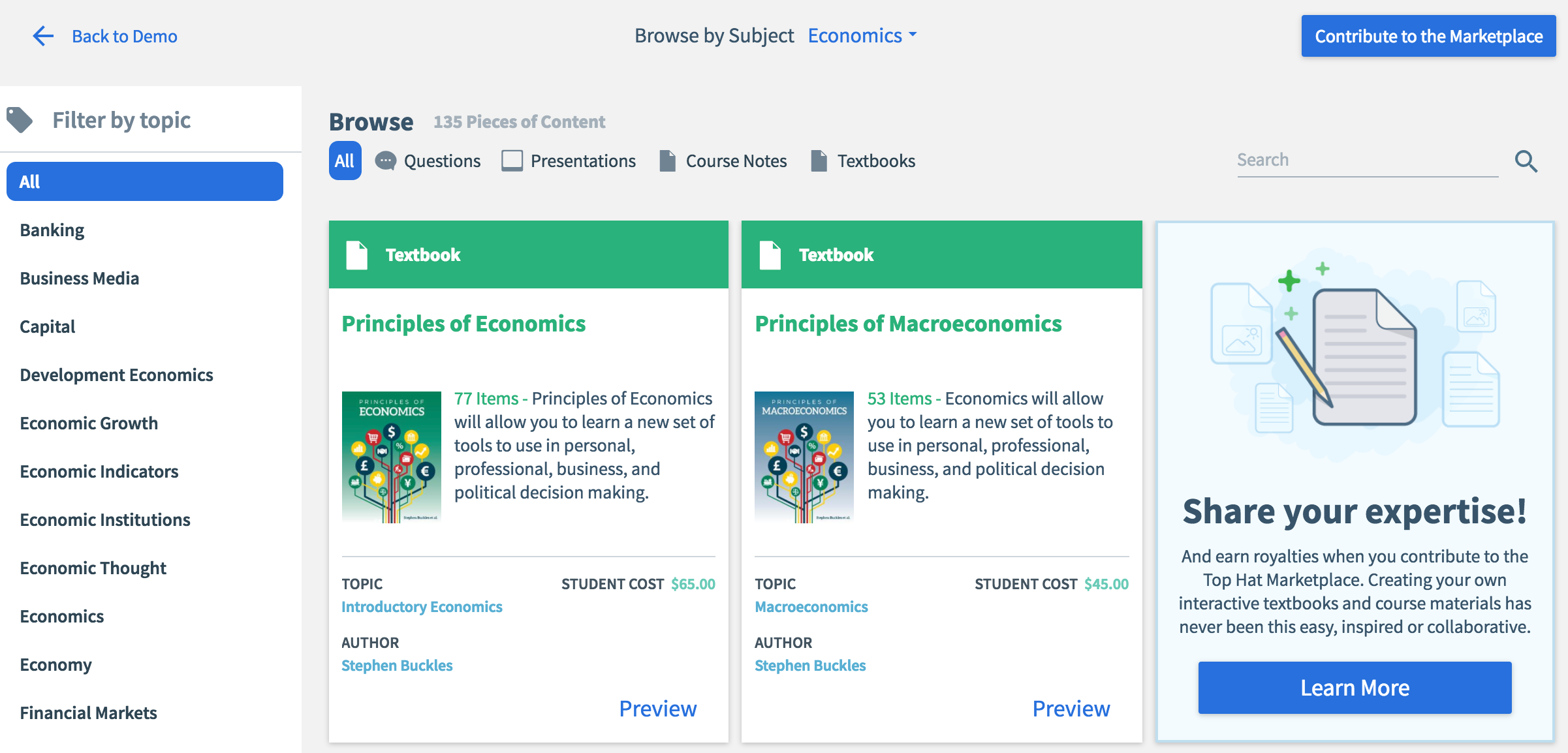
    The Marketplace provides a series of textbooks and ancillary material, (course notes, question packs, presentations, etc) that instructors can browse, adopt, modify, and share with students either as mandatory or recommended resources. Students pay fees between $0 and roughly $65 for the materials. A spokesperson for Top Hat clarified a recent change:

    As we’ve already discussed, 90% of the content in the Top Hat Marketplace is free for instructors and students to use. However, by the end of January, students no longer need to use the Top Hat engagement app to access this content—meaning, students will no longer need to pay the per-term app fee to use free textbooks and content.

    Other than reasonably low prices, nothing noteworthy so far. What is unique is that there are two primary sources for the content – self-publishing by instructors and open education resources (OER) from OpenStax. As described in the press release this summer:

    “We leveraged our existing relationship with educators already using our classroom engagement tools to test and launch the Marketplace,” said Mike Silagadze, co-Founder and CEO of Top Hat. “The Marketplace finally puts educators — the people at the forefront of learning — in charge of their course materials.

    Screen shot of economics materials

    The Marketplace has been designed as a self-publishing platform for educators designed around collaboration tools called Textbook. I interviewed Demian Hommel, senior instructor of geography at Oregon State University, and his experience helps explain the path that Top Hat is taking from classroom response systems to content marketplace. Hommel is an “an advocate for place-based and experiential education, service learning, and research-informed teaching” and has used the classroom response system for several terms. In the meantime, he has wanted to create a geography textbook but did not want to go through the traditional publishers. Since he already knew of Top Hat, when they announced Textbook and the Marketplace Hommel decided that he wanted to go with the self-publishing route.

    Hommel’s interest in publishing models does not seem to be driven by financial considerations, at least for himself, as he said he is not sure how well Top Hat will be able to scale usage of the Marketplace. One big driver for self-publishing was the interest in keeping the textbook current in a changing world of geography. Hommel views the Marketplace as providing a convenient platform enabling active learning techniques and the ability to control and update his textbook over time.

    There is another differentiator in how Top Hat provides content – the remarkably easy method to enable instructors to modify content, whether in the authoring process or as customizations to content that instructors choose to adopt. Basically, if you can author a post in Medium, you could create and modify content in the Top Hat platform.

    Consider Hommel’s Geography textbook. Here I have added the book to my course and hit edit in one section. By placing the cursor between text and an interactive text discussion prompt, then choosing the pop-up “Add” icon, I get the choice to add any of the following elements:

    Editing a textbook

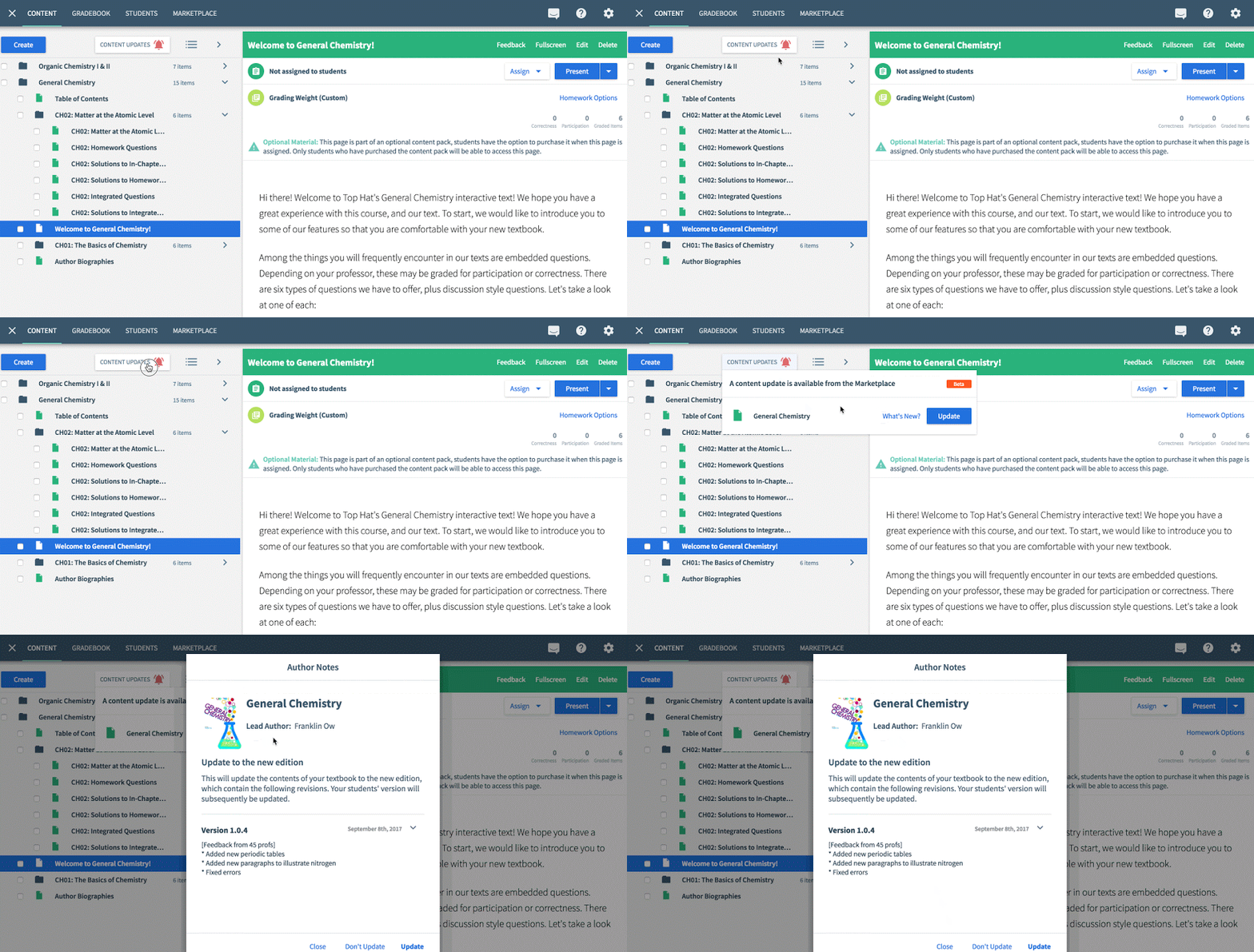
    This is the same interface as originally used to author the textbook. Beyond the ease of editing (customizing for my class, adding my content) is the apparent ease of accepting updates from the content author, based on a new feature introduced in a limited trial in September. The instructor sees a notification about updated content, reviews the updates, and (if all works out) decides whether to update while maintaining any customizations made by instructor.

    Method to accept revisions

    The functionality also promises to allow an instructor to review and adopt  customizations made by others who are working on the same base content.

    This is not an easy problem to solve, but if Top Hat is able to resolve how to deal with conflicting updates and local customizations, the intuitive user experience could change how faculty members and course designers collaborate and update content.

    Top Hat does have some real challenges in establishing themselves as a full-fledged content provider. One was mentioned by Hommel, when he pointed out the lack of broad awareness of the Marketplace amongst faculty even at his university. Top Hat is known for its classroom response and presentation systems, and with the Marketplace acting as a two-sided market, it needs sufficient supply of self-publishing content and sufficient numbers of adopting instructors.

    CEO Mike Silagadze response when I asked him about the adoption challenge is that the Classroom adoption, which they claim to be used “at 75% of North America’s leading colleges and universities and reaches millions of students”, has established Top Hat’s direct relationship with thousands of faculty members. In this way, they are betting that Demian Hommel is a model – aware of company through Classroom, interested in textbook usage based on self-publishing model, and willing to extend their personal usage of the company’s products.

    One other challenge is that it is not a done deal that self-publishing has sufficient demand on the content creation side. Are there enough instructors in a broad array of disciplines who want to invest the time and effort to create textbooks without a clear model of possible financial reward? This is the bet that Top Hat is making, that the market can grow to the point that there are reasonable clear answers on financial rewards. And there is the hope that there are enough Demian Hommels who are willing to make these commitments without financial drivers.

    I do not know if this product will take off, but if it does the Marketplace would establish a viable self-publishing model for faculty willing to work within the Top Hat platform. Over the past year in particular, the landscape of digital curricular materials is adding new models, and the Marketplace is worth watching.

    There is also an OER angle based on Top Hat’s marketing and the OpenStax partnership, which I’ll describe further in another post.

    Update 1/8: Corrected timing on change to student access and fees.

  • State of Higher Ed LMS Market for US and Canada: Spring 2017 Edition

    State of Higher Ed LMS Market for US and Canada: Spring 2017 Edition

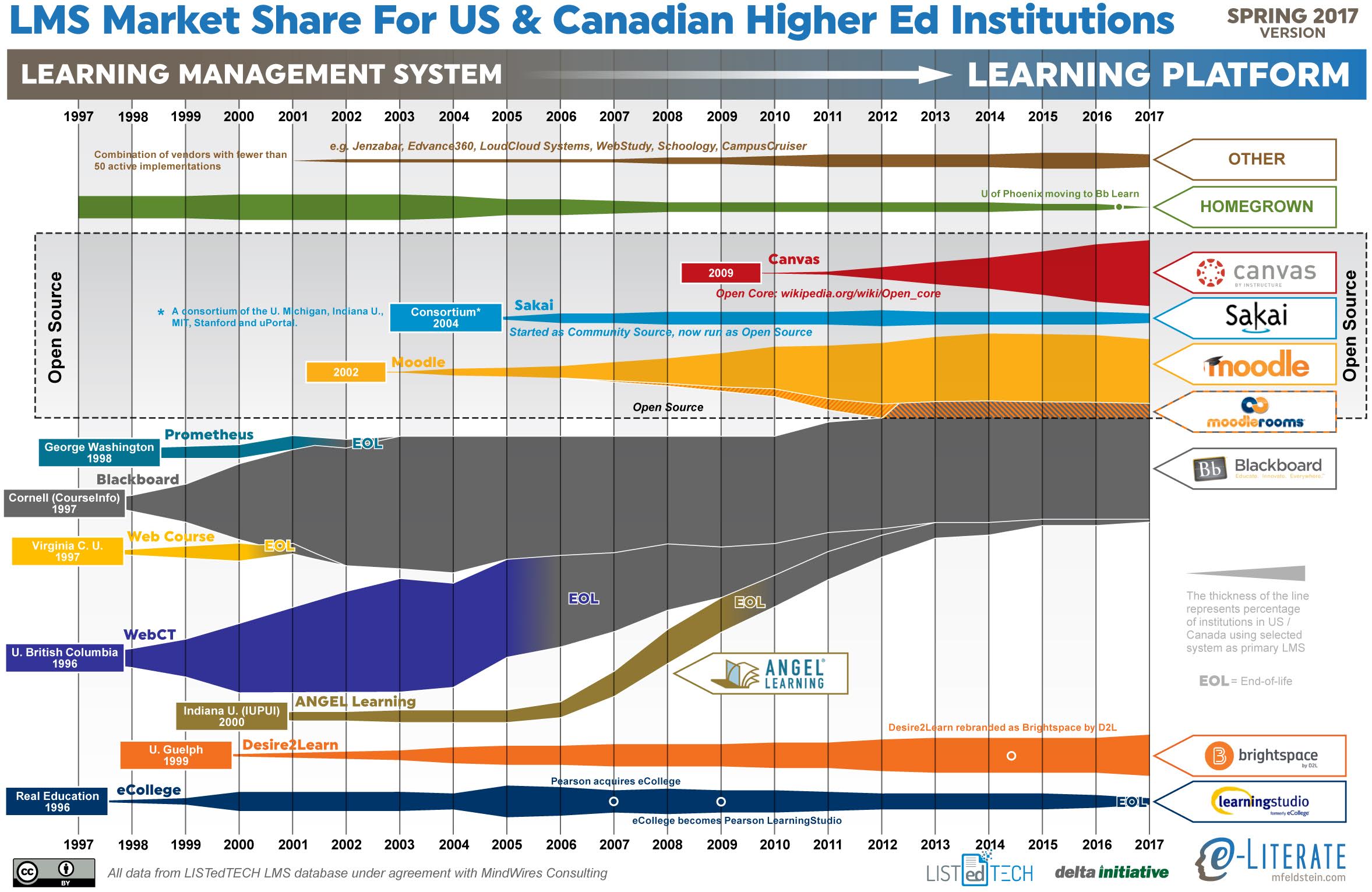
    This is the ninth year I have shared the LMS market share graphic, commonly known as the squid graphic, for US and Canadian higher education. The original idea remains – to give a picture of the LMS market in one page, highlighting the story of the market over time. The key to the graphic is that the width of each band represents the percentage of institutions using a particular LMS as its primary system.

    Last year we made a big shift based on our LMS market analysis service – we are working with LISTedTECH to provide market data and visualizations. This data source provides historical and current measures of institutional adoptions, allowing new insights into how the market has worked and current trends. Our spring report for subscribers will be released this month. Data for 2017 goes through April 1 of this year.

    (more…)

  • Pearson Releases a Significant Learning Design Aid

    Last week, Pearson announced the release of some resources they have created around science-based learning design. (Full disclosure: Pearson is a client of our consulting company, although we have not consulted with them on the subject of this post.) The resources in the release include the following:

    • A 102-page rubric the company has started using for evaulating curricular products based on their effective use of learning design principles—released under a Creative Commons license
    • A white paper describing how they are beginning to apply these principles to their own product designs
    • A few links to descriptions of early examples of these principles as they have been applied in released products.
    • A blog post providing some more background and perspective by David Porcaro, Pearson’s Director of Learning Design, whose team is behind this effort.

    In the short term, you should think of this publication as the company’s effort to “show their work,” in the classroom sense of that phrase. They want you to know more about the process they go through to incorporate research-backed learning design principles into their products. They hope that doing so will increase your confidence in the value of those products. In the medium term, they also aspire to make the framework they are developing for themselves also a useful tool for the academic community, particularly as the company refines and expands on this early release of the materials.

    In my view, the work itself is a significant contribution. It also is a positive indicator about Pearson’s future direction as a participant in and influencer of that community, although how strong an indicator is a much harder question to evaluate. And it gives us another clue about the co-evolution of educational institutions and ed tech vendors that we are likely to see over the next years and decades. In this post, I’m going to evaluate each of these aspects in turn.

    (more…)

  • Update: LMS Usage In Large Online Programs (Top 50 in US)

    By: Phil Hill and Justin Menard. Cross-posted at LISTedTECH

    Three and a half years ago Phil wrote a post “Snapshot of LMS Market for Large Online Programs in the US” giving a view into this growing segment of higher education.  Large online enrollment institutions typically mean a centrally-coordinated provision of online courses, often with duplicate course sections, and these programs tend to use more of the LMS than ad hoc online courses or blended courses. Further, these programs are dynamic – they are far more likely to grow significantly or shrink significantly than face-to-face or blended programs. As such, this segment can have different usage patterns than the broader market. Thanks to the partnership between e-Literate and LISTedTECH for our LMS subscription service, we have a much richer data set now. One of our subscribers asked a question over the weekend about this subject, so it seemed time to update this view.

    What we are showing below are the 50 institutions with the greatest number of students taking at least one online class based on the IPEDS database, for graduate and undergraduate combined. The most recent enrollment data set was for Fall 2014, so the enrollment data is slightly out of date. But the LMS listings should be up-to-date. In fact, we are showing some leading data, such as the University of Phoenix usage of Blackboard Learn and Kaplan University usage of D2L Brightspace – neither school has fully transitioned to the new LMS, but they have made official decisions and begun deployment. We have grouped the schools by sector, as well. (more…)

  • About That Cengage OER Survey

    Last month Cengage Learning released a white paper titled “Open Educational Resources (OER) and the Evolving Higher Education Landscape” where the headline called out expected increases in OER adoption:

    Open Educational Resources (OER) in higher education have the potential to triple in use as primary courseware over the next five years, from 4 percent to 12 percent, according to a survey of more than 500 faculty by Cengage Learning. In addition, the use of OER for supplemental learning materials may nearly quadruple in size, from 5 percent to 19 percent.

    The 4 percent adoption of OER as primary courseware aligns with the Babson Survey Research Group (BSRG) finding of 5.3% using open textbooks (yes, we’re assuming the terms are interchangeable at least for the survey results). But the expectation that OER adoption may triple for primary usage and quadruple for supplemental is new. The BSRG did not estimate market growth – they just identified perceptions and barriers.

    There were enough causes for skepticism, however, that prevented me from taking the report at face value. A traditional textbook publisher touting OER growth while offering little data or methodology to back up their claims. The tendency for  some OER advocates to run with half-baked numbers. The question of open-washing and associated risk of redefining OER.

    I contacted Cengage and spoke to Cheryl Costantini, VP of Content Strategy to learn more about the study. Unfortunately, the deeper I dug the more credence I give to the results (unfortunate in terms of attention-grabbing blog post headlines). Long and short – the report seems like solid information despite a few flaws and need for broader sample size. (more…)