
e-Literate

Present is Prologue

Tag: Pearson

  • Changes at D2L: A second-hand view from users conference

    As I have described to several executives at D2L, there is an interesting gap between the progress we have seen with the company’s product improvements and the reaction we hear from many of their customers. With the tighter integration with LeaP and the improved usability, particularly in content authoring, I would have expected to hear more customers react to the changes. But when talking directly to many of the institutions using the Brightspace LMS, staff describe D2L as if the company and product line had not changed in several years. What is not clear is whether this gap is due the company missing the mark (and my judgement of improvements not aligning with what colleges and universities want) or whether there is just a lag where it will take time for most customers to believe in and take advantage the new product designs and features.

    2016 has been an eventful year for D2L. COO Cheryl Ainoa, a longtime veteran of Yahoo! and most recently Intuit, joined the company in April. Although this move was not advertised through press releases or even blog posts, I believe this is a significant change to how the company operates. This is not the first time that D2L has reached outside the industry for a top executive, as they employed Dennis Kavelman from RIM / Blackberry as COO from 2012 – 2014 (the period where D2L raised $165 million in two mammoth funding rounds). But I have heard that the addition of Ainoa has already seen results internally. And in the ‘keeping work in perspective’ category, founder and CEO John Baker and his wife had their first child right before the Fusion Users Conference. (more…)
  • MarketsandMarkets: Getting the LMS market wrong

    New LMS market analysis with a leader list that includes a company that is retiring its LMS and ignores the company who has a 5x lead in new implementations for its core market? Sign me up.

    Over the next week or two, we plan several posts at e-Literate based on the various LMS users conferences we recently attended. We already covered Sakai and Blackboard, and we will have commentary on Moodle, Schoology, D2L, and Canvas soon. But before we do so, I wanted to call out the recent analysis by MarketsandMarkets, which requires some commentary as it is leading to some media coverage that could misinform those trying to understand the LMS market. The headline of their recent market report:

    Learning Management System (LMS) Market Worth 15.72 Billion USD by 2021

    According to a new market research report, “Learning Management System Market by Application, Delivery Mode (Distance Learning and Instructor-Led Training), Deployment (On-Premises and Cloud), User Type (Academic and Corporate), Vertical, and Region – Global Forecast to 2021”, published by MarketsandMarkets, the LMS market size is expected to grow from USD 5.22 Billion in 2016 to USD 15.72 Billion by 2021, at a CAGR of 24.7%.

    (more…)

  • New OER Survey: The disconnect between faculty caring and assigning

    In 2012 the Babson Survey Research Group (BSRG) put out a new report on usage and perceptions of open educational resources (OER) usage in higher education. Covered in this blog post, the 2012 report was really a combination of three separate surveys of academic leaders and faculty. In 2014 BSRG put out a new survey of faculty relating to OER, covered in this post, that I considered a significant milestone by providing actual data from a dedicated national survey to back up and clarify what many had assumed regarding OER. That report, however, was a one-off report, but the Hewlett Foundation and Pearson subsequently agreed to fund three annual longitudinal studies starting with the 2016 report released today. Per the press release:

    Key findings from the report include:

    • Faculty awareness of OER has increased, with 25% of faculty reporting that they were “Aware” or “Very Aware” of open educational resources, up from 20% last year.
    • Only 5.3% of courses are using open textbooks (includes public domain and Creative Commons licensed).
    • Large enrollment introductory undergraduate courses have adopted openly licensed OpenStax College textbooks at twice the rate (10%) as openly licensed textbooks among all courses.
    • The most common factor cited by faculty when selecting educational resources was the cost to the students. After cost, the next most common was the comprehensiveness of the resource, followed by how easy it was to find.
    • There is a serious disconnect between how many faculty consider a factor in selecting educational resources and how satisfied they are with the state of that factor. Faculty are least satisfied with the cost of textbooks, yet that is the most commonly listed factor for why they select resources.
    • The barriers to adopting OER most often cited by faculty are that “there are not enough resources for my subject” (49%), it is “too hard to find what I need” (48%) and “there is no comprehensive catalog of resources” (45%).

    Both Inside Higher Ed and the Chronicle of Higher Education covered this release and included additional interviews with co-author Jeff Seaman. (more…)

  • State of Higher Ed LMS Market for US and Canada: Spring 2016 Edition

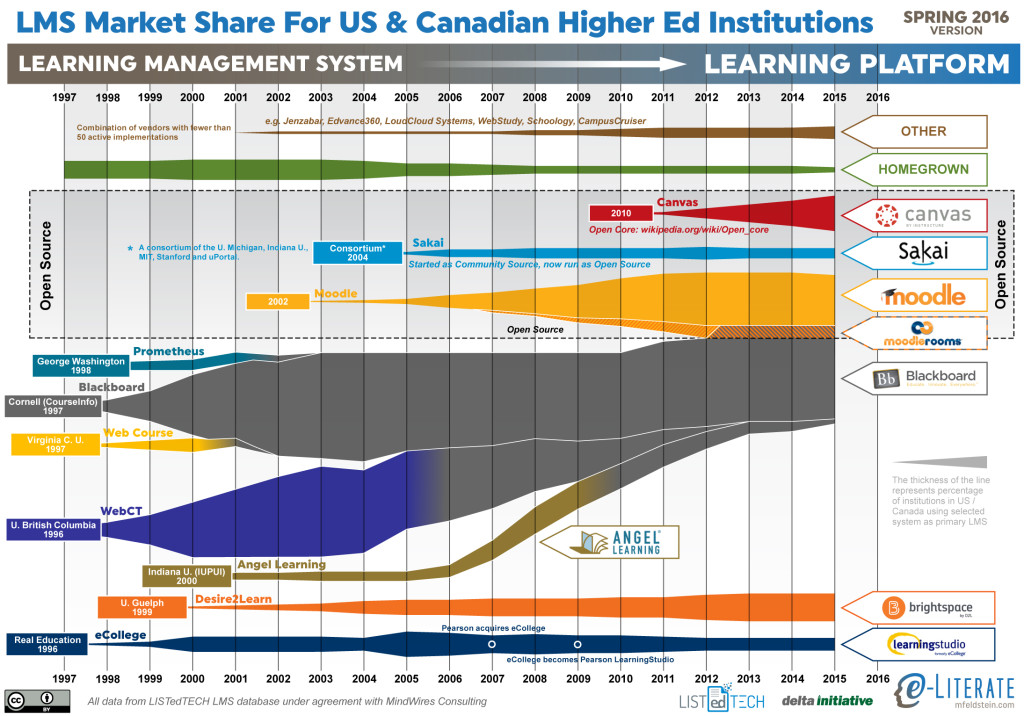
    This is the eighth year I have shared the LMS market share graphic, commonly known as the squid graphic, for (mostly) US higher education. The original idea remains – to give a picture of the LMS market in one page, highlighting the story of the market over time. The key to the graphic is that the width of each band represents the percentage of institutions using a particular LMS as its primary system.

    This year marks a significant change based on our upcoming LMS subscription service. We are working with LISTedTECH to provide market data and visualizations. This data source provides historical and current measures of institutional adoptions, allowing new insights into how the market has worked and current trends. This current graphic gets all of its data from LISTedTECH. Where previous versions of the graphic used an anchoring technique, combining data from different sources in different years, with interpolation where the data was unavailable. Now, every year’s data is based on this single data source.

    This graphic has been in the public domain for years, however, and we think it best to keep it that way. In this way we hope that the new service will provide valuable insight for subscribers but also improve what we continue to share here on the e-Literate blog.

    Since we have data over time now and not just snapshots, we have picked the end of each year for that data. For this reason, the data goes through the end of 2015. We have 2016 data but chose not to share partial-year results in an effort to avoid confusion.

    LMS_MarketShare_20160316

    A few items to note:

    • As noted in previous years, the fastest-growing LMS is Canvas. There is no other solution close in terms of matching the Canvas growth.
    • Blackboard continues to lose market share, although the vast majority of that reduction over the past two years has been from customers leaving ANGEL. Blackboard Learn lost only a handful of clients in the past year.
    • While the end-of-life occurs next year, Pearson’s has announced LearningStudio’s end-of-life for the end of 2017.
    • With the new data set, the rapid rise and market strength of WebCT becomes much more apparent than previous graphics.
    • There is a growing line for “Other”, capturing the growth of those systems with less than 50 active implementations as primary systems; systems like Jenzabar, Edvance360, LoudCloud Systems, WebStudy, Schoology, and CampusCruiser.
    • While we continue to show Canvas in the Open Source area, we have noted a more precise description as an Open Core model.

    For a better description of the upcoming LMS subscription service, read this post and / or sign up for more information here.

  • LearningStudio and OpenClass End-Of-Life: Pearson is getting out of LMS market

    Pearson has notified customers that LearningStudio will be shut down as a standalone LMS over the next 2-3 years. Created from the Pearson acquisition of both eCollege and Fronter, LearningStudio has been targeted primarily at fully-online programs and associated hybrid programs – not for simple augmentation of face-to-face classes. The customer base has mostly included for-profit institutions as well as not-for-profit programs that are often packaged with an online service prover model (e.g. Embanet customers). As of this year, LearningStudio has approximately 110 customers with 1.2 million unique student enrollments.

    This decision is not one isolated to LearningStudio, as the end-of-life notification caps a series of moves by Pearson to get out of the LMS market in general. (more…)

  • The Massive Decline In Larger Education Company Market Caps

    After our coverage of Blackboard’s CEO change last week, we were both interviewed by the Washington Business Journal, with the following lede:

    Analysts and sources I spoke with Monday, both on and off the record, said the decision to bring on Bill Ballhaus as CEO was a combination of Bhatt failing to make progress building the company’s business and lacking the experience needed to successfully run a company of that scale. And that means at least several years before Providence Equity Partners, which owns a majority of the company after paying $1.64 billion for it in July 2011, begins actively marketing the company for sale, according to industry experts.

    Earlier this week I wrote about Apollo Education Group, parent of the University of Phoenix, putting itself up for sale due to its weakening financial position. I also noted that I doubt that McGraw-Hill Education is going to be able to go public in the near-term. Part of the reason for this latter observation is the dramatic fall of Pearson in the stock market, triggered by its warnings that it would miss earnings estimates. In Audrey’s excellent year-end post on the business of ed tech, she noted:

    Private equity firms sure love buying ed-tech companies. Perhaps because the stock market’s sorta “meh” about them.

    (more…)

  • New Visual From LISTedTECH Shows LMS Market By New Implementations

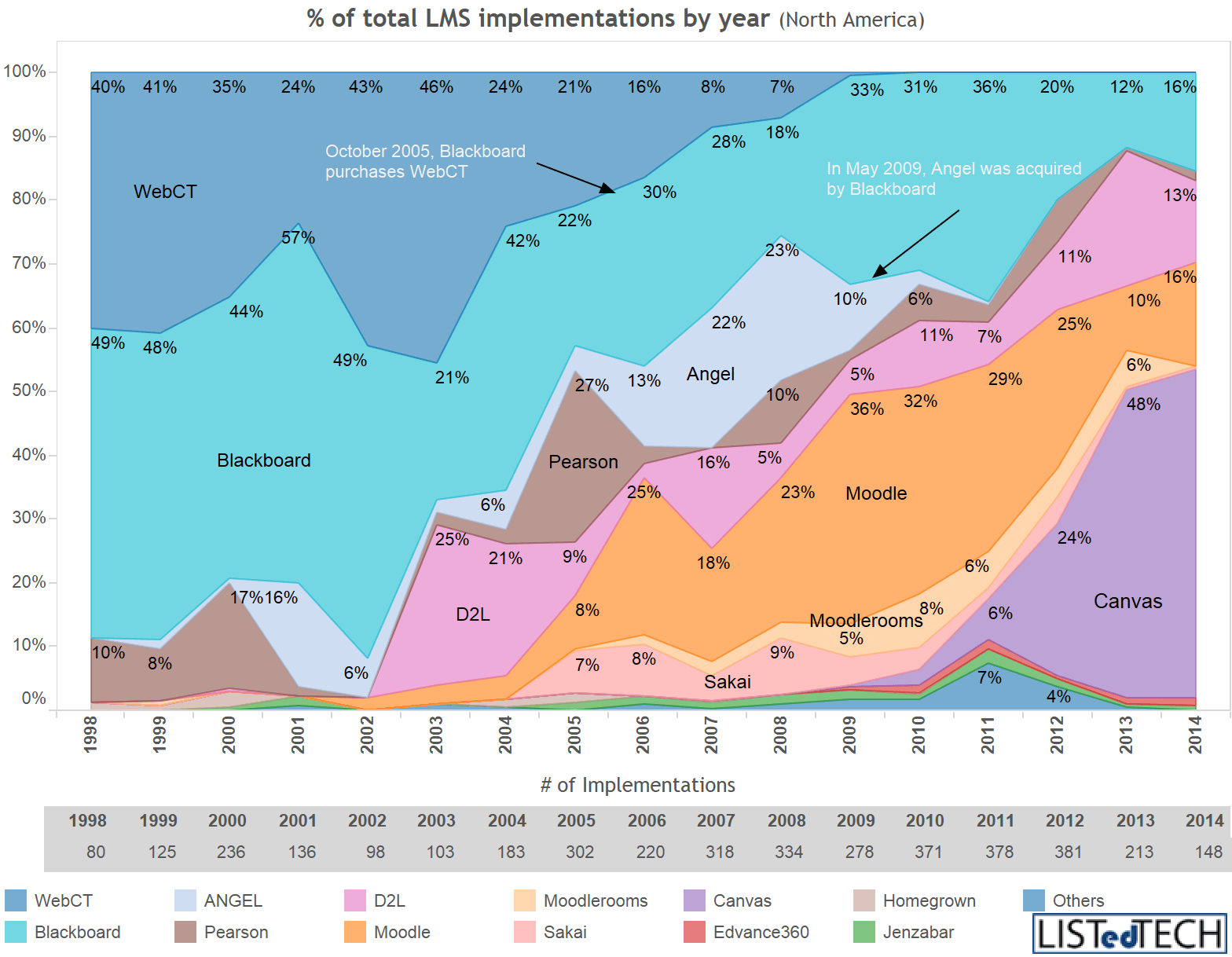
    Justin Menard and his team at ListEdTech have produced a great new visual on the LMS market in North America. Using his wiki-based data with 4,000+ institutions, he shows the percentage of LMS implementations per year (scaled to 100% for each year). While we are used to seeing LMS market share in terms of number or percentage of institutions using each LMS as primary system, this view highlights the dynamics of the market – which systems are getting adopted. See original post for full chart and additional description.

    LMS-Providers-Market-Share-by-Year1

    A few notes: (more…)