
e-Literate

Present is Prologue

Tag: UCLA

  • Mobile-first learning platform EmpoweredU acquired by Qualcomm

    Qualcomm, the giant $26 billion wireless technology conglomerate, acquired EmpoweredU – a mobile-first learning platform available for the education market. What does this acquisition mean?

    Who is EmpoweredU?

    The company was created by CEO Steve Poizner in 2011 in partnership with Creative Artists Agency, the world’s largest sports and talent agency, under the name “Encore Career Institute”. The initial work was to offer continuing ed classes targeted at Baby Boomers through the UCLA extension.  ((These are certificate programs for $5,000 – $10,000 total tuition.))  In essence, this was an Online Service Provider (OSP) model similar to Embanet, Deltak, Academic Partnerships and 2U. As described by the San Francisco Chronicle in 2011:

    Poizner, in an interview at the firm’s headquarters this week, said the company combines “three of California’s greatest assets” – its famed public university system, the creative know-how of its technology center, Silicon Valley, and the cutting-edge marketing savvy of Hollywood. [snip]

    In addition to its employment potential for Baby Boomers, Poizner said, the collaboration could bring new revenue for cash-strapped UCLA and thousands of new students from around the nation to its online courses.

    The company changed names to Empowered Careers and then eventually settled on EmpoweredU.

    In the meantime they figured out that the OSP model is high risk and expensive, often requiring investments of $1 – $10 million per program by the OSP, with revenue-sharing profits occurring several years later. EmpoweredU has pivoted over the past year to become a mobile-first learning platform with content services.

    The platform is built on top of the Canvas open source version offered by Instructure and started pilots at 15+ schools this spring (including specific programs at USC, UC Berkeley, U of San Francisco, etc). This may be the most significant use of open source Canvas, and it might end up competing with Canvas, at least indirectly.

    As we’ll see later, EmpoweredU is also attempting to create a learning ecosystem that can combine multiple technologies.

    Why is Qualcomm making an ed tech acquisition?

    I interviewed Vicki Mealer (Senior Director, Business Development, Qualcomm Labs, which is the unit acquiring EmpoweredU) and Steve Poizner today. Vicki’s description of Qualcomm’s interest in ed tech is that they are all about mobile technology, and they have had a philanthropic interest in education for years (donating over $240 million cash to various institutions).  Qualcomm wants to be a behind-the-scenes cheerleader, but they also need an ecosystem for each market. Qualcomm Labs started looking at education a year ago, trying to identify and overcome barriers for adoption of mobile technology. Some of the perceived barriers: (more…)
  • A response to Bloomberg article on UCLA student fees

    Megan McArdle has an article that was published in Bloomberg this week about the growth of student fees. The setup of the article was based on a new “$4 student fee to pay for better concerts”.

    To solve this problem, UCLA is introducing a $4 student fee to pay for better concerts. That illuminates a budgeting issue in higher education — and indeed among human beings more generally.

    That $4 is not a large fee. Even the poorest student can probably afford it. On the other hand, collectively, UCLA’s student fees are significant: more than $3,500, or about a quarter of the mandatory cost of attending UCLA for a year.

    Those fees are made up of many items, each trivial individually. Only collectively do they become a major source of costs for students and their families and potentially a barrier to college access for students who don’t have an extra $3,500 lying around.

    I’m sympathetic to the argument that college often costs too much and that institutions can play revenue games to avoid the appearance of raising tuition. I also think that Megan is one of the better national journalists on the topic of the higher education finances.

    UCLA Fees

    However, this article is somewhat sloppy in a way that harms the overall message. I would like to clarify the student fees data to help show the broader point.

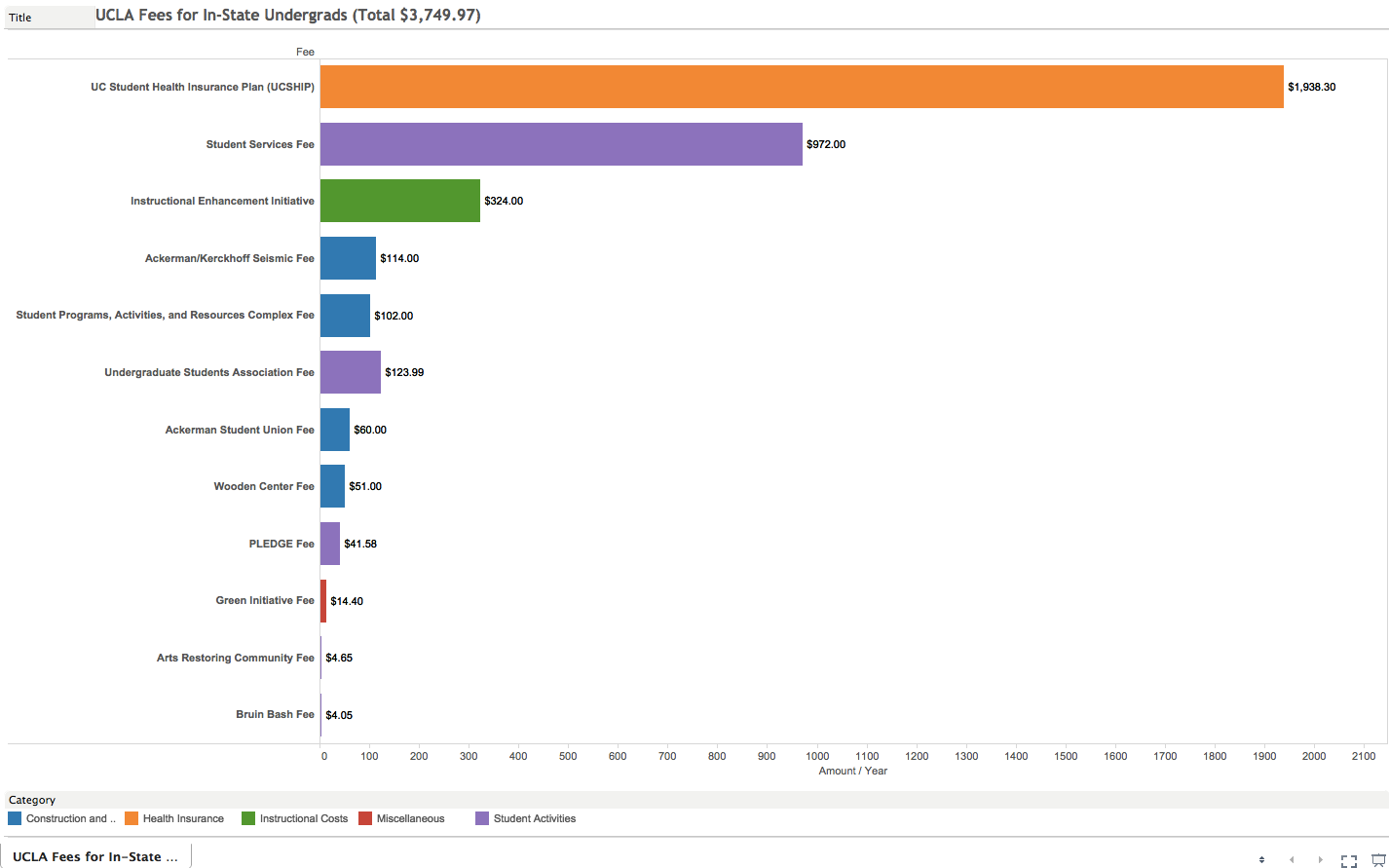
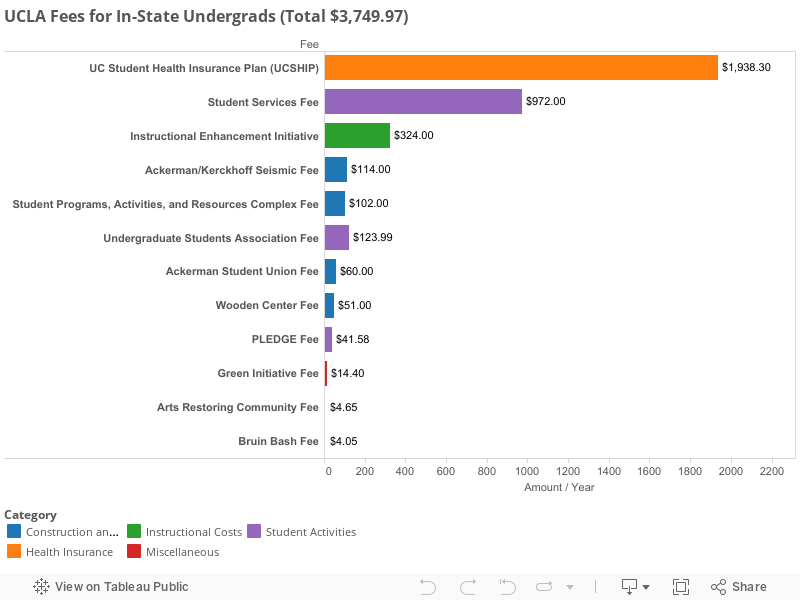
    Let’s look at the actual data from UCLA’s web site. I assume that Megan is basing this analysis on in-state undergraduate full-time students. The data is listed per quarter, and UCLA has three quarters for a full academic year. I have summarized below summing three quarters into yearly data, and you can:

    • Hover over each measure to see the fee description from UCLA’s fee description page;
    • Click on each category that I added to see the component fees;
    • Sort either column; and
    • Choose which rows to keep or exclude.
    • NOTE: Static image above if you cannot see interactive graphics

    Some Clarifications Needed

    • The total of non-tuition fees is $3,750 per year, not $3,500; however, Megan is right that this represents “about a quarter of the mandatory cost of attending UCLA for a year” ($3,750 out of $14,970).
    • The largest single fee is the UC health insurance fee (UC-SHIP), which is more than half of the total non-tuition fees. This fact (noted by Michael Berman on Twitter) should have been pointed out, given the significant percentage of the total.
    • With the UC-SHIP at $1,938 and the student services fee at $972, I hardly consider these as “trivial individually”.

    Broader Point on Budgeting

    The article’s broader point is that using extraneous fees to create additional revenue leads to a flawed budgeting process.

    As I’ve written before, this is a common phenomenon that you see among people who have gotten themselves into financial trouble — or, for that matter, people who are doing OK but complain that they don’t know where the money goes and can’t save for the big-ticket items they want. They consider each purchase individually, rather than in the context of a global budget, which means that they don’t make trade-offs. Instead of asking themselves “Is this what I want to spend my limited funds on, or would I rather have something else?” they ask “Can I afford this purchase on my income?” And the answer is often “Yes, I can.” The problem is that you can’t afford that purchase and the other 15 things that you can also, one by one, afford to buy on your income. This is how individual financial disasters occur, and it is also one way that college tuition is becoming a financial disaster for many families.

    This point is very important. Look at the Wooden Center fee, described here (or by hovering over chart):

    Covers repayment of the construction bond plus the ongoing maintenance and utilities costs for the John Wooden Recreation Center. It was approved by student referendum. The fee is increased periodically based on the Consumer Price Index.

    To take Megan’s point, this fee “was approved by student referendum”, which means that UCLA has moved budgeting responsibility away from a holistic approach to saying “the students voted on it”. This makes no financial sense, nor does it make sense to shift bond repayment and maintenance and utilities cost onto student fees.

    While this article had some sloppy reporting in terms of accurately describing the student fees, it does highlight an important aspect of the budget problems in higher education and how the default method is to shift the costs to students.

  • The IMS Is More Important Than You Think It Is

    I have long argued that the development of technical interoperability standards for education are absolutely critical for enabling innovation and personalized learning environments. Note that I usually avoid those sorts of buzzwords—“innovation” and “personalized learning”—so when I use them here, I really mean them. If there are two fundamental lessons we have learned in the last several decades of educational technology development, they are these:

    1. Building monolithic learning environments generally results in building impoverished learning environments. Innovation and personalization happen at the edges of the system.
    2. There are tensions between enabling innovation at the edges and creating a holistic view of student learning and a usable learning environment. Integration does matter.

    To these two education-specific principles, I would add a general principle about software:

    • All software eventually grows old and dies. If you can’t get your data out easily, then everything you have done in the software will die with it (and quite possibly kill you in the process).

    Together, these lessons make the case for strong interoperability standards. But arriving at those standards often feels like what Max Weber referred to as “the strong and slow boring of hard boards.” It is painful, frustratingly slow, and often lacking a feeling of accomplishment. It’s easy to give up on the process.

    Having recently returned from the IMS Learning Impact Leadership Institute, I must say that the feeling was different this time. Some of this is undoubtedly because I no longer serve on any technical standards committees, so I am free to look at the big picture without getting caught up in the horrifying spectacle of the sausage making (to mix Germanic political metaphors). But it’s also because the IMS is just knocking the cover off the ball in terms of its current and near-term prospective impact. This is not your father’s standards body.

    (more…)

  • Louisiana State University Moves to Moodle

    This is a guest post by Jim Farmer, instructional media + magic, inc.

    UPDATE: With his permission, we have appended an email response by LSU CIO Brian D. Voss in the comments section of this post.

    On Saturday, November 3rd, MoodleRooms Michael Penny reported that Louisiana State University would be moving to the Moodle Learning System. LSU is a Major research university enrolling more than 30,000 students, including more than 1,600 international students, and nearly 5,000 graduate students. LSU has more than 1,200 full-time faculty members and a staff of more than 3,000.

    Because their process was public, we have access to valuable details that are not often available for institutional decisions such as this one.

    (more…)