
One of the benefits of participating in an interactive event, such as the recent ELI Webinar that Michael and I led yesterday, is that the learning goes both ways. During the webinar, one of the participants shared a link for a report from Duke University on their first MOOC, Bioelectricity: A Quantitative Approach, delivered through Coursera in fall 2012. And what a find that was – this is the most thorough description I have yet seen from a university about their experience selecting, development, delivering and analyzing a MOOC. Kudos to Yvonne Belanger and Jessica Thornton, the authors.
What follows are some key excerpts along with some observations, but for anyone considering participation in one of the xMOOCs – read the whole report.
Some of the key findings from the executive summary:
- Over 600 hours of effort were required to build and deliver the course, including more than 420 hours of effort by the instructor.
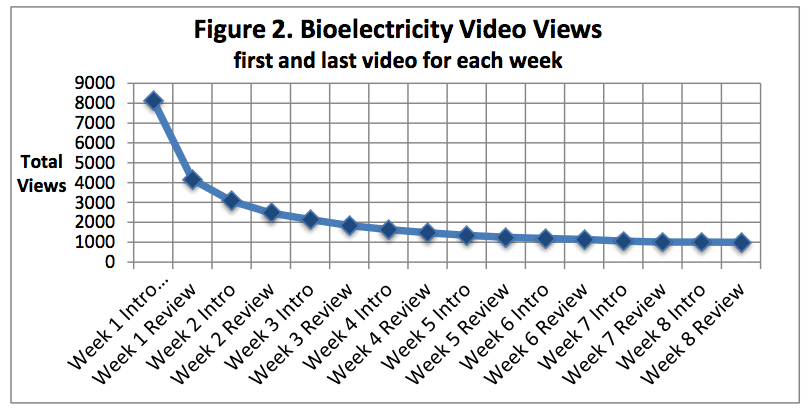
- The course launched on schedule and was successfully completed by hundreds of students. Many hundreds more continued to participate in other ways. The number of students actively participating plateaued at around 1000 per week.
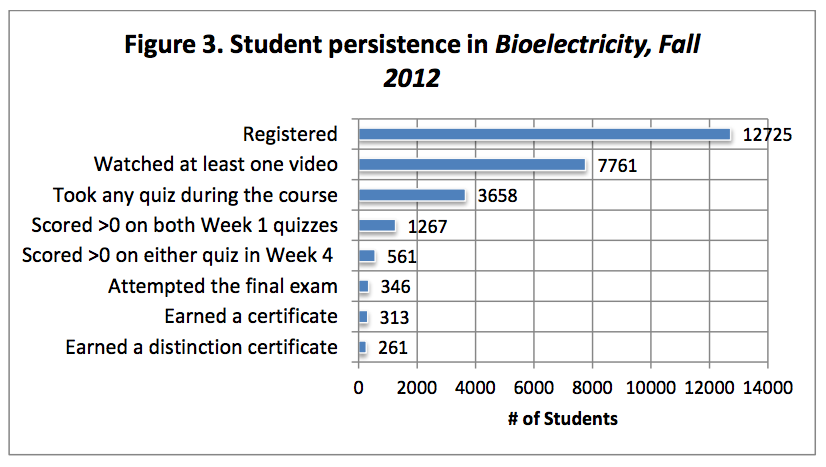
- Over 12,000 students enrolled, representing more than 100 countries. Approximately 8,000 of these students logged in during the first week.
- At the time of enrollment, one-third of enrolled students held less than a four year degree, one third held a Bachelors or equivalent, and one-third held an advanced degree.
- 25% of students who took both Week 1 quizzes successfully completed the course, including 313 students from at least 37 countries. Course completers typically held a Bachelor’s degree or higher; however, at least 10 pre-college students were among those who successfully completed this challenging upper level undergraduate course.
- Students who did not complete all requirements cited a lack of time, insufficient math background or having intended to only view the lectures from the outset. Regardless of completion status, many students were primarily seeking enjoyment or educational enrichment.
- Most students reported a positive learning experience and rated the course highly, including ones who did not complete all requirements.
- The Coursera platform met the needs of the course in spite of being continuously under development while the course was live. Technical issues reported by the students and instructor were generally minor, of short duration and/or quickly resolved. Patience, flexibility and resilience on the part of instructor, Coursera students, CIT staff, and Duke University Office of Information Technology media services staff were key elements in the success of this course.
While this is Duke’s first MOOC, it is not their only online initiative. As referenced in the report and its link here, Duke is also participating in the Semester Online program with 9 other institutions, delivered through 2U.
Finally, this report offers lessons learned and broader implications for Duke’s online initiatives (http://onlinecourses.duke.edu/), which aim to:
- Promote teaching & learning experimentation, innovation
- Support strategic goals of global outreach, knowledge in service to society
- Enhance Duke’s reputation
The report describes the efforts and artifacts from the course development work, including how much time was spent by faculty and staff, how many videos created, etc.
One very useful aspect of this report is the amount of data collected on participants. While Coursera and others have been very eager to promote the “billions served” metric, one weakness of the MOOCs is the lack of actual public data on participants. This information should serve as a model for other schools.
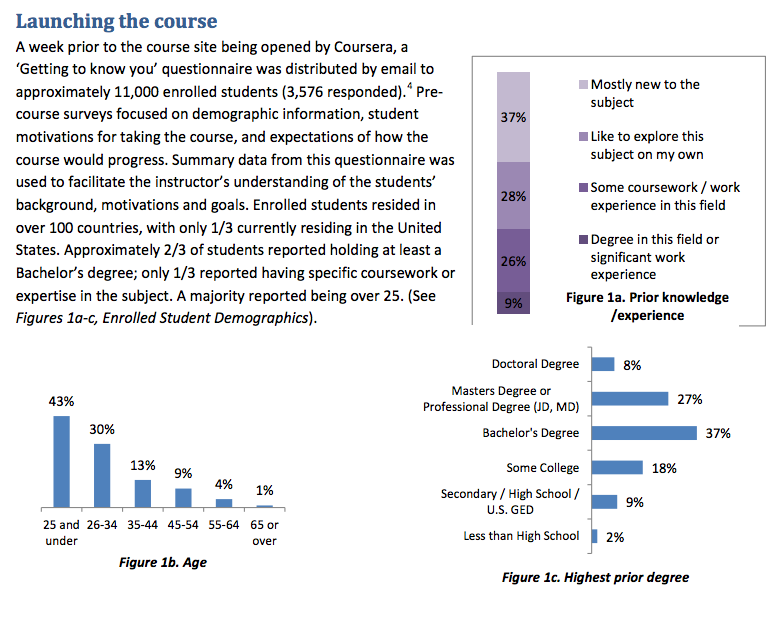
Beyond listing the number of students completing the course (313 earning some form of certificate), the Duke report also shows activity summaries per week and persistence.
There’s much more in the report, including:
- Student motives for enrolling, expectations and experiences;
- Factors promoting student completion;
- Barriers to student completion; and
- The faculty experience.
I’ll let the report speak for itself on the majority of findings, but I would like to emphasize the value of this report. Think of the value if other institutions shared this amount of information publicly. If the course is open, why not make the process and results open as well? This might be too much to ask for, but what if an enterprising MOOC provider collected and shared this type of information across courses and across institutions? I could see a real opportunity for a MOOC provider outside of the big 3 (Coursera, Udacity and edX) to distinguish themselves by sharing open data on the courses themselves.
Comments
10 responses to “The Most Thorough Description (to date) of University Experience with MOOC”
Phil
It is an excellent infornation . Candid .
During all these MOOCs discussions everybody forget ONE THING .
What is our aim in HE .
Our aim is to educate 18-22 years olds, have them a degree and have them hold a job for living . We all forget that .
MOOC is as it is today just some existing event , be careful , mainly for the subject matter interested parties. Attendents have already known the subject Our target is 18-22 years olds in the USA and as well as in the world .They need degrees to make living.
Simply colleges are expensive + quality is not good enough to find a job .
MOOCs should do that . As a marketing company Coursera does not work on that huge market either . Rest is just a good experiements and toys for big boys .
Excellent numbers.
The most expensive part of an online course is course development by a professor ( cost of professors not only salary but also his accumulated knowledge through years.) That is said 420 hours .
I would easily pay him $ 1,000 per hour for such sophğşisticated and patented work. That makes $ 420,000 Plus other 180 it seems technical work . Let us say $ 200 per hour. That is $ 36,000 . Total labor is $ 476,000
All the others hosting etc + university overheads $ 100,00 plus unforeseen say total is $ 600,000 .
Be careful this course will be repeated for at least 10 semester if it was given to College students . Say 100 per semester . Then cost per person is $ 600,000 / 10 / 100 = $ 1,000 per person .
Here is the sensitive issue . If that course is shared by 10 more colleges in the USA then cost is only $ 100 per person . If shared by 20 more colleges cost is only $ 50 .
Colleges do not know how to share their assets .
MOOCs stirred some movements for massness . I hope college presidents would wake up . Please share . Now let Duke share this course with 100 colleges in the USA with the sturdentw working toward a degree . Then you will see the cost of education in the USA will drop very quickly . Be smart SHARE your online for degrees .
[…] See on mfeldstein.wpengine.com […]
[…] The Most Thorough Description (to date) of University Experience with MOOC, Phil Hill, e-literate […]
This is still the industrialized model of education, lecture, mass production. Only the distribution has been changed. You got a larger warehouse, sped up the assembly line, and are churning out the same process with the same results (worse results actually compared to a classroom) only scaled.
The American economy is changing, yet our top educational institutions can’t get out of the industrial age.
Robert Clegg, I have to agree with you. Production line approach prevails within xMOOC’s. i was wondering if we are moving on the right track! I became enthusiastic about MOOCs of the connectivistic kind, but we seem to have taken another road!
Let me see … 2/3 of enrollees had post-secondary education and 97.5% of them failed to complete. Active participation was about 12% for most of the course. Duke University donated over 600 hours of its precious resources to a for-profit organization with no payback except for data collected (no one has yet come-up with a successful revenue generating model for MOOCs; however, costs are enormous, upfront and unavoidable; and the data is always the same — massive enrollment accompanied by massive drop-out/failure rates) … would somebody please explain to me by what measure this monstrosity was rated by Duke University as “a success”?
Maybe these courses don’t have a 97.5% failure rate– maybe traditional universities make their classes inappropriate for 97.5% of the ways people want to use education.
I love seeing the reasons students gave for not finishing. Never intended to finish in the first place, didn’t have the pre-reqs but tried it anyway, only had time for part of it. Any of those would be an expensive deal-breaker at “real” university, but this class managed to still provide some value, apparently.
I’m with you too, Robert Clegg. There are so many other ways people approach learning, and so many things that would be more useful to me personally than lectures with quizzes, or course-length curricula.
[…] very excellent site e-Literate recently posted a summary of and link to a report from Duke University outlining details from their first MOOC offering. It included […]
[…] The Most Thoroguh description (to date) of university experience with a MOOC (e-Literate, 2/12/2013) Blog post praising Duke’s report on Bioelectricity: A Quantitative Approach. […]