e-Literate

Present is Prologue

Author: Phil Hill

  • Online Program Management: A view of the market landscape

    One of the fastest-growing market segments in ed tech, and one of the least-understood, is that of Online Program Management (OPM). It doesn’t help that the terms OPM, Online Enablers, Online Service Providers are used interchangeably, although OPM is the most common now.

    OPM providers are organizations (mostly for-profit companies, but with at least one non-profit variation) that help non-profit schools develop online programs, most often for Master’s level programs. These providers provide various services for which traditional institutions historically have not had the experience or culture to support. Some examples of the services include marketing & recruitment, enrollment management, curriculum development, online course design, student retention support, technology hosting, and student and faculty support.

    It would be useful to go beyond the label and get a broader view. (more…)

  • UC Davis LMS Back Online: Update on what we know about Scriba Sakai outage

    I’ve been told by two sources that the UC Davis LMS outage I described in this post may be over, and the SmartSite LMS is back online (SmartSite is UC Davis’ implementation of Sakai, hosted by Scriba). I would like to update what we know about the overall situation while we wait for additional confirmation. The following is based on my conversations with a Scriba inside source who asked to remain anonymous, a student at UC Davis, the LISTedTECH team whose database powers our new LMS subscription service, some commenters from the blog post, and a more thorough review of the UC Davis IT status site. And I should point out that UC Davis team has done an excellent job in communications – timely messages with no defensiveness, and full transparency.

    The Outage

    On Thursday, May 19, Scriba notified UC Davis and several other schools that it would perform emergency maintenance starting Friday, May 20 at 9pm PDT and ending Monday, May 23 at 11am PDT. The outage was not caused by software applications but data center issues. I’ve asked what this means, and I’ve been told that Scriba will describe the outage in the next week. (more…)

  • Scriba Disaster: Sakai-based LMS for UC Davis is down with no plans for recovery

    In what might shape up as one of the worst LMS outages in recent history, UC Davis has been working without an LMS for the past week and does not expect their vendor to fix the problems before the end of the term. UC Davis uses a version of Sakai hosted by the LMS remnants of rSmart. In 2013 rSmart sold it’s Sakai-supporting LMS business to Asahi Net International, and in 2015 a private equity firm – Vert Capital – bought ANI and renamed it Scriba. Scriba hosts the Sakai LMS for UC Davis which has branded it as SmartSite.

    UC Davis is on the quarter system, with the last week of class next week (May 31) and finals the week of June 6. A few months ago UC Davis announced their intention to migrate to Canvas as their LMS. SmartSite subsequently went down on May 19th, and all signs are pointed to a complete and final outage. Scriba will not answer the phones (you get a message that the mailbox is full), and UC Davis staff are making a heroic attempt to in-house recreate LMS tools and even to recover grades that had been entered on SmartSite.

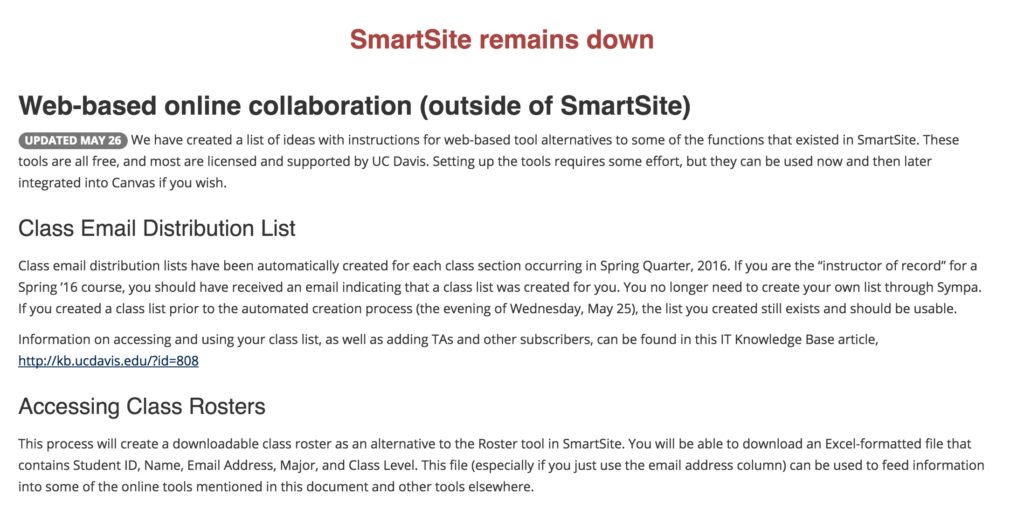
    UC Davis staff have replaced the smartsite.ucdavis.edu portal with a page telling faculty some methods to replace the LMS or go to Canvas early.
    UC_Davis_Smartsite

    There is no expectation for a repair by the vendor.

    On May 24th the UC Davis internal team sent this message to faculty and staff:

    We are working on extracting data from the SmartSite database. Our priority is to retrieve gradebook data for this quarter, and to make that information available to instructors as soon as possible. We are providing support for faculty to use alternatives to manage course materials for the rest of the quarter.

    This, folks, is a disaster. There is an interesting angle here in that Sakai is open source yet data is not easily recoverable. We will share more here at e-Literate as we find out new information.

    Update: Removed Buzzfeed post as unverified and not necessary for story.

    Update: Clarified that no expectation of repair by the vendor and that branding comes from UCD. Also adding the update from evening of May 26th.

    Progress continues on the Web interface to access grades. We expect that it will be available Friday (May 27).

    In addition, we have had a team working to build a local instance of SmartSite. This evening, the campus is completing internal testing on this limited version. A small group of selected faculty members will begin testing this version Friday morning. Depending on their results, we anticipate having this version available to spring 2016 instructors of record over the weekend. All of the content faculty have in SmartSite should be available to them.

    Please note that students will not have SmartSite access. While our goal remains to restore full access, this initial limited, local instance will only have capacity to support faculty access.

    Update: See this post for update on what happened and unconfirmed restoration of the system.

    I’ve been told by two sources that the UC Davis LMS outage I described in this post may be over, and the SmartSite LMS is back online (SmartSite is UC Davis’ implementation of Sakai, hosted by Scriba). I would like to update what we know about the overall situation while we wait for additional confirmation. The following is based on my conversations with a Scriba inside source who asked to remain anonymous, a student at UC Davis, the LISTedTECH team whose database powers our new LMS subscription service, some commenters from the blog post, and a more thorough review of the UC Davis IT status site. And I should point out that UC Davis team has done an excellent job in communications – timely messages with no defensiveness, and full transparency.

  • No, Blackboard Report Did Not Conclude That Online Classes Are “A Poorer Experience”

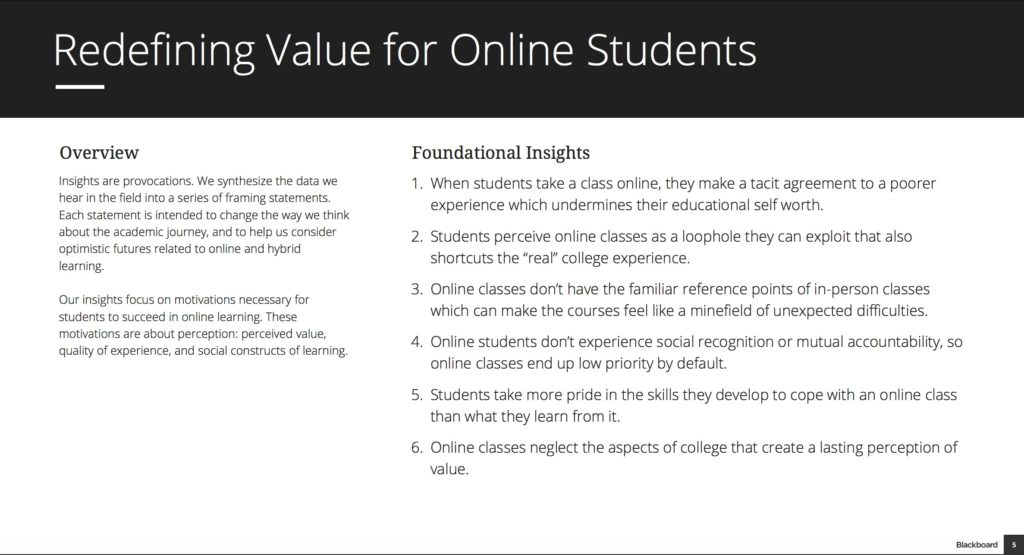
    I’m seeing a lot of chatter online about the recently-released Blackboard report and this slide in particular:

    Bb Insights

    Foundational Insights

    1. When students take a class online, they make a tacit agreement to a poorer experience which undermines their educational self worth.
    2. Students perceive online classes as a loophole they can exploit that also shortcuts the “real” college experience.
    3. Online classes don’t have the familiar reference points of in-person classes which can make the courses feel like a minefield of unexpected difficulties.
    4. Online students don’t experience social recognition or mutual accountability, so online classes end up low priority by default.
    5. Students take more pride in the skills they develop to cope with an online class than what they learn from it.
    6. Online classes neglect the aspects of college that create a lasting perception of value.

    To make matters more interesting, the next slide elaborated on insight 1), stating:

    Most students who enroll in an online class recognize and express that they are agreeing to a lesser experience.

    Did Blackboard just commit an act of unintentional honesty acknowledging that students don’t like online courses in general? That would be quite the headline. But it would not be accurate. (more…)

  • Comparing Fully-Online vs Mixed-Course Enrollment Data

    Mike Caulfield wrote a post yesterday about a new Blackboard report on design findings regarding online students. The focus of Mike’s post was that people often assume that the norm for an “online” student is taking all courses online, when in fact it is more common for students to take some courses online and some face-to-face (what Mike calls “Mixed-Course”). This distinction is important:

    What shocks some people reading this, I think, is that online students would have face-to-face courses as a comparison or option, or that they would be consciously choosing between online and face-to-face in the course of a semester. But this is the norm now at state universities and community colleges; it’s only a secret to people not in those sorts of environments.

    I agree that this is an important topic, so let’s look at the data in more detail (and for those wondering if you can connect to Tableau Public to edit online data visualizations while flying, the answer is yes if you’re patient). The best source of information is the IPEDS database, with the most recent data for Fall 2014. WCET put out an excellent report analyzing the distance education data in IPEDS – more on that later. Both IPEDS and WCET use the term “Some but not all” in the same manner as “Mixed-Course”. Based on overall data combining undergraduate and graduate students, Mike is right that more students are Mixed-Course than they are Fully-Online – 2.926 million vs. 2.824 million. (more…)

  • Previous LMS For Schools Moving to Canvas in US and Canada

    During the most recent quarterly earnings call for Instructure, an analyst asked an interesting question (despite starting off from the Chris Farley Show format).

    Corey Greendale (First Analysis Securities Corporation):  Awesome. A couple of other things on the, primarily on the Higher Ed space but I guess on education space, there’s a whole lot of couple questions about the competitive environment. When you’re and I don’t know if you will ever get into this level of granularity but when you got competitive wins against the Blackboard, are those predominantly from legacy ANGEL, are you getting those wins as much from Learn as well.

    Josh Coates (CEO of Instructure):  A lot of them are from Learn. Most, you know I don’t have the stats right off the top of my head. A lot of the ANGEL and WebCT stuff is been mopped up in the previous years and so, what’s left the majority of what’s left is Learn and our win rate against Blackboard it continues to be incredibly high, not just domestically but internationally as well.

    In fact, I think most of three out of the four international schools that we announced in this earnings where Blackboard Learn replacements, so yes Learn’s getting it.

    The question gets to the issue of whether Canvas is just picking up higher education clients coming off of discontinued LMSs (Angel, WebCT, etc) or if they are picking up clients from ongoing platforms such as Blackboard Learn. Beyond the obvious interest of investors and other ed tech vendors, this issue in general affects higher education institutions going through a vendor selection – for the system in consideration, are there many other schools considering the same migration path?

    Thanks to the work we’ve been doing with LISTedTECH and our new subscription service, we can answer this question in a little more detail. One of the charts we share shows higher education migrations over the past five years in the US and Canada. (more…)

  • A Retrospective on Implementing Common Course Management Systems

    At e-Literate we mostly avoid blogging about our consulting work through MindWires Consulting, but we have an opportunity with our work for California’s Online Education Initiative (OEI) to share information with the higher education community on a topic of growing importance. The OEI is California Community College System’s approach to help individual colleges collaborate with their online courses and programs, including a OEI Course Exchange to be launched this Fall in pilot mode that will “allow students to register for online courses across participating colleges without requiring students to complete separate application and matriculation processes”.

    Last year we at MindWires helped OEI select a Common Course Management System (yes, they use the CMS language instead of LMS) by providing market analysis and facilitating the group decision-making process. This year they asked us to review similar efforts at other consortia in the US and Canada. The point of a CCMS is not the technology platform itself but rather what the common e-learning infrastructure could allow a consortium to do – address issues such as course redesign, professional development, student support, etc. Even though the OEI was based on selecting a common system from the beginning and has experienced significant adoption already, there is still a great deal of value in learning from others that have gone before. We are releasing the result of this work with the report – “A Retrospective on Implementing Course Management Systems: Motivations, Benefits, Drawbacks and Recommendations“. (more…)