e-Literate

Present is Prologue

Author: Phil Hill

  • Interesting Comment on Pearson’s LMS Plans From Customer

    On April 1, long-time eCollege (aka Pearson’s LearningStudio) customer Texas Christian University (TCU) gave an update on their LMS selection process to the student newspaper TCU360. In this article there was an interesting statement ((Statement from the original article before it was updated.)) worth exploring [emphasis added].

    “eCollege” will soon be a thing of the past.

    TCU has narrowed its search for a Learning Management System to two platforms, Blackboard and Desire2Learn (D2L).

    “We’ve had feedback, from faculty specifically, that it’s time for change,” Assistant Provost of Educational Technology and Faculty Development Romy Hughes said.

    TCU has used Pearson’s Learning Studio system since 1999.

    “Pearson is out of the learning management system game,” Hughes said. “We need something to evolve with the Academy of Tomorrow and where we’re moving to at TCU.”

    That last comment got my attention. (more…)

  • Ellucian Buys Helix LMS, But Will It Matter?

    At this year’s Ellucian users’ conference #elive15, one of the two big stories has been that Ellucian acquired the Helix LMS, including taking on the development team. I have previously described the Helix LMS in “Helix: View of an LMS designed for competency-based education” as well as the subsequent offer for sale in “Helix Education puts their competency-based LMS up for sale”. The emerging market for CBE-based learning platforms is quickly growing, at least in terms of pilot programs and long-term potential, and Helix is one of the most full-featured, well-designed systems out there. (more…)

  • About the Diverging Textbook Prices and Student Expenditures

    This is part 3 in this series. Part 1 described the most reliable data on A) how much US college textbook prices are rising and B) how much students actually pay for textbooks, showing that the College Board data is not reliable for either measure. Part 2 provided additional detail on the data source (College Board, NCES, NACS, Student Monitor) and their methodologies. Note that the textbook market is moving into a required course materials market, and in the immediate series I use both terms somewhat interchangeably based on which source I’m quoting. They are largely equivalent, but not identical.

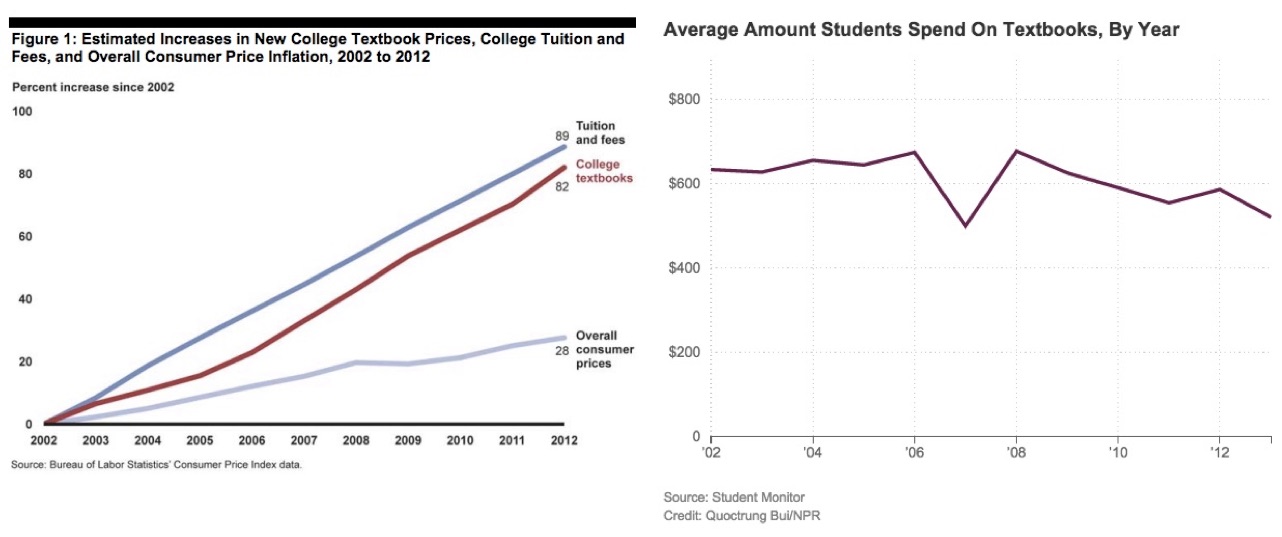
    Based on the most reliable data we have, the average college textbook prices are rising at three times the rate of inflation while average student expenditures on textbooks is remaining flat or even falling, in either case below the rate of inflation. Average student expenditures of approximately $600 per year is about half of what gets commonly reported in the national media. The combined chart comes from this GAO Report (using CPI data) and this NPR report (using Student Monitor data).

    Combined Chart

    Does this indicate a functioning market, and does this indicate that we don’t have a textbook pricing problem? No, and no. (more…)

  • Postscript on Student Textbook Expenditures: More details on data sources

    There has been a fair amount of discussion around my post two days ago about what US postsecondary students actually pay for textbooks.

    The shortest answer is that US college students spend an average of $600 per year on textbooks despite rising retail prices.

    I would not use College Board as a source on this subject, as they do not collect their own data on textbook pricing or expenditures, and they only use budget estimates.

    <wonk> I argued that the two best sources for rising average textbook price are the Bureau of Labor Statistics and the National Association of College Stores (NACS), and when you look at what students actually pay (including rental, non-consumption, etc) the best sources are NACS and Student Monitor. In this post I’ll share more information on the data sources and their methodologies. The purpose is to help people understand what these sources tell us and what they don’t tell us.

    College Board and NPSAS

    My going-in- argument was that the College Board is not a credible source on what students actually pay:

    The College Board is working to help people estimate the total cost of attendance; they are not providing actual source data on textbook costs, nor do they even claim to do so. Reporters and advocates just fail to read the footnotes.

    Both the College Board and National Postsecondary Student Aid Study (NPSAS, official data for the National Center for Education Statistics, or NCES) currently use cost of attendance data created by financial aid offices of each institution, using the category “Books and Supplies”. There is no precise guidance from DOE on the definition of this category, and financial aid offices use very idiosyncratic methods for this budget estimate. Some schools like to maximize the amount of financial aid available to students, so there is motivation to keep this category artificially high. (more…)

  • How Much Do College Students Actually Pay For Textbooks?

    With all of the talk about the unreasonably high price of college textbooks, the unfulfilled potential of open educational resources (OER), and student difficulty in paying for course materials, it is surprising how little is understood about student textbook expenses. The following two quotes illustrate the most common problem.

    Atlantic: “According to a recent College Board report, university students typically spend as much as $1,200 a year total on textbooks.”

    US News: “In a survey of more than 2,000 college students in 33 states and 156 different campuses, the U.S. Public Interest Research Group found the average student spends as much as $1,200 each year on textbooks and supplies alone.”

    While I am entirely sympathetic to the need and desire to lower textbook and course material prices for students, no one is served well by misleading information, and this information is misleading. Let’s look at the actual sources of data and what that data tells us, focusing on the aggregate measures of changes in average textbook pricing in the US and average student expenditures on textbooks. What the data tells us is that the answer is that students spend on average $600 per year on textbooks, not $1,200.

    First, however, let’s address the all-too-common College Board reference. (more…)

  • Austin Community College’s ACCelerator: Big bet on emporium approach with no pilots

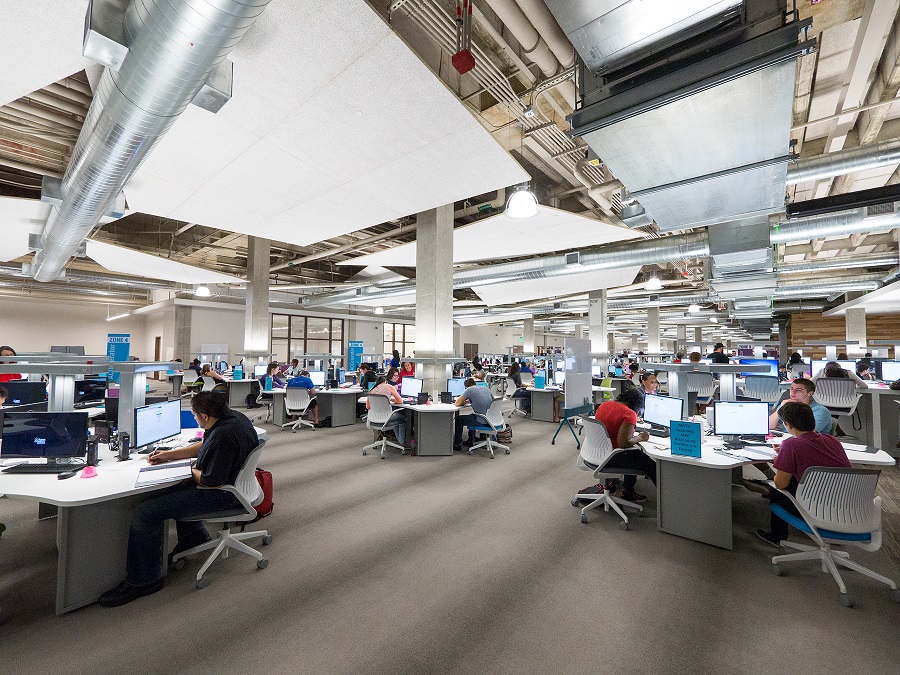
    While at SXSWedu, I was able to visit Austin Community College’s ACCelerator lab, which got a fair bit of publicity over the past month. While the centerpiece of ACCelerator usage is for developental math, the 600+ workstation facility spread over 32,000 square feet also supports Tutoring in a variety of subjects, First year experience, Group advising, Academic Coaching, Adult Education, Continuing Education, College readiness assessment preparation, and Student skills workshops.

    ACCelerator

    But it is the developmental math course that has received the most coverage.

    Austin Community College welcomed second lady Dr. Jill Biden and Under Secretary of Education Dr. Ted Mitchell on Monday, March 9, to tour the Highland Campus’ ACCelerator and meet with students and faculty of the college’s new developmental math course, MATD 0421. [snip]

    “I teach a lot of developmental students,” says Dr. Biden. “The one stumbling block does seem to be math and math anxiety and ‘Can I do it?’. This (course) seems to be so empowering and so positive. Students can see immediate success.”

    (more…)

  • Back To The Future: Looking at LMS forecasts from 2011 – 2014

    At today’s Learning Analytics and Knowledge 2015 conference (#LAK15), Charles Severance (aka Dr. Chuck) gave the morning keynote organized around the theme of going back in time to see what people (myself and Richard Katz primarily) were forecasting for education. By looking at the reality of 2015, we can see which forecasts were on track and which were not. I like this concept, as it is useful to go back and see what we got right and wrong, so this post is meant to provide some additional context particularly for LMS market. Chuck’s keynote also gives cover for doing so without seeming too self-absorbed.

    But enough about me. What do you think about me?

    I use the term forecast since I tend to describe patterns and trends and then try to describe the implications. This is different than the Katz video which aimed to make specific predictions as a thought-provoking device.

    Pre-2011

    I introduced the LMS squid diagram in 2008 as a tool to help people see the LMS market holistically rather than focusing on detailed features. Too much of campus evaluations then (and even now) missed the big picture that there were only a handful of vendors and some significant market dynamics at play.

    A 2009 presentation, by the way, was the basis for Michael and me connecting for the first time. Bromance. (more…)