e-Literate

Present is Prologue

Author: Phil Hill

  • MOOCs and Academic Exchanges Now Allowed for Iranian Students

    One development covered here at e-Literate this year has been the US State Department and Treasury Department forcing the MOOC providers to block access for students in Iran, Sudan, Cuba and Syria. Kris Olds has also provided excellent coverage as well as Carl Straumsheim at Inside Higher Ed. In late January Coursera had to start blocking students in these four countries while edX continued working with these students. Then in early March edX had to start blocking students in Iran, Sudan and Cuba.

    Today’s news is that OFAC has granted a General License G to allow academic exchanges such as MOOCs to operate within Iran.

    (more…)

  • 2U’s Upcoming IPO: Filing estimates $533 million company value

    One month ago 2U filed its registration for an IPO in 2014. 2U is an online service provider that helps traditional universities develop fully-online programs, currently based on 9 customers at the master’s level (see here for summary of revenue per student and per customer). On Monday the company set the terms for the IPO, as described by Bill Flook in the Washington Business Journal.

    2U Inc. on Monday set terms for its upcoming initial public offering. The Landover-based ed-tech company plans to sell 8 million shares at between $11 to $13 apiece. Selling stockholders plan to offload another 1.17 million shares in the offering.

    Altogether, the IPO would raise a total $110 million, assuming the 2U prices at the mid-point of that range. The company plans to list on the Nasdaq under the ticker symbol “TWOU.”

    (more…)

  • WCET Post on Distance Education Misconceptions

    It is gratifying to see WCET pick up the mantle with their analysis of distance learning based on the new IPEDS data. They have several posts up already, and today’s post is quite good and important. If only more people jumping into the fray on higher education history and reform would start with a grounding in facts, the public debate and resulting recommendations would be much more useful.

    It is surprising how many times people conflate distance (or online) education with for-profit institutions. Often these are people who should know better, whether in Congress, the press, research universities, or other higher education pundits. Certainly, the for-profits have had a huge impact on the distance education world, but maintaining unfounded perceptions does not inform policy or practice. Some examples: (more…)

  • Major Change at UF Online: Exec director abruptly resigns

    I wrote a post several weeks ago about UF Online, partially based on a phone interview with the executive director Betty Phillips.

    Several weeks ago the University of Florida Online program opened for the Spring 2014 semester, accepting 600 transfer students, and the new program will accept Freshmen starting August 2014. This announcement comes just 2 years after the Florida legislature commissioned a study from the Parthenon Group on how to best leverage online programs in the state, and this program is probably one of the highest profile new online programs in the US within the past few years (along with California’s online initiative, Open SUNY, SJSU / Udacity and GaTech / Udacity). [snip]

    What UF Online is, however, is an exclusively-online baccalaureate program leading to a UF degree for lower costs than the traditional on-campus experience. This is about expanding capacity and access to a research university, and the program aims to meet the same academic standards as the traditional UF experience . . .

    Well it seems like the situation in Florida changes rapidly in multiple directions. Just two and half months after she officially took the new position, Betty Phillips has abruptly resigned. By all appearances, this move was unexpected as the University of Florida appears to have been caught flat-footed. The Gainesville Sun reports:

    (more…)

  • First-hand experience moving to team-based course design

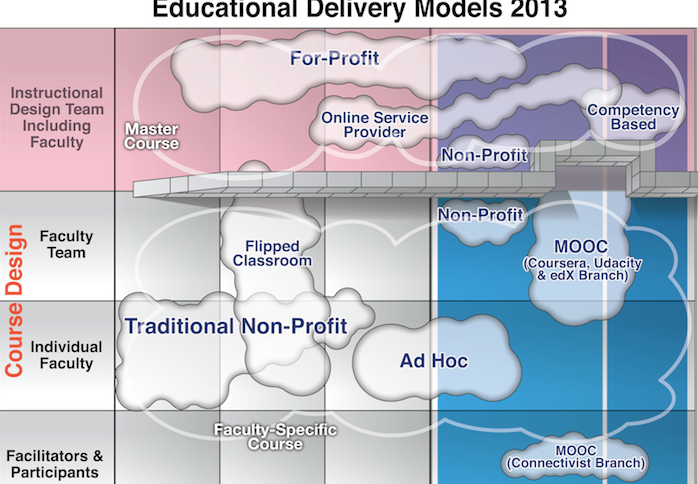
    As Michael mentioned, we have posted the last episode in the pilot e-Literate TV series with the topic of moving to a team-based course design for a flipped classroom usage. This episode provides an excellent opportunity to hear the first-hand experience of a faculty member going through this transition for the first time. Vanessa Perry of GWU had no real expectations or understanding of what this transition would encompass.

    The adoption of team-based course design presents a cultural barrier for traditional institutions, as shown by a wall in the graphic that was the basis for a 2012 EDUCAUSE Review article.

    The Wall

    Vanessa describes what this barrier, or wall, feels like as you attempt to cross it, as seen in this snippet from the interview (full transcript and video and graphics available at the full episode on e-Literate TV).

    (more…)

  • New post at 20MM: Two Approaches to Watch in Remedial Education Innovation

    The 20 Million Minds Foundation is starting a new blog, and for topics of mutual interest, Michael and I will be posting articles  several times a month on their site and occasionally cross-posting here. The first article of mine went up last week.

    Two Approaches to Watch in Remedial Education Innovation

    It is no secret that the current approach to remedial (or developmental) courses does not work. According to a study by Complete College America (see original for footnotes documenting sources):

    “The numbers tell a dispiriting story. Half of all undergraduates and 70 percent of community college students take at least one remedial course. Too many of these students never overcome being placed into a remedial course. Only about a quarter of community college students who take a remedial course graduate within eight years. In fact, most students who are referred to remedial education do not even complete the remedial sequence: One study found 46 percent of students completed the sequence in reading and only 33 percent completed it in math.”

    Following the maxim that “if it doesn’t work, try something else”, two community colleges on opposite coasts – Miami-Dade College in Florida and Cerritos College in California – are trying to change the game. What can we learn from these two divergent examples?

    Read the whole article here.


  • edX forced to block access to students in Cuba, Iran and Sudan

    In late January I wrote here and here about the US Treasury Department, through the Office of Foreign Assets Control (OFAC), blocking access to Coursera courses by students in Syria, Cuba, Iran and Sudan (also see Kris Olds article here and IHE article here). The reason for the decision appears to be that MOOCs were classified as educational services instead of informational materials. At the time, edX was permitted to operate in those countries based on their reliance on getting licenses approved by OFAC, whereas Coursera was relying on a broad interpretation by OFAC. edX president Anant Agarwal even posted on a blog a somewhat congratulatory note:

    At edX, we are pleased to announce that no one, in any country, is blocked from taking one of our courses, and we have never blocked students from receiving education on the edX platform because of where they live.

    EdX has worked for many months with the U.S. Office of Foreign Assets and Control (“OFAC”) and the U.S. State Department to determine how we can assure that no one in any country is blocked from taking an edX course.

    Now comes word that edX has been forced by OFAC to block access to several courses for students in Cuba, Iran and Sudan. From The Harvard Crimson late yesterday:

    (more…)