
e-Literate

Present is Prologue

Author: Phil Hill

  • Policy Updates on FERPA and Net Neutrality

    Two policy debates that could have a significant impact on education – updates on FERPA and data privacy & FCC proposals on Net Neutrality – both entered the next stage this week.

    FERPA Modernization

    I recently wrote about the new federal moves to update FERPA to handle the age of Big Data (should I have used scare quotes there?).

    Yesterday the White House released its report on big data and privacy implications. The focus was broadly on big data, but there will be implications for ed tech, with several key recommendations specifically focused on the education sector. Specifically, there will be a push to update and revise the Family Educational Rights and Privacy Act (FERPA, enacted in 1974) and Children’s Online Privacy Protection Act (COPPA, enacted in 2000).

    I was quite optimistic about the federal approach based on this report, and yesterday we got some more apparently good news – a bipartisan approach to improve data privacy and update FERPA made in a reasonable fashion (dogs and cats, living together). As reported by THE Journal, Senators Markey (D-MA) and Hatch (R-UT) introduced the “Protecting Student Privacy Act”, getting even a warm reception from the Software and Information Industry Association (SIIA), which had objected to the earlier version discussed in January. THE Journal summarized the key parts of the legislation (full text here): (more…)
  • Six Months After Layoffs: No signs of growth at Desire2Learn

    Late last year I wrote a post about Desire2Learn’s laying off more than 7% of the workforce, speculating that something had changed at the company. In particular, I didn’t buy the company line about continued growth.

    In the end, I have trouble believing that these recent cuts are solely based on improving Desire2Learn’s growth without needing to correct for slower-than-expected growth. The arguments made by our sources that these are significant cuts driven by not hitting growth targets are compelling. However, there is no smoking gun that I have found to back up these claims definitively.

    What I do feel confident in saying regarding employee numbers is that there’s more to the story here than just ‘churn’ alongside aggressive hiring. Since the end of the Blackboard patent lawsuit, Desire2Learn has grown at an average of 13 employees per month (140 in Nov 09, 560 in Sep 12, 750 in Nov 13). Yet the numbers might have actually gone down since July 2013.

    After that post, Desire2Learn (through an interview with a local media outlet) further explained the company line about growth with challenges. [emphasis added]

    The past year has included hirings and staff reductions as the developer of online learning software prepares for growth and expansion, says Dennis Kavelman, the Kitchener-based company’s chief operating officer.

    Kavelman stresses that the company is growing, not shrinking, and restructuring to handle the growth resulted in some layoffs.

    (more…)

  • ITC Survey: Four trends to watch in LMS market for community colleges

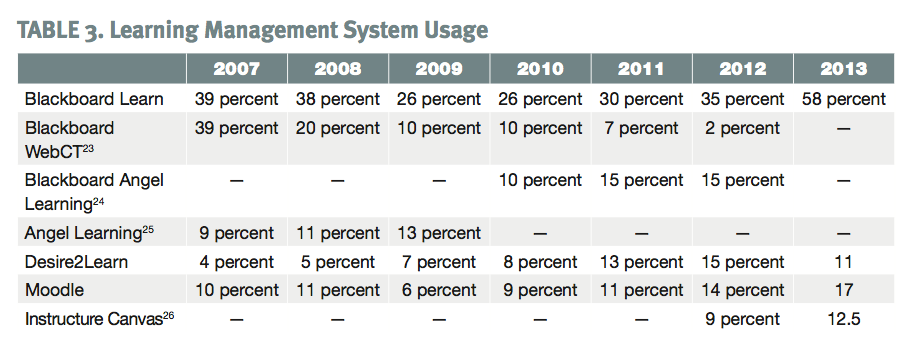
    The Instructional Technology Council (ITC), an affiliated council of the American Association of Community Colleges (AACC), has conducted a distance education survey since 2004 focusing on online education trends among community colleges in the US and Canada. With this focus, the member colleges tend to be those with a stronger interest in online education programs and therefore are more progressive in technology usage than the general community college population. One part of the ITC survey is on general LMS usage at member schools, and this provides another source of data on the higher ed LMS market.

    The survey this year was based on 142 responses out of the 375 member institutions (39%), and there are a few caveats that should be noted:

    • Prior to 2012 the survey was emailed to all AACC colleges, but due to uneven responses the survey changed to just survey ITC colleges; and
    • “No answer” responses are not listed in percentages, thus totals will not always equal 100%.

    Despite those caveats, “70 percent of the annual submissions have come from the same campuses during the nine years of the survey”, which means that it is worth exploring some broad trends for the LMS market for community colleges. Here is the data presented on LMS usage this year on page 15 (April 2014 report of Fall 2013 survey data):

    Table 3


    (more…)

  • UCF and Temple IPEDS corrections lead to new Top 20 in online enrollment

    In response to the new distance education (roughly equivalent to online education) data released by the National Center for Educational Statistics (NCES) and its Integrated Postsecondary Education Data System (IPEDS), I have written a series of posts showing different ways to view the data. In short, the data allows much greater insight into degree-granting online higher education in the US than we previously had. WCET also has a series of posts worth exploring.

    One post in particular listed the top 20 institutions in terms of how many students take at least one online course, broken down by sector. The list for public 4-year showed the following (undergrad + grad, # students taking at least one online course in Fall 2012): (more…)

  • White House report on big data will impact ed tech

    Yesterday the White House released its report on big data and privacy implications. The focus was broadly on big data, but there will be implications for ed tech, with several key recommendations specifically focused on the education sector. Specifically, there will be a push to update and revise the Family Educational Rights and Privacy Act (FERPA, enacted in 1974) and Children’s Online Privacy Protection Act (COPPA, enacted in 2000). Education Week set the context quite well in its article:

    FERPA, which was written before the Internet existed, is intended to protect disclosure of the personally identifiable information contained in children’s education records. And COPPA, which requires parental consent under certain conditions for the online collection of personal information from children under age 13, was written before the age of smartphones, tablets, apps, the cloud, and big data.

    Think Progress, part of a group founded by John Podesta, who also led the White House study, summarized the key findings as follows:

    1. Giving consumers more protection and control over their private data with a bill of rights

    2. Pass a singular data breach law to prevent the next Target fiasco

    3. Strengthen outdated and archaic laws, such as the Electronic Communications Privacy Act (ECPA), which dictates how the government accesses emails

    4. Give non-citizens the same privacy protections

    5. Ensure data collected on students is used only for educational purposes

    Ed Tech Sections of the Report Itself:

    First, there is a description of the situation in pages 24 – 26 that is too long to quote but worth highlighting: (more…)

  • GSV+ASU EdInnovations Conference: A proxy for ed tech’s big challenge

    Last week Michael and I attended the GSV+ASU EdInnovations conference commonly known as “Davos in the Desert”. This conference is growing in importance, especially in the effect on ed tech investment, as can be seen by the rising attendance. Just five years ago there were less than 300 attendees, and this year’s event had well over 2,000. Some of the notable articles covering the event:

    • Inside Higher Ed: “Let’s Make a Deal” – this article compares the rise of ed tech in general to the rise in the conference, but asks about lack of educators and lack of nationwide results (more on this later).
    • Huffington Post: “Is the American Dream a Dream Deferred?” – this article takes a positive spin on the conference, especially the focus on improving access and student success, but also questions the lack of diversity (more on gender lines than educator / non-educator lines).
    • EdSurge: “What Happened at ASU-GSV…” – this article presents an insider, booster view of the conference occasionally to accentuate the positive and defuse the negative, but it does describe the conference events quite well.
    • Getting Smart: “ASU+GSV: Education Dreaming” – ditto.
    • EdWeek: “Teachers at Summit Tell Ed. Companies What They Want–and What They Don’t” – this article covers one panel in particular, but this one is highly relevant to the following discussion on educator involvement.
    • Dusty World: “ASU/GSV Summit” – this article has a slightly humorous description of “the strangest education conference of my career”, noting that most discussions actually focused on politics and not pedagogical approaches.

    As for myself, I live-tweeted some of my observations, particularly focusing on pro-immigration reform, foundation influence, and the difficulty of interviewing Don Graham (former owner of the Washington Post and current family owner of Kaplan). (more…)

  • Partial Transcript: Richard Levin (new Coursera CEO) on Charlie Rose

    I have written two posts recently about Coursera’s appointment of the former president of Yale as the company’s new CEO, with the implicit argument that this move represents a watershed moment for commercial MOOCs. In particular, Coursera seems likely to become the third generation of Richard Levin’s dream, following AllLearn and Open Yale Courses. I’ve also argued that Levin is embellishing the history by making Internet bandwidth a primary factor in the demise of AllLearn when the lack of a viable business model was the more important issue, with even Levin arguing this point.

    Richard Levin was just interviewed by Charlie Rose, and I am including a transcript of most of the segment (starting around 3:15), highlighting some key points in bold. This interview should give us further insight into the future of commercial MOOCs, especially as we have the first non-founder CEO in one of the big three commercial MOOC providers. Follow this link to watch on CharlieRose.com and avoid the annoying Hulu ad.

    Rose: You could have gotten a government job, as an ambassador or something; maybe been Secretary of the Treasury as far as I know . . . you could have done a lot of things. But you’re out running some online education company (laughs).

    Levin: It’s a fantastic mission, it’s really the perfect job for me and for following a university president’s [job].

    Rose: Why’s that?

    Levin: One, I like running things, so it’s an opportunity to run something. But most important it’s so much an extension of what I’ve tried to do. It’s to take Yale to the world, and this is an opportunity to take 108 of the world’s greatest educational institutions (and there’ll probably be some more) and teach the planet.

    (more…)