e-Literate

Present is Prologue

Category: Pedagogy

  • Can There Be a Microscope of the Mind?

    Can There Be a Microscope of the Mind?

    In my last post, I made an extended analogy between today’s ed tech and 19th Century medicine. My core argument was that effective ed tech cannot evolve without a trained profession of self-consciously empirical educators any more than effective medication could have evolved without a profession of self-consciously empirical physicians.

    In this post, I’d like to go beyond analogies and look at the actual state of some cutting-edge cognitive science. I want to do this for several reasons. First, a lot of educators are skeptical or even cynical regarding the potential relevance of this work to the ways that they think about teaching. This is completely understandable, particularly given that most educators hear about this sort of research through product commercials or hyperbolic media puff pieces. By exploring the science in some detail, I want to show that having a basic understanding of even foundational research that has no direct classroom applications can stimulate the thinking of classroom educators in useful ways.

    Second, I want to show that even educators with no background in science or math can achieve an empowering level of cognitive science literacy with a reasonable investment of time (like the time it takes to read a long blog post, for example).

    And finally, I want to show that, after we strip away the hype and the ennui it engenders, we can recover a sense of wonder about the science while maintaining a sense of realism about its practical applicability. I have chosen to characterize the methodological paper I’ll be explaining as an attempt to create a “microscope of the mind.” That’s dangerously close to “robot tutor in the sky that can semi-read your mind” territory. I hope to demonstrate that there is a non-hyperbolic sense in which we can believe that my microscope of the mind analogy is a reasonable one.

    Here’s how I’m going to do it:

    I am going to explain a research study on cognitive neuroscience. It’s not a big, sexy paper that gets coverage in outlets like Wired. It’s a methodology study. I’m going to explain enough of the basic underlying concepts in math, physics, and cognitive psychology for you to be able to get the gist of the paper and judge its significance for yourself. I’m going to explain how fMRIs work and what machine learning is. And I’m going to explain the larger context of why the researchers tried this particular experiment and how it is relevant to our larger understanding of how people learn. Along the way, I will touch on topics as diverse as theology, Russian literature, and the miracle of selfies, but always with the goal of showing how the science can be accessible, interesting, and relevant to non-scientists.

    This is not a short read, but I hope that it will reward your effort.

    (more…)

  • Recommended Reading: The Power of Explaining to Others

    Recommended Reading: The Power of Explaining to Others

    Mike Caulfield is one of a sadly dwindling number of truly interesting, deep-thinking bloggers about educational technology in higher ed. If you don’t follow his blog, you should. ((Mike, you really need to add an email subscription option to your site. You’ll be shocked to hear that not everybody uses RSS.))

    He can be an acquired taste. He has his obsessions that take him into weird little intellectual corners sometimes. But as he lays out in his fantastic post, The Power of Explaining to Others, it all ties together into something important and compelling if you just give Mike enough time and patience to let him lay out his case.

    His basic argument is that we learn best when we are explaining things. That certainly rings true to me personally. I often don’t fully know what I think on a topic until I write a blog post about it or answer a panel discussion question on it at a conference. It sharpens my thinking, which was my original motivation for starting a blog and which also has animated all aspects and phases of my career, whether I was a teacher, a consultant, an analyst or blogger, a product designer, or some combination of the above. I love learning and I learn best when I have to explain what I am learning to somebody else.

    Mike’s intellectual canvas is enormous, so his posts related to this topic in one way or another range from micro-interventions in the design of a distributed wiki enormous societal problems and trends like how to confront the rise of fake news and political tribalism. I never blow off his pieces even when he seems to be off on a weird jag that I dont’ understand at first blush. There’s always something interesting going on underneath. If I’m willing to work for it, Mike’s pieces generally reward my investment. And his latest post is something of a Rosetta Stone to his blog.

  • Understanding Learning Science and Its Value to Educators

    Understanding Learning Science and Its Value to Educators

    simon-header

    In a world where we are constantly barraged with product claims about “learning science,” most educators have very little sense of what that really means and how it is relevant to what they do. I was lucky enough to be able to hear from and interview some actual academic learning sciences last year at Carnegie Mellon University’s Simon Initiative. The trip itself was paid for by CMU—I was part of a group of “media fellows”—and the video production was paid for by a grant from the Bill & Melinda Gates Foundation. The result was a trio of interview videos that I’m particularly pleased to share. (more…)

  • Improved NAU Student Success in Subsequent Courses After Math Emporium

    Improved NAU Student Success in Subsequent Courses After Math Emporium

    Last week I published three e-Literate TV episodes on Northern Arizona University and their suite of initiatives aimed at helping first-year (and often first-generation) students. In those videos, NAU staff made some interesting claims, in particular that they are seeing improved student performance in subsequent courses after students take one of their modified emporium math courses in the Lumberjack Mathematics Center.

    (YouTube playlist: http://bit.ly/etv_NAU)

    (Video source specific claim: http://bit.ly/NAU_SMCclaim)

    (more…)

  • Northern Arizona University: Modified math emporium for first-year students

    Northern Arizona University: Modified math emporium for first-year students

    In episode 1 of our e-Literate TV case study on Northern Arizona University, we gave a broad overview of the suite of initiatives (primarily) targeted at helping first-year students amidst the tensions coming from growing enrollments. ((Disclosure: Our e-Literate TV series of video case studies and explainer videos is funded by a grant from the Bill & Melinda Gates Foundation.)) In episode 2 we covered their advising and student support, including work with IPASS initiative. In this episode we look at their modified math emporium approach leveraging the Lumberjack Mathematics Center.

    Math emporia have a mixed reputation, occasionally described as “the place where all the non-math majors are generally sent to virtually teach themselves subjects” or that “we’ve outsourced jobs for professors to a bunch of students on hourly wage”. Yet studies have shown positive results in many cases. Just saying there is an emporium approach doesn’t tell you much – some are run well with plenty of support for students, and some leave students on their own with poor support. So it is useful to see a specific case. How has NAU implemented a math emporium approach, what does it look like, what support is provided, and what are the results? NAU has implemented a modified emporium, and they have invested in a new facility to support this model.

    (Video source: https://youtu.be/A1GLmGri1So)

    (more…)

  • Northern Arizona University: Their work in student support and IPASS initiative

    Northern Arizona University: Their work in student support and IPASS initiative

    In episode 1 of our e-Literate TV case study on Northern Arizona University, we gave a broad overview of the suite of initiatives (primarily) targeted at helping first-year students amidst the tensions coming from growing enrollments. ((Disclosure: Our e-Literate TV series of video case studies and explainer videos is funded by a grant from the Bill & Melinda Gates Foundation.)) In this episode we look outside of the classroom to see how they’re approach advising and student support.

    As we mentioned yesterday, NAU has a rapidly growing enrollment and has a large percentage of students (more than 40% of incoming freshman) that are first-generation. These students do not have a long-history of academic success, and they typically do not have a family support system in place to help them understand what to expect in college and how to succeed. First-generation students tend to come from lower-income families and have a greater tendency to work 20+ hours per week on top of their college studies. We even documented last year how first-generation students tend to spend more on textbooks. Simply put, for schools attracting high percentages of first-generation students, there is an even greater need to provide support and advising structures in place to help them acclimate to college life and studying requirements. And even guidance on how to manage their degree and career plans.

    This is the context to understand the challenges NAU faces as they have changed their approach to advising and student support.

    (Video source: https://youtu.be/0uuogTI_IRY)

    (more…)

  • Northern Arizona University: A suite of initiatives to help first and second-year students

    Northern Arizona University: A suite of initiatives to help first and second-year students

    As part of our e-Literate TV series of case studies, we had a chance this fall to interview faculty and staff at Northern Arizona University about, well, a lot of stuff. ((Disclosure: Our e-Literate TV series of video case studies and explainer videos is funded by a grant from the Bill & Melinda Gates Foundation.)) Rather than highlighting a specific program or course redesign, NAU has invested in and implemented a suite of initiatives focused on improving student learning and success by rethinking the experience of (mostly) first-year students.

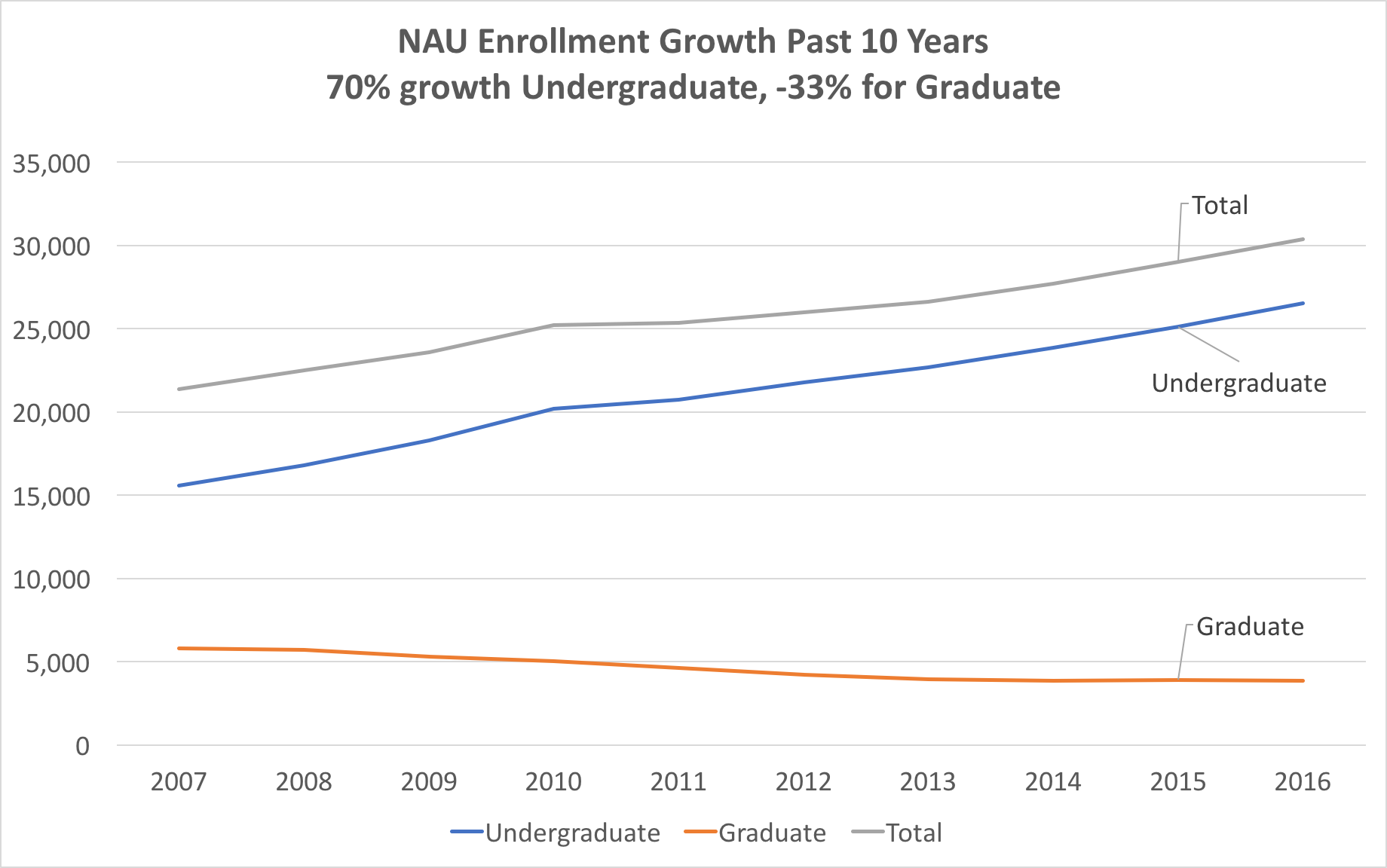
    The core challenge NAU faces is to make these student-facing changes while facing growing enrollment, particularly for full-time undergraduate students.

    enrollment-growth-level
    (more…)