e-Literate

Present is Prologue

Category: Strategy & Change Management

  • California Should Watch Arkansas Process for Creating New Online Institution

    California Should Watch Arkansas Process for Creating New Online Institution

    Two months ago I wrote a post about Governor Brown’s directive for a fully-online community college in California, noting that:

    What this points to is that for a new fully-online institution to get to some meaningful level of enrollment (let’s say 20,000) in the same ballpark as these comparison schools, I estimate it would take a full decade at the least. This is the reason, by the way, that Mitch Daniels and Purdue University made the Kaplan University deal even though Kaplan’s enrollments are dropping. Daniels did not want to wait a decade to get to meaningful enrollment numbers for an online college serving working adults – if everything works out, within a year Purdue will have a fully-online institution serving 30,000+ working adults. That is a big if, by the way.

    This estimate is probably optimistic, however, based on the outlook for eVersity, the fully-online institution being created in the state of Arkansas. The eVersity leaders have decided that they cannot wait for regional accreditation as reported at Inside Higher Ed today [emphasis added].

    When the University of Arkansas System envisioned creating the online-only institution eVersity in 2014, it planned to follow the well-worn path trodden by other public higher education systems in launching fully online institutions: building on the accreditation of the system’s other universities before seeking independent approval from the regional accreditor.

    But come January, eVersity will seek approval from the Distance Education Accrediting Commission — a national body that overwhelmingly accredits for-profit and nonprofit online institutions — rather than the Higher Learning Commission, which accredits all other public institutions in Arkansas and many nonprofit colleges in 18 other states.

    One of the primary factors shaping eVersity’s decision is speed. The regional accreditor told the university that it could take roughly six years for HLC to award its stamp of approval, while DEAC — assuming it affirms eVersity in January — will have acted in just under two years. Institutional accreditation is required for eVersity students to gain access to federal financial aid, and to ensure that their credentials are valued by employers and others.

    The challenge with national accreditation includes severe limitations on students being able to transfer credits out of the school.

    On the issue of speed, [senior policy analyst at the Center for American Progress] Flores noted that institutions waiting for regional accreditation can often apply for federal aid during the candidacy stage of their application, and that students who attend regionally accredited institutions will have a much easier time transferring their credits than those who attend nationally accredited ones. Flores said eVersity seemed like “a little bit of an odd fit” for DEAC, which typically accredits smaller for-profit institutions that don’t offer federal aid.

    The IHE article (very well-written, by the way) described the path chosen by previous fully-online institutions.

    A more conventional route to regional accreditation, however, is to start as a division of an already regionally accredited campus, said Goldstein. This is what the University of Maryland University College did before obtaining independent regional accreditation. Colorado State University Global Campus also went this route.

    [Chief academic and operating officer of eVersity] Moore said that eVersity decided not to do that, as it did not want to be under the academic and administrative control of another University of Arkansas System institution. “We wanted the ability to be nimble and responsive and not burdened by legacy systems, practices and policies. There are certainly advantages to built-in infrastructures, but they also come with a cost,” said Moore.

    Think about the implications – if a state wants a new, fully-online institution to serve working adults, there seems to be four choices before there is meaningful impact in numbers of students enrolled in institution:

    • Establish new, separate institution, choose regional accreditation, be patient in realistic enrollment growth, and expect 10 – 15 years for meaningful impact
    • Do the above but choose national accreditation and limit transfer ability and possibly impact enrollment, and expect 6 – 11 years
    • Establish division of another school using their accreditation, then spin off for separate institution later on, and risk getting caught up in traditional institution’s legacy policies and practices (unknown timescale)
    • Pull a Mitch Daniels and buy an existing online (or mostly online) institution through creative process, risk not being approved due to transfer of control, and risk getting caught up in the online institution’s legacy policies and practices – and expect 2 – 3 years if the bet works out

    California likely faces similar choices with the fully-online college directive being evaluated this fall. This is a legacy-building project, but there will be real pressure to not have to wait 10 – 15 years to start getting meaningful impact. eVersity from Arkansas is going through this same process ahead of time, and the California team should learn lessons by watching what works and doesn’t work in this case.

    More broadly, the IHE article ends with a key point about accreditation needing to change.

    Russell Poulin, director of policy and analysis at the WICHE Cooperative for Educational Technologies, said that accreditors needed to figure out how to accredit new providers more quickly, without compromising on quality. “Accreditation is slow and innovation is fast; we are starting to see political and business pressure to find alternatives,” he said.

    Read the entire IHE article. This subject is important.

  • Fear Itself

    A little over a week ago, I wrote a “recommended reading” post pointing to a piece from Inside Higher ed and The Times Higher Ed called “Fear of Looking Stupid” about research from Carnegie Mellon University anthropologist Lauren Herckis about faculty resistance to “innovative” approaches. (I use quotes here not to imply a value judgement but to indicate that “innovative” was the word used in the article.) The title of the article gives you a pretty good sense of the angle taken by the author. The comment thread on that article was fascinating, as was John Warner’s terrific column in response.

    We are lucky to have a guest post from Dr. Herckis and her colleagues Richard Scheines and Joel Smith with some additional perspective and follow-up information. I took the liberty of adding a title to their post.

    – Michael

    We were delighted that Times Higher Education and Inside Higher Ed reported on the anthropological research being conducted at Carnegie Mellon on the roadblocks to implementation of demonstratively effective pedagogical innovations. We’d like to take the opportunity to expand the conversation.

    Our research exposes multiple factors behind faculty resistance to making changes to their teaching practice, including the institutional barriers encountered by faculty adopting evidence- or research-based practices and especially where technology is involved. There are, of course, many effective teaching practices in use, and current research helps to explain why they work when they do. But that research also points to many other tools and practices that increase teaching effectiveness.

    Our aim is to develop a detailed and actionable understanding of what impedes and what helps faculty adopting research-based practices.

    The idea that faculty are invested strongly in avoiding embarrassment, and are thus sometimes reluctant to adopt innovative tools or practices – as reported in the THE/IHE article – is true. But the story is richer.

    Faculty do not want to waste students’ time; they want to teach well. Using methods that they have honed is therefore important. Faculty learn to teach over years of practice, as most of us have little or no training in teaching. Tried and true methods are appealing because faculty have reason to think that they work.

    If students have seemed to enjoy the material and report learning from the course, why change? Methods that leave students feeling good about the course (and the professor) are appealing, both because they are validating (“yes, I AM a good professor!”) and because happy students provide good evaluations of teaching, which are vital for faculty job security.

    Until we change the incentives and provide alternative sources of personal identity affirmation, faculty will not be motivated to invest time and energy in changing their teaching to adopt practices shown by research to be more effective.

    Our research on implementation of research-based instruction shows that faculty care about their students, and want to ensure that students have a good experience. Yes, some faculty at Carnegie Mellon hesitate to use unfamiliar methods or technology because they don’t want to embarrass themselves in class. Few of us want that. But they also don’t want to waste students’ time if something goes awry, want the validation of satisfied students, take student satisfaction as a sign that things are going well, fear the professional consequences of poor teaching evaluations, don’t think alternatives are a good fit, are sceptical of literature that supports alternatives, and believe that institutional support for alternatives is lacking.

    Innovation for the sake of innovation doesn’t serve faculty or students. But the use of research-based, effective teaching methods does serve students, and it is in our interest to learn how to support faculty in adopting and sustaining the use of such methods.

    To do this, we need to step back, look at the big picture, and address the multiple contributing factors to success and failure in implementing evidence-based practice. Our research shows that systematically incorporating anthropological analysis is an important and rarely used tool for understanding roadblocks to, and enablers of, meaningful innovation in higher education. Without it, we are flying blind.

    The research results that we had time to report in our brief presentation at the Global Learning Council meeting  (and reported in THE/IHE) are only a small part of what we have learned about implementation of instructional innovation. A full report detailing our findings will be available in September 2017 at http://cmu.edu/simon.  Academic articles regarding methodology and results will be submitted for peer review in the coming months; these articles will be shared at http://www.cmu.edu/simon/projects/flagship-projects/barriers-to-tel.html as they are published


    Lauren Herckis is Simon Initiative research scientist and adjunct instructor, Richard Scheines is dean of Dietrich College of Humanities and Social Sciences, and Joel Smith is distinguished career teaching professor, all at Carnegie Mellon University.

  • Enrollment Implications Regarding Directive for Online Community College in California

    A month ago Governor Jerry Brown directed Eloy Oakley, Chancellor of the California Community College System (CCCS) ((Disclosure: The Online Education Initiative from CCCS is a client of MindWires. The views in this and future posts represents my independent views and not OEI’s.)) to “take whatever steps are necessary” to establish a fully-online college. At first glance this directive appears to be a solution in search of a problem, so it is worth looking beyond the headline see what is motivating this move.

    In an article from Community College Daily:

    Noting that the system has significantly expanded the number of online courses, Brown said, “I believe it is time now for our community colleges to increase even further the availability of online courses and degree programs – and make college far more accessible and affordable.”

    Reaching more students

    “The governor has been interested in realizing the promise of online education for a number of years,” Oakley said in an interview with CCDaily. He added that Brown also wants a way to reach more nontraditional students.

    “We have literally tens of thousands of working adults with some college and no credentials and a couple of million working adults who are unemployed or underemployed,” Oakley said. “This is a wonderful opportunity to reach a population that really needs a community college to achieve economic mobility.”

    The details are not yet worked out, and Oakley is pulling together a group to advise on the options available to make this directive a reality, with the recommendations due in November. Oakley’s comments clearly establish access for nontraditional students to be the ultimate driver. In an interview with Inside Higher Ed, Oakley commented further:

    “Part of this is the governor’s desire to reach more students in California through a technology platform,” said Eloy Ortiz Oakley, chancellor of the California Community College system. “The 114 campuses are designed in a traditional manner, so we’re reaching a traditional population that is students coming out of high schools.”

    But a new online-only college could reach students those traditional brick-and-mortar campuses are currently missing — adults who are unemployed or underemployed, he said.

    To achieve these goals of reaching more working adult students, there are some real challenges to address.

    View of CCCS Enrollment Mix

    It is worth viewing the historical headcount numbers available from the Chancellor’s office, focusing on age group to get a better understanding of the status quo.

    The headcount for CCCS peaked in 2009 at 2.93 million students and has since dropped to the current 2.36 million level, a reduction of 19%. Across the state, colleges are looking for ways to increase, or at least slow the decrease, in overall enrollment.

    What is most striking in the data, however, is the shift from older students (age 25 and above, or “adults”) to younger students (age 24 and blow, or “traditional”) for the community college system, with the mix roughly reversed from 25 years ago. Chancellor Oakley and Governor Brown are right to note that the older student population is not being served well, at least if we use actual enrollment as a proxy. And the situation is getting worse, not better. However, while the majority of students in CCCS are 24 or younger, there are also a large number of older adult students. In other words, there appears to be an overlap between the students in the current 114 colleges and the target students for the new fully-online college. This will present quite a challenge for Oakley and other planners to make the following statement from the IHE interview a reality.

    “We don’t want to cannibalize the system, and we wouldn’t want to create a college to take enrollment from other colleges,” Oakley said. “Any solution would have to complement what we do, and it has to have an opportunity to share revenue with the colleges and really enhance their ability to serve students.”

    This statement is sounds good on paper and will be crucial in terms of getting at least tacit support from the current colleges to the creation of a new, full-online college. But the data shows there is not a clear and easy path to serve adult, non-traditional students without affecting existing colleges.

    National Trends

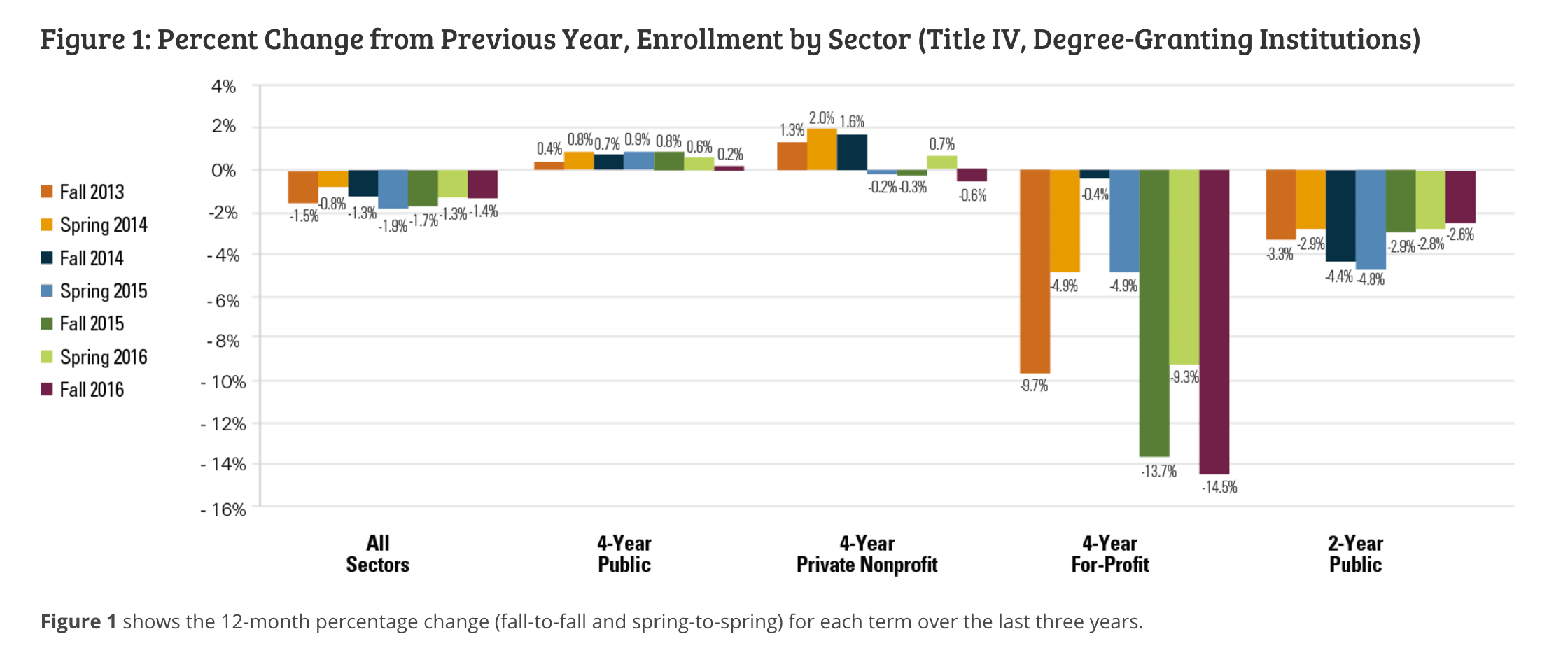
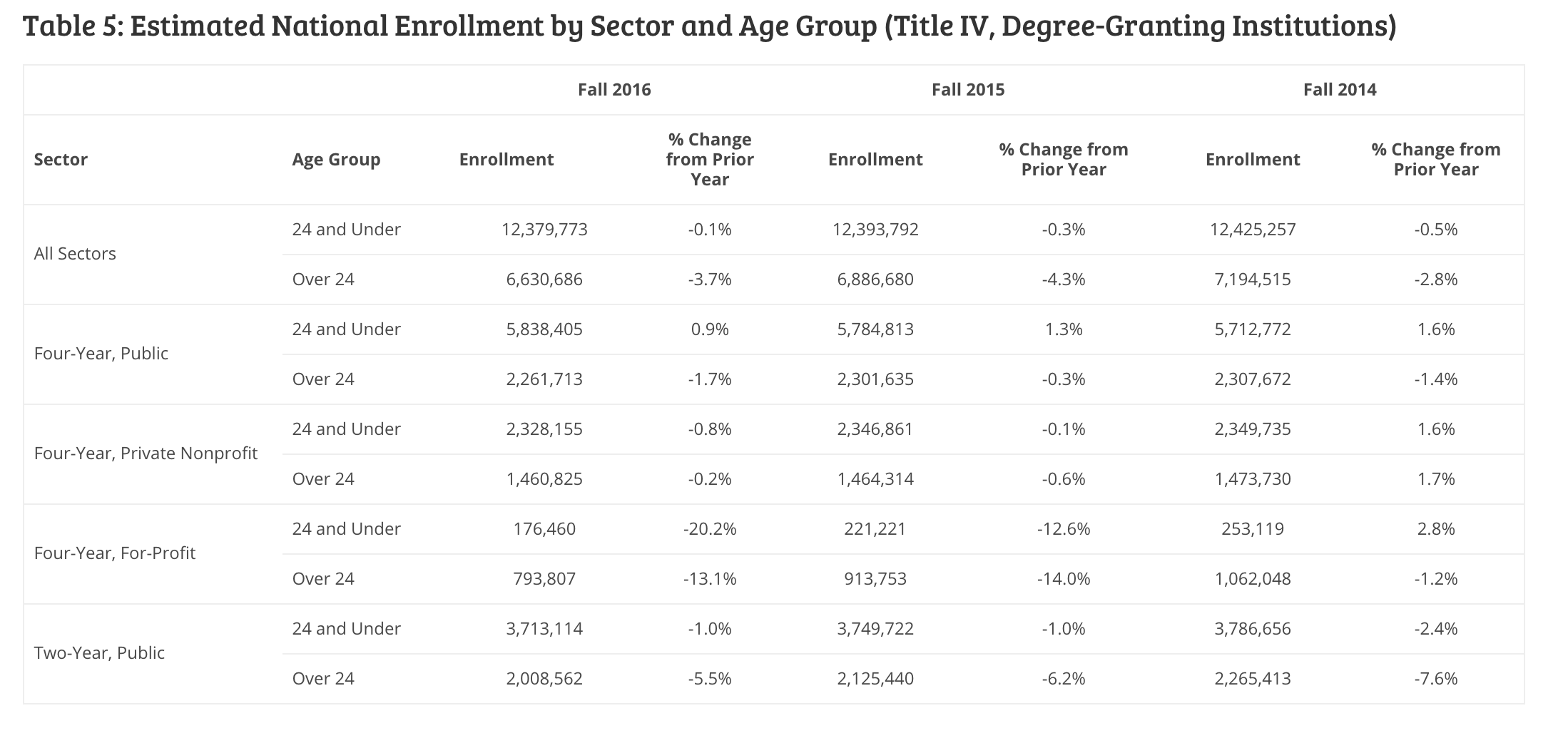
    In this situation California is not alone. The National Student Clearinghouse research for Fall 2016 shows first that community college (2-year public) enrollments have been dropping nationwide.

    And just like in California, adult student enrollment has been dropping much faster than 18-24 year old enrollment. 24 and under groups have dropped 1.0 – 2.4% per year while 25 and above groups have dropped 5.5 – 7.6% per year (see bottom two rows).

    This will be another challenge for the CCCS planning team, as there is no indication that California is screwing up while other states have the same problem figured out – the reduction in community college enrollments, particularly for adult students, appears to be a nationwide demographic trend.

    Comparison Colleges

    Assuming that the plan works out and they find new enrollment opportunities that don’t cannibalize existing college student groups, it is also worth considering how large this college might become. I pulled together the IPEDS data for several of the top-growing online undergraduate colleges ((The comparison colleges might not be exclusively online, but they have become at least predominantly online.)) to get some idea of what the best-case scenario might be in terms of enrollment growth. This data looks at fall enrollment numbers which will be lower than full-year headcount numbers.

    Once we get past the “holy crap, look at Southern New Hampshire University’s (SNHU) growth”, there are a few observations to make.

    • We’ll have to see where SNHU goes, but there has traditionally been a ceiling to the size of online enrollment per institution of around 80,000 – 100,000. The primary exception has been the University of Phoenix that reached a quarter of a million online students back in 2010, but their enrollment has been dropping since then and are more of the exception that proves the rule. All others have peaked well under 100,000 students. Just this spring Liberty University experienced their first recent enrollment drop, leading to staff layoffs.
    • The maximum growth rate of these cherry-picked successful schools ranges from ~1,200 / year for Excelsior to ~7,700 / year for SNHU (note that Rio Salado at ~1,400 / year is the only public institution). Add to this the fact that all of these schools have been around for decades. No accreditation issues, no time-consuming establishment of core leadership team, etc.
    • There is a big difference in dealing with institutional issues and statewide issues, particularly in California. One in five US community college students in the US do so in California, and the statewide issues tend to come in large numbers. Statewide issues tend to come in hundreds of thousands while institutional issues tend to come in tens of thousands.

    What this points to is that for a new fully-online institution to get to some meaningful level of enrollment (let’s say 20,000) in the same ballpark as these comparison schools, I estimate it would take a full decade at the least. This is the reason, by the way, that Mitch Daniels and Purdue University made the Kaplan University deal even though Kaplan’s enrollments are dropping. Daniels did not want to wait a decade to get to meaningful enrollment numbers for an online college serving working adults – if everything works out, within a year Purdue will have a fully-online institution serving 30,000+ working adults. That is a big if, by the way.

    None of this analysis is to argue that CCCS should not try to establish a fully-online college. The goal of better serving nontraditional populations – adult students with and without jobs – is worth pursuing on its own merits.

    The numbers do argue, however, for a realistic view on the challenges they face:

    • Fighting against national demographic trends for adult students of community colleges;
    • Trying to avoid cannibalizing enrollment from existing California Community Colleges;
    • Having the patience to support the schools while it take years to grow to a size with meaningful enrollment levels; and
    • Accepting that best case this approach probably recovers less than 10% of the enrollment drop since 2009.

    I would hope that the CCCS planning efforts take the hard numbers into consideration when searching for different options to satisfy the governor’s directive.

  • Recommended Reading: Fear of Looking Stupid

    Inside Higher Ed has summarized some findings of a study by Carnegie Mellon University anthropologist Lauren Herckis about why faculty hesitate to try new teaching practices. (The article in IHE uses the word “innovative,” but I find that word loaded, and since I don’t know if or how it was used in the study itself, I’m going to avoid it for now.) The one that made the headline of the article is faculty being afraid of looking stupid in front of their students, but two other important ones were fear of punishment from bad course evaluations (or “smile sheets,” as they are sometimes derogatorily called) and deep “gut” convictions based on personal experience that they know what good teaching is and will prefer that instinct over the findings of a research article. Read the comment thread as well as the article; the discussion is fascinating (and tends to back up the latter two findings).

    We happened to interview Dr. Herckis for e-Literate TV a while back, and here she is making a related observation:

    I also recommend reading John Warner’s response in IHE about the necessity of being comfortable looking stupid. Great stuff.

    A couple of commenters on the original IHE article asked for a link to the original study. I don’t have one at the moment and am not sure it’s been published yet but will post it when it becomes available.

  • Setting a Standard for Explanations in Learning Science and Ed Tech

    Setting a Standard for Explanations in Learning Science and Ed Tech

    Via John Gruber, I was struck by this quote from David L. Goodstein in his book Feynman’s Lost Lecture:

    Feynman was a truly great teacher. He prided himself on being able to devise ways to explain even the most profound ideas to beginning students. Once, I said to him, “Dick, explain to me, so that I can understand it, why spin one-half particles obey Fermi-Dirac statistics.” Sizing up his audience perfectly, Feynman said, “I’ll prepare a freshman lecture on it.” But he came back a few days later to say, “I couldn’t do it. I couldn’t reduce it to the freshman level. That means we don’t really understand it.”

    First of all, I love what this says in general about the relationship between teaching and academic work. My high school English teacher Mrs. Galighani used to say, “If you’re not writing clearly, then you’re not thinking clearly.” Feynman takes this to the next level. If you can’t explain your research clearly to a smart novice in a manageable amount of time—say, the amount of time you have in a single lecture period—then maybe you don’t fully understand what you’re talking about. And not just you, but maybe even your entire field.

    I’ve certainly found that to be true in both educational technology and educational research. I’ve read a lot of academic papers that sling a lot of statistical lingo to obscure the fact that they haven’t actually proven anything. Actually, that’s not entirely fair. I think some authors get so buried in the lingo and the details that they don’t actually realize that they haven’t proven anything. The same is true, by the way, with many of the theoretical papers in the constructivist camps that get all wrapped up in French literary theory and add the suffix “-atized” to every third word. Clarity is hard. Even Feynman didn’t know that he didn’t fully understand why spin one-half particles obey Fermi-Dirac statistics—indeed, that nobody did—until he tried and failed to boil it down to a freshman-level lecture.

    On the other hand, we get marketing copy or press summaries of summaries of summaries that completely lose the original thread, never mind the nuance. Again, I suspect in most cases the authors don’t know that they are dumbing down the research. They are working on deadline, with a word count limit, and a finite knowledge base.

    The end result in both cases is the antithesis of enlightenment. If we are to move education forward, then there has to be a social contract between those who do the research and those who could use it in the classroom. Authors must commit to communicating clearly to laypeople—to reducing their research to the level of a freshman lecture. In return, people consuming that information must be willing to commit the time and effort that they would hope and expect from freshmen sitting in on one of their own lectures.

    There is a role here for “media,” writ large. At e-Literate, we make an effort to make complex research accessible to laypeople who are willing to invest in reading an 8,000-word article. We also attempt to recover information that is lost in translation when academic studies get boiled down so far that there’s nothing left in the pot. But we’re not going to solve the larger problem with a blog. Academia needs to embrace the notion of education as an applied science, which means we need to generate both supply and demand for Feynman-style explanations of what we are learning about learning.

  • Do For-profit Institutions Converting to Non-profit Affect Distance Education Enrollment Numbers?

    Do For-profit Institutions Converting to Non-profit Affect Distance Education Enrollment Numbers?

    In a comment to my post on the new Digital Learning Compass report covering distance education enrollment trends for US higher education, Richard Garrett, Chief Research Officer at Eduventures and Director at The Observatory on Borderless Higher Education, asked an interesting question.

    I’d welcome your view on a related issue I’ve been wrestling with, namely how to treat for-profit institutions with significant numbers of online students that are now nonprofit. A number made such a conversion in the fall 2012-15 period, and more are to come (e.g. the EDMC and Kaplan announcements). In your study, did you use institutional control for the year concerned or continue to treat former for-profits as such? If the former, then I think it is worth pointing out that some of the private nonprofit growth, and for-profit decline, is due to control conversion.

    With all of the news around for-profit changes, include Corinthian Colleges, ITT, Kaplan University, DeVry rebranding, I thought it would be worth addressing this question in a new post instead of just in the comments as I suspect others may have the same question.

    tl;dr – There has been no material effect of these institutional control changes for the periods covered in the DL Compass report (Fall 2012 through Fall 2015). (more…)

  • Digital Learning Compass: New report on distance education higher ed enrollments

    Digital Learning Compass: New report on distance education higher ed enrollments

    The next generation of the long-running Online Learning Survey is here, and it is now called Digital Learning Compass. Originally known as the Sloan Survey of Online Learning, then known as the Online Learning Survey, this study led by Jeff Seaman and Elaine Allen from the Babson Survey Research Group (BSRG) has been the definitive source for understanding the state of online learning for higher education in the United States since 2003.

    Three years ago the Department of Education’s Integrated Postsecondary Data System (IPEDS) started releasing census-based data on online enrollments, starting with the Fall 2012 term. The most recent data set is from Fall 2015, and today’s release of the Digital Learning Compass: Distance Education Enrollment Report covers this new data. Download the full report for free here. (more…)