The “Business & Economics” category covers the business aspects of ed tech, including the financial health and business models of individual companies, economic aspects of selling in education that shape the available offerings, and coverage of markets and investment.
In one of our premium versions of the LMS Market Analysis services, targeted primarily at the investment community, we have noted since early summer (starting in June 2018) that the global LMS market appears to be slowing down for higher ed. Given our public market analysis role and given the trend now lasting more than half a year, this news seems more than just a note for investors.
Based on CFO Steven Kaminsky’s comments during Instructure’s quarterly earnings call, we’re not the only ones noticing:
So for renewals what we’ve seen specifically this year is fewer large deals in the multi-hundred thousand dollar range than we’ve seen in previous years. It’s a little still too early to talk about 2019, we’ll be doing that in a few months but we have seen that and when I referenced earlier that it didn’t look like we’re going to grow domestic Canvas by much of it all, that’s what I was really referring to, that’s the key driver there.
A recent analysis note from Brian Peterson at Raymond James shared similar observations.
Our proprietary higher-ed North American LMS tracker pointed to a notable slowdown in large deal activity in 2018, with full year levels (as defined by the number of students) down in the double digits.
But first a note about our data to help readers determine how to interpret the description of this trend.
Along with new implementations (changes from one LMS to another at a particular institution), we also track what we call “First Seen” data. This captures how many LMS decisions we capture in a given month, and over time this metric acts as a leading indicator of implementation changes. This data is broken down by global region (North America, Europe, Latin America, and Australia / New Zealand are currently covered), LMS provider, and enrollment band (to capture institution size).
What we noted in Summer 2018 was a fairly dramatic drop in First Seen data, particularly in North America. Over time, we also noted a change in Trailing 12 Month data from New Implementations (total of previous 12 months for each measured month to smooth out market seasonality). For Dec 2018 T12M data, capturing the full 2018 calendar year, the activity of new implementations is roughly 20 – 25% lower than it was a year prior.
Some notes on the data shown described and above:
Even with T12M data smoothing, the trends are still somewhat lumpy, which is the nature of academic markets.
The market for implementations seems to have peaked at the end of the spring 2018 academic calendar and then dropped to current levels that represent a plateau rather than ongoing downward trend.
To allow reasonable comparisons over time, the data above represents T12M as we knew it at the time. The data is not a full set, as it does not contain implementations we discovered more than a month after the reported month, so the key is to look at trends and not absolute levels.
There are other factors to consider that impact company finances, such as the ongoing enrollment declines in North America, particularly among for-profit or formerly for-profit institutions, but we now have two different variables both pointing to at least a temporary dropping of activity.
It’s premature to determine whether the slowdown will continue or whether market activity will rise again in 2019. We have some statistical and anecdotal indicators for both cases but are not ready to predict yet.
Hopefully this data description of market activity hasn’t been too tedious, but there are strong arguments that company financial health in 2018 / 19 for the providers will continue to have an outsized impact on the future of LMS offerings.
One month ago the Education Corporation of America (ECA) was the latest for-profit system to shut down, as described by Inside Higher Ed:
Education Corporation of America owns more than 75 campuses and enrolls at least 20,000 students in mostly certificate-granting professional disciplines such as cosmetology, culinary arts and medical and dental assistant programs. It operates chains including Virginia College and Brightwood College.
Adtalem Global Education (NYSE: ATGE), a leading global education provider, today announced the completion of the transfer of ownership of DeVry University (DVU) and its Keller Graduate School of Management to Cogswell Education LLC. Today’s announcement closely follows Adtalem’s disclosure of the transfer of ownership of Carrington College to San Joaquin Valley College, Inc. (SJVC Inc.) which was completed on Dec. 4, 2018. Post divestitures, Adtalem Global Education’s U.S. postsecondary degree-granting institutions serve the high-demand, rapidly growing medical and healthcare markets.
The centerpiece of Adtalem’s remaining portfolio ((Disclosure: Adtalem is a former client of MindWires and past subscriber of our LMS Market Analysis service.)) is Chamberlain University, a growing system of nursing-based programs, and a look at the underlying data reveals that Chamberlain is one of only two large for-profit systems with significant growth.
Given all the changes in for-profits, we tend to see either anecdotes about specific institutions or aggregate data on all for-profits combined. What is missing, though, is a view in between, showing enrollments and changes to a select group of for-profit schools, to help understand the different fates of different institutions.
Why does this matter? For one, many for-profit chains are accredited as a number of different institutions, and they need to be combined to understand overall company strength. Second, following Tolstoy’s idea that “All happy families are alike; each unhappy family is unhappy in its own way”, the decline of for-profit institutions has a number of unhappy families with different lessons. In the case of ECA there is something unseen in other cases – ECA abruptly shut down despite growing enrollment by 32% year-over-year across Virginia College and Brightwood Colleges in the most recent IPEDS.
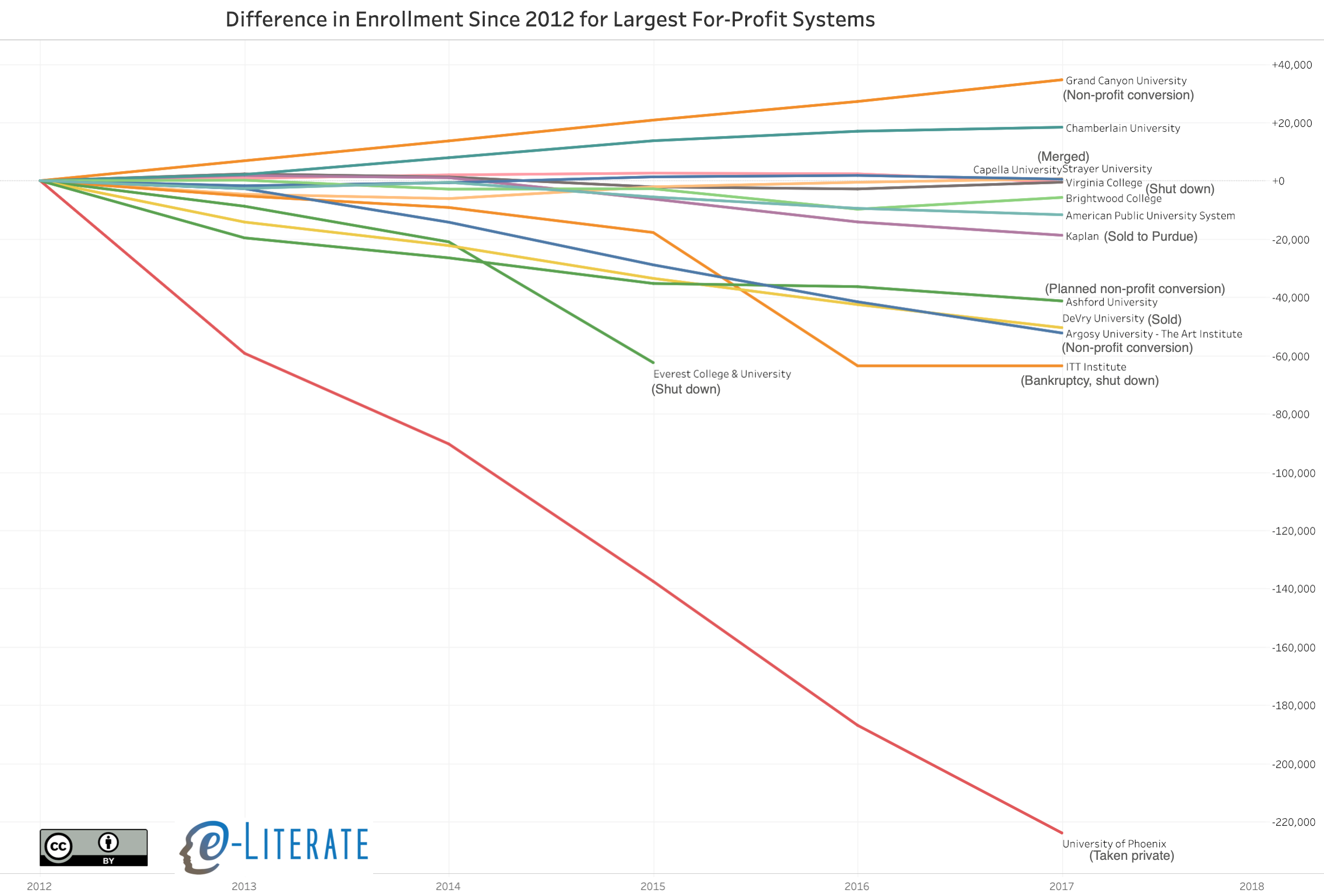
The chart below shows differences from the Fall 2012 IPEDS enrollment report (grad + undergrad) for the 13 largest degree-granting systems as of that date, running through the Fall 2017 report (the most recent data available). I’ve added notes to show the various changes in ownership, control, and status for these systems – converting to non-profit status with a for-profit operating entity, merging of institutions, sale of institutions as with DeVry, going bankrupt withy full shut-down of systems, or taking the company private as with the U of Phoenix. Click on image for full size version.
Some notes:
To read the chart properly, note that Chamberlain University had almost 20,000 more students in Fall 2017 than they had in Fall 2012, while DeVry University had roughly 50,000 fewer students in that same time period;
Seen together, it is startling the extent of changes in ownership, control and status among these former high-flying for-profit systems;
The only significant growth for these large systems came from Grand Canyon University and Chamberlain;
The changes to Virginia College and Brightwood College are not that significant; and
By far the largest decrease in enrollment has been the University of Phoenix.
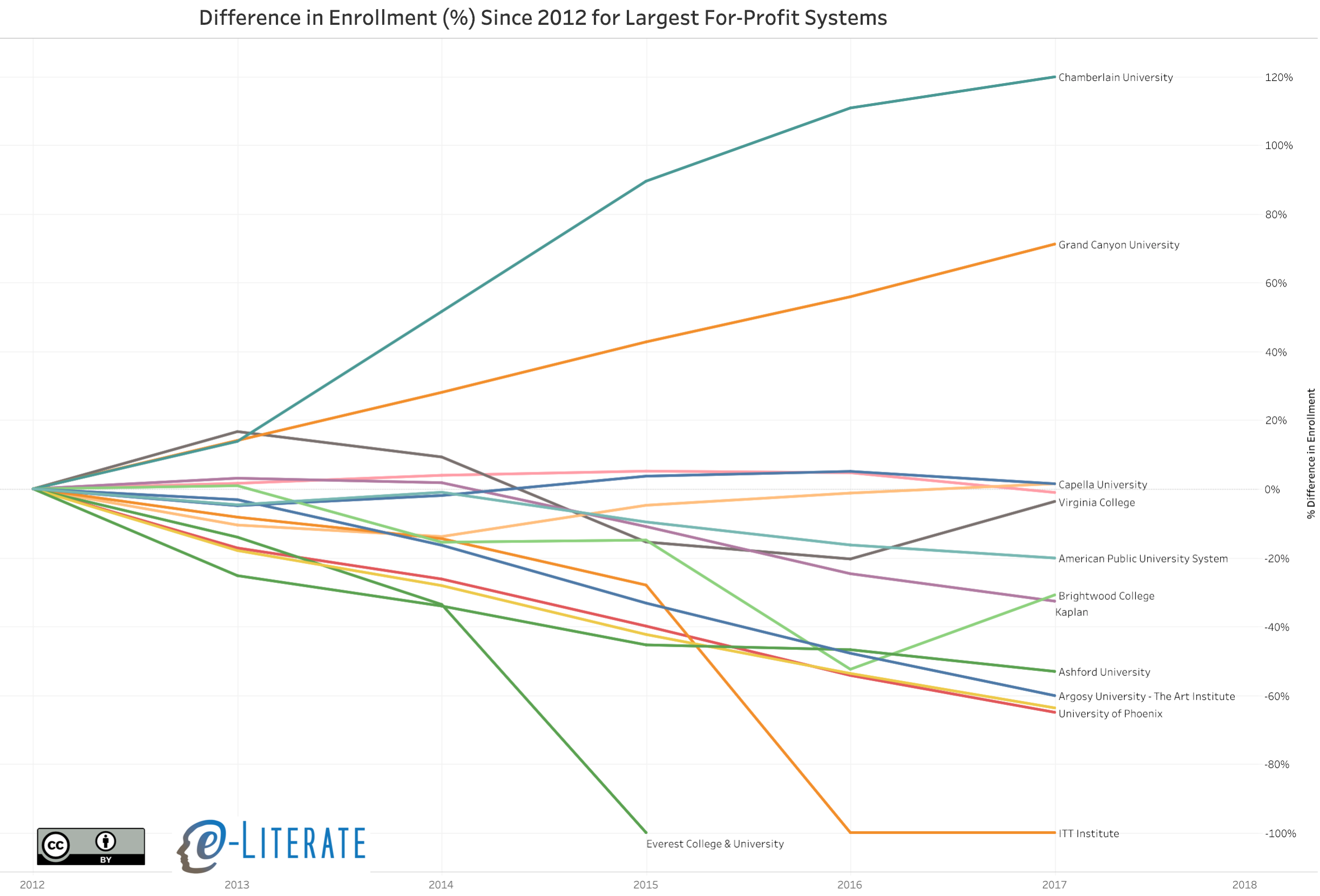
While that view shows enrollment changes in total numbers, it is also useful to see relative changes for these same systems since 2012 to take into account the different enrollment sizes of the systems.
Some notes:
To read the chart properly, note that Chamberlain University grew roughly 120% from Fall 2012 to Fall 2017, while DeVry University shrank more than 60% in that same time period;
In percentage terms, Chamberlain’s growth exceeds Grand Canyon University’s, which surprised me, but it seems to be leveling off;
Likewise, in percentage terms, DeVry University’s decline is roughly the same as the University of Phoenix’s;
Virginia College and Brightwood College actually grew from Fall 2016 – Fall 2017; and
We can see the shutdown of Corinthian Colleges (Everest) and ITT with 100% declines (ITT reported data in 2016 and 2017 even with no students).
Let’s focus on just the four brands mentioned in last month’s stories – DeVry University & Chamberlain University for Adtalem, and Virginia College and Brightwood College for ECA.
With this view, Adtalem’s strategy of selling DeVry while keeping Chamberlain makes a lot of sense, even if several years late and if they essentially gave away DeVry.
ECA’s shut down, however, is not easily explained by the data. Unlike ITT and Everest, Virginia College and Brightwood College were not in enrollment free fall, and in fact there was instead recent enrollment gains getting them roughly back to 2012 levels. So why such an abrupt shutdown of ECA? The answer seems to lie with how the Department of Education and its accreditor handled recent troubles, based on IHE reporting.
The shutdown follows years of declining enrollment for the chain. More recently, the privately held company scrambled to turn around its troubled finances by closing about a third of its campuses and pursuing a corporate overhaul through a court-approved receivership. But ECA continued to be dogged by creditors after falling behind on payments and rent for many campus locations. In October the company filed a lawsuit, which was later dismissed, against the U.S. Department of Education in an attempt to maintain its access to federal student aid.
In an email to campus employees Wednesday morning, ECA CEO Stu Reed said that the Department of Education had added new restrictions on its access to Title IV student aid. And on Tuesday night, the Accrediting Council for Independent Colleges and Schools suspended the colleges’ accreditation. Those steps meant the company couldn’t secure the additional capital needed to operate its campuses, he said.
I do not have enough knowledge to judge whether the ED should have shut off access to financial aid at the time that they did, but it does appear that students are paying the price despite signs that the schools were making significant enrollment gains. From the news coverage, there were significant outcomes issues beyond financial health of the parent company, but to my knowledge, this is a new situation among for-profit colleges in having a shut down despite very recent enrollment gains.
Nine months ago we wrote about the new movement for the companies formerly know as “for-profits” in the education space to convert the actual schools into non-profit entities and declare their intent for parent companies to become a new form of Online Program Management (OPM) providers. Kaplan University, Grand Canyon University, Ashford University (Bridgepoint Education) all made similar declarations, but the problem was that each one was a single-client OPM – serving only their supposedly independent non-profit schools. That’s not much of a new market segment.
Today the movement became real as Grand Canyon Education announced their agreement to buy Orbis Education Services for more than $362 million.
Grand Canyon Education, Inc. (NASDAQ: LOPE), a publicly traded shared services partner dedicated to serving colleges and universities, announced today that it has entered into a definitive agreement to acquire Orbis Education Services, LLC, an education services company that supports healthcare education programs for 17 regionally accredited universities across the United States (“Orbis Education”), for $362.5 million in cash. The transaction is expected to close during the first quarter of 2019, subject to customary closing and regulatory conditions.
The acquisition combines the strengths of two of the nation’s most innovative service providers in higher education in an effort to align their expertise and better address a nationwide shortage in licensed healthcare professionals.
“This is a natural extension of what Grand Canyon Education is already doing as an education services partner,” said Brian Mueller, GCE’s CEO. “We are very impressed with the quality of nursing and healthcare education that Orbis Education’s client institutions are providing. GCE can help grow that by providing investment capital and advanced technologies with behind-the-scenes support that will help University partners accomplish their goals and increase the number of licensed healthcare professionals they educate with the same high-quality outcomes.
While they use the phrase “education services partner” instead of OPM, Grand Canyon in one move became a competitive provider worth watching. This news is significant.
The large for-profit chains all developed scalable processes for the same functions that OPM vendors provide for non-profit schools – marketing & recruitment, course & curriculum development, technology platform & data analysis, and student support & retention services – and the basic idea of this market change is for the for-profit parent companies to provide these same services for other non-profit schools. With the Orbis acquisition, Grand Canyon will pick up 17 partner institutions.
Orbis Education is a niche-market full-service OPM provider serving pre-licensure healthcare programs (mostly nursing) and was founded in 2003. Parter institutions include Concordia University, Northeastern University, Marquette University and Mercer University.
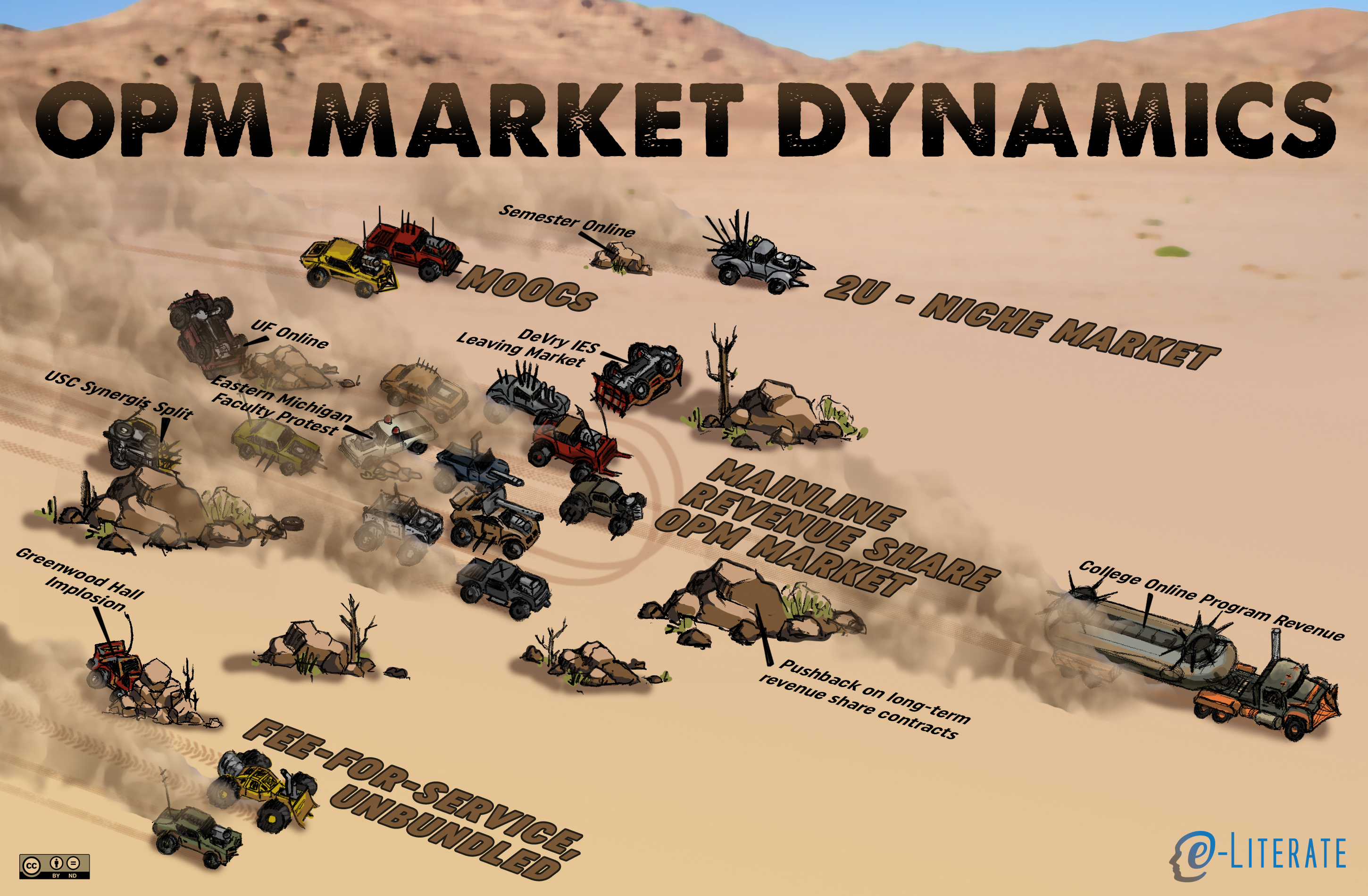
In a broader sense, this acquisition follows the Wiley acquisition of Learning House for $200 million announced this fall. We’ll need to update our graphics, but the OPM market is profitable and growing, but it is also messy and chaotic. OPM vendors are in a battle to have the financial strength and customer scale to survive the chaos and grow in an expensive model.
We’ll follow this story and others like it while sharing information on the likely impacts on the overall OPM market. For now the biggest issue is establishing that this for-profit-turned-OPM segment is real.
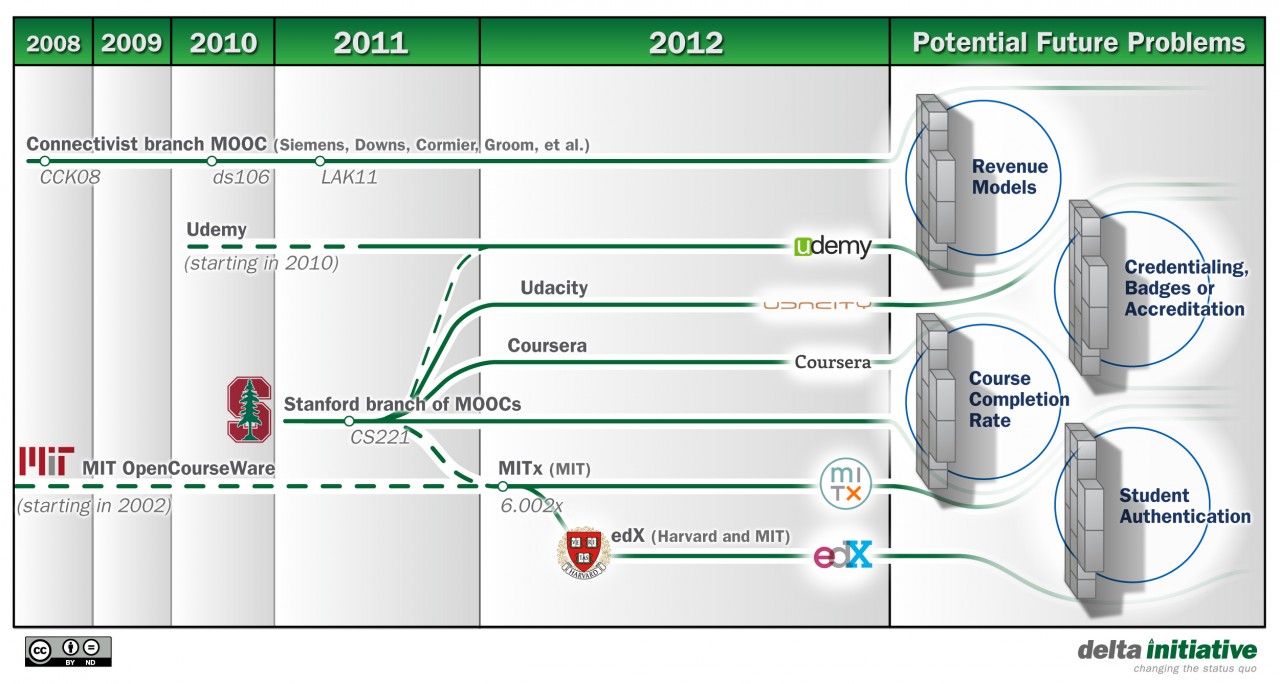
In mid 2012 during the midst of MOOC mania, I wrote a post noting that we should pay attention to future generations of the concept and that there were four barriers that the MOOC vendors would have to overcome to have any long-lasting impact.
Given this short timeline and the nature of investment-backed educational experiments, I think the real focus should be on whether and how MOOCs or successor models build on current scalability and openness while overcoming these four barriers.
Six years later, it is becoming increasingly clear that the next-generation model for MOOCs in higher education is to become a form of Online Program Management (OPM) providers, including the near-term focus on master’s degrees. The OPM market has demonstrated revenue models (tuition revenue sharing mixed with fee-for-service), the end credential is the already-accepted degree, course completion rates are higher for paying and matriculated students, and degree programs have methods for student authentication. In other words, the MOOC-based OPM model is the next-generation designed to address these challenges.
The shift into the OPM market has been documented in a series of posts in July of 2017, March, April, and May of 2018; and from Dhawal Shah from Class Central . In the May e-Literate post:
The picture one gets is of a chaotic market that is not for the faint of heart, and one that will likely see further consolidations and category changes. 2U, for its part, has been successful partially due to a niche strategy where they go after elite master’s programs and mostly avoid direct competition or engagement with the rest of the market. And recently we have started to see the MOOC providers become OPM providers – where the primary revenue for Coursera and FutureLearn are based on revenue sharing with online programs, albeit with lower sharing rates and with very different marketing approaches. In other words, there seems to be several efforts to enter into the same OPM race, but if possible to avoid being in the mainline rev-share OPM market.
Last week Julia Stiglitz from GSV Advisors, in their first podcast episode, interviewed Coursera CEO Jeff Maggioncalda who joined the company summer 2017. This interview gives the clearest view yet of Coursera’s emerging business model, and by extension it helps explain the new subset of MOOC-based OPM that includes FutureLearn, edX, and Udacity as vendors. ((Outside of Georgia Tech legacy contract, Udacity has moved to corporate professional development market, which is a different approach to same problem.)) I think that the media narrative of tuition revenue-sharing vs. fee-for-service OPM models is overblown, especially since there is a spectrum in that respect more than a binary choice of OPM vendor types. What the MOOC-based OPM entry introduces is a more fundamental characteristic of how traditional institutions develop online programs – namely low-cost vs. full-cost online degrees.
The first note from the interview is that the Coursera of 2018 is not the Coursera of 2012. While Maggioncalda still shows aspects of that old-time MOOC belief system, his approaches are very much rooted in focusing Coursera on a solid business model. And the difference shows. The second note is that 2U’s success in the OPM market and a successful IPO had a big influence on Coursera’s shift. [Emphasis added in transcript]
Julia: You know when you first joined. You spent some time looking at Coursera’s strategy, and really digging in and looking at the different businesses that Coursera had, and one of them that you were particularly attracted to, and you have put increased attention on here at Coursera is the online degrees business. What was it about online degrees that excited you?
Jeff: Yeah. This is sort of I think another good example of what good entrepreneurs have to do, is you have to have feedback loops; you need to get information from multiple sources to understand the nature of a problem so that you can come up with solution. The nature of an opportunity so you can develop a strategy to go after it. It’s really actually pretty simple. I came in – you were on the team, too, we did a lot. We call them deep dives. We went all through the business model, and there’s a great book Business Model Generation that really, to me, gives a nice framework for saying this is what a business model is. It is a target customer. It is a value proposition and offering that solves their needs. It’s a set of channels of how you acquire those customers. It’s a servicing models of how you service the models. Internally it’s the key activities and resources you bring to bear on that. It’s the partners that you work with. It’s the financial revenues and costs, and is your competition. So and that’s the framework. And we stepped through every one of those. I wrote 250 questions across that business model that we as an executive team went through. You know step by step by step, so that everybody learned the nature of our business. And what became very obvious is we had a few things that nobody else really has.
We had 36 million learners, at the time it was 25 million. 25 million learners from all around the world. That’s a pretty big asset. We had university partners. Now there are competitors out there like LinkedIn Learning, previously Lynda, like PluralSight, like SkillSoft. You know there’s YouTube, there’s Khan Academy – there’s a lot of content out there. You were one of the ones who told me in one of those early meetings, “Hey we’re worried that content, generic content, might become a commodity.” Well, we don’t want to play a commodity game. So what is it about my partners that’s super distinctive? Well our partners are universities, and they’re not just the universities, they’re the best universities in the world, and they’re spread around the world. So you say, well I’ve got a resource that almost no one has, which is this network of universities. Right now they’re publishing MOOCs, and there’s something special about MOOCS, but MOOCs are a little more susceptible to that commoditization just as MOOCs. But what was not very susceptible to commoditization are degrees. So that’s OK. We have an asset nobody else has, and what they do really well is degrees, and they still have market sizing. How big is the market for degrees? 1.5 trillion dollars. Okay, well that’s a pretty big opportunity. And then you say, what’s the likelihood that that industry could be transformed due to technology . . . You know, some industries it’s easier to transform, others, it’s harder. The provision of education is absolutely set up nicely to be enhanced, transformed by technology.
I think Uber and Lyft were really smart when they said “you know on-demand transportation, called a taxi, it’s a big market, but it’s a broken product. And if we just do some sort of digital view of this kind of redesign what on-demand transportation looks like, it’ll be a much bigger market.” I’m looking at degrees, I’m not saying it’s broken altogether, but if you look at the student debt out there, you look at the the lack of access, and you look at how inconvenient it is for people to have to stop their lives – especially for master’s degrees – quit their job, move their family, pay hundreds of thousands of dollars, forfeit their income. That’s a broken product. So I thought we got partners who are really good, and a massive economic opportunity, and a product that is just ready to be dramatically improved by technology, and so I thought this is pretty good. We should go after this. By the way we also had 2U trading at like a 12 times forward multiple. So clearly Wall Street loved the idea of online degrees, and 2U’s been doing great. They’re growing really rapidly, so there’s a data point out that says, hey this company is doing really, really well; We should be able to do pretty well here, too.
Julia: Could you share a little bit about what this redesign looks like? Because the online degrees aren’t new. You know 2U is doing them. And before 2U there were a whole set of online degree providers that were out there, so why is what Coursera is doing different?
Jeff: Yeah I think it’s a few things. The number one, I would say, is quality. When I say quality, I mean the quality of the credential. So a lot of people have spent a lot of money on for-profit college degrees that just don’t have very good credential value, they’re not recognized in the job market. You pay a lot of money, you don’t get much back for it. One of the reasons that people pay so much for the top universities is that those types of degrees means something in the job market. There have been a lot of online degrees out there, from universities, that charge a lot and don’t get you very far. Our partners happen to be the best universities in the world, with the highest credential value in the world. When these degrees come online, and these degrees online are the same degrees as on campus, you’re getting something as a credential that’s extremely valuable. That should have a very high ROI. Because we’re doing it online the cost is often less than half. So it’s a top quality credential at half the price. Same credential you get on campus.
Different Assumptions on Tuition
There’s a lot of useful insight in the full interview, but I’d like to call out the fundamental question that gets raised about online education with this market view. Should online degrees from traditional universities cost the same as face-to-face offerings, or should they cost significantly less?
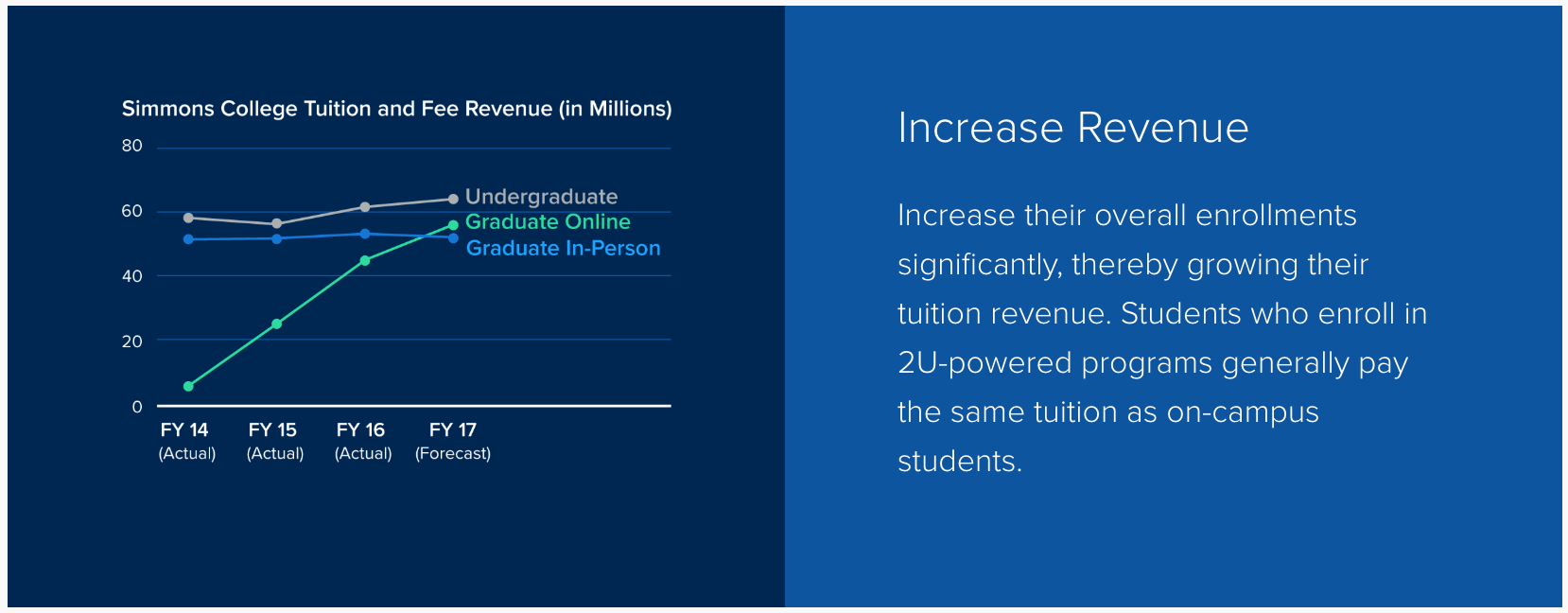
For full-service revenue-sharing segment of the OPM market, some core assumptions are built on the assumption of high revenue share percentages and full-priced online degrees. 2U is probably the best-known and arguably the most successful OPM company, and like Coursera they target elite institutions as partners. In 2U’s website under “Our Approach” they describe how their online programs typically charge the same as on-campus programs.
Most of the full-service revenue-sharing segment of the OPM market is similar in its view, whether from Pearson, Wiley, Academic Partnerships, or others – relying on consistent tuition as for online programs, and if there are lower prices they tend to be marginally lower. ((Disclosure: 2U and Pearson are sponsoring participants in our Empirical Educator Project.)) The Coursera approach is in direct contrast with this view, based on the interview as well as several of their online degree programs. There are arguments for either approach. With full-cost tuition, the idea is that the online degree gives at least as much value to students as the face-to-face, or on-campus, degree, and therefore students will be willing to pay the same. With low-cost tuition, the idea is that while students get the same value, “because we’re doing it online” the costs should necessarily be lower. Online infrastructure and marginal costs are much lower than investment in physical facilities. The point here is that this is a fundamentally different set of assumptions.
For most, the initial appeal of the program was certainly the price tag. Illinois’ iMBA costs a fraction of a degree from an elite school, where the median cost is roughly $171,000 and can break the $200,000 mark at the far end of the scale. Illinois’ own residential two-year MBA costs more than $100,000. Arshad Saiyed, executive director of online programs at the Gies College, acknowledges that the low cost brought the program to many prospective students’ attention — but says the iMBA has kept students around through a combination of high-quality instruction and successful community building.
Different Assumptions on Student Recruiting
For OPM full-service vendors, the largest expense is typically marketing and sales – i.e. recruiting potential qualified students. The predominant approach to OPM student recruitment has been based on digital marketing – advertising and outreach on social media platforms, search engine placement, digital advertisements in articles. With the MOOC-based OPM subset of the market, there is now an alternative approach based on having a multi-sided platform model. Coursera views their 36 million registered learners as an asset – a natural base of potential students for online degrees that can be reached without external advertising. In addition, the original aim and design of large-scale MOOCs is based on ability to easily sign up new learners for low- or no-cost, with the opportunity to move these students into higher-cost credentials and degrees over time, not requiring full financial commitments from students up front. While a Coursera or FutureLearn might use digital marketing for recruitment, that is not their primary method.
Different Assumptions on Course Size
Related to the above assumptions, in 2U’s case the class size is small – typically 10 – 20 students leveraging the platform’s design around small discussion groups, using both synchronous and asynchronous learning. This 2018 article about Washington University’s two programs partnering with 2U partially describes this approach.
But what is it like for student to pursue a graduate degree in law fully online? How could a pre-recorded lecture support the active teaching that’s integral to discipline? After all, watching a video isn’t the same as participating in a conversation. To support such engagement, 2U created a new tool.
“Through building an online LLM [master’s of law] program with Washington University in St. Louis, we learned how to design one of the most important tools we provide today: the bidirectional learning tool, or BLT,” said Chip Paucek, co-founder and CEO of 2U. “Socratic-style teaching is fundamental to all law curriculum and coursework. As such, it was imperative for us to design a way to conduct Socratic-style group discussions for Wash U once we signed their online LLM program.
“What we didn’t realize is that while we were developing a software tool to help solve the challenge of teaching the Socratic method online, we were simultaneously creating a way to facilitate discussion-based learning in an asynchronous environment that would eventually be used in all of our future partner programs.”
The approach that 2U and Wash U Law conceived relies upon the ingenious integration of asynchronous and synchronous course components. Instead of lecturing from a podium, faculty address small groups of student actors. At key points, the instructor breaks the fourth wall and addresses the online student, who is prompted to answer without the benefit of knowing how his or her peers have responded. In other words, students can’t piggyback like they might in an in-person class.
After responding, online students can review one another’s answers. They might be prompted to answer follow-up questions, or they might be asked to come to the next live class prepared to defend whatever position they’ve chosen. The preparatory work that might otherwise happen during an in-person class is accomplished in advance through the pre-recorded sessions, enabling faculty to make better use of live, synchronous time.
In contrast, consider a Class Central interview with Maggioncalda when talking about scaling and its challenges.
I think about systems. As the system gets bigger, where would the bottlenecks emerge? My sense is that the bottlenecks will emerge in live sessions and in grading. That’s my guess. The grading, I’m actually not so concerned about because I think the ability to automate grading at scale will become pretty good. The live sessions get tricky. From a technology perspective, I’m not that worried about it. It’s the professor’s time and attention. My thought is it’s going to be a little bit like pyramid, where the number of hours that the main professor puts in won’t really change. If you think about how medical systems have worked, a doctor is in the system, but the number of minutes and hours that a doctor spends [with each patient] becomes an increasingly smaller portion of the total time [during which medical treatment is being delivered]. I think it will probably be somewhat similar for education. The size of the classes could be big, let’s say 10,000. But that will be broken into sections of say 50. And each of those sections has an expert who’s probably not the professor. Also, there will be a lot more collaborative learning among the peers in the class. If you think about it, a lot of learning does actually happen among the folks in a class. The expert just dispensing wisdom is not the way most learning happens. I call it “high engagement learning at scale.” A major piece of high engagement learning at scale is utilizing your classmates to provide a highly valuable learning experience.
Coursera is pursuing a path to enable high enrollments in low-cost programs, and they view their challenge to balance scale and student engagement, with class sections of ~50 students.
Good Enough vs. Better Enough
In twoposts recently, Michael described a battle in the digital curricular materials market. Focusing on Cengage Unlimited in the first one, he described this dynamic.
Make no mistake; this is a potential inflection point in the curricular materials market. There is a war raging between curricular materials that are “good enough,” meaning that the lower price has a bigger impact on student outcomes than any differences in the quality of more expensive alternatives, versus “better enough,” meaning both instructors and students believe the product makes a sufficient difference in student outcomes that the more expensive product is worth the premium. Cengage is betting the farm on “good enough” beating out “better enough” and, win or lose, their bet could cause tectonic shifts in how curricular materials are developed, purchased, and used. It will have implications for inclusive access, adaptive courseware, textbook companies, textbook authors, and the landscape of options available to students and teachers.
Elaborating in the second post:
The distinction I’m trying to make between two strategies is a little tricky. I’m not arguing that Cengage, for example, thinks that their products aren’t great or that they think all anybody needs is the cheapest PDF possible. And on the other hand, “better enough” no longer means better editing or better production values, which is the way that textbook publishers used to position themselves against OER (and still do sometimes, although that reflex is beginning to fade). Rather, it’s about improving student outcomes.
What we are seeing in the OPM market, with the introduction of MOOC-based degrees, is a new battle. MOOC providers and its partner institutions, represented by Coursera, betting on “good enough”; and 2U and its partners betting on “better enough”. Like the curricular materials market, the product is based on student outcomes, which wraps in the value of the credential coming from the university along with the academic and administrative experience enabled by the company. Coursera obviously believes in the quality of their experience, and their partners have some programs that are not deeply discounted, but their market position is based on the program price being the compelling feature for students, including free or low-cost on-ramps. 2U understands that students are seeking more cost effective options, which was one driver behind creating the short-course segment with the acquisition of GetSmarter, but their market position is based on quality of experience and value of credential being the compelling feature for students. But the difference in approaches is stark and significant.
While there is likely room in the market for both approaches, the Coursera of 2018 (and not the Coursera of 2012) deserves careful observation to understand future trends with online degrees. Win or lose, their bet on low-cost online degrees will have big implications in the market.
Earlier this month Ben Thompson from Stratechery wrote a post, analyzing SAP’s $8 billion acquisition of Qualtrics, that provides insight into the shift in value proposition of the academic LMS. The SAP explanation along enterprise software lines shows the broader shift of enterprise software extending the view of the internal operations of an organization to also include a deeper view of the end users of an organizations offerings – students in the case of the LMS.
Thompson describes how SAP was founded in the 1970s and has a dominant position in Enterprise Resource Planning (ERP) systems that use central databases to provide customers with “a ‘real-time’ view of the state of their company” – essentially showing what the company is doing from an internal view. Customer Relationship Management (CRM) products emerged in the 1990s with the rise of ubiquitous PCs and the emerging Internet, tracking interactions with a company’s customers across time and across multiple locations – essentially showing a view of who the customers are and their interactions. Thompson then describes the challenge that modern companies face.
Fast forward another 20 years and the world has dramatically shifted yet again: not only are computing devices and Internet access ubiquitous, but critically, that ubiquity is not confined to businesses: customers, the ultimate endpoint of any business, are today just as connected as the employees of any large enterprise.
This can be a rather frightening proposition for large businesses: look no further than social media, where seemingly every week some terrible story about a company with poor customer service goes viral; there are an untold number of similar sob stories shared instantly with friends and family.
This same trend applies in education, with students being just as connected as faculty and staff of a college or university.
There are millions of complaints every day about disappointing customer experiences. This is called the experience gap. Businesses used to have time to sort this out, but in today’s unforgiving world, the damage is immediate, disruption is imminent. This has shifted the challenge from a running a business to guaranteeing great experiences for every single person.
Qualtrics provides a survey tool along with a sophisticated set of analytics and reporting tools based on this data – the key for SAP to understand consumer experiences. What is crucial, however, is not the standalone capabilities of Qualtrics, but the combination, again described by SAP’s CEO [emphasis added]:
To win in the experience economy there are two pieces to the puzzle. SAP has the first one: operational data, or what we call O-data, from the systems that run companies. Our applications portfolio is end-to-end, from demand chain to supply chain. The second piece of the puzzle is owned by Qualtrics. Experience data, or, X-data. This is actual feedback in real-time from actual people. How they’re engaging with a company’s brand. Are they satisfied with the customer experience that was offered. Is the product doing what they expected? What do they feel about the direction of their employer?
Think of it this way: the O-data tells you what happened, the X-data tells you why it happened.
This view of enterprise software navigating the larger trends of ubiquitous technology and connectivity, leading from the what to who to why, provides clarity on many of the trends we see in the ed tech world.
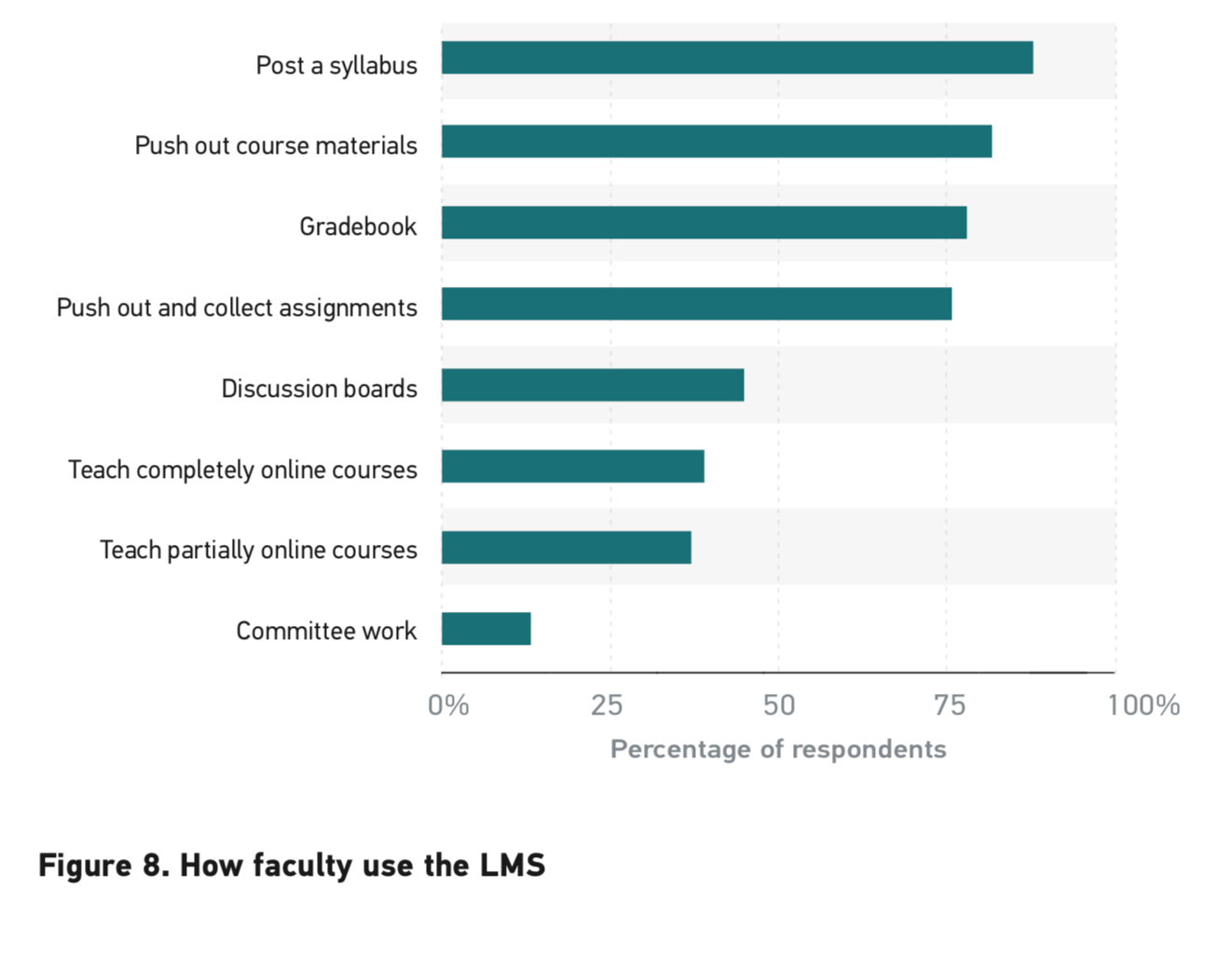
In education, the Learning Management System (LMS) was originally and more accurately called a Course Management System, and it has historically been focused on the management of courses, primarily through announcements to class, rosters, grade book, distribution of syllabus and course content, and submission of student work. Consider this figure from the ECAR Study of Faculty and Information Technology, 2017 that mirrors several other studies in its results:
While the modern LMS has advanced in many ways – particularly around usability, interoperability, and system reliability – the common usage of the this ERP-of-the-classroom has remained fairly steady. The dominant usage is managing the what of courses.
The LMS provides tools to manage communications – a view of the who of courses – through inbox, discussion boards, announcements, and various conferencing apps, but of these the dominant usage is through announcements. One way communication from faculty to students. The tools are there but not the reality of holistic views of interactions with students.
The shift in education from running a course to guaranteeing great experiences for students, to bastardize the SAP explanation, is much like the move towards experience management referred to in the Stratechery article. The movement is in its infancy, and it is likely to be measured in terms of decades, not years. Michael referred to this move in his most recent post.
If you’re a regular e-Literate reader, you know we have a macro thesis that the higher education sector is in the early stages of an evolution from having a philosophical commitment to student success toward having an operational commitment to student success. In other words, colleges and universities are starting to approach student success systematically, not as the natural by-product of hiring good faculty but as something that every student-facing aspect of the institution needs to be optimized for.
When you talk about student success, and great experiences, you have to go well beyond the official production of course content and grades and rosters. It doesn’t just matter what grades students get, it matters whether each student is learning, whether and when they get frustrated, and how often they’re engaging in the class. This gets to learning analytics and formative assessments and opportunities for students to quickly get help.
None of this is new, per se, and we’ve even seen attempts at alternative learning platforms to address this richer ecosystem. Consider the learning platforms designed initially to support competency-based education (CBE) such as Motivis Learning (spun out of Southern New Hampshire University’s College for America) or Sagence Learning (formerly FlatWorld Knowledge). These systems ((Disclosure: SNHU and Motivis were past subscribers to our LMS Market Analysis service.)), often called Learning Resource Management (LRM) systems, are designed to “see a holistic view” of students and “track student engagement”. They are designed to achieve the stated goals of SAP to combine operational data and tools along with experience data and tools.
We’ll get into more detail in future posts, but the category often labeled as adaptive courseware platforms are another example of next-generation systems that are designed to capture both operational data and experience data. These systems blur the boundaries between content and platforms and have the advantage of combining the two into a common design, which should allow deeper instrumentation of student activity during the learning process.
These examples get to the common question of whether the LMS will survive and exist in 10 years. The original LMS concept was designed around a course, not the learner, and most usage is administrative in nature, not learning activities. Shouldn’t next-generation systems like LRMs overtake the LMS market, as these companies expand beyond just CBE programs (see this post for context)? Well, the data do not show signs of this movement, and in fact the LMS market has been consolidating around just four solutions for institutional adoption – Canvas, D2L, Blackboard, and Moodle.
In the meantime, most of the LMS vendors have been adding functionality, whether through extension of their platforms or strategic integrations with third party tools, that seeks to provide views of the student experience. Learning analytics and reporting capabilities, mastery learning additions, federated sharing of student activity data.
One reason for the persistence of the primary LMS is that the LRM and courseware markets are not the ERP market. There are no SAPs in these worlds that already have ubiquitous usage. According to the Stratechery article “SAP is at the center of 77% of transactions worldwide”. The LRM typically starts out in a new CBE program with dozens, or maybe hundreds of students.
What is dominant in higher education circles? The LMS. It is one of the few ed tech solutions used in a majority of courses across online, blended, and face-to-face modalities. What the market appears to be doing is waiting for solutions that build on top of the LMS, or even extend the LMS itself, rather than replacing the LMS. And one of the main reasons is that the LMS has already been accepted as the enterprise system for academic usage, with operational data and tools managing the what of courses. It may be that over time alternative learning platform models will build up enough market share to become a credible threat to change the broader LMS market, but the signs so far are not encouraging for those vendors.
Qualtrics proved to be so valuable ($8 billion) because it could augment the ubiquitous SAP. SurveyMonkey, by contrast, went public as a standalone company and is worth far less ($1.8 billion, still a respectable number).
Looking into the future, the LMS will have to provide useful analytics on student outcomes, learning, and experiences along the way. Shifting from mostly running a course to guaranteeing great experiences for students. Whether this happens within the LMS of the future or as third-party augmentations of the LMS, and whether this happens with the current top four vendors or a different set, is not known. But the move to combine operational and experience data and tools is a trend we should expect to see over the next decade, both in ERP systems like SAP and in the academic LMS market.
We have published market share data measured by total institutional enrollment instead of institutional count inseveralposts at e-Literate over the years, within the twice-annual reports of our LMS Market Analysis service, and for several of our premium subscribers of the same service. In July of this year we reported that Canvas had overtaken Blackboard as the market leader in US higher education in terms of institutional adoptions as well as scaled by enrollment. These last two posts got a fair amount of media and vendor attention.
What we have realized, however, is that we have not made this information on market share by enrollment easy to access in one place. LMS company revenue tends to be based on the total enrollment of adopting institutions, thus this enrollment-based measure provides a more direct connection to company finances. Given the increased importance of LMS provider business models and revenue to the future trends of the market, we are sharing the information more broadly.
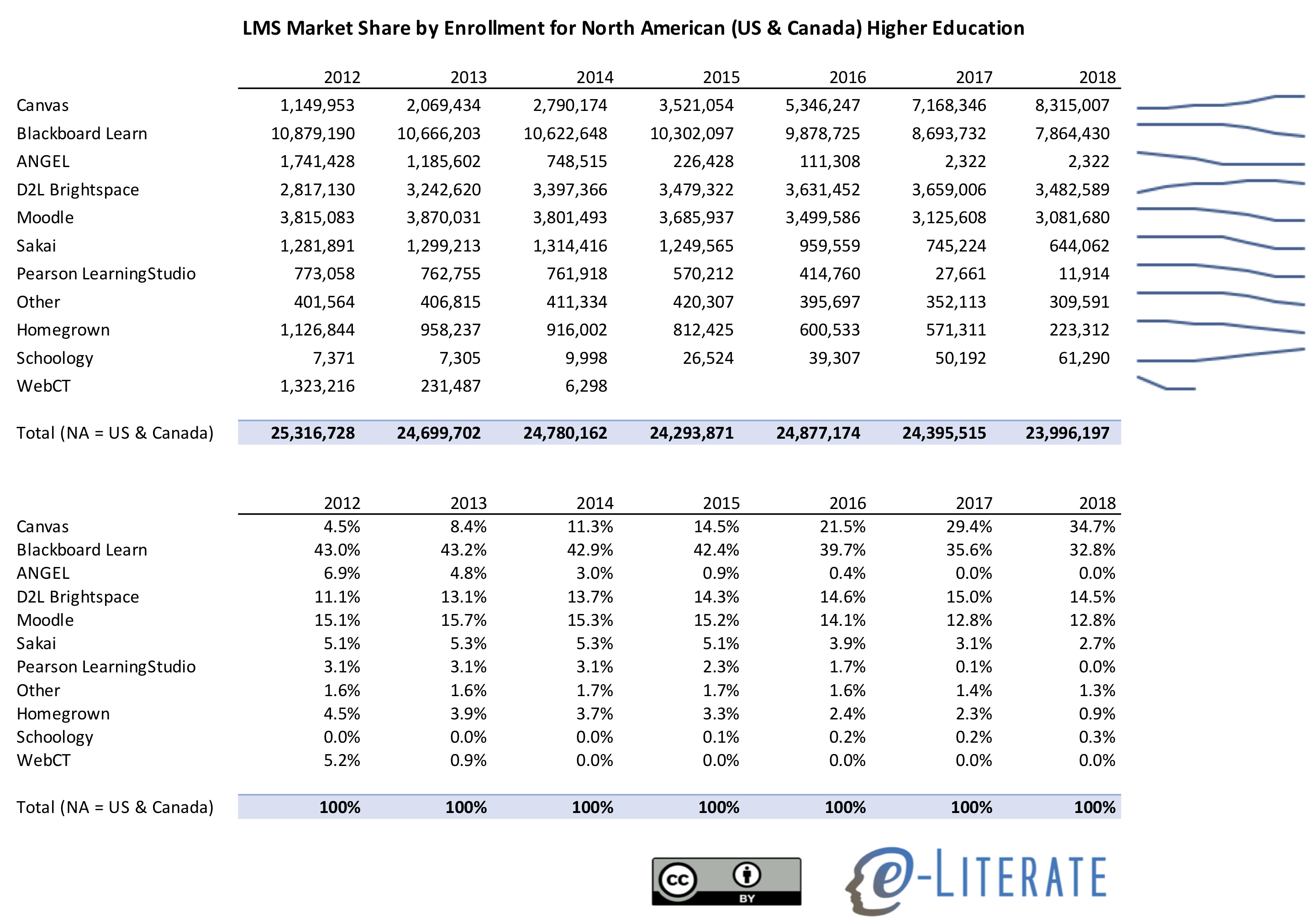
In this view below we share North American (US and Canada combined) total enrollment for LMSs that are primary – that is, available for the entire institution. Total enrollment in this case means the institutional student count, but it does not imply that all students at that institution actually have courses using the LMS (see comment below from John Fritz). It is important to note that during an LMS transition there is often a period of time (6 – 18 months) where two systems overlap, with both available to the school. Therefore the total market share enrollments will be somewhat higher than actual total enrollments, as a subset of LMS-transitioning institutions will be counted twice.
Canvas has not just surpassed Blackboard Learn in this updated view, 35% to 33% – it has also expanded its lead as the most-adopted LMS in North American higher ed markets (while Moodle has clear lead worldwide in total installed base).
D2L Brightspace has been in third place for NA HE markets since 2016 when viewing by enrollments.
Moodle is fourth and has been dropping in recent years.
The top view of total enrollments adds in the effect of changing enrollments – both at a national level and an institutional level.
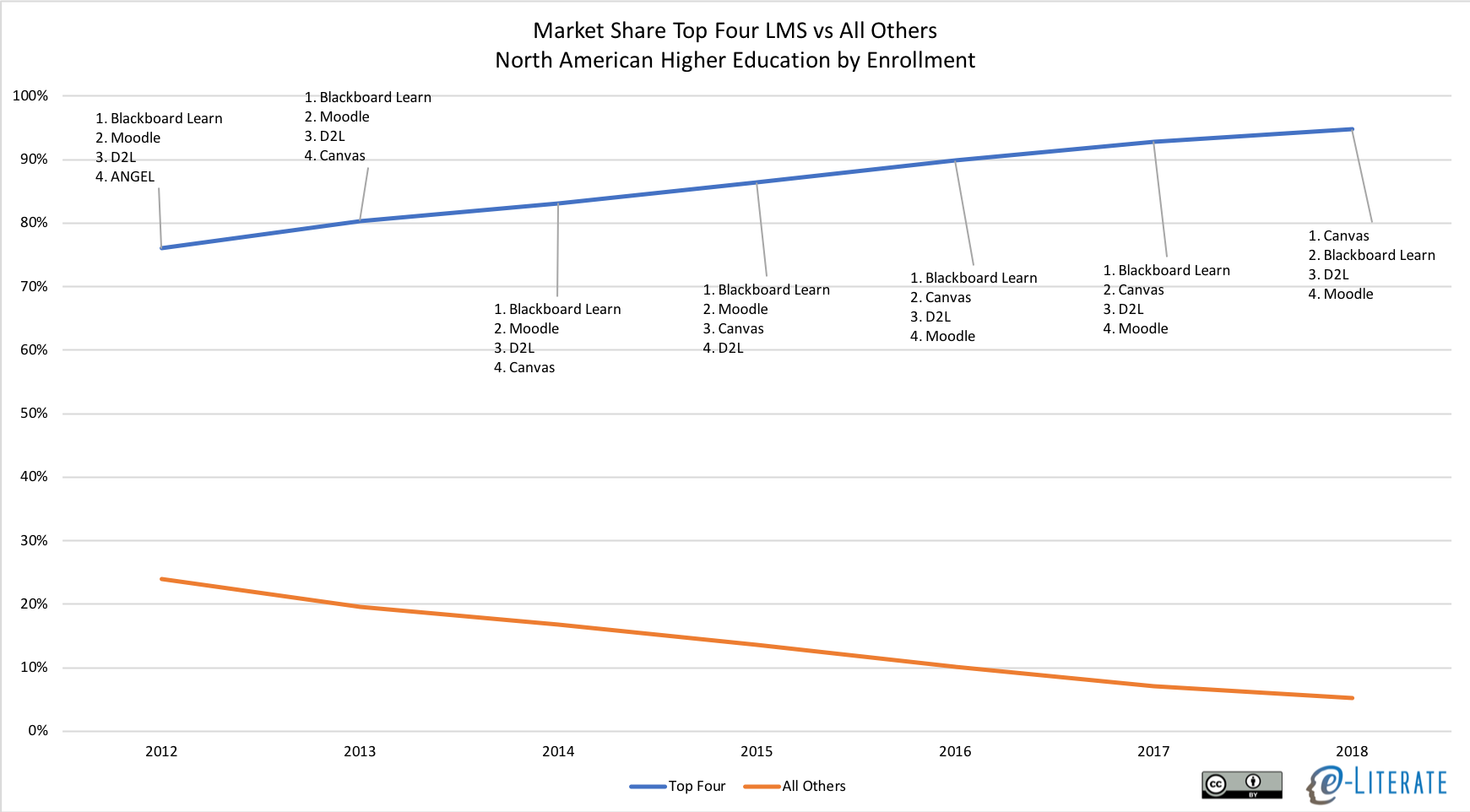
In the past five years, the LMS Market for North American higher ed has become increasingly dominated by “the Big Four” (Instructure Canvas, Blackboard Learn, D2L Brightspace, Moodle) for institution-wide adoptions; the aggregate market share of year’s top four systems moving from 80% to 95% in past five years.
This last point deserves more analysis. There are other systems gaining new institutional clients (think Schoology here, or think CBE-specific platforms like Motivis), but they are mostly picking up either small schools or being adopted for specific programs and not for the entire institution.
Expect more coverage as we enter ed tech fall conference season.
Update 8/3: Added sentence in third paragraph to clarify usage of total enrollment terminology.
We are seeing a tremendous surge in interest regarding Online Program Management (OPM) companies. Certainly many of the major higher education news outlets are running stories on them and many analyst firms are publishing white papers. That’s a sign that others who pay attention to this space are hearing…something. But it’s not a strong signal by itself.
In our own work, we are definitely hearing more interest in OPMs, and we are also hearing from OPM companies (and OPM-like companies) that there is a pick-up in incoming requests from universities. For example, we had an opportunity to facilitate an institution-wide approach at UCLA to vet and pre-qualify OPM vendors as individual colleges determine their online strategy. There was a pretty robust and diverse range of responses. Equally importantly, the pre-qualification approach indicates a sense that different schools and other stakeholder groups within large universities or systems may have different needs.
You can see this as well in Open SUNY’s system-wide Request for Information (RFI). Here is one of the largest university systems in the country, and they are essentially casting a wide net, asking, “What do you think we should know about this space in order to serve our 64 very different campuses with a wide range of needs, while also serving the needs of the system as a whole?”
That wide open RFI from SUNY really speaks to the good news/bad news of the current state of the OPM market. The good news is that there is an increasingly broad range of options for colleges—or schools within those colleges—with different needs. The bad news is that the market is such a mess right now that it’s hard for colleges to find the right vendors to talk to and hard for vendors to find potential customers who need what they’re offering.
A lot of the analysis we’ve seen so far has been variations on a theme: “There’s a lot of [mostly unspecified] innovation in the the OPM market. For example, revenue sharing isn’t the only financial model anymore!”
While there is indeed increasing variation in the OPM space—only some of which we would call genuine “innovation”—we believe the expanding range of financing options is the tip of the iceberg. The deeper cause of the current chaos in the market is largely the result of a more profound broadening out of demand. This, in turn, is driven by a tectonic shift in how universities go about fulfilling their core mission of enabling student success. As new change management needs emerge, we don’t yet have names for the solution categories that meet those needs. But since the new solutions share elements with solutions to online program management problems, everything is getting lumped under the heading of “OPM.”
There are several factors that are major contributors to the current rush to by vendors to call themselves OPMs:
The variation between kinds of programs that universities are looking to launch is significant and increasing. As a result, different OPM vendors are specializing in different kinds of programs.
More universities are making fine-grained choices about which aspects of their online programs they want to outsource to a specialist, which aspects they want to pay a consultant to help them get started or improve, and which aspects they believe they can do themselves. This broadening out of customer choices is creating further variability in in OPM business models and OPM-like services offered by an increasingly wide range of companies.
As the OPM business disaggregates, universities are increasingly recognizing that certain functions that OPMs perform, like recruiting students who are likely to be successful in a program, redesigning courses to maximize student success, providing early interventions to promote student success, and working with employers to help with career readiness and post-degree employment are all services that might be useful for improving the success of their traditional programs.
The common theme with all three factors is that customers who think they are all looking for “OPMs” are, in fact, trying to solve a wide range of different problems. So wide a range, in fact, that the term “OPM” is on the verge of becoming meaningless.
We believe that all of these needs belong under a larger umbrella that we call “Digital Enablement Services.” In general, colleges and universities are beginning to move from having a philosophical commitment to student success toward operational excellence at enabling student success. The idea here is to use modern tools—and more importantly, the educational practices and organizational processes enabled by those tools—to do a better job of making sure that students don’t fall through the cracks.
It’s easiest for universities to see the need to improve their operational excellence when they are launching a new, (hopefully) revenue-generating and net cashflow-positive degree or certificate programs. They are making a substantial upfront financial investment in the hope that future tuition will make that investment pay off for the university as well as for the students. To do this, they need to keep students happy enough that they stay in the program, even as the university loses the traditional face-to-face touchpoints that they have relied on to engage with their students and have to figure out how to build digital equivalents. It can feel like a scary (and potentially career-ending) undertaking. This is why 2U—a publicly traded OPM with a $3.9 billion valuation—made a smart branding choice with their tag line, “No back row.” ((Disclosure: 2U is one of the sponsors of the Empirical Educator Project.)) It is also why universities have been willing to accept revenue share arrangements. They reduce the up-front cost of the program—sometimes to the point of making an otherwise unaffordable program possible—and shift some of the risk to the vendor in return for a share of new revenues and some sharing of control over certain aspects of the program design and management.
There is increasing interest from universities to step away from revenue sharing agreements and be more selective in how they use external vendors to plan, launch, and manage new online programs. That’s a real trend, though it is being somewhat hyped by shallow market coverage and some industry players who are looking to differentiate themselves against more established competitors. As far as we can tell, there is growth across the different models, particularly since the range of program types universities are looking to offer increasingly have different kinds of risk profiles.
Think about the differences in launching and running the following different types of programs: (1) a largely synchronous online nursing degree, including a required face-to-face practicum at a hospital, (2) a mostly self-paced, competency-based MBA, (3) a “micro-masters” degree in cyber-security, and (4) a code academy. Think about what it would take to design and launch each type of program, how much new expertise each would require of the university, how much support the students would need in each case, how hard it would be to recruit students, to track them in the existing ERP system, and so on.
Given the differences in these challenges, there should be demand for significant variety in OPM services with different sweet spots. OPMs with different models do end up competing head-to-head in the market sometimes, but that’s partly because customers don’t yet have a good way of sorting out what kinds of characteristics are most important to support their specific goals. In its current state, the market isn’t efficient at enabling customers and vendors to determine if there’s a good fit.
The chaos we are seeing now is nothing compared to what’s coming. Universities are beginning to see needs for OPM-like services elsewhere. As budgets continue to tighten and pressure to improve outcomes continues to rise on public colleges and universities, academic leaders are increasingly realizing that improving degree completion and decreasing time to degree are good for both the student and the financial health of the institution. At the same time, changing student expectations are putting pressure on high-end private colleges and universities to recognize that the formula which has made them successful for the past century is not guaranteed to bring them top students and generous alumni in the next one. This has the potential to be a Pandora’s box. Where is the line for defining an OPM? And how can universities find vendors with the kinds of OPM-like services and business models that are appropriate for helping solve their particular problem?
Over the next months, we at e-Literate are going to try to put some definition around this market, first by defining the boundaries of the OPM solution category—and the variation within those boundaries—and then by naming and defining other, similar-looking solution categories that solve different problems. We will be blogging about it and releasing at least one report about it as well.