Moodle unveiled its new product, Moodle Workplace, at the the Learning Technologies conference in London three weeks ago. While the open source Moodle LMS has been used by companies and organizations for employee training for years (approximately 40% of Moodle implementations worldwide according to this 2015 interview), Workplace represents a new approach for Moodle’s usage of open source deployment.
Based on an email interview with Moodle Pty Ltd (aka Moodle HQ) CEO and founder Martin Dougiamas, Moodle Workplace is a “a series of well-written plugins that sit cleanly on top of the standard core distribution” and is being released under an open source GPL license. The plugins add functionality to:
Create training paths;
Create departmental structures and reporting;
Automate enrollment, certificates and other back end processes; and
Customize reporting and report delivery.
From first reading, the Workplace functionality is a subset of the features available in other products, notably Totara Learning. That solution is also based on Moodle core, although Totara forked its code base more than three years ago. ((At the time of the fork, Totara management also predicted Moodle was planning to offer the market ‘Moodle for Workplace’.)) Workplace appears to be a solid, if somewhat unremarkable platform for organizational training delivery which can provide compliance tracking, learning pathways, and other business-focused features. For organizations looking to add training features to existing stock Moodle, Workplace should offer an easier migration path than Totara.
The bigger news is the change in the distribution and business model as described by Dougiamas.
We are restricting distribution to Moodle Partners for now so that we can give more value back to our Moodle Partners who invested time and money into it.
Similar to Totara’s business model, there are limitations put on the Moodle Partners to prevent modification or distribution of the code. By providing Workplace only as a SaaS solution, Moodle is using the same distribution loophole in the GPL. ((For those unfamiliar with the peculiarities of open source licensing, Moodle and Workplace are released under the General Public License (GPL). The GPL requirement to release the source code ONLY applies if you are providing someone a copy of the binary. Providing software as a service does not constitute “distribution” under the GPL. This is how Google, Amazon, Facebook and all the other major internet players can build on open source, but not release their source code.)) The upshot is that if a company or organization wants to use Moodle Workplace, they have to work through a Moodle Partner and cannot download and install the software for free.
The business model around Moodle Workplace is clearly a departure from the norm for Moodle, where the core GPL code is available to anyone, anytime, for free. But it is not clear whether this change in model for Workplace is a limited play or has broader applications that may impact education markets. In our interview, Dougiamas directly addressed our question on whether we should expect similar changes to Moodle core:
No, we remain intensely committed to developing and improving Moodle core as a GPL product with the same license, open source practices and active community as now.
He further stated:
Our team developing Workplace have been contributing features (the more general ones) into core at the same time, and the plan is that any Workplace features that also supports sectors like Higher Ed or schools will always be migrated into core this way.
So, what are educational institutions to make of the new business model around Moodle Workplace? We’re not entirely sure at this point. At a minimum, it would appear to be an attempt to better monetize the large installed base – a move to satisfy investors and to replace the Blackboard revenue after cancellation of their Moodle Partner agreement. At a more strategic level, it could be an attempt to stay competitive with peers, particularly SumTotal and Totara, who are going after the corporate learning space.
If Workplace is successful, it will create a new revenue stream for Moodle HQ, potentially accelerating the development of the core educational product. A Moodle Partner we interviewed for this piece claimed they were already seeing increased lead generation from the announcement. The small and medium business (SMB) market is larger and generally has faster sales cycles than the education market, which could drive partner revenue and cash flows. The partners who are able to create sales momentum in both spaces and find their product / market niche are likely to see some accelerated growth. If this is successful, Moodle HQ should capture additional revenue and accelerate the product and service roadmap. This move directly addresses the issue Michael raised in the Fall about the termination of the Blackboard contract and revenue stream.
For Moodle, everything rides on their ability to grow alternative sources of revenue. The company has been touting newer offerings such as MoodleCloud, MoodleNet, LearnMoodle, and MoodleServices. Since we don’t have any external evidence that these are material sources of revenue for the company, and since the company itself has not shared numbers that we can independently evaluate, it’s very hard to tell what their chances are. Moodle has a huge installed base, which gives the project a lot of momentum. But the company that drives most of the core platform development has a business model that has not aged well and is in the process of diversifying into business models that are as yet unproven. I remember enough physics to know that momentum and acceleration are not the same thing. I think the risks are probably greater for Moodle Pty. than they are for Blackboard. But both sides of the equation bear watching.
Moodle Workplace as a monetization strategy seems to be a stronger bet than the previous offerings.
The risk for education institutions, however, is that the Workplace development roadmap pulls resources from making investments in core Moodle necessary to keep pace with better-funded rivals. At worst case, Workplace fails to find a market niche and position itself in a crowded field. The opportunity cost of investing in Workplace vs other potential investments in the core education product and cloud services could end up having larger knock on effects downstream.
What we have observed over the past 6 – 9 months is an increased customer focus by Moodle HQ, acknowledging the importance of market messaging (e.g. first-time presence at EDUCAUSE, announcing Workplace at London conference) and better understanding and satisfying business needs of revenue-generating Moodle Partners. The jury is still out on how these changes will impact financial sustainability and competitiveness of Moodle in education markets, but there is little doubt that there are changes in behavior.
In the end, this is another example of corporate financial health issues having an outsized impact on the LMS market in 2018 – 2019. And one that bears watching, coming from the LMS provider with the world’s largest installed base.
Update 3/6: Changed naming throughout to Moodle HQ instead of Moodle Pty to reflect more accurate and common usage. Also edited footnote about ‘Moodle for Workplace’ prediction to remove the implication of Moodle Workplace being a copy of Totara code.
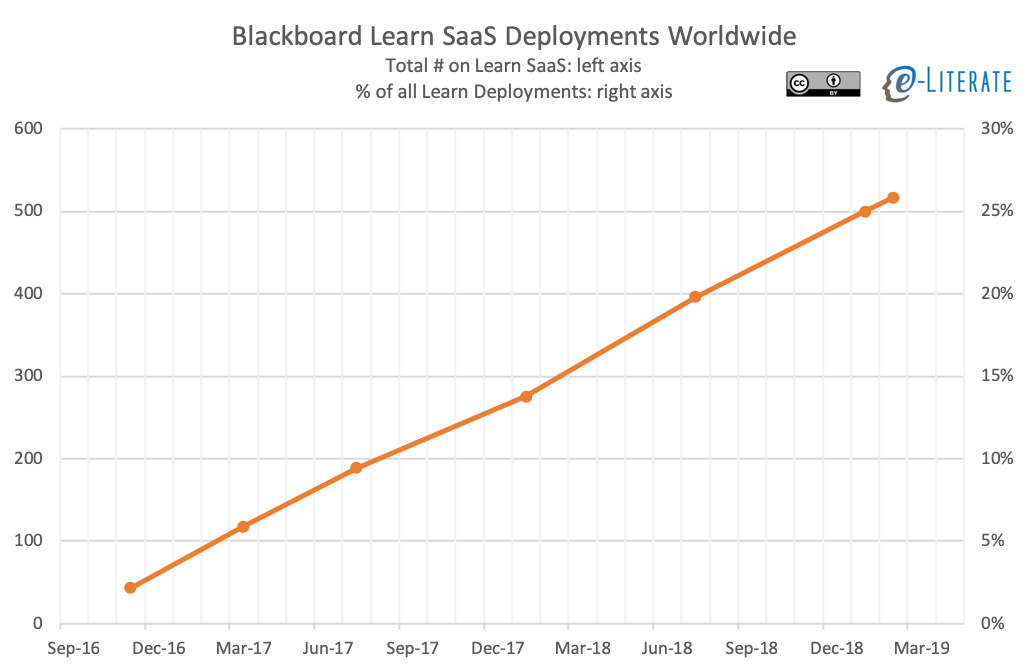
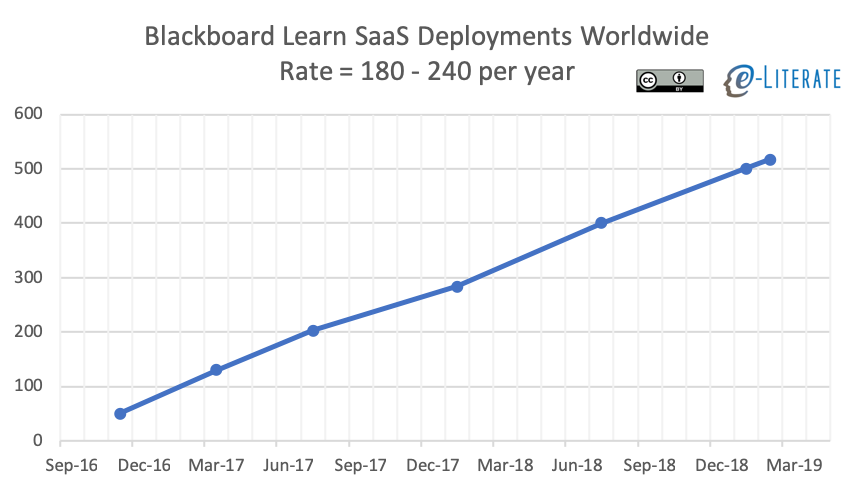
In last week’s post on Blackboard, I shared the roughly linear progression of migration of the Learn LMS to a software-as-a-service (SaaS) model – a move that we believe is more important than is the Learn Ultra user experience. If you take into account percentages of total Learn deployments, you see that Blackboard has roughly 25% of Learn clients on SaaS after starting in late Fall 2016, increasing by approximately 10% per year. ((Each point is taken from Blackboard public release of information either directly to us at e-Literate or in press releases.))
Blackboard is not the only LMS company migrating to the cloud, however, and D2L ((Disclosure: D2L and Blackboard and Instructure are all subscribers to our LMS Market Analysis service.)) has taken a more aggressive bet on SaaS for their Brightspace LMS platform (also based on AWS), as described in Summer 2018.
While we heard grumblings from multiple clients during the transition – especially through early 2017 – D2L clearly made some hard choices and and is aggressively moving to the cloud, not just as an option, but as their primary delivery model. According to David Koehn, VP of Product Management at D2L:
All new Brightspace implementations are on AWS cloud;
Virtually all current Brightspace implementations use Continuous Delivery; and
Approximately 50% of current customers are already on the AWS version of cloud deployment; and
By the end of 2018, a large majority of customers will be on cloud deployment.
Last Fall I spent time at D2L’s Kitchener, Ontario headquarters getting an update on the company’s progress on a number of initiatives. D2L executives described that all but roughly a dozen Brightspace clients are now on SaaS deployment, and by the end of 2019 they should be fully a SaaS platform company.
Why is percentage of total deployments important? Two reasons are that the move to 100% SaaS deployment enables the movement to a single version of code, dramatically simplifying regression testing and enabling more rapid development of new designs, while also taking advantage of modern technology stacks. As described in the Summer 2018 post:
David Koehn also pointed out that the real driver for the AWS cloud move by D2L is to enable a redesign of the user experience [branded Daylight] and to provide improved scalability and reliability. In other words, the cloud deployment is a means to the Daylight end.
The downside, of course, is that pure SaaS deployments largely leads to a reduction in customization capabilities. Companies like D2L and Blackboard that are moving from an enterprise model to a cloud model are betting that they can build in appropriate configuration options (rather than customized code) and leverage third-party integrations to overcome this challenge. But to get the full advantage of SaaS, a company needs to do the entire move.
I further spent some time in London and had the opportunity to talk with D2L’s London-based leadership team that covers EMEA and Latin America regions. D2L leaders in London presented a transparent and honest appraisal of the company’s current market position in Europe and Latin America, and where they see the biggest opportunities. For starters, D2L acknowledged that Instructure’s system-wide wins for the Canvas LMS in the Nordic countries had largely blocked opportunities for expansion in that region. Other areas, however, have been much more promising. They are doing well particularly in the Benelux countries (Belgium, Netherlands and Luxembourg) with Ghent University in Belgium being an example of a recent, large (45,000 student) implementation. There have been important wins in the UK and Ireland, and activity in Spain seems to be picking up some momentum. Germany continues to be a challenging place to get a foothold partially due to university funding that favors in-house staff maintaining open source systems.
In Latin America, D2L was open about cutting back investment in the region in 2017, particularly in Brazil, largely due to economic uncertainties and limited growth opportunities. They now see activity picking up in the region and have been investing to take advantage of the market potential.
In both Europe and Latin America, the provision of professional services beyond the LMS platform, as well as willingness to add requested features, appears to be a differentiator for D2L, especially in comparison to Instructure. D2L has shown a much greater willingness to roll up their sleeves and collaborate on instructional design, course building, and online pedagogy using internal staff, almost in an Online Program Enablement model. It surprised me during my Fall HQ visit to see just how well-established is the content creation team that helps schools redesign courses and even design front-end web sites for online programs. We have heard similar messages from D2L customers and even from a consulting firm that works directly with Canvas and Brightspace customers.
To a degree, none of this post is different from our Summer 2018 coverage other than updating on progress, so why has D2L not made more of a market share increase in the past year? I suspect there are three reasons. One is that D2L has done a better job updating their product line and introducing new services than they have done in fixing issues with current customers, particularly around data and analytics. During my Fall HQ meetings, when the D2L team was describing their new data and analytics approach called the Brightspace Data Platform, I pointed out that while this appears to be an improved approach, it does not acknowledge that D2L has been touting its data and analytics capabilities for years. There are leftover frustrations from customers based on previous attempts that did not match client expectations.
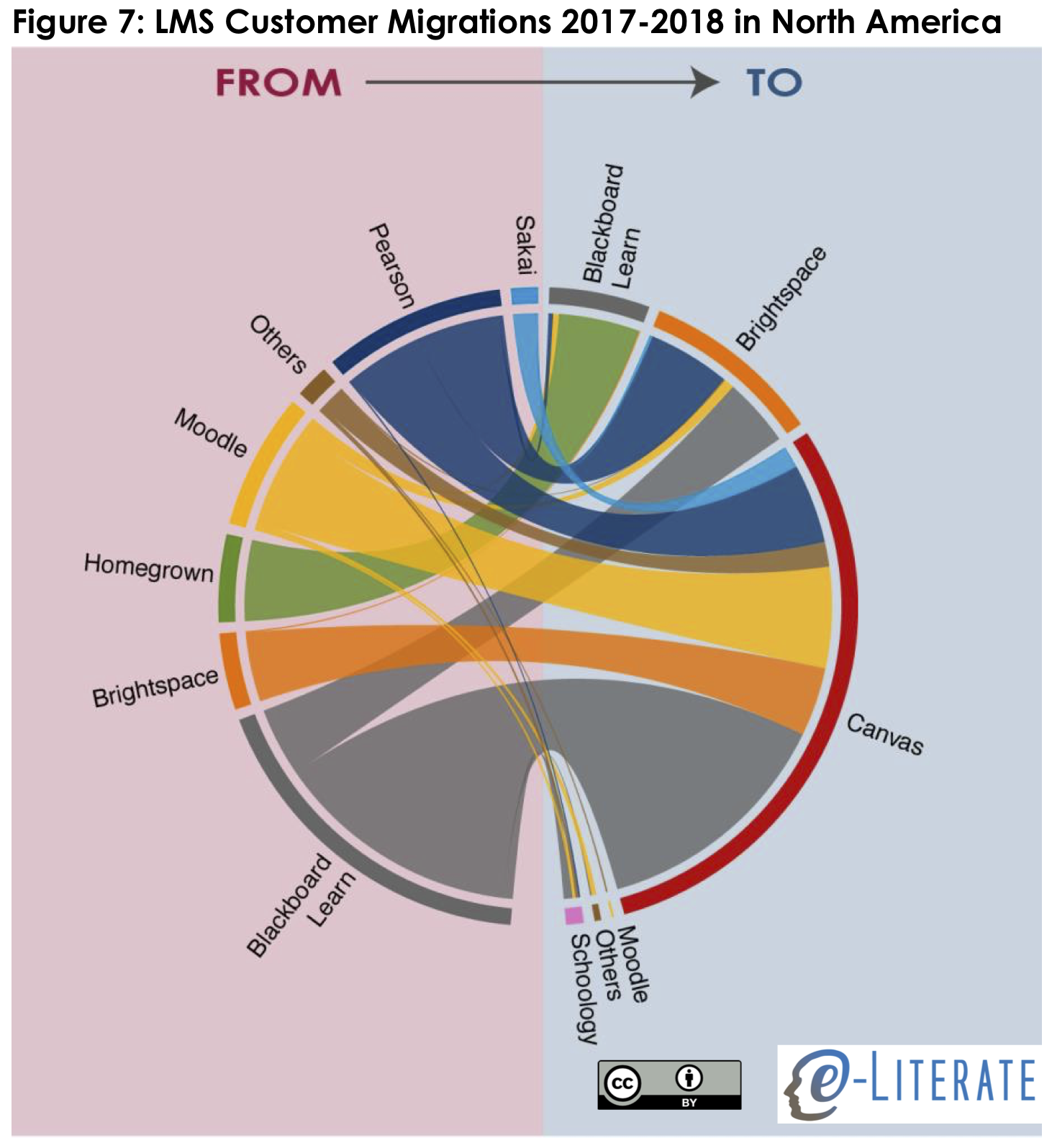
The second reason is Instructure. While D2L is in a solid second place for new implementations worldwide (schools migrating from one LMS to another), they have also lost a number of clients in North America – almost all to the Canvas LMS. In our recent LMS Market Analysis report, we showed a transition graphic with higher ed LMS migrations from 2017 – 2018.
The third reason is that it is very difficult to be a third competitor in terms of customer mindshare. The academic LMS market has tended to have a narrative of a major competitor and an upstart. Blackboard and WebCT in the early and mid 2000s, Blackboard and Moodle in the late 2000s, and Blackboard and Canvas through much of the 2010s. It is difficult for a company like D2L to break through this narrative and be top of mind for institutions from day one of an evaluation.
While D2L has challenges in market position and introduction of a new data and analytics approach, they are completing the transition to a SaaS platform company and focusing on flexibility and services.
Blackboard had a lot of news to share two weeks ago when we spoke with CEO Bill Ballhaus and senior teaching and learning executives. The updates addressed efforts to streamline the business, customer retention, and customer acquisition. Blackboard ((Disclosure: Blackboard is a subscriber to our LMS Market Analysis service.)) was upbeat about their current position and prospects going forward, but we see a mixed picture.
Ballhaus said that Blackboard’s efforts to simplify the business were paying off and leading to greater focus on their core teaching and learning businesses. While the company was built as an enterprise software amalgamation based on 20+ corporate acquisitions, Ballhaus described how management is looking forward to becoming a Software as a Service (SaaS) business with a simpler focus. While the executives declined to comment on current M&A activity, Blackboard appears to be trying to sell its CashNet and Transact products that are part of the same business line focused on campus ID and payment processing, for up to $800 million and $720 million respectively ((Although it is possible that both of these reports are referring to the same combined transaction – CashNet and Transact together. This explanation makes more sense to me.)). Remembering that Blackboard reportedly tried but failed to sell the entire company for ~$3 billion in 2015, there is no guarantee that they will actually sell either unit or get the desired prices. [Update 3/7: Blackboard did end up selling entire Transact business unit , including CashNet, to PE firm Reverence Capital for a reported $720m.] But if they do succeed, the profits from either sale will help the company pay down and manage its debt. And it will back up the claims of focusing the company on core teaching and learning business.
The claim of the company looking forward to being a pure-SaaS business is largely based on their ability to migrate the flagship Learn LMS client base over to the AWS-enabled Learn SaaS offering. Blackboard leadership believes that the ongoing migrating effort has been a critical factor in improving their customer retention numbers, an argument that we made last summer.
The third issue, which is related to the first two, is that we believe that the migration to Learn SaaS might be a better indicator – at least in the short run – than Ultra adoption of whether a school plans to stick with Blackboard. Whether or not the school enables Ultra base navigation or any courses in the Ultra Experience.
When a school moves to Learn SaaS, they tend to sign contract extensions for 1 – 3 years to cover the new services. And the migration to Learn SaaS does not suffer from the vague terminology issues – a school either uses Learn deployed on SaaS (through AWS) or they don’t.
Ballhaus went so far as to say that Blackboard’s improvements in client retention was the primary factor in the overall market slowdown last year. While we certainly feel that Blackboard has benefited from the slowdown and has improved client retention lately, we are not convinced on the cause and effect dynamics. By tracking the public proclamations of Learn SaaS adoptions, we see an interesting linear trend leading to the current ~25% of Learn clients being on SaaS.
Blackboard continued to present the importance of their broad product portfolio combined with their experience. Ballhaus stressed that the LMS is necessary but not sufficient as a strategy for the company. Blackboard management sees Blackboard at an inflection point in 2019 in a good way, and they stressed that their big focus will now be on data and analytics offerings. Remember this paragraph when we get to the Instructure update post.
Early in February Blackboard announced what could be their biggest LMS win since we broke the news of University of Phoenix selecting Blackboard Learn Ultra in late 2015 (a migration that is scheduled to be complete by this summer). From the press release about Galileo Global and their 100,000+ student system:
Blackboard today announced that Galileo Global Education, a leading international provider of higher education and Europe’s largest higher education group, will roll out Blackboard Learn with the Ultra experience as the common Learning Management System (LMS) for its network of 37 schools with 80 campuses across 10 countries. Blackboard Learn Ultra was selected over other cloud-based solutions for the ease of use, the powerful features, and the unparalleled level of support provided by Blackboard.
On the surface, this is a big win for Blackboard, but the story comes with a caveat regarding its relevance to the LMS market. What was not shared during our call with Blackboard executives is that they share their private equity owner (Providence) with Galileo as described in late 2017.
Laureate Education, Inc. (NASDAQ:LAUR), the world’s largest global network of higher education institutions, and Galileo Global Education, a company under the umbrella of Providence Equity, a leading global asset management firm, have signed an agreement for the sale of Laureate’s institutions in Italy and Cyprus for a total transaction value of Euro 225 million (USD 263 million at the current exchange rate).
Two or three schools within Galileo were already on Blackboard Learn, a few on Moodle, and the majority on Homegrown or not really using an LMS previously. Unless we can get independent confirmation about the nature of the selection (was it truly competitive or was it earmarked for Blackboard as long as they met minimum requirements), I would not extrapolate this news to show broader movements in the market.
Blackboard also presented some data around roughly 200 new LMS customer acquisitions in 2018 (“new logos”) for both Open LMS (the rebranded Moodlerooms) and Learn.
The majority of the reported wins, roughly 120 based on interview, are for Open LMS, showing continued growth for this under-the-radar Blackboard product. These numbers are impressive, but we note that last year the company reported 223 Moodlerooms “new logos” in 2017. It will be interesting to track over time if this deceleration is primarily driven by the general market slowdown vs. fallout from the cancelled Moodle Partner agreement.
For the Learn LMS, Blackboard is reporting ~80 new logos in 2018, of which 52% are in higher education. If accurate, this would be a significant turnaround for the company; however, our data do not show this level of new wins for Blackboard unless you include Galileo as roughly 30 “new logos”. We asked Blackboard to back up that number with specifics such as sample listings to see if we have holes in our data, but Blackboard declined to provide further information due to “privacy reasons”. During the same time period, according to our data, Blackboard has lost more than 100 institutions, more than three fourths moving to Canvas and the remainder moving to D2L Brightspace.
In the end, Blackboard is making steady progress with Learn SaaS deployments and contract extensions, benefiting from the LMS market slowdown, and winning their biggest new LMS account since 2015. We are not convinced that Blackboard is causing the slowdown or that their new Learn momentum goes beyond Galileo Global, but there are signs of progress worth sharing.
Update 2/27: Fixed description of CashNet and Transact, which are part of the same business line, and added footnote.
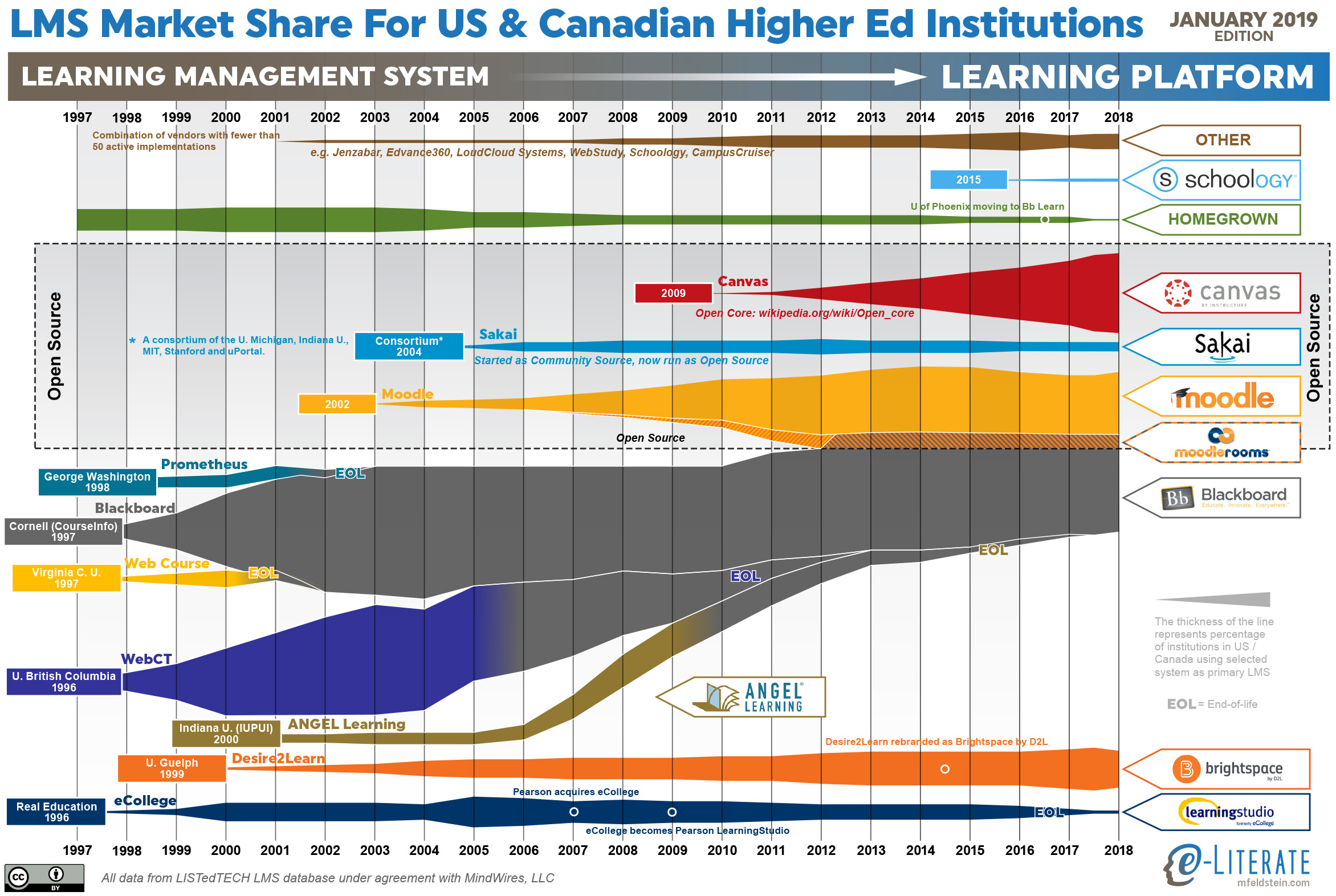
This is the eleventh year I have shared the LMS market share graphic, commonly known as the squid graphic, for US and Canadian higher education. This past year we at e-Literate shifted our LMS Market Analysis reports from Spring / Fall to Mid-Year / End-of-Year to better allow analysis of entire years. With the release of our end-of-2018 report last week to subscribers, it’s time for us to look at updates on the institutional LMS market for North America (US and Canada) higher education. Note that our coverage for the market analysis includes Europe, Latin America, Oceania (Australia, New Zealand, and surrounding island countries) as well as emerging coverage of the Middle East.
We present the following data “by institutions”, with market share as a percentage of the total number of institutions using each LMS as a primary system, and “by enrollments”, where we scale the institutions by its total enrollment. The latter better captures the business of the LMS market, since most licensing deals are based the number of students.
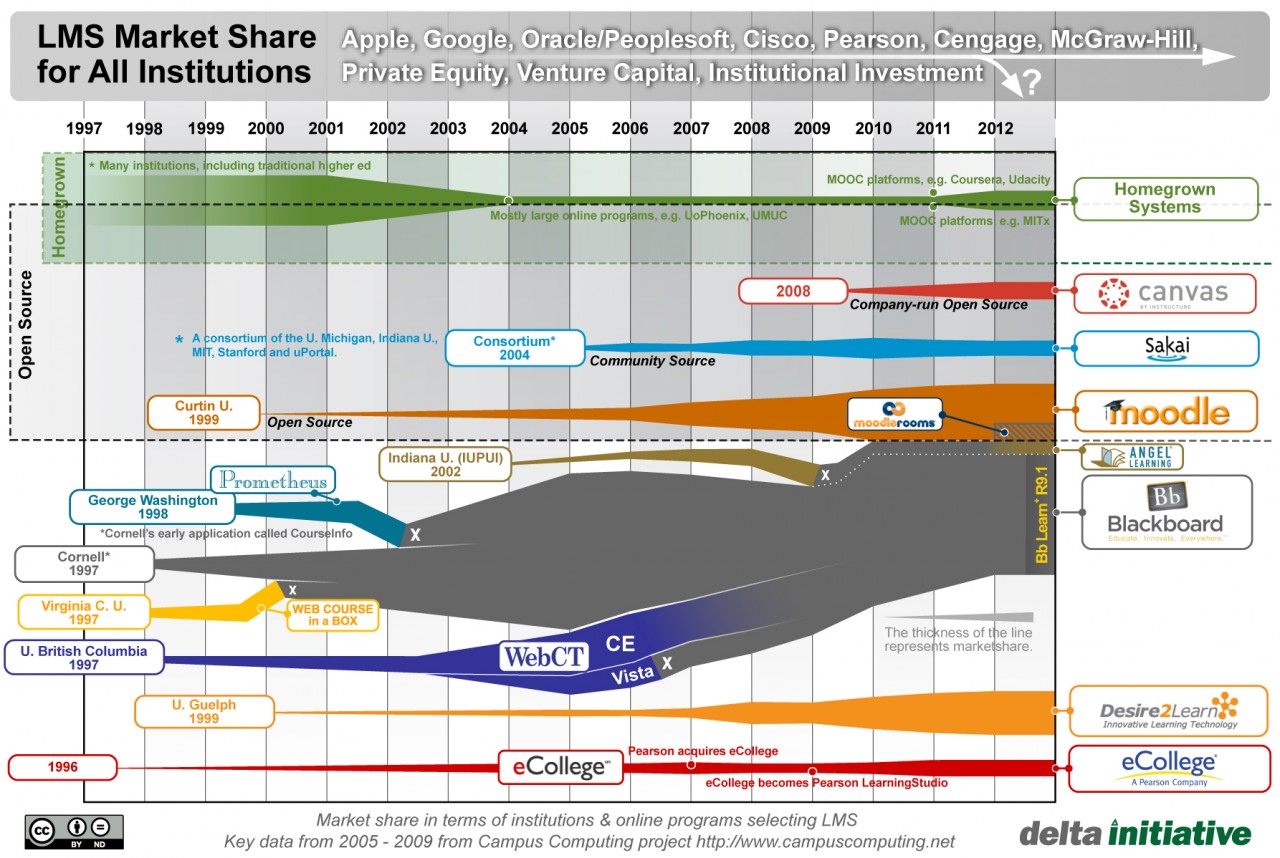
But first, let’s look at an updated LMS market share graphic, commonly known as the squid graphic, for US and Canadian higher education. The original idea remains – to give a picture of the LMS market in one page, highlighting the story of the market over time. The key to the graphic is that the width of each band represents the percentage of institutions using a particular LMS as its primary system.
This year there are two inter-related trends that deserve a broader explanation -the LMS market slowed down with less activity overall, and Canvas and Blackboard continue to be neck-and-neck in the top spot of this market.
We recently described the overall market activity slowdown in that there are fewer LMS formal evaluations taking place since mid 2018, with initial data pointing to a 20 – 25% drop from a year earlier. This slowdown seems to be a type of plateau rather than a continuing trend, and we are watching to see if it is temporary or not.
Last summer we shared the symbolic passing of the torch where Canvas surpassed Blackboard in US market share, which was the first time Blackboard was not the top system since the market emerged two decades ago. What is interesting is that half a year later, the two systems are still neck-and-neck. In the US Canvas is still slightly ahead, and in North America (adding in Canada), Blackboard remains in the top spot by 0.4% (26.8% to 26.4%). Why is Canvas not continuing to extend its lead? Looking at the underlying data, there seems to be three reasons to consider:
The overall market slowdown means that there are fewer deals for Canvas to win lately.
Blackboard continues its University of Phoenix implementation, which still includes dozens of campuses despite its enrollment drop.
The shutdown in December of the for-profit Education Corporation of America (Virginia College and Brightwood College systems) meant that Canvas lost several dozen campuses.
The latter two points should fully play out in the next three months, possibly making this a one-time change in trends, but it is important to call this situation out.
Some other notes:
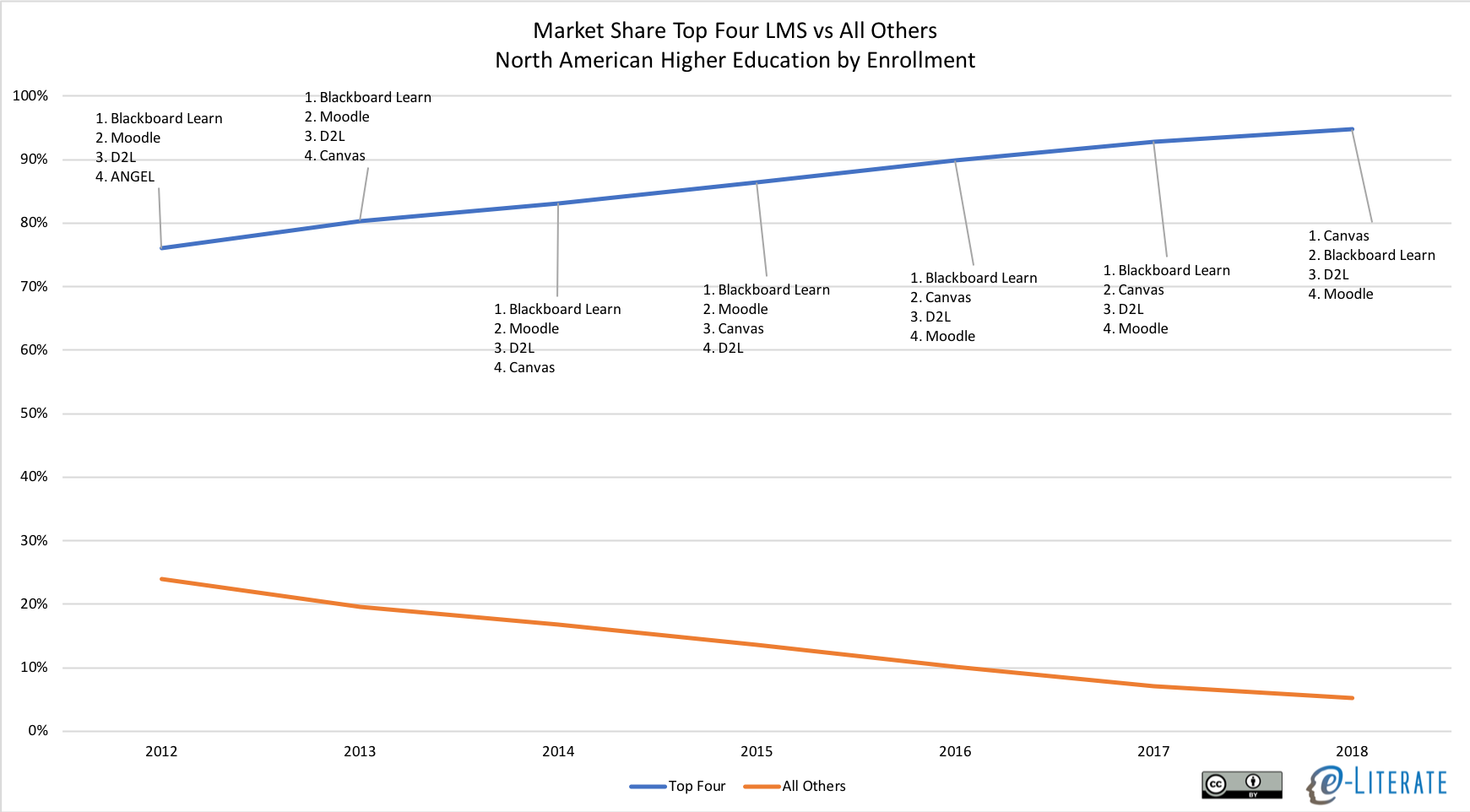
The market continues to consolidate around the Big Four – Blackboard, Canvas, D2L Brightspace, and Moodle.
The Homegrown option for LMS usage is going away, at least in a statistical sense. Only a handful of schools even consider this option.
D2L shares the challenge of having picked up several large for-profit systems that are closing campuses and therefore hurting market share. In D2L’s case, the biggest one is the former EDMC schools – the Art Institutes, Argosy University, and South University – that were sold out of bankruptcy to a non-profit entity and have closed dozens of campuses over the past year. These losses offset many of D2L’s wins in 2018.
Moodle had a few new wins in North America.
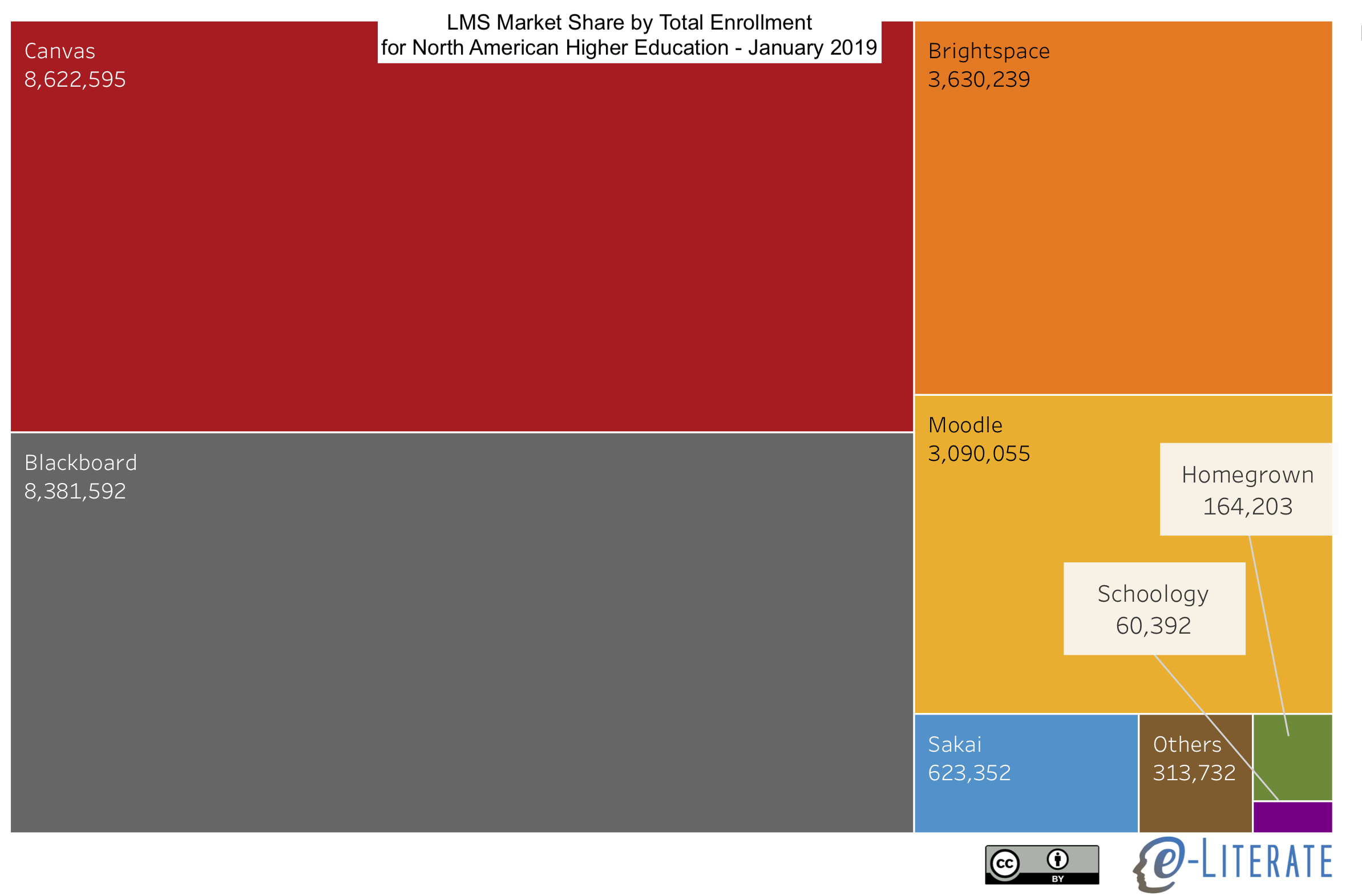
Sticking with North America, we can also show LMS market share scaled by the enrollment of each institution, giving a different measure worth considering.
We’ll share more information on other global regions in the coming months.
In one of our premium versions of the LMS Market Analysis services, targeted primarily at the investment community, we have noted since early summer (starting in June 2018) that the global LMS market appears to be slowing down for higher ed. Given our public market analysis role and given the trend now lasting more than half a year, this news seems more than just a note for investors.
Based on CFO Steven Kaminsky’s comments during Instructure’s quarterly earnings call, we’re not the only ones noticing:
So for renewals what we’ve seen specifically this year is fewer large deals in the multi-hundred thousand dollar range than we’ve seen in previous years. It’s a little still too early to talk about 2019, we’ll be doing that in a few months but we have seen that and when I referenced earlier that it didn’t look like we’re going to grow domestic Canvas by much of it all, that’s what I was really referring to, that’s the key driver there.
A recent analysis note from Brian Peterson at Raymond James shared similar observations.
Our proprietary higher-ed North American LMS tracker pointed to a notable slowdown in large deal activity in 2018, with full year levels (as defined by the number of students) down in the double digits.
But first a note about our data to help readers determine how to interpret the description of this trend.
Along with new implementations (changes from one LMS to another at a particular institution), we also track what we call “First Seen” data. This captures how many LMS decisions we capture in a given month, and over time this metric acts as a leading indicator of implementation changes. This data is broken down by global region (North America, Europe, Latin America, and Australia / New Zealand are currently covered), LMS provider, and enrollment band (to capture institution size).
What we noted in Summer 2018 was a fairly dramatic drop in First Seen data, particularly in North America. Over time, we also noted a change in Trailing 12 Month data from New Implementations (total of previous 12 months for each measured month to smooth out market seasonality). For Dec 2018 T12M data, capturing the full 2018 calendar year, the activity of new implementations is roughly 20 – 25% lower than it was a year prior.
Some notes on the data shown described and above:
Even with T12M data smoothing, the trends are still somewhat lumpy, which is the nature of academic markets.
The market for implementations seems to have peaked at the end of the spring 2018 academic calendar and then dropped to current levels that represent a plateau rather than ongoing downward trend.
To allow reasonable comparisons over time, the data above represents T12M as we knew it at the time. The data is not a full set, as it does not contain implementations we discovered more than a month after the reported month, so the key is to look at trends and not absolute levels.
There are other factors to consider that impact company finances, such as the ongoing enrollment declines in North America, particularly among for-profit or formerly for-profit institutions, but we now have two different variables both pointing to at least a temporary dropping of activity.
It’s premature to determine whether the slowdown will continue or whether market activity will rise again in 2019. We have some statistical and anecdotal indicators for both cases but are not ready to predict yet.
Hopefully this data description of market activity hasn’t been too tedious, but there are strong arguments that company financial health in 2018 / 19 for the providers will continue to have an outsized impact on the future of LMS offerings.
Our favorite technology industry blog—Ben Thompson’s Stratechery—has a great piece up about Amazon’s relationship to open source that also explains a lot about the tectonic shifts in the LMS market. The story he’s interested in telling is about the dynamics behind Amazon’s move to essentially copy and abandon a popular open source database called Mongo DB. His introductory analogy to the music business is revealing and worth quoting at length:
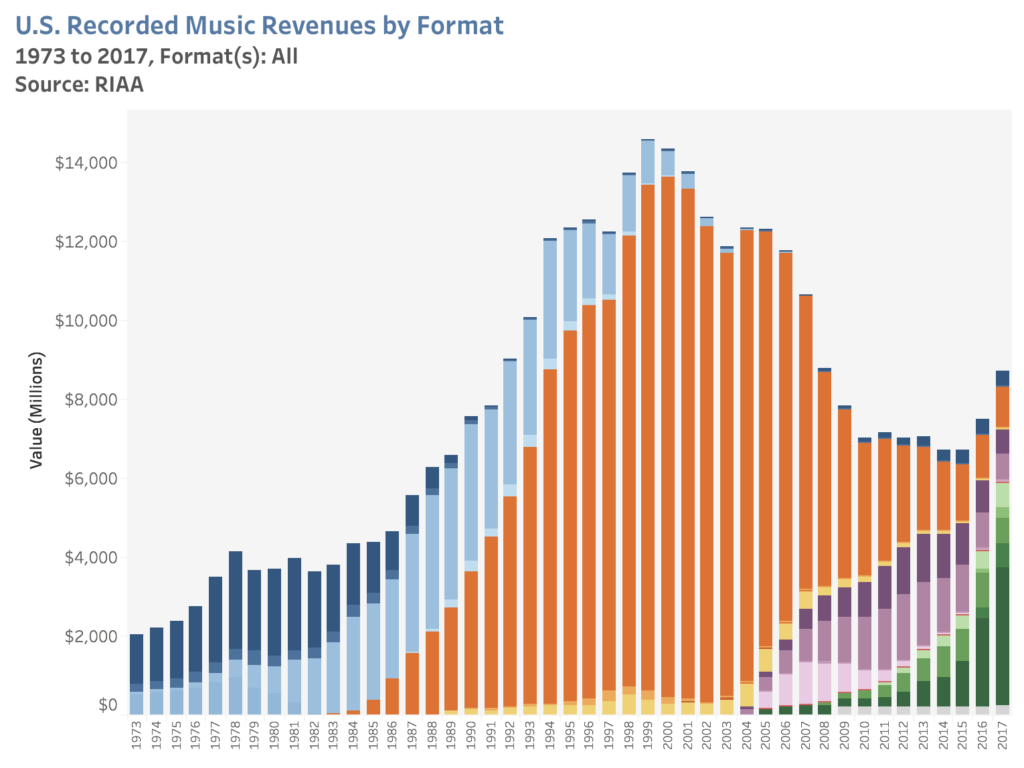
In 1999, music industry revenue in the United States peaked at $14.6 billion (all numbers are from the RIAA). It is important to be precise, though, about what was being sold:
$12.8 billion was from the sale of CDs
$1.1 billion was from the sale of cassettes
$378 million was from the sale of music videos on physical media
$222.4 million was from the sale of CD singles
In short, the music industry was primarily selling plastic discs in jewel cases; the music encoded on those discs was a means of differentiating those pieces of plastic from other ones, but music itself was not being sold.
This may sounds like a stupid distinction, but it explains what happened after that peak:
Music industry revenue plummeted, even as the distribution and availability of music skyrocketed: the issue is that people were no longer buying plastic discs, which is what the music industry was selling; they were simply downloading music directly.
Selling Convenience
The problem is that recorded music has always been worthless: once a recording is made, it can be copied endlessly, which means the supply is effectively infinite; it follows that to capture value from a recording depends on the imposition of scarcity. That is exactly what plastic discs were: a finite supply of a physical good differentiated by their being the most convenient way to get music. Pirating MP3s from sites like Napster or its descendants, though, was even more convenient — and cheaper.
As you can see from the chart, the industry started to stabilize in 2010, and in 2016 returned to growth; 2018 looks to be up around 10% from 2017’s $8.7 billion number, and it seems likely the industry will pass that 1999 peak in the not-too-distant future.
What happened is that the music industry — prodded in large part by Spotify, and then Apple — found something new to sell. No, they are still not selling music; in fact, they are beating piracy at its own game: the music industry is selling convenience. Get nearly any piece of recorded music ever made, for a mere $10/month.
I don’t agree with some aspects of his analysis of open source in the rest of the article, but Thompson’s introductory framing is brilliant. Sometimes we get hung up on the thing that we think is the product in way that blinds us to the critical aspects that are valuable to the customer. These blind spots can cause us to miss potential points of instability in a seemingly stable market landscape. And cloud computing is a classic example of a thoroughly unsexy idea that can sneak into one of those blind spots. It certainly did in the LMS market.
The Instructure surprise
Instructure’s rise is a perfect example of one of those surprises. Let’s think back to the late Noughties, when the company was founded. This predates Phil’s coming to blog on e-Literate, so we’ll have to look at a 2009 version of his famous squid chart that he posted on the blog of his former employer:
2009 Squid Chart
Instructure, having been founded the year before this version of the chart was made, had not yet scored its first big deal with the Utah Education Network. They were literally not on the map. Blackboard was a juggernaut, having successfully swallowed two of their most formidable North American competitors, WebCT and ANGEL. Blackboard was also in the midst of a patent infringement case with Desire2Learn (now known as D2L), having won their case in 2008, only to lose upon appeal in mid-2009. Even after the suit was over, nobody knew how well Desire2Learn would bounce back after seeing their sales largely freeze during the year when it looked like Blackboard would win. eCollege was doing…fine, but it was serving the niches of for-profits and small schools, and there was no real sign that it was going to break out into the general market.
The real action in 2009 appeared to be in open source. Moodle, having picked up the smaller customers that Blackboard had deliberately driven away because of their low profitability, was beginning to score bigger wins. The change was most visible in the Cal State system, where Moodle was spreading there like a virus. Sakai’s growth by institutional adoption numbers was not nearly as dramatic, but in contrast to Moodle, they were rich in prestigious R1 university adopters. In 2005, when I was working at SUNY, I remember my boss at the time telling me, “They have MIT, Stanford, Michigan, Indiana…they can’t fail!” There was a widespread feeling among academics that the only way to escape being a Blackboard hostage…er…customer was to run an open source LMS that the company couldn’t buy. (Blackboard didn’t acquire the largest Moodle hosting provider in the United States until 2012.) It felt like the battle was going to be between Blackboard and open source.
Two years later, Phil’s squid diagram in his inaugural e-Literate post wasn’t much different:
You can see at the top of the diagram that there was increasing speculation about whether other companies—mostly big, established ones—might enter the market. There were, as always, a few startups that popped up in that time period, only to fade away, either by dying or by pivoting. (Remember Epsilen?) But by and large, the fight continued to be perceived as Blackboard vs. Open Source, with D2L and eCollege—by then rebranded by Pearson as LearningStudio—doing fine but not setting the world on fire. Instructure is still not yet on Phil’s map. We had noticed Instructure and written a few posts about them, but honestly, neither of us thought that a new proprietary entrant could break its way into the market, particularly if it lacked the muscle of a big player like a major SIS vendor or textbook publisher.
But by 2013, the picture had changed:
2013 squid diagram
Canvas was growing. Fast. Here’s the squid diagram a year later:
2014 squid diagram
Look at that Canvas line.
Whoah.
It was really only in 2013 and 2014 that most of us started to realize that Canvas was not only going to survive but might provide significant competition to the incumbents. Why did it take us so long to see it coming?
I would argue that we undervalued three of Instructure’s core strengths: usability, customer service, and reliability. We’ve written here before about how Instructure’s usability was a step function better than its competitors at the time. The early but seminal example was Speed Grader, Canvas’ grading app that greatly increased ease of use of the grading function and was the first mobile LMS app that demonstrated the potential of tablet computing. Blogs and wikis, which LMS providers had begun to add, only to find them barely used, were not considered valuable by most faculty. Giving them back hours of their time that they would have spent entering grades, on the other hand…. Likewise, we’ve written about how Instructure quickly established itself as the “uncola” of LMS companies by providing excellent customer service that was inextricably tied with their “not-Blackboard, not-Oracle” brand identity. Both of these non-features turned out to be more valuable to many customers than the bazillion features that were beginning to encrust the older, more “mature” LMSs.
But at least usability, customer service, and branding are all visible to end users in some tangible sense. In contrast, cloud computing was most valuable for something that it made invisible. Specifically, downtime. By 2012, the LMS had become a mission-critical application. Online learning was in full swing. For-profit universities like the University of Phoenix as well as public (mostly Sloan Consortium-funded) public universities like University of Maryland, University College (UMUC) had reached impressive scale in around 2008, right when Instructure was being born. In the intervening four-year period, many colleges and universities were chasing that scale. In 2010, Western Governors University founded its first offshoot campus in Indiana. The Online Program Management (OPM) business was hitting its stride. Academic Partnerships and 2U, two of the most successful OPM companies, were both founded the same year as Instructure. By 2012, both were surging. (Forbes named 2U one of the “10 startups changing the world” that year.)
And online usage in general was surging. Gmail exited beta in 2009. The two remarkable aspects about Gmail were that it provided full, intuitive functionality in any browser and it never went down. Not for crashes, and not for upgrades. It was just always there. Occasionally you would log in and there would be a new feature. But most of those upgrades were invisible to the user. A friend of mine used to love to ask a question during this period to make this exact point: “What version of Google are you using?” Not having to know your version number, having the software be always there and always up-to-date, turned out to be a killer capability. The most important feature turned out to be the one that you never noticed, because it turned your app into something that end users could come to take for granted. As more people were using rich web-based applications—remember “Web 2.0”?—they started having higher expectations for online usage in general. If buying stuff online became a normal, everyday thing, then why wouldn’t checking your course grades online? Even in a traditional, face-to-face classroom, students were starting to expect the convenience of the web to just be there for them in their classes. Documents should be there. Announcements should be there. Schedules should be there. Grades should be there. All the time. Increasingly, when the LMS went down, it was like the ATM machines going down. Before ATMs existed, life went on. Nobody died without them. Nobody noticed the lack of convenience. But afterward, since people have grown to take them for granted, any outage is an outrage.
I honestly didn’t understand why Instructure was making such a big deal about the cloud when they first launched. Neither did their competitors. And it took them quite a long time to figure it out.
Blackboard’s Hopes
Let’s fast-forward now to the relatively recent 2017 version of the squid diagram: ((It’s worth remembering that these diagrams are of market share for the US and Canada only.))
2017 squid diagram
It’s a different world. Sakai and Moodle, having peaked at slightly different points, are in decline in US and Canadian higher education. Canvas’ growth has been off the charts, and has only really slowed down in the year since this chart was made, as LMS adoptions in general have slowed in this market. D2L’s Brightspace bounced back after the patent suit and is holding their own.
But the biggest change is that Blackboard, far from being dominant, is a shadow of its former self in terms of its share of this market. These days, their press releases about customer “wins” in the United States are about Blackboard customers who decide not to leave after conducting an evaluation. We’re not seeing new customer wins in this market.
One of the reasons that we’ve been arguing that SaaS adoption is more important to Blackboard than adoption of its new(er) Ultra user experience right now is for the same reason that SaaS was so important to Instructure. The most important feature for Blackboard right now is the one that the end user doesn’t see. LMS migrations may be easier than they used to be, but they still require significant time and, often, pain on the part of the users who experience the transition. Most of Blackboard’s most risk-tolerant customers have already migrated to a newer, shinier alternative. The company’s remaining North American customer base is heavily risk-averse. It’s exactly that risk aversion that makes SaaS attractive. Blackboard is saying to these customers, essentially,
Hey, migrating is hard. Why don’t you just switch to SaaS? It can be invisible to your end users if you want it to be, but you won’t be in the firing line anymore with the painful downtime that you always get blamed for. And once you’re on SaaS, you can try out Ultra at your own pace. If the change is too scary, then don’t worry. You don’t have to make it. If you want to try it, slow or fast, with a few classes or with all of them, you’re in control. But let’s get rid of that pesky downtime for you. And let’s make upgrades less painful too. Just sign here to extend your contract for a few years and we’ll make those nasty surprises go away for your stakeholders.
It’s the SaaS, rather than Ultra, that is the primary driver for contract extensions. Which is likely why the company’s latest “Hey, we’re doing great!” press release was entitled “SaaS Deployment of Blackboard Learn Continues to Gain Momentum Around the World” rather than “Ultra Deployment of Blackboard Learn Continues to Gain Momentum Around the World” even though both headlines could equally fit the text of the press release. If Ultra adoption creeps along for another couple of years, it probably wouldn’t hurt Blackboard too badly. But if SaaS adoption creeps along, that would be a lot more serious.
Moodle’s worries
The SaaS shoe is on the other foot for Blackboard when it comes to Moodle. While the company has been playing catch-up to Instructure with their 3-year-old SaaS Learn offering, they are doing to Moodle something like what Instructure did to them with their Blackboard Open LMS offering. When Moodlerooms, which was the largest Moodle hosting provider in the US, was acquired by Blackboard in 2012, they had already built out a highly scalable SaaS version of Moodle. (In fact, Blackboard Learn’s SaaS architecture is based on lessons the company learned from studying the Moodlerooms SaaS architecture.) In global higher education markets outside of North America, Moodle is still a formidable player. In fact, it is the dominant player in many places. But the core open source Moodle project has been slow to roll out true multi-tenant SaaS capabilities. This has created an opportunity for Blackboard to roll into markets that are heavily saturated with self-hosted Moodle and say, essentially,
Hey, moving is hard. Why don’t you just switch to our Moodle-based SaaS LMS? It can be invisible to your end users if you want it to be, but you won’t be in the firing line anymore with the painful downtime that you always get blamed for. And once you’re on SaaS, you can try out our enhancements at your own pace. If the change is too scary, then don’t worry. You don’t have to make it. But if you want to try it, slow or fast, with a few classes or with all of them, you’re in control. But let’s get rid of that pesky downtime for you. And the upgrade cycles. Just sign here to have us get you on an Open LMS contract and we’ll make those nasty surprises go away for your stakeholders.
Those self-hosted Moodle customers that aren’t moving to Blackboard’s Open LMS are generally moving to…wait for it…the SaaS versions of Blackboard Learn, Instructure Canvas, or D2L Brightspace. Self-hosting as an option is fading away in the LMS market, for the same reason that fewer and fewer organizations are hosting their own email servers. The market has apparently decided that self-hosting these applications brings them a lot of pain without a lot of gain. And they may be willing to trade off functionality and autonomy in return for the perceived reliability that comes with SaaS.
This brings us full circle to Ben Thompson’s blog post about Amazon and Mongo DB. Amazon basically built its own database that runs natively on the company’s cloud platform and implements an older version of Mongo’s APIs. The threat to Mongo is that customers will find Amazon’s hey-it-just-works offering to be more attractive than Mongo’s more up-to-date APIs or than any benefits, either ideological or practical, that come from adopting open source. We don’t know how this will play out with Amazon and Mongo yet, but we’ve certainly seen how it has played out (and continues to play out) in the LMS market. It’s easy to get distracted by shiny feature-driven trends like competency-based learning, adaptive learning, or learning relationship management. These may or may not turn out to be important. But if you undervalue the boring and often invisible product attributes of “easy” and “reliable,” you can easily miss a sharp turn in the road.
Earlier this month Ben Thompson from Stratechery wrote a post, analyzing SAP’s $8 billion acquisition of Qualtrics, that provides insight into the shift in value proposition of the academic LMS. The SAP explanation along enterprise software lines shows the broader shift of enterprise software extending the view of the internal operations of an organization to also include a deeper view of the end users of an organizations offerings – students in the case of the LMS.
Thompson describes how SAP was founded in the 1970s and has a dominant position in Enterprise Resource Planning (ERP) systems that use central databases to provide customers with “a ‘real-time’ view of the state of their company” – essentially showing what the company is doing from an internal view. Customer Relationship Management (CRM) products emerged in the 1990s with the rise of ubiquitous PCs and the emerging Internet, tracking interactions with a company’s customers across time and across multiple locations – essentially showing a view of who the customers are and their interactions. Thompson then describes the challenge that modern companies face.
Fast forward another 20 years and the world has dramatically shifted yet again: not only are computing devices and Internet access ubiquitous, but critically, that ubiquity is not confined to businesses: customers, the ultimate endpoint of any business, are today just as connected as the employees of any large enterprise.
This can be a rather frightening proposition for large businesses: look no further than social media, where seemingly every week some terrible story about a company with poor customer service goes viral; there are an untold number of similar sob stories shared instantly with friends and family.
This same trend applies in education, with students being just as connected as faculty and staff of a college or university.
There are millions of complaints every day about disappointing customer experiences. This is called the experience gap. Businesses used to have time to sort this out, but in today’s unforgiving world, the damage is immediate, disruption is imminent. This has shifted the challenge from a running a business to guaranteeing great experiences for every single person.
Qualtrics provides a survey tool along with a sophisticated set of analytics and reporting tools based on this data – the key for SAP to understand consumer experiences. What is crucial, however, is not the standalone capabilities of Qualtrics, but the combination, again described by SAP’s CEO [emphasis added]:
To win in the experience economy there are two pieces to the puzzle. SAP has the first one: operational data, or what we call O-data, from the systems that run companies. Our applications portfolio is end-to-end, from demand chain to supply chain. The second piece of the puzzle is owned by Qualtrics. Experience data, or, X-data. This is actual feedback in real-time from actual people. How they’re engaging with a company’s brand. Are they satisfied with the customer experience that was offered. Is the product doing what they expected? What do they feel about the direction of their employer?
Think of it this way: the O-data tells you what happened, the X-data tells you why it happened.
This view of enterprise software navigating the larger trends of ubiquitous technology and connectivity, leading from the what to who to why, provides clarity on many of the trends we see in the ed tech world.
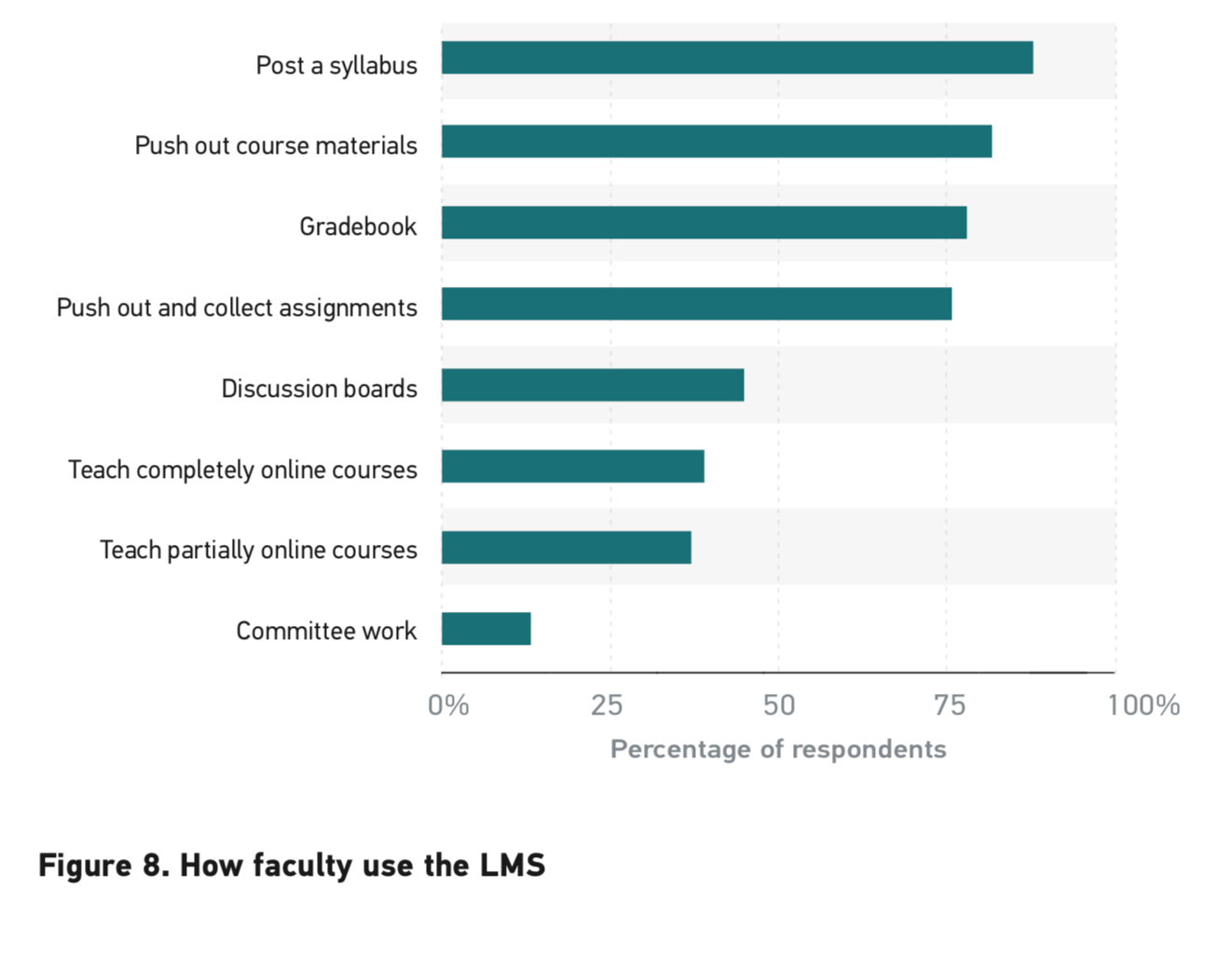
In education, the Learning Management System (LMS) was originally and more accurately called a Course Management System, and it has historically been focused on the management of courses, primarily through announcements to class, rosters, grade book, distribution of syllabus and course content, and submission of student work. Consider this figure from the ECAR Study of Faculty and Information Technology, 2017 that mirrors several other studies in its results:
While the modern LMS has advanced in many ways – particularly around usability, interoperability, and system reliability – the common usage of the this ERP-of-the-classroom has remained fairly steady. The dominant usage is managing the what of courses.
The LMS provides tools to manage communications – a view of the who of courses – through inbox, discussion boards, announcements, and various conferencing apps, but of these the dominant usage is through announcements. One way communication from faculty to students. The tools are there but not the reality of holistic views of interactions with students.
The shift in education from running a course to guaranteeing great experiences for students, to bastardize the SAP explanation, is much like the move towards experience management referred to in the Stratechery article. The movement is in its infancy, and it is likely to be measured in terms of decades, not years. Michael referred to this move in his most recent post.
If you’re a regular e-Literate reader, you know we have a macro thesis that the higher education sector is in the early stages of an evolution from having a philosophical commitment to student success toward having an operational commitment to student success. In other words, colleges and universities are starting to approach student success systematically, not as the natural by-product of hiring good faculty but as something that every student-facing aspect of the institution needs to be optimized for.
When you talk about student success, and great experiences, you have to go well beyond the official production of course content and grades and rosters. It doesn’t just matter what grades students get, it matters whether each student is learning, whether and when they get frustrated, and how often they’re engaging in the class. This gets to learning analytics and formative assessments and opportunities for students to quickly get help.
None of this is new, per se, and we’ve even seen attempts at alternative learning platforms to address this richer ecosystem. Consider the learning platforms designed initially to support competency-based education (CBE) such as Motivis Learning (spun out of Southern New Hampshire University’s College for America) or Sagence Learning (formerly FlatWorld Knowledge). These systems ((Disclosure: SNHU and Motivis were past subscribers to our LMS Market Analysis service.)), often called Learning Resource Management (LRM) systems, are designed to “see a holistic view” of students and “track student engagement”. They are designed to achieve the stated goals of SAP to combine operational data and tools along with experience data and tools.
We’ll get into more detail in future posts, but the category often labeled as adaptive courseware platforms are another example of next-generation systems that are designed to capture both operational data and experience data. These systems blur the boundaries between content and platforms and have the advantage of combining the two into a common design, which should allow deeper instrumentation of student activity during the learning process.
These examples get to the common question of whether the LMS will survive and exist in 10 years. The original LMS concept was designed around a course, not the learner, and most usage is administrative in nature, not learning activities. Shouldn’t next-generation systems like LRMs overtake the LMS market, as these companies expand beyond just CBE programs (see this post for context)? Well, the data do not show signs of this movement, and in fact the LMS market has been consolidating around just four solutions for institutional adoption – Canvas, D2L, Blackboard, and Moodle.
In the meantime, most of the LMS vendors have been adding functionality, whether through extension of their platforms or strategic integrations with third party tools, that seeks to provide views of the student experience. Learning analytics and reporting capabilities, mastery learning additions, federated sharing of student activity data.
One reason for the persistence of the primary LMS is that the LRM and courseware markets are not the ERP market. There are no SAPs in these worlds that already have ubiquitous usage. According to the Stratechery article “SAP is at the center of 77% of transactions worldwide”. The LRM typically starts out in a new CBE program with dozens, or maybe hundreds of students.
What is dominant in higher education circles? The LMS. It is one of the few ed tech solutions used in a majority of courses across online, blended, and face-to-face modalities. What the market appears to be doing is waiting for solutions that build on top of the LMS, or even extend the LMS itself, rather than replacing the LMS. And one of the main reasons is that the LMS has already been accepted as the enterprise system for academic usage, with operational data and tools managing the what of courses. It may be that over time alternative learning platform models will build up enough market share to become a credible threat to change the broader LMS market, but the signs so far are not encouraging for those vendors.
Qualtrics proved to be so valuable ($8 billion) because it could augment the ubiquitous SAP. SurveyMonkey, by contrast, went public as a standalone company and is worth far less ($1.8 billion, still a respectable number).
Looking into the future, the LMS will have to provide useful analytics on student outcomes, learning, and experiences along the way. Shifting from mostly running a course to guaranteeing great experiences for students. Whether this happens within the LMS of the future or as third-party augmentations of the LMS, and whether this happens with the current top four vendors or a different set, is not known. But the move to combine operational and experience data and tools is a trend we should expect to see over the next decade, both in ERP systems like SAP and in the academic LMS market.